Week to 23 December – news counteracting the nuclear-military-industrial-media complex

Some bits of good news
– Incredible progress in reducing infant mortality in South Asia – UNICEF,
India extended health coverage to millions of elderly citizens, The green economy defied sceptics
TOP STORIES
Syria Today, Iran Tomorrow, and Inevitably China.
Finding the Unmentionable: Amnesty International, Israel and Genocide. Israel’s War on Gaza Is a War on Children.
SpaceX Wants to Increase Launches at Boca Chica Without a Full Environmental Review.
Olkiluoto 3 has been a financial catastrophe for Areva, Siemens.
Dutton said a reactor’s waste would fill a Coke can: Try 27,000 of them.
Climate. World’s largest iceberg on the move again after months spinning on the spot.
Noel’s notes. ‘Tis the season to be fake about nuclear power, AI, plastic leaves, and a lot of other things.
******************************
AUSTRALIA. The LNP’s nuclear policy is working just fine. Don’t want nuclear power’: Wild scenes as protestors storm Perth’s CBD during inquiry into nuclear energy.
The Coalition is playing voters for mugs once again with its nuclear costings. Coalition’s nuclear plan will hit Earth with 1.7bn extra tonnes of CO2 before 2050. The glaring gaps and unanswered questions in the Coalition’s nuclear plan and costings. More Australian nuclear news headlines at https://antinuclear.net/2024/12/17/australian-nuclear-news-headlines-17-23-december/
NUCLEAR ITEMS
| ART and CULTURE. Power, control and symbolic masculinity: How Freud might diagnose the pro nuclear lobby |
| ATROCITIES. Israel’s Crime of Extermination, Acts of Genocide in Gaza. |
| CLIMATE. Major report joins dots between world’s nature challenges. |
| ECONOMICS.Privatizing Syria: US Plans to Sell Off A Nation’s Wealth After Assad.U.S. Corporate Land Grab in Ukraine Underlies War With Russia.France’s most powerful nuclear reactor joins grid after €13bn holdup. https://www.youtube.com/watch?v=32XKveP01x4Foreign company withdraws from plans for Swedish nuclear power. |
| ENVIRONMENT. Risky Revival: How Michigan’s Palisades nuclear plant could impact agriculture . Will the legacy of nuclear power ever disappear from our coasts?. |
| LEGAL. Nuclear company Orano seeks arbitration over Niger mining licence. |
| POLITICS. Martial Law Fiasco Casts Doubt Over Korea’s Nuclear Power Push. Starmer backs minister accused of embezzling billions in Bangladesh. |
| POLITICS INTERNATIONAL and DIPLOMACY. Israel, not the ‘liberators’ of Damascus, will decide Syria’s fate. Blinken Confirms the US Is in Direct Contact With al-Qaeda-Linked HTS. Blinded to Syria. How Washington and Ankara Changed the Regime in Damascus. |
SAFETY.
- Europe fears nuclear catastrophe: This plant sets off all alarms due to risk of explosion.
- Nuclear Power Plants Report Massive Uptick In Drone Sightings. Drone Incursions Closed Wright-Patterson Air Force Base’s Airspace Friday Night.
- Missing nuclear package sparks major search after ‘very dangerous’ radioactive container vanishes on its way to Spanish airport.
- Aldermaston nuclear bomb factory makes explosives error.
- Incidents. Radioactive spill reported in Northeast Ohio nuclear power plant. U.S. Nuclear Regulatory Commission Releases Report Confirming Radioactive Material Lost in Transit — Shipping Container Arrives Damaged and Empty in New Jersey.
| SECRETS and LIES. “I don’t care if its tainted money”: Council leader’s telling admission in Nuclear Waste Services cash grab debate. |
| SPACE. EXPLORATION, WEAPONS. US Space Force conducts ‘simulated on-orbit combat’ training. |
| TECHNOLOGY. Nuclear shipping will face significant challenges. |
Decommissioning. ‘Long journey ahead’ for nuclear plant clean-up. Final German nuclear power plant enters dismantling phase.
| WAR AND CONFLICT On Ukraine war, will Trump channel JFK or LBJ? Pentagon admits massive surge of US troops in Syria. Overnight Israeli Strike In Syria So Large It Caused Earthquake. Trump And Israel Can’t Wait To Start Bombing Iran. |
| WEAPONS and WEAPONS SALES. With no real enemies, US poised to spend $1.8 trillion for national security in 2025. Despite 100% Pentagon Audit Failure Rate, House Passes $883.7 Billion NDAA. Israel’s not-so-secret nuclear weapons. |
Communities vent frustration at Coalition’s nuclear plan for their towns
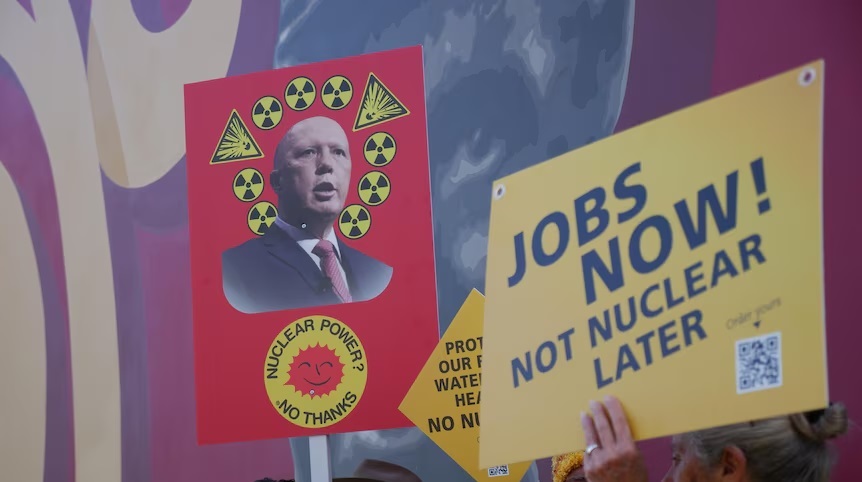
By Joanna Woodburn, ABC Central West, 22 Dec 24,
In short:
Regional communities have shared their views on the federal Coalition’s plan for seven nuclear reactors around Australia.
A parliamentary inquiry has heard pleas for more detail about the proposal, but people have been told to wait for “all the facts”.
What’s next?
The federal committee is due to deliver its report by April 2025.
Opposition leader Peter Dutton has promised his vision to build seven nuclear reactors around Australia will “keep the lights on”.
But people in the communities earmarked to host the plants feel they are being left in the dark as to what the Coalition’s plan means for them.
“What are we actually signing up for?” New South Wales Hunter Valley resident Tony Lonergan said.
Mr Dutton has so far released the locations of the proposed reactors and the costings.
The Coalition wants to build nuclear plants on the sites of seven coal-fired power stations which have shut, or are earmarked to close, at Tarong and Callide in Queensland, Mount Piper near Lithgow and Liddell in NSW, Port Augusta in South Australia, Loy Yang in Victoria’s Latrobe Valley and Muja near Collie in Western Australia.
“I can’t help but feel that politicians see our region as apathetic, desperate and an easy target,” Lithgow resident Tom Evangelidis said.
In the absence of few other details, Labor established a federal inquiry into nuclear power which generated more than 800 submissions from individuals, business owners, industry groups and MPs.
The House Select Committee on Nuclear Energy, which will cease to exist after the inquiry, has toured Australia to hear from the residents whose towns have been selected to host the nuclear reactors.
Wait for ‘the facts’
A repeated request throughout the inquiry has been for the Coalition to explain what technology would be used, how much water would be needed, where the waste would be stored, how it would be transported and whether the infrastructure and technology were safe.
“Even after [the Lithgow hearing] there’s very poor details on will there be one here? When? And those concerns [about] land, safety concerns, environmental concerns; those are all very major concerns and I’ve seen no answers here today,” former NSW mining union executive Wayne McAndrew said.
“The Coalition is proposing the seven sites and I’ve seen nothing from them either.”
The inquiry’s deputy chair, Liberal MP Ted O’Brien, repeatedly told witnesses their communities would have access to a two-and-a-half year “on the ground” consultation process where people’s questions would be answered.
Outside the Port Augusta hearing, SA Liberal MP for Grey, Rowan Ramsey, urged people to wait.
But these assurances have not pacified witnesses.
“That’s not adequate in supporting the general public in forming opinions on things that affect everyone and nor is it adequate for people just to be expected to read or interpret a lengthy report,” Patsy Wolfenden from the Mingaan Wiradjuri Aboriginal Corporation in NSW said at the Lithgow hearing.
“We have agendas that are political and are imposed upon communities without their engagement and without their initial consent in the first place,” Associate Professor Naomi Godden from Edith Cowan University told the Collie hearing in WA.
Jobs promise
One of the Coalition’s key promises is secure employment for coal industry workers who will be out of a job when their power stations close.
In the Latrobe Valley, the Loy Yang power station in Traralgon is due to shut in 2035, which is the same year the Coalition wants its first reactors to be operating.
Local resident Adrian Cosgriff said power station workers were being given false hope, and instead should be encouraged to consider transitioning to the burgeoning renewable energy industry. “Get our coal workers involved, attract other industries as much as we can, so that when they start coming out of those power stations there’s actually work for them,” Mr Cosgriff said.
At Collie in WA, Daniel Graham from the Australian Manufacturing Workers’ Union shared some of the questions and concerns being posed by members.
“What am I going to do? Looking at the nuclear timeline, [I’m] just not sure how that matches up and how that’s going to help Collie,” Mr Graham told the inquiry…………………………………………………. https://www.abc.net.au/news/2024-12-22/coalitions-nuclear-plan-frustrates-communities-at-inquiry/104730522
The glaring gaps and unanswered questions in the Coalition’s nuclear plan and costings.

Peter Dutton’s vision doesn’t address the climate crisis anytime soon and cost savings are based on a comparison with Labor’s proposal that produces 45% more electricity
Graham Readfearn and Josh Butler, 13 Dec 24, https://www.theguardian.com/australia-news/2024/dec/13/australia-nuclear-power-costings-frontier-economics-plan-peter-dutton-coalition-policy?fbclid=IwY2xjawHUXJZleHRuA2FlbQIxMQABHSLJcWqEbGOzAYkAVsppgXxhFjGsXpZLdVYB4J2Fn2n1iyTzXrnP5XMYRg_aem_g_g5MDvHcqIrdVL96ybbNA
The Coalition has revealed further details of its plan to build nuclear reactors in Australia, claiming it could deliver an electricity system costing $263bn less than the Albanese government’s plans to power Australia on renewables backed by storage and gas.
The Coalition is relying on Frontier Economics modelling to argue its nuclear vision for seven reactors across the country would be 44% cheaper than the government’s renewables-led plan.
So what do we need to know about the Coalition’s proposal?
Does the plan address the climate crisis?
Not for about 25 years. Frontier’s modelling shows the amount of CO2 released for every megawatt hour of electricity generated under the Coalition’s nuclear plan.
The report shows the “emissions intensity” of electricity stays much higher with nuclear than without until sometime between 2046 and 2049 – after which electricity would be slightly cleaner.
This is mostly because, under the Coalition, the modelling shows more coal stays in the grid for longer, releasing more CO2.
Any delays in rolling out nuclear reactors, which experts say is very likely, would lead to higher emissions for longer.
The Coalition’s chosen scenario to develop the electricity grid is in line with a 2.6C rise in global temperatures by the end of the century.
Is the Coalition’s plan comparable to the government’s?
No. The Coalition says its plan delivers an electricity system that costs 44% less than the government’s proposal – a saving of $263bn.
But the detail in the Frontier Economics report shows this 44% cost reduction comes as a result of comparing two different scenarios for the future of the electricity grid.
The Australian Energy Market Operator (Aemo) looks at three scenarios for the electricity grid and Frontier based its modelling on two of them – called “progressive change” and “step change”. The Albanese government prefers step change.
Frontier says the “progressive” scenario is preferred by the Coalition and adding nuclear to this “is 44% cheaper than the step change future as envisaged by the federal Labor government”.
The problem here is obvious. We are not comparing apples with apples.
Tristan Edis, director of Green Energy markets, says the “progressive change” scenario “involves total electricity consumption in 2052 of 311TWh, whereas step change is 450TWh or almost 45% greater electricity demand”.
So the Coalition’s plan to deliver nuclear is based on a scenario where Labor’s preferred plan is producing 45% more electricity than the Coalition’s.
Clearly, a system producing more power will cost more. Dr Dylan McConnell, an energy systems expert at UNSW, says without adding nuclear, Aemo’s “progressive change” costs are about $133bn less than for “step change”.
The “progressive change” scenario being promoted by the Coalition assumes much slower roll-outs of electric vehicles, rooftop solar and the electrification of homes and businesses.
That suggests consumers would miss out on any cost savings from running electric vehicles or using less gas in their homes for cooking and heating (as well as the cuts in emissions that come with using less fossil fuels).
How realistic is the Coalition’s timeline for building reactors?
Frontier Economic’s report suggests the first nuclear power would enter the grid in 2036 – but many experts say this is wildly optimistic.
The CSIRO estimates it would take at least 15 years for Australia to establish the necessary legal and regulatory functions and then finance, commission and build a working reactor.
Energy expert Simon Holmes à Court laid out his own timeline this week saying there was “not a hope in hell” a nuclear reactor could be working before 2040. He said his own optimistic scenario put the date at 2044.
What other roadblocks does Peter Dutton face?
Dutton said because the Coalition was in opposition it hadn’t been able to begin the negotiations needed to make nuclear a reality in Australia.
Before a single nuclear energy plant could be built, the Coalition would have to win the next federal election.
Then, a Dutton-led government would have to overturn a Howard-era national ban on nuclear energy – with laws passing both Houses of Parliament. If Dutton winning a majority in the lower house seems a tough ask, getting such a plan through a likely hostile Senate would be even harder.
Then, the Coalition would have to see various state governments overturn their bans on nuclear energy. Finally, state leaders would need to be onboard to support reactors being built in their back yards.
As Guardian Australia has reported, Labor governments and Coalition oppositions in New South Wales, Victoria, Queensland and South Australia are either outright opposed to the plan or have failed to endorse it. The new Queensland Liberal premier, David Crisafulli, ruled out nuclear during that state’s recent election campaign.
Dutton has pointed to constitutional powers to override state objections if necessary. He has also noted the openness of SA’s Labor premier, Peter Malinauskas, to nuclear.
How much will electricity cost under the Coalition’s nuclear plan?
Dutton claimed the nuclear option would mean “a 44% saving for taxpayers and businesses” but does that translate into cheaper power prices?
Frontier’s report says it does not “present any results for the prices [of wholesale electricity] as this will depend on how the cost of new capacity will be treated in the future”.
In other words, they don’t know what the cost of power will be.
How have critics responded?
The climate change and energy minister, Chris Bowen, criticised the Coalition for not detailing how the nuclear plan would affect consumer power bills and pointed to other modelling showing it could push up bills by $1,200 a year.
He claimed the Frontier report contained “fundamental errors” and “heroic assumptions”, pointing out it assumed Australia would consume less power than Aemo’s modelling forecast. Bowen also criticised the report for using cheaper prices to produce nuclear power than the CSIRO and AEMO accounted for.
The federal Greens leader, Adam Bandt, called it a “con job for coal”, noting the nuclear strategy relied on extending the life of fossil fuels.
The Australian Chamber of Commerce And Industry said the plan needed to be scrutinised thoroughly. It wasn’t critical but called for “long-term certainty” for the business community regarding power prices and reliability.
The Clean Energy Council said it would be a “disaster” for power bills and dramatically slow the rollout of renewables like rooftop solar.
Rod Campbell, of the Australia Institute, said the nuclear plan was a “distraction to prolong fossil fuel use and exports”.
1 This month
7 April – WEBINAR – Australia and the Doomsday Clock – Preventing nuclear war through NoFirstUse and other policies
Online | Tuesday April 7, 4:00-5:30pm, Australian Eastern Time / 8:00-9:30am Central Europe Time
– Access the registration link
15 April – Zoom –Nuclear Power is Not the Solution
Apr 15, 2026 01:00 AM in Canberra, Melbourne, Sydney

Join the International Physicians for the Prevention of Nuclear War (IPPNW) on Tuesday, April 14th for a timely webinar exploring the risks associated with nuclear power and challenging the myth that it offers a simple, safe, carbon-free solution to the climate crisis

21 April Webinar: No Nuclear Weapons in Australia
Start: 2026-04-21 18:00:00 UTC Canberra, Melbourne, Sydney (GMT+10:00)
End: 2026-04-21 19:30:00 UTC Canberra, Melbourne, Sydney (GMT+10:00)
Event Type: Virtual
A virtual link will be communicated before the event.
Host Contact Info: australia@icanw.org

of the week – Australians for War Powers Reform (AWPR)
To see nuclear-related stories in greater depth and intensity
 Antinuclear