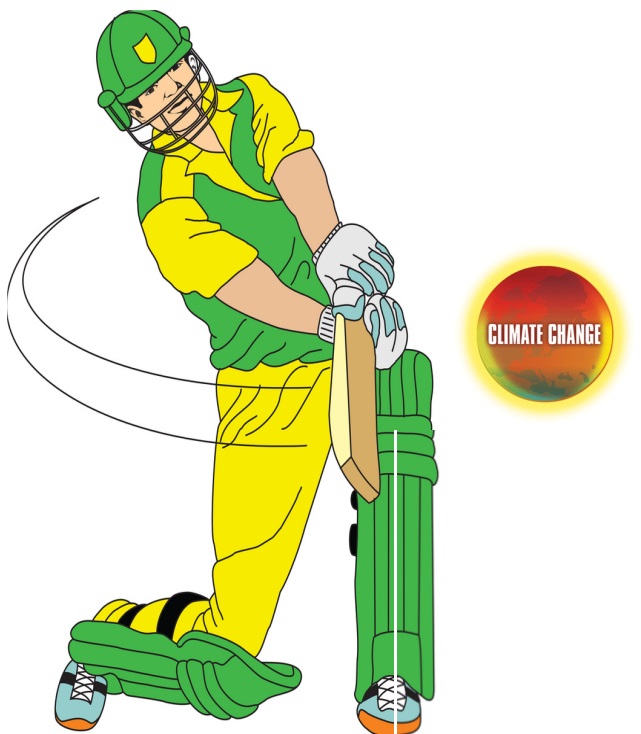
The Australian election as a game of cricket: cost of living is the issue, but does Nature bat last?
December 26, 2024 , By Noel Wauchope, https://theaimn.net/the-australian-election-as-a-game-of-cricket-cost-of-living-is-the-issue-but-does-nature-bat-last/
It is not nice to talk about politics at this happy festive time. But you can talk about cricket. Indeed, in Melbourne, it is your patriotic duty. So, I will – sort of.
A prestigious political analyst, Paul Bongiorno, writes in The Saturday Paper about the focus of campaigning for the 2025 Australian federal election. He sees both political parties emphasising the economy, and the “cost of living”. But Bongiorno warns that climate change could suddenly become once more the big factor in the political game, if summer does bring bushfires and floods.
Bongiorno argues that Dutton and the Liberal Coalition are out to stop renewable energy development:
“If the Dutton-led Coalition manages to take the treasury benches, the brakes will be dramatically applied to climate action. The energy transition would be stalled and billions of dollars of new-energy investment put in jeopardy.A key Labor strategist says… it would take only another summer of catastrophic bushfires or floods to significantly jolt public opinion.”
Bongiorno goes on to argue that “The portents here are not favourable for Dutton.” And he cites powerful arguments about “deep flaws” in Dutton’s energy plan’s economic modelling. Bongiorno draws the conclusion that if climate change extremes hit Australia, voters will recognise the value of renewable energy, and vote for the present Labor government’s policies on climate action.
If only that would be the effect of weather disasters – Australian voters embracing action on climate change – the development of renewable energy and energy conservation!
Paul Bongiorno is a much-admired and well-informed analyst. And I am presumptuous to doubt his opinion. But I do doubt it. Look what happened in 2023, with the Australian public first supporting the concept of an Aboriginal Voice to Parliament, but finally voting a resounding “No” to that plan.
How did it happen?
We are in a different era of media and opinion. We are in extraordinary times. When it comes to national elections, people still do vote according to what they see as “their best interest”. It’s just that now, due largely to the power and influence of “social” media, information about “one’s best interest” has become very confusing.
We thought that the Internet would give everyone a voice. And it did. But very soon the new information platforms found money and power could be bought by corporate interests, and indeed, that they themselves could become ultra-lucrative corporations. The media has become a smorgasbord of conflicting information, with so much of it not fact- checked. The “old” media still checks its facts (though I’m not sure about Sky News), but the old media has always been beholden to corporate influence. Even the ABC is circumspect in what it covers, and what it omits – and still makes sure to provide “balance”, even when one side is plainly unreasonable.
Anyway, for the old media to compete – the news has to be preferably exciting, dramatic, even violent. Except for sport and feel-good stuff.
In the new zeitgeist of 24 hour information barrage from so many different outlets, political news can be, and indeed is, swamped by cleverly designed brief messages, from forces like the Atlas Network, from the dominant global fossil fuel corporations. That swamping propelled many Australians to vote against the Aboriginal Voice.
In political news, media emphasis has shifted dramatically away from facts to personalities. In the USA, Donald Trump was seen as a strong, confident, interesting man, as against weak, indecisive, (and female) Kamala Harris. In Australia, there’s an obvious contrast between careful, measured, Anthony Albanese, and strong, outspoken Peter Dutton. In the USA, it didn’t matter that Trump offered few positive policies, so in Australia, the Liberal Coalition does the same.
In the USA, with a population of 334.9 million, approximately 161.42 million people were registered to vote. But only about 64% of these actually did vote in the 2024 general election. So, the majority of Americans don’t vote anyway. Trump was elected by a minority. The rest either didn’t care, or weren’t able to vote.
The Australian election system is so different. With compulsory voting, preferential voting, and the nationwide and highly reliable Australian Electoral Commission (AEC), most Australians do vote. You’d think that with factual news being provided by mainstream media, climate change information would become so important to voters, in the event of summer weather disasters. Paul Bongiorno thinks so.
I think so, too, But the advantage for Peter Dutton in the current national mood might be twofold.
First, Dutton is still that “tough, decisive person” with a tough plan, too – nuclear power instead of renewables. Secondly, the Dutton plan can so easily be marketed as the only real solution to global heating – nuclear power portrayed as “emissions free”, and “cheaper” than solar and wind power.
Never mind that there are substantial greenhouse gas emissions from the total nuclear fuel cycle. Never mind the astronomic cost. Never mind problems of radioactive wastes, safety, and weapons proliferation. The very telling point is that nuclear reactors cannot be up and running in time to have the needed effect on cutting greenhouse emissions. The time for effective action is now, not decades later.
Action on climate change is critical for Australia – and now!
But for the global nuclear lobby, getting Australia as the new poster boy for nuclear power – is critical – now!
Nuclear power should be a dying industry. There is ample evidence of this: reactors shutting down much faster than new ones are built, and of the mind-boggling cost of decommissioning and waste disposal. However, “peaceful” nuclear power is essential to the nuclear weapons industry – with the arms industry burgeoning in tandem with the increasing risk of nuclear war. It seems that the world cannot afford to weaken this war economy.
And the cost and trouble of shutting down the nuclear industry with its tentacles in so many inter-connected industries, and in the media, and in politics, is unimaginable.
The old poster boy, France, has blotted its nuclear copybook recently with its state energy company EDF deep in debt, and things rather crook with its latest nuclear station. But hey! What about Australia, a whole continent, with a national government perhaps ready to institute nuclear power as its prime energy source, and all funded by the tax-payer!
The long-promised nuclear renaissance might really come about – led by Australia, the energetic new nation, with its AUKUS nuclear submarines, with brand-new nuclear waste facilities, and kicking off this exciting new enterprise – nuclear power. This is the opportunity for a global nuclear spin machine to gear up for an onslaught on Australia. They really need the Liberal-National Coalition to win this election.
Dutton will be fed with the right phrases to regurgitate. It’ll be all about a “balanced” economy – nuclear in partnership with renewables and so on, if people have any worries about that. All the same, there are those problems of pesky independent politicians like Monique Ryan and David Pocock, and there’s still the ABC, Channel 9 TV and its print publications.
First, I’m hoping that Australia does avoid bushfires and floods this summer. And second, I’m hoping that in the event of climate disasters, Australians will choose the Labor Party with its real plan for action against climate change, and reject the Coalition with its nuclear power dream. There is a good chance of this result.
I’m hoping that Paul Bongiorno is right, if climate change does bat last in the election game, and that I am wrong about the power of personality politics + slick lies.
No comments yet.
1 This month

of the week – Australians for War Powers Reform (AWPR)
To see nuclear-related stories in greater depth and intensity
 Antinuclear
Leave a comment