The $80 billion question buried in Dutton’s nuclear power plan.

“Companies can go bust, but the nuclear waste is still going to be there. It has to be owned by the government.”
Two elements of the opposition’s nuclear plan are not included in the costings – waste management and public liability for disasters.
Mike Foley, January 3, 2025 , https://www.theage.com.au/politics/federal/the-80-billion-question-buried-in-dutton-s-nuclear-power-plan-20241218-p5kzg9.html
Decommissioning any plants built under the Coalition’s nuclear energy plan could cost more than $80 billion, and taxpayers would have to foot the bill.
Opposition Leader Peter Dutton’s planned seven nuclear plants, with a likely 14 large-scale reactors, would be publicly owned, so taxpayers would be liable for clean-up costs from the radioactive sites and any accidents during operation.
Last month, Britain’s National Audit Office found that the bill to clean up its old nuclear sites, which date back to the 1940s, would be $260 billion.
About $200 billion of this is to decommission Britain’s original Sellafield site for weapons and energy generation, with contaminated buildings and radioactive waste.
Another $48 billion is to decommission eight other nuclear sites, which now range from 36 to 48 years old, at a cost of $6 billion each. They are set to be handed back by a private operator to the government for decommissioning from 2028.
University of NSW energy researcher Mark Diesendorf said international experience showed the cost of decommissioning a nuclear reactor could be roughly in line with its construction cost, which the Coalition has said would be about $9 billion a reactor in Australia.
“For a rough approximation, you’re looking at probably the equivalent of the construction cost,” Diesendorf said.
If the Coalition’s plan to build 14 nuclear reactors by the mid-2040s is realised, the decommissioning bill would be roughly $82 billion to $125 billion in today’s dollars.
Private firm Frontier Economics produced costings of the opposition’s plan that included decommissioning in an overall $331 billion bill to build 14 gigawatts of nuclear generation. However, it is unclear what price was attached to clean-up and whether it is plausible, given Frontier has declined to release the assumptions it used.
Frontier said the government’s policy to boost renewables to nearly 100 per cent of electricity generation by 2050 would cost $595 billion – a figure the federal government has rejected. Labor says nuclear is the most expensive form of new energy generation.
Opposition energy spokesman Ted O’Brien said the Coalition’s plan was cheaper than the government’s renewable energy goals.
“Unlike the Coalition, Labor refuses to calculate the full cost of its plan, such as the decommissioning costs of massive offshore wind projects in the six zones it has identified off the Australian coast,” O’Brien said.
Griffith University Emeritus Professor Ian Lowe said Diesendorf’s assumption that decommissioning a large-scale reactor would cost the same as building it was “sensible”.
“The World Nuclear Association has information about the 25 reactors that have been decommissioned, and the figures vary enormously,” Lowe said.
“The figure of about $6 billion per reactor sounds about the average figure, assuming that there are no complications.”
The opposition has said its nuclear reactors would operate for 80 years, and University of NSW Associate Professor Edward Obbard, a nuclear materials engineer, said it made “perfect sense” for a country to hold the liability for nuclear decommissioning, given the cost and timescale required.
“I don’t think there’s any alternative to the state being responsible for decommissioning a nuclear power program,” Obbard said.
“Companies can go bust, but the nuclear waste is still going to be there. It has to be owned by the government.”
The government could choose to isolate an old nuclear reactor once it reaches its end of life, and leave it alone for several decades until the radioactivity had reduced, he said.
Two elements of the opposition’s nuclear plan are not included in the costings – waste management and public liability for disasters.
Diesendorf and Lowe said public liability in the unlikely event of a nuclear accident could run into the hundreds of billions of dollars, given the $290 billion clean-up bill from Japan’s 2011 Fukushima nuclear disaster.
Is it realistic for Donald Trump to boast of a quick peace deal for Ukraine ?
AIMN Editorial, https://theaimn.net/is-it-realistic-for-donald-trump-to-boast-of-a-quick-peace-deal-for-ukraine/ 2 Jan 25
Donald Trump has made so many promises on what he will quickly achieve once he takes office as President. The one about ending the Ukraine war in 24 hours probably gained him support from quite a few normally left-leaning people, who understand that the history of this conflict is far more complicated than is portrayed by the Western media.
However, Trump made that statement in July 2023. By 2025, he has somewhat moderated that particular promise. He has had several conversations with Ukraine’s President Zelensky, . Zelensky praised their Paris meeting on 7 December as “productive and meaningful”, but there were no details discussed. Later, Trump opposed the sending of long-range missiles for Ukraine , but said he would not “abandon” Ukraine. He predicted “less aid” to Ukraine https://www.youtube.com/watch?v=E-R7Gi-uLiY. BY 21st December, it was reported that Trump would continue to supply military aid to Ukraine, provided that NATO members dramatically increase their defence spending.
So, peace in Ukraine is not going to happen in such a hurry, even with President Trump and his supposed great negotiating skills. Britain considers sending troops to Ukraine to train Ukrainian regiments. NATO is not prepared for any compromises, especially about giving up the plan for Ukraine’s NATO membership. With any peace deal, the Western allies agree with Zelensky – “Security guarantees without the US are not sufficient for Ukraine.”
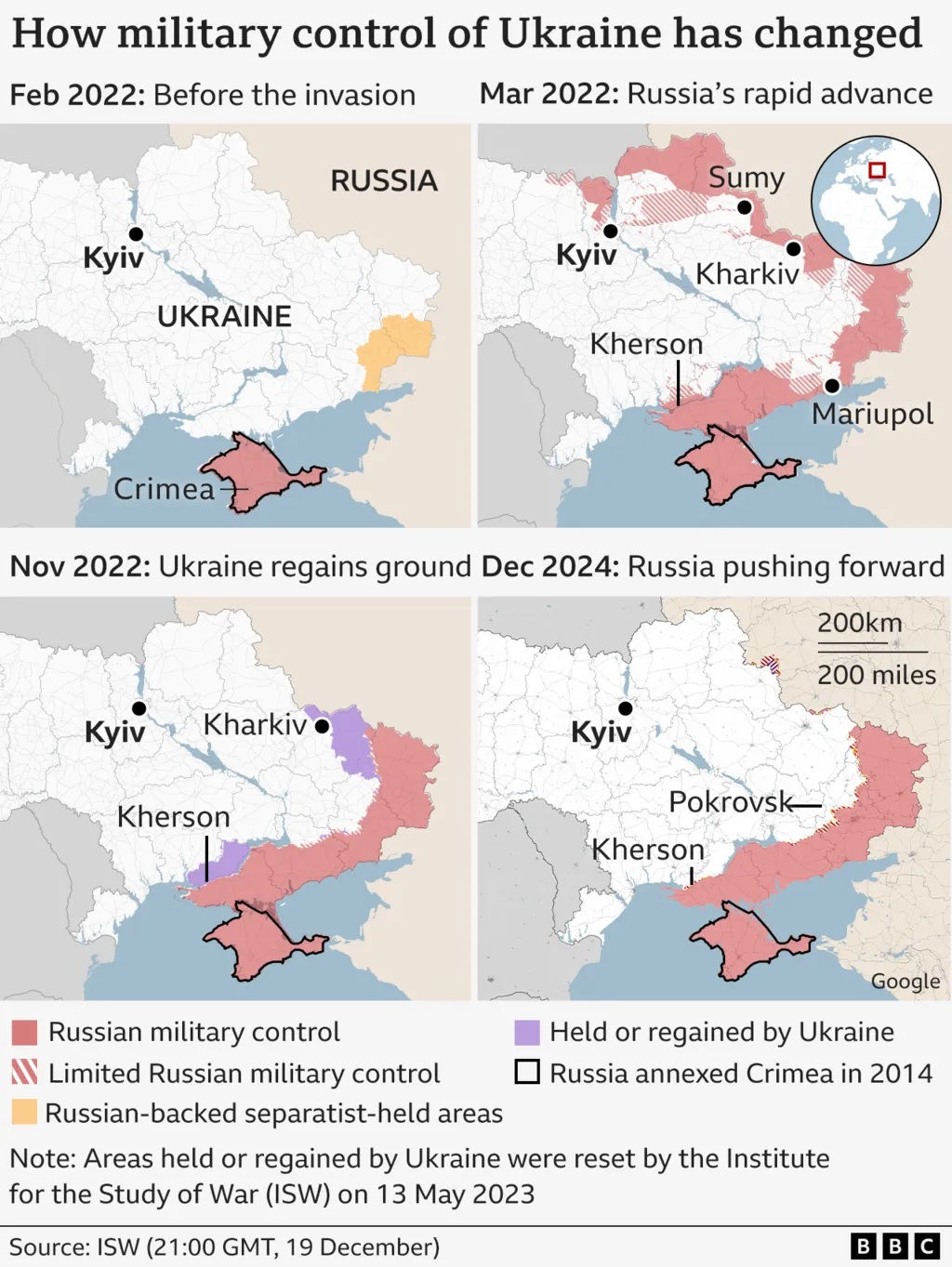
As well as European reluctance to a peace deal, there is the Russian point of view. Despite many set-backs, and a catastrophic loss of soldiers’ lives, Russia is now headed towards winning this war. Why make a deal now, before being in a more powerful position for demanding concessions?
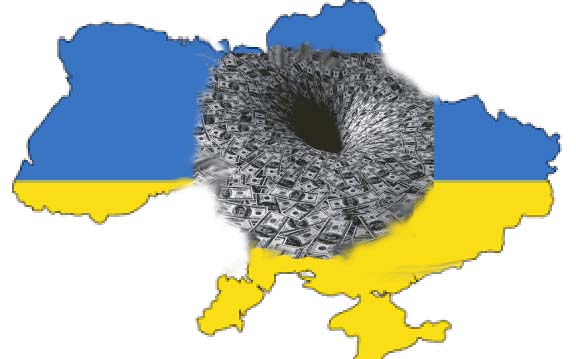
Then we come to the USA. However much Donald Trump might want to end the carnage, and be seen as the peace hero, he is up against significant forces at home – making up what he calls the Deep State. This is a conspiracy theory that helped Trump to gain popularity – and I hate to agree with it, in its rather paranoid theme. BUT, war enthusiasts do exist – among the, military, intelligence, government officials, and wealthy industrialists, and they do exercise influence, and pressure politicians of both parties, to manipulate America’s defense policies. The war in Ukraine continues to be profitable to America’s weapons industries, and at no cost to American lives.
In the whole saga of the war in Ukraine, history has been forgotten. Of course Ukrainian-Russian relations have been tortuous and often terrible. In modern history it goes back to the 1930s, with Stalin’s starvation and genocide of Ukrainians. Then, following oppression from Russia, came in 1941, the short-lived moment of “liberation” by the German Nazis. That brought mass killings of Jews, slave labour, wholesale destruction, and the loss of up to 7 million lives. Russian control over Ukraine returned in 1944, and while the economy was restored, Stalin’s totalitarian rule was back again. In 1991 Ukraine gained independence from Russia.
Is it any wonder that Ukraine, with both Russian and Ukrainian languages still in common use, has been divided in attitudes and loyalties? Going even further back in history, Catherine the Great of Russia, in the 18th Century, made Kiev become Europe’s centre of art and culture, as well as making improvements in health, education, legal rights for Jews, improved conditions for serfs. Sure, she was an absolute monarch, – miles away from being democratic. Now her name and her statues are trashed in Kiev, which is a pity.
From 2014 to 2022, the Ukrainian government waged a war against the separatists in the Eastern, Donbass region. The war was about the 2014-2015 Minsk agreements which meant that the Donbass should have its autonomous government within Ukraine. Volodymyr Zelensky was elected on a platform that he would implement those agreements, but later he reneged on this promise. Russia’s President Putin in 2022 started what he called “a special military exercise” to support the separatists and uphold the Minsk agreement. That turned into the full-scale war against Ukraine.
European and USA support for Ukraine developed into a campaign, at enormous cost, to weaken Russia. The phrase “too big to fail” is used to describe financial crises. But it could apply to the Russia-Ukraine war. From the Western perspective the war is seen as a battle between good and evil – the evil giant Putin against the heroic little Zelensky. With NATO, with most European countries lined up against Russia, it is world democracy to be desperately defended, For Russia, it now is to prevent that last big nation on its border joining that threatening USA-armed line-up.
It was a mistake that Russia started a ‘special military enterprise’ -to evolve into a full-scale war. Some argue that by encouraging Zelensky to reneg on the Minsk agreement, the Western nations provoked the war.
Whatever started the war, the majority of Ukrainians, and especially those in the East, now just want it to end. The prevailing cry of Western leaders – “Putin must fail, Ukraine must prevail” expresses that simplistic view of good versus evil, and just ignores the complicated historic and local concerns of Eastern Ukraine. Diplomacy is jettisoned. As one writer puts it – voices calling for pragmatism and peace remain drowned out by the cacophony of war rhetoric.
Ultimately , every war ends in some sort of a diplomatic outcome. It is doubtful that Trump can make this one end quickly. It might be just one of the promises that he has to give up.
1 This month

of the week – Australians for War Powers Reform (AWPR)
To see nuclear-related stories in greater depth and intensity
 Antinuclear