PM sharpens attack on nuclear in election-style tour

Maitland Mercury, By Kat Wong and Tess Ikonomou, January 7 2025 –
Anthony Albanese is testing new lines of attack as he hurtles through key battlegrounds ahead of an official election campaign.
The prime minister has embarked a whirlwind tour of Queensland, the Northern Territory and Western Australia just months before voters are expected to go to the polls.
A federal election must be held by late May and, while Mr Albanese is yet to pull the trigger, the trip might be seen as a soft campaign launch………………………………………………….
Labor has renewed its offensive against the opposition’s $330 billion bid to set up seven nuclear reactors.
It initially aimed its criticism at safety and environment concerns, leaning on the nuclear fears of older generations.
But its latest attack highlights cost, viability and time, with a particular focus on economic consequences for the Sunshine State.
Fresh analysis released by Labor shows the coalition’s plan assumes it will cost Queensland more than $872 billion in lost output by 2050 and treasurer Jim Chalmers said Mr Dutton’s “economic madness” would leave Queensland households worse off.
“As a Queenslander, I won’t sit back and watch Peter Dutton push energy prices up and growth down right across the state,” he said…………………………………………………………… more https://www.maitlandmercury.com.au/story/8860529/pm-sharpens-attack-on-nuclear-in-election-style-tour/
The continual cover up – Jenny Hocking on the strange disappearance of Gough Whitlam’s ASIO file
January 5, 2025 , Australian Independent Media, By Jenny Hocking
And it is not just Gough Whitlam’s ASIO file that has been “culled” by the National Archives of Australia. The relevant Government House Guest Books at the time of the Dismissal have disappeared and the entire archive of Kerr’s prominent supporters, including Lord Mountbatten, was accidentally burnt in the Yarralumla incinerator.
I was made sharply aware of the conceptual and physical fragility of archives as historical representation 20 years ago through a chance encounter, or more precisely a lost encounter, with Gough Whitlam’s Australian Security Intelligence Organisation (ASIO) file. I had stumbled onto Whitlam’s security file quite unexpectedly through a reference to it in another, unrelated, file. Clearly, any file maintained by the domestic security service on Gough Whitlam would be a critically important historical record in itself, and even more so given the Whitlam government’s fractious relationship with the security services and the well-known surveillance excesses of ASIO and the state Special Branches at that time.
To find evidence of the existence of an ASIO file on Whitlam that I had never expected was a rare moment of archival anticipation. That anticipation was dashed four months later when the Archives informed me that, having maintained this security file for nearly 40 years, it had been destroyed in a routine culling, just weeks before I requested it. Although Archives assured me that, according to ASIO’s records, the now destroyed file “contained material of a vetting nature only”, this is now impossible to verify. A request for access to the ASIO documents referred to in this response and on which this claim about the nature of the file was based, went unanswered.
As a former Prime Minister, Whitlam was a recognised “Commonwealth Person”, for the purposes of the Archives management systems. These are “individuals who have had a close association with the Commonwealth” and whose records are therefore expressly collected and preserved for history. Notwithstanding that acknowledged significance, the Archives had issued an authorisation for ASIO to destroy Whitlam’s security file within weeks of my request to view it. It brings to mind Blouin’s arch observation that “a historian working in state archives, particularly on topics related to the recent past, is constantly engaged in some way in a struggle with the politics of state-protected knowledge”.
The misplaced destruction of Whitlam’s security file compounds the unsettled history of the dismissal by allowing the circulation of competing speculations over its coincident erasure: was this a vetting file as ASIO stated, did the file identify agents or surveillance methods, would its release have led to files on other members of the Whitlam government? This latter is no idle speculation. ASIO was already monitoring deputy Prime Minister Dr Jim Cairns, whose ASIO “dossier” was sensationally leaked to The Bulletin in 1974, causing immense damage to the Whitlam government and to Cairns personally. The possibility of security files on other ministers and even on Whitlam himself is only stirred by the deliberate destruction of ASIO’s vetting file. In the absence of the file itself an already clouded history becomes further compromised.
It was this episode that introduced me to the force of what Elkins terms “archival scepticism” in archive-based research. Whatever the reason for its apparent destruction, the Archives had successfully removed Whitlam’s ASIO file from public view and therefore from the consideration of history. In doing so it had played an important role in the construction of the dismissal in history, in which a security file on Gough Whitlam does not and cannot now feature. This underscores precisely, if there were any doubt about this, that archives are not neutral replicators of documented history, but politicised re-creators of it.
The Lost Archive: Government House Guest Books
In 2010, I first requested access to the Government House guest books held by the Archives, which provide the details of visits and visitors to “their Excellencies” at Yarralumla………………………….. The guest books appear regularly from July 1961 until July 1974, before stopping altogether until December 1982.
…………………………………………. The guest books for 1975 are now officially lost.
These missing guest books add fuel to the longstanding speculation that security and defence officials, notably the Chief Defence Scientist Dr John Farrands as the recognised authority on Pine Gap and the Joint Facilities, had briefed Kerr in the week before the dismissal about mounting security and defence concerns over Whitlam’s exposure of CIA agents working at Pine Gap, and his planned Prime Ministerial statement on this in the House of Representatives on the afternoon of 11 November 1975. ……………………………………….
The Burnt Archive: Sir John Kerr’s Prominent Supporters
In 1978, soon after Kerr left office, a cache of letters “of outstanding value” to Kerr was accidentally reduced to ashes in the Yarralumla incinerator………………………………
Kerr had sought these congratulatory letters for use in his forthcoming autobiography Matters for Judgement. Among his correspondents was the Queen’s second cousin, Lord Louis Mountbatten, Prince Philip’s uncle and King Charles III’s great mentor; the former Governor-General and distant royal relation, Viscount De L’Isle; and other prominent individuals supporting Kerr’s dismissal of Whitlam. These names alone indicate that these burnt letters were as important to history as they were to Kerr. Were it not for this secondary file of correspondence between Smith and Kerr detailing the saga of the “burnt letters”, the existence and apparent inflammatory end of Kerr’s correspondence with his minor aristocratic supporters would never have come to light. The letters themselves now never will.
Philip Ziegler’s authorised biography of Mountbatten, however, gives just a glimpse of this story. Ziegler recounts that Mountbatten wrote to Kerr days after the dismissal, congratulating him on his “courageous and correct action” in dismissing Whitlam. It was a remarkably partisan royal intercession, and Mountbatten was not alone among Kerr’s royal supporters. We now know, thanks to letters released in 2020 following the High Court’s decision in my legal action, that King Charles also fully supported Kerr’s actions. Charles’s letter to Kerr, written in starkly similar terms to Mountbatten’s weeks after the dismissal, leaves no doubt of Charles’s support for Kerr; “What you did […] was right and the courageous thing to do.”
As Kerr later wrote to the South Australian lieutenant-governor, Sir Walter Crocker, “I never had any doubt as to what the Palace’s attitude was on this important point.”
*************************
These are extracts from Professor Jenny Hocking’s essay ‘Critical Archival Encounters and the Evolving Historiography of the Dismissal of the Whitlam Government’, Australian Journal of Politics and History, 11 April 2024.
Open access publishing facilitated by Monash University, as part of the Wiley – Monash University agreement via the Council of Australian University Librarians. This article was originally published on Pearls and Irritations and has been republished with permission. https://theaimn.net/the-continual-cover-up-jenny-hocking-on-the-strange-disappearance-of-gough-whitlams-asio-file/
The polar playground for a suicidal species?
https://theaimn.net/the-polar-playground-for-a-suicidal-species/ 7 January 25
Where to begin on this mind-boggling story about epic changes on a very small planet?
Well, let’s begin on the fun part. The Australian Antarctic Program encourages some pretty innocuous recreational activities, plus of course, encouragement for tourists to come, and to learn about the polar world. So that’s OK, I suppose. But lately, in the news, there is growing concern that tourists, Australians in particular, are taking such a playful attitude to Antarctica, that they are risking their personal safety.
Interesting that the video above puts the blame on TikTok for encouraging the fun and danger. But tourism itself is good for increasing education about Antarctica. As long as individuals personally behave safely, that’s fine, isn’t it?
But what about planetary safety?
What Australians, and most of the world, learn about Antarctica, is that it’s pretty, and has penguins, Oh, and the ice is melting a bit, too. And that’s about it. The media does not trouble our complacent little minds with information about the thermohaline ocean circulation, the atmospheric circulation patterns, the carbon-sequestration of krill, the polar vortex…. Much too hard for us, in this cricket-tennis season.
Right now, Northern Europe and parts of the USA are experiencing extreme cold weather. No doubt some people would say that this disproves global heating, climate change. Alas, these extremes, emanating from the Arctic, by the polar vortex, are exacerbated by global heating. The polar vortex is a complex system, difficult to grasp, for the average news reader, so it is part of the whole poorly known, global climate system.
Antarctica is at the other end of the world – not connected to all this? Well, not if you ignore the global thermohaline circulation, among other things like sea level rise.
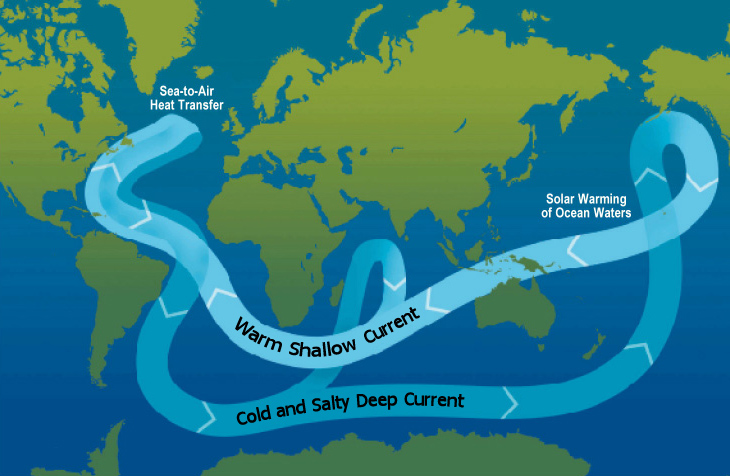
Global thermohaline circulation
Professor Elisabeth Leane, Professor of Antarctic Studies at the University of Tasmania says – What happens in Antarctica doesn’t stay in Antarctica. Its future will shape the future of the planet
Which brings me to the question of safety in relation to Antarctica – planetary, not just personal.
And here’s what the University of Tasmania says about it – Antarctica’s tipping points threaten global climate stability.
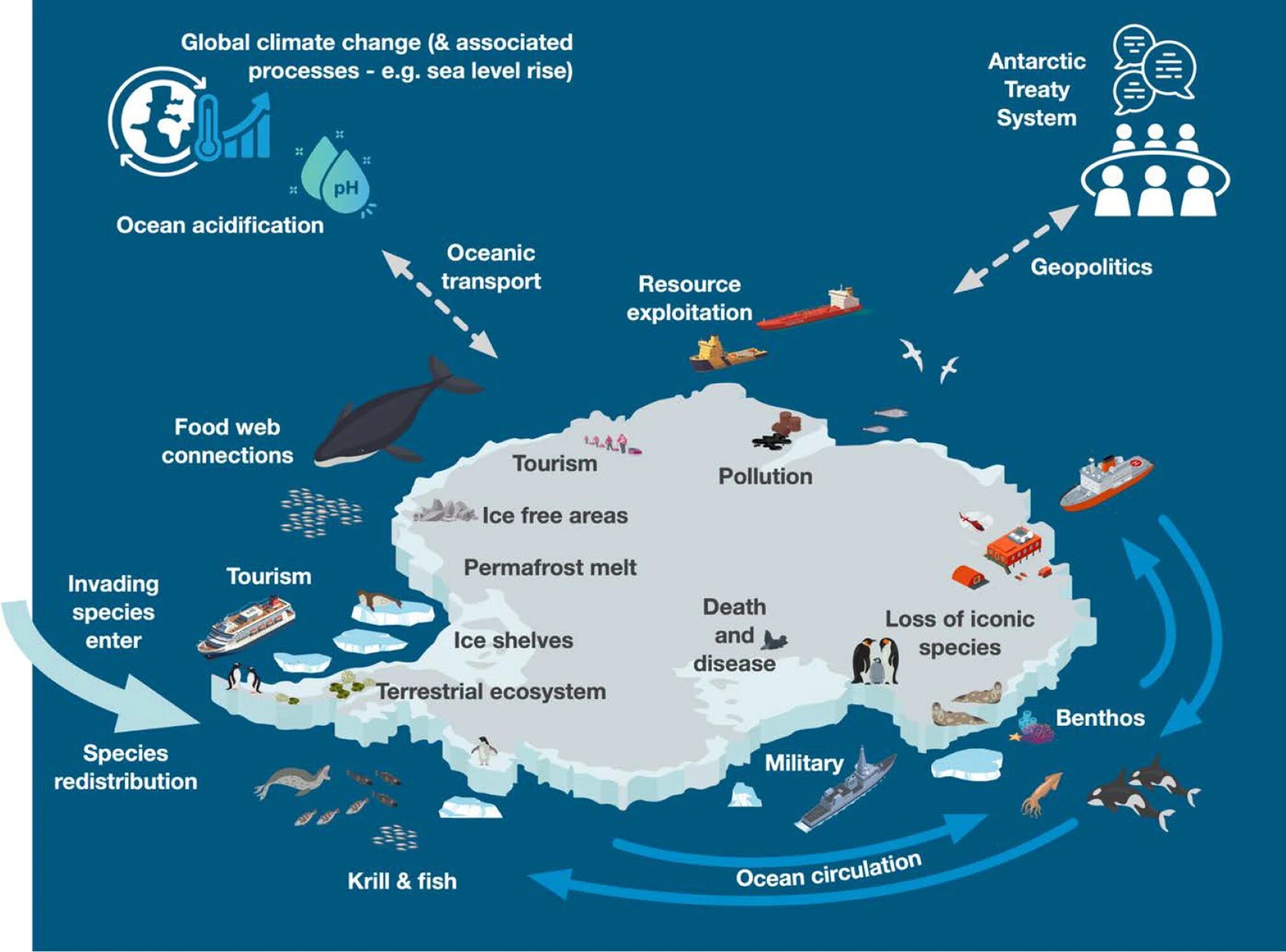
The map above is from the University of Tasmania’s report by international climate scientists . It identifies the various cascading tipping points and their interactions and pressures on the ecosystem.
For those who care about the climate change issue, and about Australia and the Antarctic, I would urge them to watch, and persist with, this brilliant report by climate researcher Paul Beckwith – https://www.youtube.com/watch?v=6WccDhnM8R8
Beckwith explains the potential tipping points identified by the study and their interrelationships , and adds the issue of sea ice loss. Critical issues are ice sheets, ocean acidification, ocean circulation, species redistribution, invasive species, permafrost melting, local pollution, chemical impacts, social impacts, local pollution and the Antarctic Treaty System. He goes on to explain with excellent graphics, the global thermohaline circulation, and then, in-depth, the records on sea ice, and then on to his detailed study on the tiny krill or light shrimp, and their global importance. Finally, Beckwith outlines the politics, the various national claims in the Antarctic Treaty System. The scientists’ conclusion – the urgent need for action on climate. Heavy stuff. Fascinating stuff. He finishes with a reminder of the unique role of that amazing critter the krill.
If you want a more concise discussion of the University of Tasmania’s December remarkable workshop of international marine scientists – go to Radio Ecoshock – World-changing Tipping Points – In Antarctica !
The “mainstream media” rarely covers climate change in any depth. For decades, the public has been informed very superficially on this life and death matter for our survival. The dedicated scientists produce their research results, but the media seem to find these too difficult, or too “political” to bother to report on them properly. The December 2024 “emergency summit” of international polar scientists in Tasmania barely got a mention in the Australian or international press.
You have to go to alternative media, to get any real insight into what is happening to the climate of our planet home. For decades now, Paul Beckwith has being producing his highly informative and wonderfully illustrated videos, on Youtube. Meanwhile Alex Smith has been doing the same sort of thing on radio and podcast, and print, – on Radio Ecoshock, which is heard in Australia on Community Radio 3CR.
In 2025, it is ever more urgent for people to wade through the morass of “social” media, and corporate media, and “alternative” media, to find the facts on climate change. Paul Beckwith and Radio Ecoshock are two examples of a rare and endangered human species – journalists who do their homework on climate change.
1 This month
7 April – WEBINAR – Australia and the Doomsday Clock – Preventing nuclear war through NoFirstUse and other policies
Online | Tuesday April 7, 4:00-5:30pm, Australian Eastern Time / 8:00-9:30am Central Europe Time
– Access the registration link
15 April – Zoom –Nuclear Power is Not the Solution
Apr 15, 2026 01:00 AM in Canberra, Melbourne, Sydney

Join the International Physicians for the Prevention of Nuclear War (IPPNW) on Tuesday, April 14th for a timely webinar exploring the risks associated with nuclear power and challenging the myth that it offers a simple, safe, carbon-free solution to the climate crisis

21 April Webinar: No Nuclear Weapons in Australia
Start: 2026-04-21 18:00:00 UTC Canberra, Melbourne, Sydney (GMT+10:00)
End: 2026-04-21 19:30:00 UTC Canberra, Melbourne, Sydney (GMT+10:00)
Event Type: Virtual
A virtual link will be communicated before the event.
Host Contact Info: australia@icanw.org

of the week – Australians for War Powers Reform (AWPR)
To see nuclear-related stories in greater depth and intensity
 Antinuclear