The polar playground for a suicidal species?
https://theaimn.net/the-polar-playground-for-a-suicidal-species/ 7 January 25
Where to begin on this mind-boggling story about epic changes on a very small planet?
Well, let’s begin on the fun part. The Australian Antarctic Program encourages some pretty innocuous recreational activities, plus of course, encouragement for tourists to come, and to learn about the polar world. So that’s OK, I suppose. But lately, in the news, there is growing concern that tourists, Australians in particular, are taking such a playful attitude to Antarctica, that they are risking their personal safety.
Interesting that the video above puts the blame on TikTok for encouraging the fun and danger. But tourism itself is good for increasing education about Antarctica. As long as individuals personally behave safely, that’s fine, isn’t it?
But what about planetary safety?
What Australians, and most of the world, learn about Antarctica, is that it’s pretty, and has penguins, Oh, and the ice is melting a bit, too. And that’s about it. The media does not trouble our complacent little minds with information about the thermohaline ocean circulation, the atmospheric circulation patterns, the carbon-sequestration of krill, the polar vortex…. Much too hard for us, in this cricket-tennis season.
Right now, Northern Europe and parts of the USA are experiencing extreme cold weather. No doubt some people would say that this disproves global heating, climate change. Alas, these extremes, emanating from the Arctic, by the polar vortex, are exacerbated by global heating. The polar vortex is a complex system, difficult to grasp, for the average news reader, so it is part of the whole poorly known, global climate system.
Antarctica is at the other end of the world – not connected to all this? Well, not if you ignore the global thermohaline circulation, among other things like sea level rise.
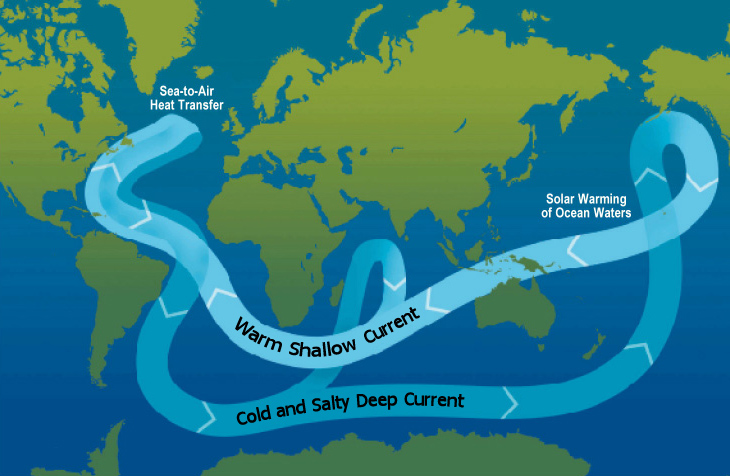
Global thermohaline circulation
Professor Elisabeth Leane, Professor of Antarctic Studies at the University of Tasmania says – What happens in Antarctica doesn’t stay in Antarctica. Its future will shape the future of the planet
Which brings me to the question of safety in relation to Antarctica – planetary, not just personal.
And here’s what the University of Tasmania says about it – Antarctica’s tipping points threaten global climate stability.
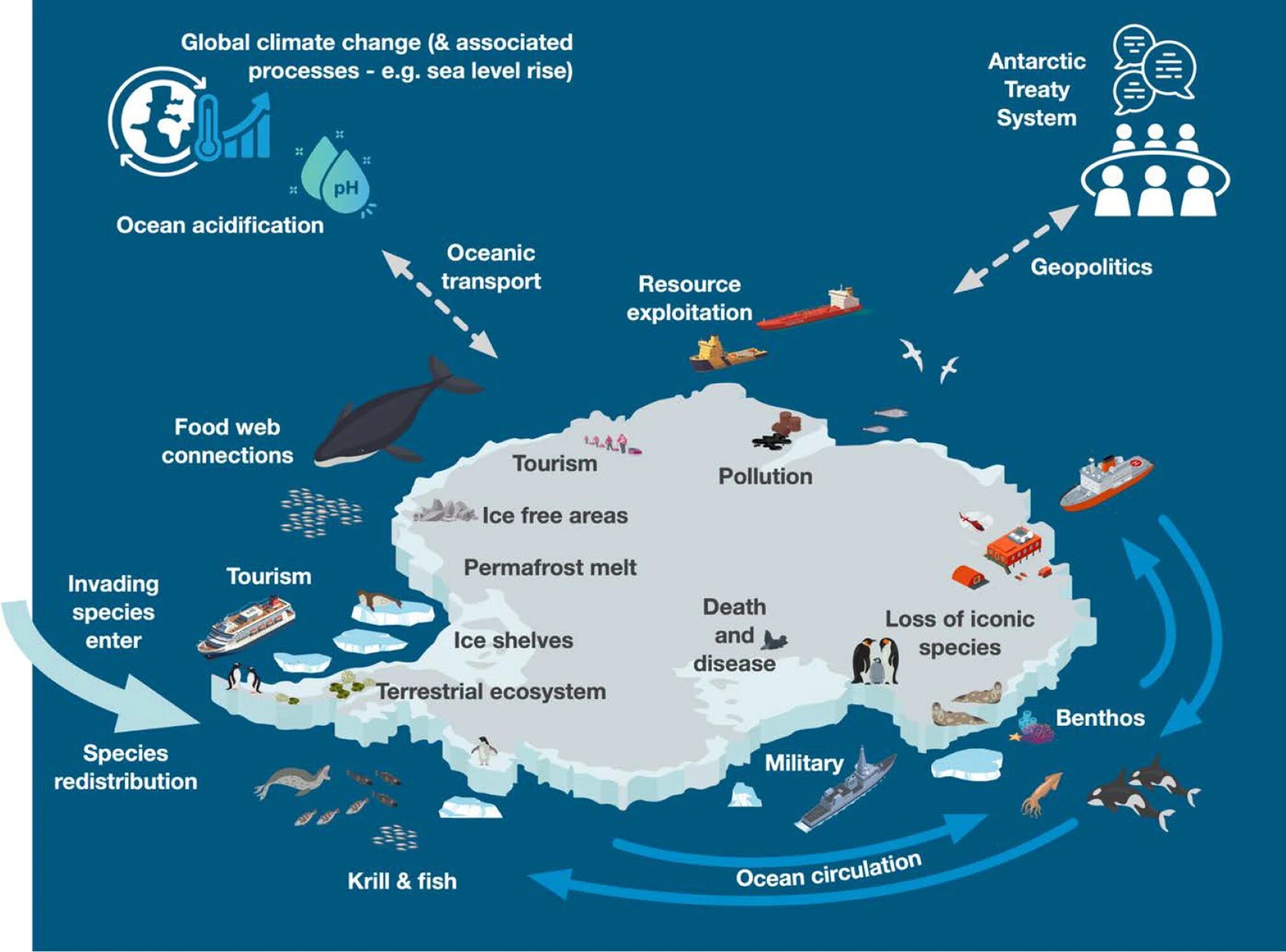
The map above is from the University of Tasmania’s report by international climate scientists . It identifies the various cascading tipping points and their interactions and pressures on the ecosystem.
For those who care about the climate change issue, and about Australia and the Antarctic, I would urge them to watch, and persist with, this brilliant report by climate researcher Paul Beckwith – https://www.youtube.com/watch?v=6WccDhnM8R8
Beckwith explains the potential tipping points identified by the study and their interrelationships , and adds the issue of sea ice loss. Critical issues are ice sheets, ocean acidification, ocean circulation, species redistribution, invasive species, permafrost melting, local pollution, chemical impacts, social impacts, local pollution and the Antarctic Treaty System. He goes on to explain with excellent graphics, the global thermohaline circulation, and then, in-depth, the records on sea ice, and then on to his detailed study on the tiny krill or light shrimp, and their global importance. Finally, Beckwith outlines the politics, the various national claims in the Antarctic Treaty System. The scientists’ conclusion – the urgent need for action on climate. Heavy stuff. Fascinating stuff. He finishes with a reminder of the unique role of that amazing critter the krill.
If you want a more concise discussion of the University of Tasmania’s December remarkable workshop of international marine scientists – go to Radio Ecoshock – World-changing Tipping Points – In Antarctica !
The “mainstream media” rarely covers climate change in any depth. For decades, the public has been informed very superficially on this life and death matter for our survival. The dedicated scientists produce their research results, but the media seem to find these too difficult, or too “political” to bother to report on them properly. The December 2024 “emergency summit” of international polar scientists in Tasmania barely got a mention in the Australian or international press.
You have to go to alternative media, to get any real insight into what is happening to the climate of our planet home. For decades now, Paul Beckwith has being producing his highly informative and wonderfully illustrated videos, on Youtube. Meanwhile Alex Smith has been doing the same sort of thing on radio and podcast, and print, – on Radio Ecoshock, which is heard in Australia on Community Radio 3CR.
In 2025, it is ever more urgent for people to wade through the morass of “social” media, and corporate media, and “alternative” media, to find the facts on climate change. Paul Beckwith and Radio Ecoshock are two examples of a rare and endangered human species – journalists who do their homework on climate change.
No comments yet.
1 This month
15 April – Zoom –Nuclear Power is Not the Solution
Apr 15, 2026 01:00 AM in Canberra, Melbourne, Sydney

Join the International Physicians for the Prevention of Nuclear War (IPPNW) on Tuesday, April 14th for a timely webinar exploring the risks associated with nuclear power and challenging the myth that it offers a simple, safe, carbon-free solution to the climate crisis

of the week – Australians for War Powers Reform (AWPR)
To see nuclear-related stories in greater depth and intensity
 Antinuclear
Leave a comment