Sovereignty not worth a nickel?
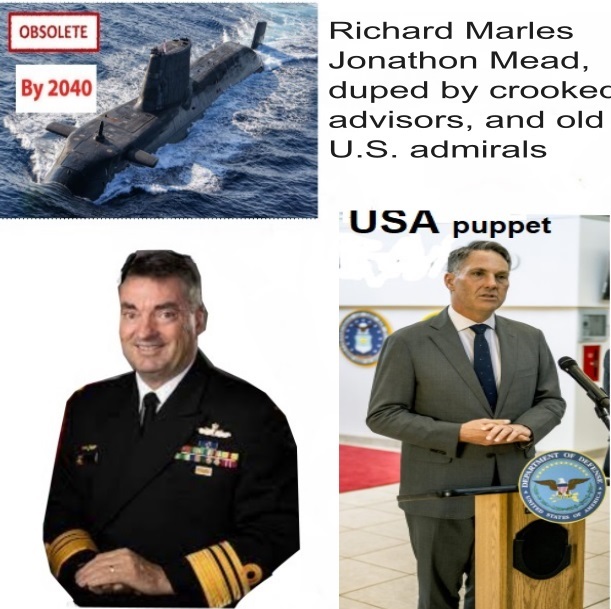
A terse exchange between Greens Senator David Shoebridge and Vice Admiral Jonathan Mead during a Senate Estimates hearing earlier this year revealed that contracts signed by the Australian government that have handed billions of taxpayer dollars to American and British shipyards, supposedly to support the faster delivery of submarines, did not include standard protective clawback provisions.
If we never see a submarine—as is possible—we don’t get any of our billions back.
In influence and dollar terms, foreign-owned companies comprise the vastly dominant proportion of the industrial base, not “part of” it. Research by the Australian Strategic Policy Institute in 2017 showed that the top 15 weapons contractors received 91 per cent of the Department’s expenditure.
A decade of spin from both sides of politics has inured Australians to the stark reality of our loss of independence inside the US alliance. At what cost?
Michelle Fahy, Jan 12, 2025, https://undueinfluence.substack.com/p/sovereignty-not-worth-a-nickel?utm_source=post-email-title&publication_id=297295&post_id=154382292&utm_campaign=email-post-title&isFreemail=true&r=1ise1&triedRedirect=true&utm_medium=emailAustralia’s independence has been dangerously compromised by Labor and Coalition governments, which have signed up to deep-rooted military agreements with the United States of America. These agreements have also underpinned the increasing militarisation of Australia: witness the 2022 speech by Labor’s Richard Marles, the newly appointed deputy prime minister, in Washington DC when he announced that Australian military forces would now become interchangeable with those of the United States.
In August, after this year’s formal annual talks with the United States, Defence Minister Marles announced that the meeting had “built on the last two in seeing a deepening of American force posture in Australia”.
He added: “American force posture now in Australia involves every domain: land, sea, air, cyber and space.”
A decade of spin from both sides of politics has inured us to the stark reality of our loss of independence. Much is made of “defence industry cooperation” with the United States, for example, but this is simply code for the expansion of the US arms industry in Australia in support of its increasing military presence on our soil.
The day before AUKUS was launched in 2021, the US State Department made plain the importance of Australia in supporting America’s military-industrial base:
Australia is one of America’s largest defence customers, supporting thousands of jobs in the United States … The United States is Australia’s defence goods and services partner of choice … the partnership is expected to deepen further over the coming decade, including in the area of defence industry cooperation.
Soon after this statement was published, Marles flew to Washington to endorse its sentiment. He reassured the Americans that when it came to arms production, “our ultimate goal is to supplement and strengthen US industry and supply chains, not compete with them”.
Meanwhile, our much-trumpeted “sovereign defence industrial base” is simply a collection of the world’s top arms multinationals, dominated by the British-owned BAE Systems, the French-owned Thales, and the American-owned Boeing.
Then there is the egregious erosion of Australia’s sovereignty contained within the little-known Force Posture Agreement (FPA) with the United States, which the Abbott Coalition government signed in 2014.
In short, the FPA permits the US to prepare for, launch and control its own military operations from Australian territory.
Yet AUKUS dominates the headlines, even though other decisions by our political leaders that have sold out the public interest have received little coverage in the mainstream media.
A terse exchange between Greens Senator David Shoebridge and Vice Admiral Jonathan Mead during a Senate Estimates hearing earlier this year revealed that contracts signed by the Australian government that have handed billions of taxpayer dollars to American and British shipyards, supposedly to support the faster delivery of submarines, did not include standard protective clawback provisions. If we never see a submarine—as is possible—we don’t get any of our billions back.
The single most important downside of the US alliance, rarely mentioned, is arguably Australia’s military dependence on a foreign power. The Australian Defence Force is critically dependent on US supply and support for the conduct of all operations except those at the lowest level and of the shortest duration.
We were warned about this substantial sacrifice of national freedom of action. In 2001, a Parliamentary Library research paper stated that “it is almost literally true that Australia cannot go to war without the consent and support of the US”.
Foreign-dominated “sovereign” defence industry
Australia’s political and defence hierarchy regularly assert the need to build “a sovereign defence industrial base”. Most people would assume this to mean Australian-owned defence companies, with profits that stay local. This is not what the Defence Department means by it.
The world’s largest weapons companies, including BAE Systems (UK), Thales (France) and US companies Boeing, Lockheed Martin, Raytheon and Northrop Grumman, dominate the local defence industry. Almost all of the top 15 weapons contractors to the Defence Department are foreign-owned. In June 2024, Deputy Secretary Christopher Deeble, the head of the Capability Acquisition and Sustainment Group—the Department’s arms-buying group—explained in a Senate Estimates hearing the government’s definition of “sovereign” in this regard. Deeble agreed with independent senator David Pocock that the local subsidiaries of foreign weapons multinationals, such as Lockheed Martin Australia, were not “sovereign” Australian companies. Nevertheless, he said, the Department considers such foreign-owned subsidiaries to be “part of the sovereign defence industry base here in Australia”.
In influence and dollar terms, foreign-owned companies comprise the vastly dominant proportion of the industrial base, not “part of” it. Research by the Australian Strategic Policy Institute in 2017 showed that the top 15 weapons contractors received 91 per cent of the Department’s expenditure.
Force Posture Agreement
The erosion of Australian sovereignty accelerated in 2011, when Labor prime minister Julia Gillard agreed that up to 2,500 US Marines could be stationed in Darwin on a permanent rotation, and that an increased number of US military aircraft, including long range B-52 bombers, could fly in and out of the Top End and use Australia’s outback bombing ranges.
This agreement was expanded dramatically a few years later by the Force Posture Agreement, which provides the legal basis for an extensive militarisation of Australia by the US, particularly across the Top End.
The tri-nation military pact AUKUS, between Australia, the United Kingdom and the United States, was later negotiated and agreed to, in secret, by the Morrison Coalition government. AUKUS gained bipartisan support within one day of it being revealed to Anthony Albanese’s Labor opposition in September 2021. Among other things, AUKUS, in conjunction with the FPA, ensures that Australia’s navy will be tightly integrated with the US navy for the purpose of fighting China, and that the two navies can operate as one from Australian ports and waters.
Two months after Labor assumed office in May 2022, Marles was in Washington DC announcing that Labor would “continue the ambitious trajectory of its force posture cooperation” with the United States. Australia’s engagement with the US military would “move beyond interoperability to interchangeability” and Australia would “ensure we have all the enablers in place to operate seamlessly together, at speed”.
Non-lethal” F-35 parts
Australia’s newest high-tech major weapons systems make us more reliant than ever on the United States. As veteran journalist Brian Toohey reported in 2020, “The US … denies Australia access to the computer source code essential to operate key electronic components in its ships, planes, missiles, sensors and so on”. This includes the F-35 fighter jets, which both Foreign Minister Penny Wong and Defence Minister Marles have noted form the largest proportion of the air force’s fast jet capacity.
When it agreed to buy Lockheed Martin’s expensive and controversial fifth generation fighter jets, Australia became one of the early members of the F-35 consortium. As part of the deal, Australia negotiated a role for local industry in the F-35 global supply chain. As of June 2024, more than 75 Australian companies had shared in $4.6 billion worth of work, according to the Defence Department.
But there’s been a significant ethical downside. Israel, also a member of the F-35 consortium, is using its F-35s in its war against Gaza. Israel stands accused in the world’s highest court of conducting a genocide in Gaza. Every F-35 built contains Australian parts and components, and for some of these Australia is the sole source.
A senior Defence Department official, Hugh Jeffrey, said in a Senate Estimates hearing in June 2024:
“We are a member of the F-35 consortium [which] exists under a memorandum of understanding … That gives the defence industry opportunity to contribute to that supply chain. It also requires Australia to provide those contributions in good faith…” [emphasis added]
Jeffrey also noted that when assessing any export permit, “we have to have high confidence that, in agreeing to the permit, it’s consistent with our national security requirements and with our international legal obligations”.
What happens if the Department perceives a conflict between Australia’s “national security requirements” and its “international legal obligations”? Is Australia “required” to continue supplying Australian-made arms “in good faith”?
In June, after nine months of spreading disinformation, the Australian government was forced to admit that Australia was still supplying parts and components to the F-35 global supply chain. At the time of writing, the government was allowing this supply to continue despite repeated calls from the UN asking nations—and multinational weapons makers—to cease supplying weapons to Israel, including parts and components, or risk being responsible under international law for serious human rights violations.
Decoded: Defence Department’s deadly deceits
Michelle Fahy, July 10, 2024
No comments yet.
1 This month
15 April – Zoom –Nuclear Power is Not the Solution
Apr 15, 2026 01:00 AM in Canberra, Melbourne, Sydney

Join the International Physicians for the Prevention of Nuclear War (IPPNW) on Tuesday, April 14th for a timely webinar exploring the risks associated with nuclear power and challenging the myth that it offers a simple, safe, carbon-free solution to the climate crisis

of the week – Australians for War Powers Reform (AWPR)
To see nuclear-related stories in greater depth and intensity
 Antinuclear
Leave a comment