Virginia, we have a problem

14 Jan 2025, |Peter Briggs, https://www.aspistrategist.org.au/virginia-we-have-a-problem/
Australia’s plan to acquire Virginia-class submarines from the United State is looking increasingly improbable. The US building program is slipping too badly.
This heightens the need for Australia to begin looking at other options, including acquiring Suffren-class nuclear attack submarines (SSNs) from France.
The Covid-19 pandemic dramatically disrupted work at the two shipyards that build Virginias, General Dynamics Electric Boat at Groton, Connecticut, and Huntington Ingalls Industries’ yard at Newport News, Virginia. It badly hindered output at many companies in the supply chain, too. With too few workers, the industry has built up a backlog, and yards are filling with incomplete submarines.
Within six years, the US must decide whether to proceed with sale of the first of at least three and possibly five Virginias to Australia, a boat that will be transferred from the US Navy’s fleet.
Nine months before the transfer goes ahead, the president of the day must certify that it will not diminish USN undersea capability. This certification is unlikely if the industry has not by then cleared its backlog and achieved a production rate of 2.3 a year—the long-term building rate of two a year for the USN plus about one every three years to cover Australia’s requirement.
The chance of meeting that condition is vanishingly small.
The situation in the shipyards is stark. The industry laid down only one SSN in 2021. It delivered none from April 2020 to May 2022. The USN has requested funding for only one Virginia in fiscal year 2025, breaking the two-a-year drumbeat, ‘due to limits on Navy’s budget topline and the growing Virginia class production backlog’.
As of January 2025, five of 10 Block IV Virginias ordered are in the yards, as are five of 12 Block Vs for which acquisition has been announced. (Work has not begun on the other seven Block Vs.)
The building time from laying down until delivery has increased from between 3 and 3.5 years before the pandemic to more than 5 years. The tempo is still slowing: the next Virginia, USS Iowa, is due to be delivered on 5 April 2025, 5.8 years after it was laid down.
On the original, pre-pandemic schedule, all the Block IVs could probably have been delivered to the USN by now. This is a gap that cannot be recovered in a few years, despite all the expensive manpower training and retention programs in hand.
Exacerbating the problem for the yards, the Block V submarines are 30 percent larger, and more complex to build, making a return to shorter build times unlikely. Speaking to their shareholders in October, the chief executives of Huntington Ingalls and General Dynamics blamed their slowing delivery tempo on supply chain and workforce issues. HII says it is renegotiating contracts for 17 Block IV and Block V Virginias.
Furthermore, Electric Boat has diverted its most experienced workers to avoid further slippage in building the first two ballistic missile submarines of the Columbia class, the USN’s highest priority shipbuilding program, in which the Newport News yard also participates.
It gets worse. Many USN SSNs that have joined the US fleet over the past few decades are unavailable for service, awaiting maintenance. The pandemic similarly disrupted shipyards that maintain the SSNs of the Los Angeles and Virginia classes. In September 2022, 18 of the 50 SSNs in commission were awaiting maintenance. The Congressional Budget Office reports lack of spending on spare parts is also forcing cannibalisation and impacting the availability of Virginia class SSNs.
Australia’s SSN plan must worsen the US’s challenge in recovering from this situation, adding to the congestion in shipyards and further over loading supply chains already struggling to deliver SSNs to the USN.
A US decision not to sell SSNs to Australia is inevitable, and on current planning we will have no stopgap to cover withdrawal of our six diesel submarines of the Collins class, the oldest of which has already served for 28 years.
In the end, Australia’s unwise reliance on the US will have weakened the combined capability of the alliance. And Australia’s independent capacity for deterrence will be weakened, too.
As I wrote in December, it is time to look for another solution. One is ordering SSNs of the French Suffren class. The design is in production, with three of six planned boats delivered. It is optimised for anti-submarine warfare, with good anti-surface, land-strike, special-forces and mining capability. It is a smaller design, less capable than the Virginia, but should be cheaper and is a better fit for Australia’s requirements.
Importantly, it requires only half the crew of a Virginia, and we should be able to afford and crew the minimum viable force of 12 SSNs.
Let’s build on the good progress in training, industry and facility preparations for supporting US and British SSNs in Australia, all of which should continue, and find a way to add to the alliance’s overall submarine capability, not reduce it.
AUKUS: Flawed and Sinking

January 13, 2025 Dr Binoy Kampmark, https://theaimn.net/aukus-flawed-and-sinking/
A stillborn agreement treated as thrivingly alive; an understanding celebrated as consensual and equal. The AUKUS security arrangement between Australia, the United Kingdom and the United States, envisaging the transfer and building of nuclear-powered submarines to the Royal Australian Navy, continues operating in haphazard fashion. So far, the stream has flown away from Australia and into the military industrial complexes of the UK and the US, both desperate to keep the production of these absurd boats steady.
Australia has yet to see the fabled white elephants of the sea and remain at the mercy of the US Congress. In the meantime, the country is becoming garrisoned, billeted and appropriated to Washington’s geopolitical vanities. Not being a natural enemy and adversary in any sense, and being the most lucrative trading partner, China has become a fantastically idiotic target for Canberra’s foreign policy dunces.Announced in September 2021 as “an enhanced trilateral security partnership,” AUKUS has hobbled and stuttered its way into 2025. Commentary from the pompom holders for war at such outlets as The Economist continue with such mild remarks as “ambitious but expensive”. The Australian, armed and eager to do battle in print and digital media against the Yellow Peril, features an article about feeding the military industrial complex by politely calling it “a defence revolution.”
19FortyFive fastens onto the idea that Australia’s naval modernisation is central in this endeavour, though never mentions the obvious beneficiary. (In two words: not Australia.) “Nevertheless, AUKUS allows for a broader integration of technological advances in its partners and much-needed modernization of the Australian navy.”
This optimistic glow, despite the limping, the delays, and the blunders, can also be found in Australian Defence. The military industrial complex never needs concrete reasons to exist. It’s a creature onto itself. “Global firms are partnering with Australian based entities in a bid to position themselves for lucrative AUKUS submarine contracts, despite law reforms needed to progress.” One of them is the Texas-based Fluor Corporation, an engineering and construction firm proud, in the words of its Australia & New Zealand president, Gillian Cagney, of its “thousand engineers who have nuclear capability.” Cagney, like most chiefs and CEOs in this line of work, is good at saying nothing about nothing in particular. When doing so, the language can be guaranteed a good mauling. “We have that experience and capability that we will be supporting the joint venture to bring to bear and making sure we’re bringing the best in class globally.”
Even then, Cagney concedes that the whole business of nuclear-powered submarines for the RAN, known in military planning circles as “Pillar One”, is dicey. Hardly a reason to panic, as this tortured statement testifies: “One of the things as Worley Fluor Australia we are able to do is in multiple sectors globally is to ramp up to meet our customers needs so it’s no different.”
From the United States Studies Centre, that comfortable, uncritical bastion of Pax Americana, a senior research associate, Alice Nason, is found telling France’s Libération that hiccups are bound to take place when the tasks are large. “In a project of this size, length and complexity of AUKUS, it’s no surprise that disruptions and delays are going to arise.” The truism here is intended to excuse the unpardonable. Why projects of such scale are ever needed is left dangling in ether.
These dreary excuses for justifications dressed up as analysis never hide the fundamental defect of AUKUS. It remains, almost entirely, governed by US domestic and foreign interests. It says almost nothing about Australia’s needs, merely speaking to confected Australian fears. It advances the agenda of insecurity, not security. The analysts, lined up from one row to another, cannot assure anybody about what Congress will do if the submarine supply quota lags, or if there will be a war over that strip of territory known as Taiwan.
No publication, however lovingly disposed to the business of war, can avoid the teasing worries. Even that pro-Washington, and US defence industry funded outlet based in Canberra, the Australian Strategic Policy Institute, has gone so far as to consider a heresy. In December, it ran an article by Peter Briggs, past president of the Submarine Institute of Australia, suggesting that Canberra consider acquiring “at least 12 submarines of the French Suffren design. The current AUKUS plan for eight nuclear-powered attack submarines (SSNs) has always been flawed, and now its risks are piling up.” And so we return to where we began: a Franco-Australian agreement to acquire submarines that was sunk in 2021 by Prime Minister Scott Morrison.
All in all, forget the submarines, Pillar One, or whatever pillar the strategists tie themselves in knots about. Focus, instead, on the second “pillar”. Australia has become captive – aided through its dim bulbed representatives – of an empire that fears growing old, haggard and weak. It has been enlisted as servitor, grounds keeper and nurse. Retirees from the US Navy are being given astronomical sums in consultancy fees to divulge wisdom they do not have on junkets Down Under. Think tankers from Australia purporting to be academics make similar trips to Washington to celebrate a failing agreement with treasonous delight. The price Australia is paying is already savagely burdensome. It may well, in the long run, prove worse.
Leaked polling shows regional support for renewables.

Colin Packham, January 14th, 2025, https://www.theaustralian.com.au/business/mining-energy/leaked-polling-shows-regional-support-for-renewables/news-story/aeba90ecc98aaa1f39698cfdaa237459
Leaked polling commissioned by renewables industry body The Clean Energy Council has found regional voters support renewable energy rather than nuclear power due to concerns about environmental impacts and the promise of economic opportunities from large-scale wind and solar projects.
Should the polling — seen by The Australian but not yet released publicly — be accurate, it indicates the Coalition has just months to reverse the sentiment ahead of an election where the opposition hopes to sway voters with its centrepiece strategy of building seven nuclear power stations.
A record number of Australians are struggling to pay their utility bills, a situation the Coalition hopes will result in a friendly swing to it when voters return to the polls. But, the research by Freshwater Strategy — a widely respected polling firm — shows regional voters remain concerned about nuclear energy despite also holding misgivings about renewables.
The poll showed regional respondents believed renewables would deliver larger benefits for them than metropolitan voters, as the transition sees a spree of new jobs and offers of financial sweeteners.
Both regional and metropolitan voters said they believed nuclear power is environmentally damaging, a stance which fuelled their broad concern about the fuel source.
The concern over nuclear power was sharper with Labor and Greens voters. Voters who identified as Coalition voters had a far weaker commitment to renewables than Greens voters.
Such a sentiment would aid the Coalition in cementing its standing with its core voter base, but the polling also found those yet to make up their minds about voting intentions had a favourable view on renewables.
These swing voters strongly believed renewables would lower power bills, the polling found.
The Coalition has insisted nuclear will lower power bills and remains the only feasible way Australia is going to meet its net zero emissions by 2050 commitment.
Recent polling shows the Coalition ahead in a two-party preferred vote as years of high inflation and 13 interest rate rises has led to simmering anger among voters.
The federal Labor government hopes for some reprieve from the Reserve Bank of Australia via an interest rate cut or two by May. Labor must return to the polls by May and the market has in recent weeks ramped up bets of a loosening of fiscal policy at the central bank’s meeting in February.
Labor hopes its re-election prospects will be bolstered and has committed Australia to a rapid transition away from coal. Labor has cemented its plan to have renewables generate 82 per cent of the country’s electricity by 2030 — a commitment which requires significant amounts of new wind, solar and batteries.
Some 100,000km of high voltage transmission lines will also need to be built by 2050 if Australia is to meet net-zero emissions targets, which threatens to cause significant upheaval to regional communities.
States and territories have steadily increased their financial compensation offers to affected communities but pockets of opposition remain.
Federal Energy Minister Chris Bowen continues to insist Australia will meet its 2030 targets, though independent figures have said the timetable is increasingly unlikely.
Colin Packham Colin Packham is the energy reporter at The Australian. He was previously at The Australian Financial Review and Reuters in Sydney and Canberra.
1 This month
7 April – WEBINAR – Australia and the Doomsday Clock – Preventing nuclear war through NoFirstUse and other policies
Online | Tuesday April 7, 4:00-5:30pm, Australian Eastern Time / 8:00-9:30am Central Europe Time
– Access the registration link
15 April – Zoom –Nuclear Power is Not the Solution
Apr 15, 2026 01:00 AM in Canberra, Melbourne, Sydney

Join the International Physicians for the Prevention of Nuclear War (IPPNW) on Tuesday, April 14th for a timely webinar exploring the risks associated with nuclear power and challenging the myth that it offers a simple, safe, carbon-free solution to the climate crisis
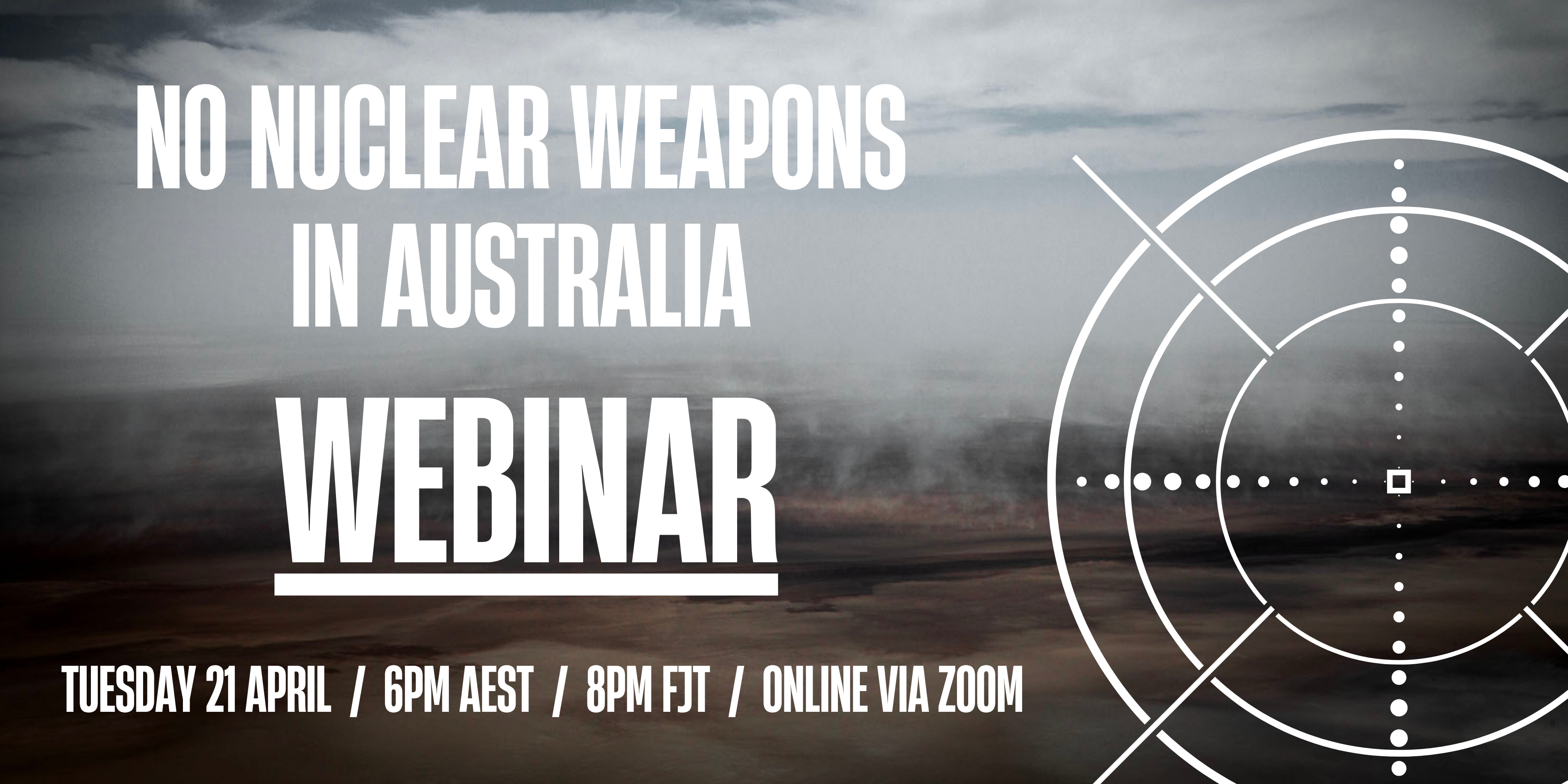
21 April Webinar: No Nuclear Weapons in Australia
Start: 2026-04-21 18:00:00 UTC Canberra, Melbourne, Sydney (GMT+10:00)
End: 2026-04-21 19:30:00 UTC Canberra, Melbourne, Sydney (GMT+10:00)
Event Type: Virtual
A virtual link will be communicated before the event.
Host Contact Info: australia@icanw.org

of the week – Australians for War Powers Reform (AWPR)
To see nuclear-related stories in greater depth and intensity
 Antinuclear