We know why nuclear build costs are soaring — and Australia faces the biggest increases
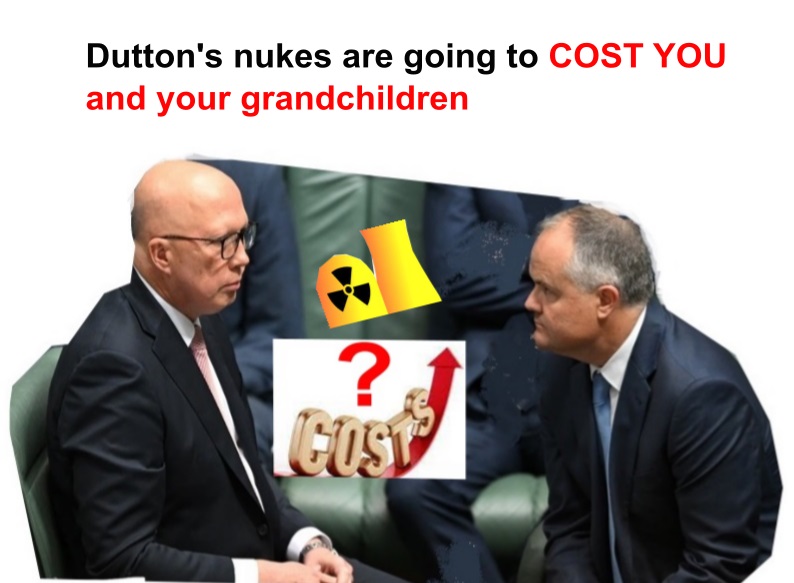
Around the world, experts have investigated why nuclear power construction costs keep going up. And we’re ignoring their lessons.
Crikey, Bernard Keane 21 Jan 25
The history of nuclear power construction is the history of costs going up and up, and delays getting longer and longer — not just over the past decade but since the 1960s. And studies of what has caused such rampant inflation show Australia is in the worst position to enter the complex and eye-wateringly expensive business of building nuclear power plants.
Global price spikes in construction materials resulting from the pandemic and the invasion of Ukraine have helped push infrastructure costs up everywhere, but significant blowouts in the construction costs of nuclear power plants are a much older story (when Crikey first covered nuclear power in Australia, in 2009, the first thing we pointed out was the cost…………………………………. (Subscribers only) more https://www.crikey.com.au/2025/01/21/australia-nuclear-energy-cost-peter-dutton/
Nuclear waste springs eternal in the human folly

25 Jan 25, https://theaimn.net/nuclear-waste-springs-eternal-in-the-human-folly/
“Hope springs eternal in the human breast;
Man never Is, but always To be blest.” – Alexander Pope, An Essay on Man, 1733
Pope goes on to say – “The soul, uneasy, and confin’d from home,
Rests and expatiates in a life to come.” I’m not sure what he means, but “never is, but always to be blest” really does suggest that the blessed solution actually never comes.
All that is fine, in the religious context. Because that way, it will all come good when we get to Heaven, in the next life.
In the nuclear waste context, the powers that be are as confident as the religious leaders, that all problems will be solved – later on, so we can go on hell-for-leather, making the poisonous trash.
‘High likelihood’ of radioactive waste in smoldering landfill, Missouri officials say
I was prompted to these thoughts by January 22nd news from Missouri – High likelihood of radioactive waste in smoldering landfill, Missouri officials say. I’ve been following this particular radioactive trash problem for at least 12 years https://nuclear-news.net/2013/05/16/radioactive-trash-in-st-louis-related-to-underground-landfill-fire/. And that fire’s still going! And that radiation is still causing cancers in the local community.
Dr Helen Caldicott, founding president of Physicians for Social Responsibility, visiting St Louis in 2016, said – the radioactive contamination in north St. Louis County is “worse than most places” she’s investigated, and called the situation “obscene.” Records reveal 75 years of government downplaying, ignoring risks of St. Louis radioactive waste.
So, the cleanup of St Louis’ County radioactive sites, contaminated by wastes from nuclear-weapons -making, goes on, with ever hopes to complete it, – while the nuclear-weapons-making goes on, creating even more radioactive trash
St Louis County is symbolic of the whole obscene nuclear waste situation across the planet.
Energy expert Kurt Cobb, writing in Oil Price, examines Sweden’s options for disposing of nuclear waste. He argues that climate change, political instability, and technological limitations could all pose threats to the long-term safety of nuclear waste storage. The Swedish plan is to fill the storage site—”60 km of tunnels buried 500 metres down in 1.9 billion year old bedrock”—sometime by 2080 at which time it will be closed.
Cobb points out that civilization, that is, human settlement in cities, has only been around about 10,000 years, but the wastes must be safe and secure for 100,00 years. The containers, copper capsules, are likely to corrode, and leak radioactive elements into groundwater, in a much shorter time.
He questions our faith in technological progress, which is supposed to absolutely solve the nuclear waste problem. It’s very like the Christian view on Alexander Pope’s statement – we’re not going to be blest in this world, so just look to life in the hereafter.
Kurt Cobb also discusses nuclear reprocessing, which brings its own problems, and still creates more waste, and he mentions other suggestions – shooting such waste into space or into the Sun.
Now here’s where I’m shocked at Mr Cobb. In all my years of reading worthy treatises on nuclear waste disposal, this is the first time I’ve found an energy expert to come up with a heretical thought like stopping making radioactive trash:
“I wonder if we were wise to create something in the first place that requires 100,000 years of care, given how heedless we as a species are to hazards of our own making that may destroy our current civilization much, much sooner than a thousand centuries from now.“
Really, Mr Cobb, wash your mouth out with soap! You don’t say things like that, if you want to be taken seriously by the world’s reputable nuclear experts.
The devil of Frontier’s nuclear modelling is not in the detail, it’s in the omissions
Alan Rai, Jan 23, 2025, ReNewEconomy
In November and December 2024, Frontier Economics released two reports on the transition required in the NEM to achieve net zero emissions by 2050, drawing on AEMO’s 2024 Integrated System Plan (ISP).
This was followed by various summaries and takeaways of the Frontier modelling by, amongst others, Steven Hamilton, Matt Kean, Kane Thornton, and David Leitch.
In contrast to some of the public reaction to date, I think Frontier’s work adds to the debate about the potential for nuclear power generation in Australia. In particular, Frontier’s work raises a philosophical question about the pace of decarbonisation we want, and our willingness to pay for it.
We might all subscribe to “Net Zero by 2050”, but the pathway to get there, as AEMO’s and Frontier’s modelling show, can clearly differ. I will return to this issue, below.
This article differentiates from what’s been publicly said and written about Frontier’s work in two important ways:
1. It focuses on the assumptions in and implications of Frontier’s modelling, whereas the bulk of the existing public discussion mixes aspects of Frontier’s analysis with political parties’ and politicians’ statements on nuclear power and their selective use of Frontier’s analysis to support their statements.
2. It discusses both of the Frontier reports, whereas the bulk of existing discussion focuses on selected aspects of Frontier’s second report.
…………………………………………………………………………………………………………………………………………………………………. In conclusion
To reiterate what I started with, I think Frontier’s work adds to the debate about the potential for nuclear power generation in Australia – their modelling poses some important philosophical questions for us.
However, the above-noted challenges means Frontier’s modelling falls short of a definitive answer to whether nuclear is appropriate, at any scale and at any future time horizon, for Australia’s power sector. As Frontier appropriately noted, their modelling is not “the last word on this matter.” https://reneweconomy.com.au/the-devil-of-frontiers-nuclear-modelling-is-not-in-the-detail-its-in-the-omissions/
1 This month
7 April – WEBINAR – Australia and the Doomsday Clock – Preventing nuclear war through NoFirstUse and other policies
Online | Tuesday April 7, 4:00-5:30pm, Australian Eastern Time / 8:00-9:30am Central Europe Time
– Access the registration link
15 April – Zoom –Nuclear Power is Not the Solution
Apr 15, 2026 01:00 AM in Canberra, Melbourne, Sydney

Join the International Physicians for the Prevention of Nuclear War (IPPNW) on Tuesday, April 14th for a timely webinar exploring the risks associated with nuclear power and challenging the myth that it offers a simple, safe, carbon-free solution to the climate crisis

21 April Webinar: No Nuclear Weapons in Australia
Start: 2026-04-21 18:00:00 UTC Canberra, Melbourne, Sydney (GMT+10:00)
End: 2026-04-21 19:30:00 UTC Canberra, Melbourne, Sydney (GMT+10:00)
Event Type: Virtual
A virtual link will be communicated before the event.
Host Contact Info: australia@icanw.org

of the week – Australians for War Powers Reform (AWPR)
To see nuclear-related stories in greater depth and intensity
 Antinuclear