Media coverage of Dutton’s nuclear ‘plan’: Scrutiny, stenography or propaganda.
By Victoria Fielding | 28 January 2025, https://independentaustralia.net/politics/politics-display/media-coverage-of-duttons-nuclear-plan-scrutiny-stenography-or-propaganda,19
Unsurprisingly, the conservative media has failed to scrutinise Peter Dutton’s nuclear plan, once again displaying bias towards the Coalition, writes Dr Victoria Fielding.
WHEN OPPOSITION LEADER Peter Dutton snuck his dodgy nuclear energy “plan” out just before Christmas, it was an important moment for Australian news media to demonstrate the quality of journalism they produce: scrutiny, stenography or propaganda.
It was also their opportunity to be honest with the public about why Dutton is backing nuclear power, an opportunity they unsurprisingly did not take.
I analysed 37 news reports published by the ABC, The Guardian, News Corp and Nine newspapers on 13 December 2024, the day Dutton released his long-awaited “plan” for nuclear power. I categorised each article as either scrutinising the plan (a useful form of journalism that critically assesses the viability of the nuclear policy), as stenography (just repeating Dutton’s plan without scrutiny), or as propaganda (news presented to look like news but what is actually a form of political advocacy, aiming to persuade readers to support Dutton’s nuclear plan).
Here are the results.

In what will not be surprising to anyone, propagandistic content made up the majority of News Corp’s 20 articles about Dutton’s nuclear plan, with 14 out of 20 enthusiastically supporting nuclear power as a viable energy solution for Australia.
One notable example of this propagandistic approach by News Corp was in The Australian’s editorial on the subject which clearly gave away the views of the masthead.
‘…the Opposition Leader has taken an important and brave step, setting out the economics of the issue in a context relevant to concerns about living costs, especially power bills… Frontier’s modelling shows that the Coalition’s plan, incorporating nuclear and renewables, would cost $331 billion across 25 years, 44 per cent less than Labor’s renewables approach.’
Just like much of News Corp’s propagandistic content advocating for right-wing policies and politicians, the implied suggestion that nuclear is cheaper than renewables is manipulatively deceiving.
According to Climate Council reports using CSIRO’s analysis:
‘…the cost of electricity generated from nuclear reactors by 2040 would be about $145-$238 per MWh, compared to $22-$53 for solar, and $45-$78 for wind. So that’s at least twice as much for nuclear, or up to ten times as much when comparing with the lowest-cost solar.’
Dutton and his News Corp collaborators never let facts get in the way of manipulating voters.
Next, we have stenography. Stenography is the laziest form of journalism. Rather than doing the difficult work of analysis and being a watchdog to ensure only credible information is relayed to voters, stenographers just repeat what a politician has said, uncritically.
This has the effect of allowing manipulative politicians like Dutton to put information in the public domain which is false and/or misleading. Stenography is actually the opposite of what of journalism is meant to be.
Nine’s newspapers published six articles which just lazily repeated Dutton’s nonsensical nuclear plan, giving it undue credibility and failing to adequately scrutinise it.
For example, Phillip Coorey in the Australian Financial Review authored a piece originally titled ‘New costings signal war over energy’, which starts with the sentence:
‘The Coalition’s nuclear power plan will cost up to $263 billion less than Labor’s renewable rollout between now and 2050, translating into cheaper electricity over the long run, its long-awaited economic modelling purports.’
Coorey would no doubt claim that he is not responsible for any manipulative or misleading content he has included in his article, because he is just reporting what Dutton said. But that is exactly the problem with stenography. Although it is not as bad as News Corp’s overt propagandist style, it still gives Dutton a platform to mislead the newspaper’s audience.
The only useful form of journalism out of the three categories is scrutiny. Indeed, the whole point of political journalism is to scrutinise politicians and policies to ensure voters are not misled and have useful information in which to make an informed decision when voting. All four outlets included at least some articles with extensive scrutiny of Dutton’s nuclear plan. News Corp had five and Nine published three.
The ABC (four articles) and The Guardian (three) were the only two outlets to only present Dutton’s nuclear policy alongside critical analysis.
One shining example of scrutiny from The Guardian’s Graham Readfearn and Josh Butler’s explainer, titled ‘The glaring gaps and unanswered questions in the Coalition’s nuclear plan and costings’, methodically lays out the facts and problems with Dutton’s plans — including the true higher cost comparison with renewables and the huge amount of time it would take nuclear to come online.
The ABC and The Guardian’s useful critique of Dutton’s plan is exactly the information that voters need to accurately appraise whether Dutton’s nuclear policy is beneficial to them and their community. No doubt News Corp and Nine would claim that this scrutiny just shows the ABC and The Guardian are “left wing”, but it shows no such thing. The ABC and The Guardian are doing a public service in scrutinising a major policy announcement and providing factual analysis comparing the real costs of nuclear and renewable energy.
If a left-wing party announced a different energy policy, they would do exactly the same thing. It is called public interest journalism.
Unfortunately, however, this is not the end of the story. There was one major element of Dutton’s nuclear policy which was only included in one of the 37 news reports I analysed — the motive behind Dutton’s nuclear push. This was included in The Guardian’s Readfearn and Butler explainer, albeit only in two after-thought quotes at the end of the piece.
Under the sub-title ‘How have critics responded?’ The Greens’ Adam Bandt was reported to have said “the nuclear strategy relied on extending the life of fossil fuels”. The Australia Institute’s Rod Campbell similarly said the nuclear plan was a “distraction to prolong fossil fuel use and exports”.
Disappointingly, no articles overtly pointed out to the public that the whole point of Dutton’s nuclear policy was to undermine investment in renewable energy, unsettling the transition to a low carbon economy, to slow down efforts to address climate change, all in aid of fossil fuel and mining billionaires. This exclusion is not just a small part of the story of Dutton’s nuclear policy, it is the story.
This truth, unfortunately, is the story journalists collectively have failed to tell.
Geoscience Australia declares Darwin, Latrobe Valley high-risk earthquake zones
The Age By William Howard, 29 Jan 25
In short:
Darwin and Victoria’s Latrobe Valley have been identified as high-risk earthquake zones.
The National Seismic Hazard Assessment has been updated for the first time since 2018.
What’s next?
The Coalition has earmarked the Latrobe Valley as a potential site for a nuclear reactor if it wins the election, which is a concern for some residents.
…………………………………….In an update to the National Seismic Hazard Assessment, Geoscience Australia identified the Latrobe Valley and Darwin as the only two areas in Australia with a “higher risk of strong ground shaking”.
The Woods Point quake, centred about 130 kilometres east of Melbourne and 125km south of Ms Cox’s Traralgon South home, was the largest onshore event of its kind in the state’s modern history.
There were more than 43,000 reports from the public and the earthquake was felt in parts of New South Wales, South Australia, Tasmania, and the Australian Capital Territory. https://www.abc.net.au/news/2025-01-30/darwin-and-latrobe-valley-high-risk-earthquake-zones/104873178
Funding to electrify homes expanded as Bowen slams Opposition’s ‘nuclear fantasy’
Tim Fernandez, ABC Illawarra, Tue 28 Jan
In short:
Energy Minister Chris Bowen is calling for community groups across Australia to apply for grants to help residents install electrical appliances.
He says the scheme will reduce power bills and emissions and described the Opposition’s energy plan as a “nuclear fantasy”.
What’s next?
The expansion comes after “encouraging” results from a pilot program in NSW………………………………………………………………………………………………………………………………………………………… more https://www.abc.net.au/news/2025-01-28/chris-bowen-expands-household-electrification-scheme/104868630
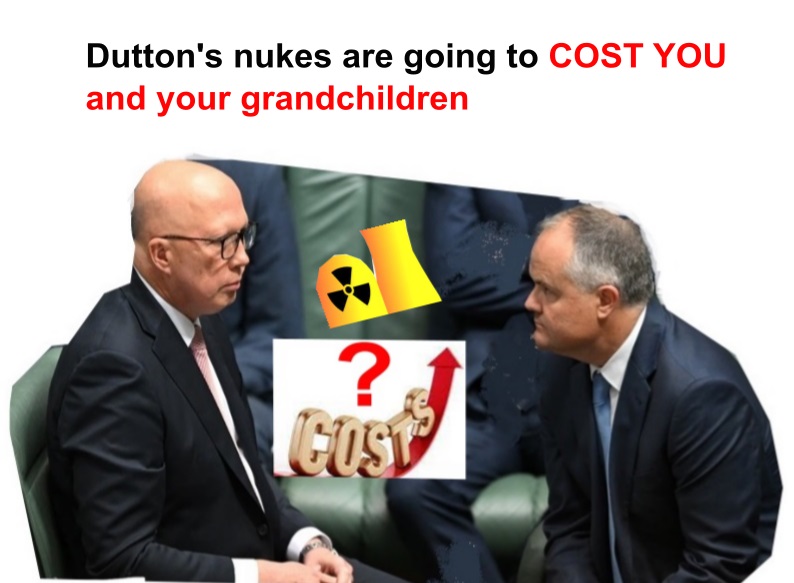
Dutton’s atomic power bill for a ‘nuclear family’ could be nearly $39K
By Steve Bishop | 28 January 2025, https://independentaustralia.net/politics/politics-display/duttons-atomic-power-bill-for-a-nuclear-family-could-be-nearly-39k,19381
The Dutton nuclear power plan will cost about $264 billion if the type of reactor extolled by Shadow Energy Minister Ted O’Brien is adopted.
That’s equivalent to more than $9,700 for every man, woman and child in Australia — and $38,800 for the proverbial “nuclear family”.
The costings are simple.
Opposition Leader Peter Dutton announced on 13 December:
‘By 2050, our plan will deliver up to 14 GW of nuclear energy, guaranteeing consistent and stable electricity for all Australians.’
O’Brien even produced a video highlighting the virtues of the Bill Gates-backed Natrium reactor, which provides 345 megawatts of power and is costing US$4 billion (AU$6.45 billion) for the first one being built in Wyoming by TerraPower.
Forty-one of the reactors would be needed to produce the promised 14GW of nuclear power at a cost of $264.45 billion.
Australia has an estimated population of 27.2 million, giving a total of $9,724 for every man, woman and child.
Mr Dutton has made it plain he is opposed to big nuclear facilities and the Natrium small modular reactor (SMR) reactor meshes with his pledge to ‘place the latest zero emission nuclear technologies on the sites of seven retiring coal-fired power plants’.
Another reactor that falls within his pledge to use the latest technologies is the Rolls Royce UK SMR 470 MWe which could cost between £3 billion and £4 billion (AU$5.9-7.9 billion) apiece.
Even the lower estimate of £3 billion equates to $5.9 billion. Thirty of them would be needed to meet the 14GW target, at a cost of $176.7 billion.
But Nuclear Consulting Group chairman Paul Dorfman has warned that because the Rolls Royce reactor is more than 50 per cent bigger than an SMR it “will need big sites, standard nuclear safety measures, exclusion zones, core catchers, aircraft crash protection and security”.
Ontario and the Tennessee Valley Authority are planning to use the innovative GE Hitachi BWRX-300 reactor but it has been reported that planning documents reveal a cost of around US$5.4 billion (AU$8.6 billion), amounting to a cost of $369 billion for the 43 needed to produce 14KW of power.
Another new SMR is the Westinghouse AP300 SMR.
An order for four of the reactors has been placed in the UK for the Tees Valley with the Daily Express reporting:
‘The four reactors would cost £10 billion and generate 1.2 gigawatts of power, enough for 1.6 million homes.’
That’s £2.5 billion each, or AU$4.91 billion. Forty-three would be needed to meet the LNP target of 14GW — costing $211 billion. But this does not factor in the sort of cost blow-out experienced with other SMRs.
Mr Dutton was asked by ABC journalist Bridget Brennan in June:
“So, surely Australians need to know right now how much this is going to cost? Is it going to be as much as $16 billion per site?”
The answer is very much more expensive — more than $35 billion for each of the seven sites if Ted O’Brien’s preferred Natrium reactor is adopted.
Former Miss America’s Australian nuclear tour clouded by Chinese AI blow to her employer
Royce Kurmelovs, Jan 30, 2025, https://reneweconomy.com.au/former-miss-americas-australian-nuclear-tour-clouded-by-chinese-ai-blow-to-her-employer/
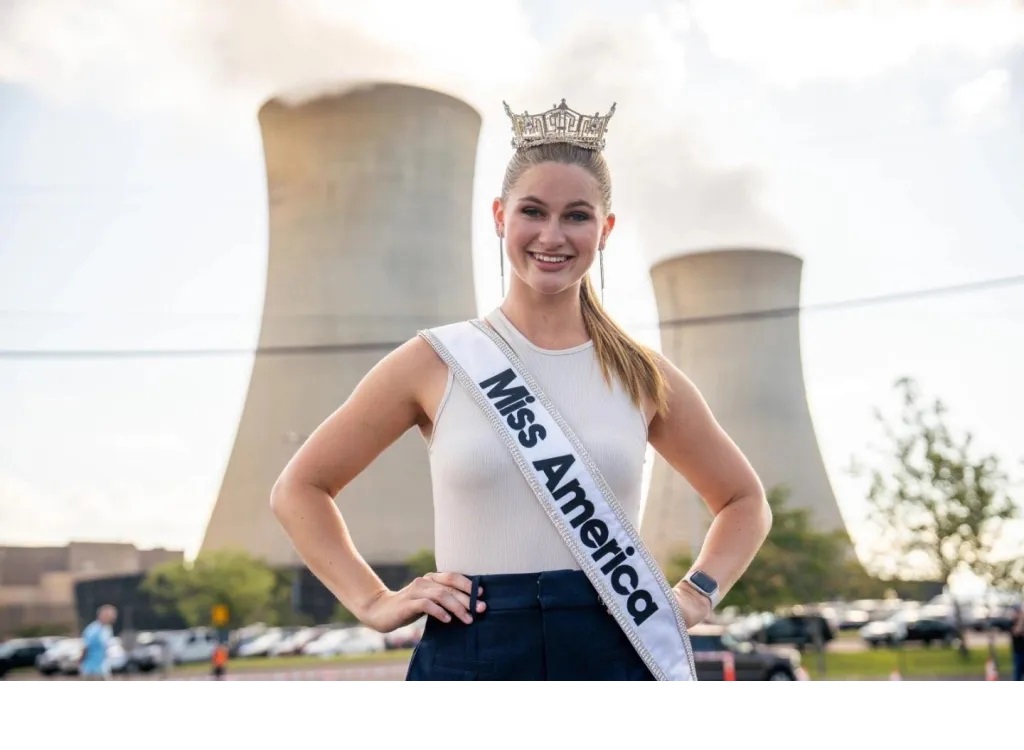
Miss America 2023 winner Grace Stanke has begun her Australian tour to promote nuclear power, just as the US energy giant that employs her has taken a big market hit after Chinese company DeepSeek claimed to have found a cheaper way to make AI.
Stanke, who flew into Perth on Wednesday, is a nuclear engineer who works in public relations for Constellation to promote nuclear technology, and has been brought out for an Australian tour by campaign group Nuclear For Australia in an attempt to drum up local support for the technology.
Nuclear For Australia is nominally headed by 18-year-old Will Shackel. But Stanke’s tour has reportedly been bankrolled by Australian businessman Dick Smith, who also provided the funding to establish the group.
The tour comes amid an aggressive expansion drive by Constellation, which holds a suite of nuclear and fossil fuel assets. According to the company’s 2024 Sustainability Report, nuclear makes up 67% of its generation capacity, with natural gas and oil making up 25% and renewables and storage accounting for 8%.
Constellation has increasingly been looking to capitalise on the development of AI as a driver in future electricity demand that it hopes to meet with nuclear power.
In September last year the company announced it would buy the Three Mile End nuclear facility under a deal to supply Microsoft with power to run its AI data centres.
Earlier in January, Constellation bought out rival Calvine for $US 27 billion, a move that meant it acquired the company’s gas-plants.
As gas-peaking plants currently help smooth out spikes in the wholesale electricity market by turning on during periods of high demand — at the expense of nuclear generators — the acquisition potentially gives Constellation greater influence over wholesale prices.
Late last week, President Donald Trump announced the US would pour $US 500 billion into AI development in what has been described as an “arms race” with China, a decision welcomed by Constellation CEO Joe Dominguez.
“President Trump is right that sustaining and enhancing America’s global AI dominance goes hand in hand with reliable, abundant American electricity,” he said. “Data center developers, generators, utilities, and other stakeholders should continue to work together to accomplish the President’s goals on behalf of the American people.”
On Tuesday, however, the assumption that power-hungry chipsets needed to train and run AI data centres would continue to drive demand for “clean” nuclear power ran into a wall.
Chinese firm DeepSeek announced it developed an open large-language model (LLM) that provides roughly the same service as ChatGPT with a smaller team and a fraction of the hardware as their US counterparts.
With the Chinese market subject to sanctions that limit access to the full-power graphics processing units (GPUs) needed to build their own models, the company was forced to find a workaround to do more with less.
These GPUs perform the calculations needed to drive LLMs and are manufactured by chipmaker Nvidia that was, until Wednesday, considered the world’s most valuable publicly-traded company with a market cap of $3.45 trillion. That changed with the latest news from DeepSeek.
In December, DeepSeek claimed it cost (USD) $5.6m and two months to develop its V3 model – a portion of what it cost to create ChatGPT. The accuracy of this figure, however, is questionable as the price of electricity is unknown.
Last week the company released the full version of its R1 model that it said is 30-times cheaper to run than equivalent models produced by US competitors such as OpenAI. The company has not released the training data, but has published papers outlining its methods, effectively allowing anyone to take DeepSeek work and expand upon it for free.
The announcement of a cheaper, less-demanding model triggered a massive 17% drop in Nvidia shares — wiping off $USD593bn, and knocked 20 per cent off the price of Constellation shares. By Thursday Constellation’s performance had partially recovered but not nearly enough to make up for Tuesday’s losses.
These events coincide with the arrival of 22-year-old Stanke, now a pro-nuclear influencer, in Australia to help local campaigns sell the technology to the Australian public.
Her tour includes appearances in Perth, Brisbane, Melbourne, Adelaide and Sydney, a parliamentary briefing and appearances at private events, including a community meeting in Lithgow, New South Wales.
The town selection is interesting as it has been a flashpoint for an anti-wind and anti-renewables campaign and has traditionally been a strong Nationals stronghold.
Lithgow falls within the federal seat of Calare which is currently held by federal independent Andrew Gee, who resigned from the National Party in 2022 over its opposition to the Indigenous Voice to Parliament.
Australia’s new chief scientist open to nuclear power but focused on energy forms available ‘right now’
Prof Tony Haymet says nuclear industry will need to ‘rebuild their social licence’ while noting solar and wind are ‘incredibly cheap’.
Josh Butler, Guardian 28th Jan 2025 –
Australia’s new chief scientist has said he is open to the prospect of nuclear power playing a role in the country’s energy mix, but remained focused on forms of energy that were “available to help us right now”.
On his first day in the job, Prof Tony Haymet said new energy-intensive technologies like artificial intelligence could be powered by renewables, but that he thought serious discussions about nuclear in Australia were likely to be years away.
“If you go back and look at Chernobyl and Three Mile Island and so on, there wasn’t enough transparency and openness. I think the nuclear industry has accepted the fact that they have to rebuild their social licence to operate,” Haymet told a press conference when asked about small modular reactors (SMRs).
“You know, for the next chief scientist in 2030 or 2040, I think you can re-ask your question.”
Haymet said Australia shouldn’t “rule out any energy source” but said new technologies, like AI datacentres, would require much more power in the short term.
“So I’m looking at the slate of energies that are going to be available to help us right now. If we wait until we perfect wave energy or nuclear fusion, or some other source of power, we’re going to miss the bus,” he said……………………………………….
The CSIRO’s GenCost report in December reaffirmed that electricity from nuclear energy in Australia would be at least 50% more expensive than power from solar and wind, backed up with storage. Electricity from SMRs would be significantly more expensive again, with the report rejecting opposition claims that nuclear power plants could be developed in Australia in less than 15 years.
The former chair of the Antarctic Science Foundation and high-level working groups on climate change, Haymet has also held senior roles at the CSIRO, with a particular focus on oceans.
Amid a heated debate on nuclear energy, sparked by the Coalition’s pledge to build conventional large reactors and SMRs – a developing technology that does not exist anywhere on a commercial basis – Dutton and his shadow ministers have been strongly critical of scientific reports and experts who have cast doubt on the viability of an Australian nuclear power industry.
Energy experts have noted the Coalition’s modelling forecasts much lower consumption of energy in Australia than Labor’s renewables-focused energy policy, which the treasurer, Jim Chalmers, claimed would see a $4tn hit to Australia’s economy. The Coalition modelling does not forecast a reduction in power bills and the Coalition senator Matt Canavan admitted the plan was “unachievable”.
At the press conference alongside the science minister, Ed Husic, Haymet strongly backed his former colleagues in the CSIRO.
“You may not be surprised to hear that I think the CSIRO report is a very fine piece of work. I don’t know of any mistakes in it, and if you do, please let me know. Having been inside CSIRO, I see the care and the diligence that goes into these reports,” he said. https://www.theguardian.com/australia-news/2025/jan/28/australia-nuclear-power-plan-tony-haymet-chief-scientist
1 This month

of the week – Australians for War Powers Reform (AWPR)
To see nuclear-related stories in greater depth and intensity
 Antinuclear