Australian nuclear news headlines February 4 – 11
Headlines as they come in:
- Explained: Why nuclear power has been banned in Australia for more than 25 years.
- Briefer Flawed ‘assessment’ of Osborne / Port Adelaide nuclear submarine site ignores accident risk (David Noonan, Feb. 2025)
- My favourite despicable Australian politician (Richard Marles).
- Honest Government Ad | Nuclear – https://www.youtube.com/watch?v=JBqVVBUdW84
- How Australia’s CANDU Conservatives Fell in Love with Canadian Nuclear.
- Coalition trying to brainwash Queenslanders into nuclear.
- .Pro-nuclear lobby group ramps up social media ad spend by nearly 150 pct
- Lidia Thorpe erupts in a fiery outburst at an American pro-nuclear activist during her visit to Parliament. (Media coverage example 2 at..)
- Media coverage of Dutton’s nuclear campaign, Example No 1
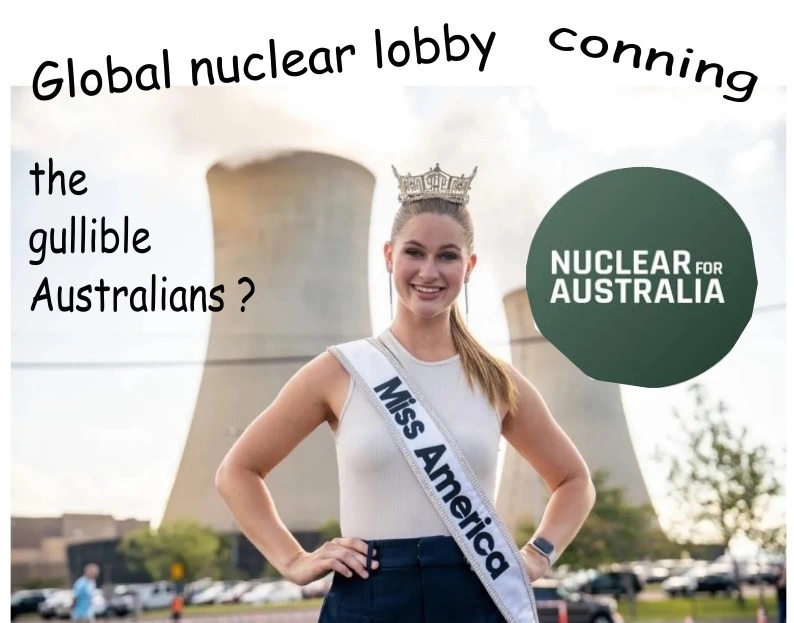
- Lidia Thorpe crashes pro-nuclear press conference fronted by ex Miss America winner Grace Stanke
- Morwell hears from Miss America on nuclear .
- New UK data sends nuclear warning for Australia .
- Lies, damned lies and Coalition energy economics: Dutton’s latest nuclear claim slammed .
- ‘No idea what he’s talking about’: Dutton’s nuclear plan could raise – not cut – electricity bills, experts warn .
- Nuclear curious? Here’s what you need to know about the Coalition’s energy claims.
- The paradox of recent politics.
Morwell hears from Miss America on nuclear

Intriguing coverage of the Miss America pro-nuclear blitz….
Questions from the floor were not permitted……. Security was tight for the event……… the selected few who did not entirely agree with what was being said quietly walked out.
By LIAM DURKIN, https://latrobevalleyexpress.com.au/news/2025/02/04/morwell-hears-from-miss-america-on-nuclear/
COMMUNITY passion was evident on Sunday night, as locals congregated to hear from international nuclear experts in Morwell.
The Nuclear for Australia roadshow made its way to the Latrobe Valley, with more than 200 people cramming into the function centre of the Italian Australian Club.
The panel discussion was headlined by former Miss America and nuclear engineer Grace Stanke.
Ms Stanke spoke for around half-an-hour, detailing her career and attempting to spell out some misconceptions surrounding a possible nuclear future for the Latrobe Valley.
She was followed by UBH Chief Nuclear Officer, Mark Schneider, speaking on the finer points of nuclear operations, and University of Adelaide Adjunct Nuclear Law Lecturer, Kirsty Braybon on what would need to take place for nuclear to be given the green light at federal level.
Well-known local union delegate Mark Richards (of the Mining Energy Union) also spoke briefly.
The panel then took questions, although these were selected by the emcee through an online system.
Questions from the floor were not permitted.
Nationals MPs Darren Chester and Danny O’Brien were in attendance, as was Latrobe City Mayor, Dale Harriman and deputy mayor, Sharon Gibson.
Security was tight for the event, with tickets and bags checked upon arrival. Tickets were not available at the door.
Crowd behaviour was first rate, and the selected few who did not entirely agree with what was being said quietly walked out. One man did however mutter a few unpleasantries on his way to the exit.
With Ms Stanke and Mr Schneider both hailing from the United States, their speeches focussed greatly on nuclear in their home country. As a result, it was understandable there were some who felt the Morwell event became little more than a Yankee talkfest.
For the majority however, most reported finding the evening informative and insightful.
Full coverage of the seminar will feature in next week’s Express.
Nuclear curious? Here’s what you need to know about the Coalition’s energy claims
Peter Dutton says building nuclear reactors will bring down power prices but experts doubt it and say it will cost the climate too
Graham Readfearn, https://www.theguardian.com/australia-news/2025/feb/04/nuclear-power-liberal-coalition-energy-power-plan-details
Peter Dutton says the Coalition would slow down the rollout of renewable energy and and instead eventually spend tens of billions of taxpayer dollars to build nuclear power plants at seven sites across the country.
He claimed “power prices will be cheaper under us in the near term” and that his policy would be expected to lead to “a 44% reduction, or of that order, being passed through in energy bill relief” – that is, a dramatic and unprecedented cut in household power bills.
Does this stack up? Here’s what you need to know about the Coalition’s plans, the risks it poses to the country’s electricity supply and its climate targets.
What does the Coalition say it will do?
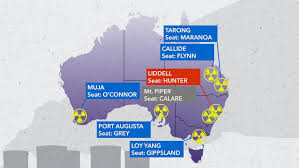
The Coalition wants to build large nuclear reactors at the sites of five coal-fired power stations – Liddell and Mount Piper in New South Wales, Tarong and Callide in Queensland, and Loy Yang in Victoria.
Small modular nuclear reactors, which are not yet commercially available anywhere, are proposed at the sites of Northern power station in South Australia and Muja power station in Western Australia.
All the reactors would be taxpayer-funded. The Coalition claims it could have smaller units working by 2035 and the first large reactor working by 2037.
How long would it take?
Most energy experts, including those from the CSIRO, say the Coalition’s timeline is unrealistic.
They argue it is highly unlikely Australia could do everything necessary – including creating a regulatory system, developing a skilled workforce, completing geological and environmental work and commissioning and building a nuclear reactor, with community approval – before the early 2040s, if not later.
The Coalition would also have to overturn a legislated federal ban on nuclear energy and convince the states to overturn their bans. Most state premiers and opposition leaders are opposed to introducing a nuclear energy system.
With Labor, the Greens and some independents opposed to nuclear energy, repealing federal laws would be a major obstacle.
The Nationals senator Matt Canavan has claimed the Coalition was “not serious” about building nuclear and it was being backed because it “fixes a political issue”.
Would building nuclear reactors keep the lights on?
Many of Australia’s coal plants are old.
On average, coal plants are forced offline through unplanned outages for about 10% of the year. Australia’s electricity market operator expects 90% of coal-fired power stations to be closed by 2035 – two years before the Coalition claims its first nuclear plant would be producing power.
The Coalition’s plan would mean requiring ageing coal plants to run for longer, increasing the risk of unplanned outages unless there was significant new spending on maintenance.
Experts say promising to build taxpayer-funded nuclear plants could also lead to investors deciding not to build the solar, wind, batteries and pumped hydro currently planned, and needed now, to replace much of the electricity from coal.
Would nuclear power really bring down the cost of living?
The Coalition has provided no evidence to back up its claim that its proposal could bring electricity prices down.
Dutton has claimed that modelling by Frontier Economics judged the Coalition’s plan to be 44% cheaper than Labor’s policy of running the grid overwhelmingly on renewable energy, and that this meant power bills would be cut by 44%.
This claim has no basis in fact. Frontier’s own modelling report said it had not modelled the impact of a nuclear plan on prices.
The modelling used by the Coalition is based on an electricity system producing 31% less electricity than Labor’s preferred renewables-based approach.
More than half of a household’s electricity bill is related to factors outside the Coalition’s plans, such as the cost of local poles and wires, or the costs passed on by retailers.
Overseas, particularly in western democracies, nuclear plants have become notorious for large cost blowouts and delays.
The Coalition says its plan would cost less because it would avoid having to build some of the new towers and power lines needed to connect the new solar, wind and battery farms planned across the country.
But CSIRO analysis found even if Australia had an established nuclear program with a suite of reactors, the electricity would cost at least 50% more than power from solar and wind backed by battery and other energy infrastructure needed to ensure the power grid remained reliable even when the wind wasn’t blowing and the sun wasn’t shining.
What will the Coalition’s nuclear plan mean for the climate crisis?
About a third of Australia’s greenhouse gas emissions come from burning coal and gas to produce electricity. Cleaning up the grid is essential to cutting Australia’s climate pollution and meeting its international commitments.
The Coalition’s plan assumes that for the next 20 years or so there would be significantly less renewable energy and significantly more electricity from coal and gas-fired power stations than proposed by regulators and backed by the Labor government.
Not surprisingly, this would mean higher emissions. This point was reinforced in modelling supported by the Coalition released in late 2024. It found that Dutton’s proposal would lead to substantially higher pollution between now and 2048 than on the current path.
Independent analysis has backed this up, suggesting the Coalition’s plan would lead to an extra 1.7bn tonnes of CO2 being emitted by 2050. This is equivalent to about four years’ worth of emissions released across the entire Australian economy.
The Coalition’s plan also assumes slower decarbonisation in other parts of the economy. It suggests fewer people would buy electric vehicles than under Labor, and fewer rooftop solar panels would be installed.
The Coalition has aligned its plan to a scenario laid out by the Australian energy market operator that is in line with global heating of about 2.6C by 2100.
Lies, damned lies and Coalition energy economics: Dutton’s latest nuclear claim slammed
“Mr Dutton is either dangerously ill‑informed or he is lying to the Australian public.
Sophie Vorrath, Feb 3, 2025, https://reneweconomy.com.au/lies-damned-lies-and-coalition-energy-economics-duttons-latest-nuclear-claim-slammed/
Blink and you might have missed it, but Peter Dutton delivered another toe-curling example of energy policy hokum on Sunday morning, as the first guest of the first episode of the ABC’s Insiders program for 2025.
In amongst other well-spun lies – such as the claim Labor’s energy policy requires 28,000km of new transmission to be built – the leader of the federal opposition appeared to say that electricity bills would be 44 per cent cheaper under a Coalition government than under Labor.
“[Frontier Economics] look[d] at our energy policy compared to Labor’s, they judge[d] that it’s 44 per cent cheaper than Labor’s,” Dutton says.
When Insiders host David Speers points out that the 44% figure – itself hotly contested, as is Frontier’s Economics’ entire approach to modelling nuclear costs for Australia – relates to the cost of building nuclear between now and 2050 and not the power price impact, Dutton fudges further.
“If you’re delivering a model that’s 44% cheaper, that translates into cheaper power prices,” he says.
Pushed on this point, Dutton says, “If you apply the economics, so if there’s a 44% reduction in the model of delivering an energy system, you would expect a 44% reduction, or of that order, being passed through in energy bill relief.”
Pushing once more, Speers says: “But Frontier didn’t tell you that that number, you’re just, you’re just drawing that assumption yourself.”
Dutton: “Again, David, I mean, that’s that’s the economics of it. …All other variables being equal, if you have a 44% reduction in the overall cost to deliver that model, that is going to translate into that price reduction for households and for businesses, and that’s what we must do.”
Happily for Dutton, the discussion switches away from energy at this point, leaving his highly questionable application of “the economics of it” more or less unchallenged.
Unhappily for Dutton, certain energy market experts and actual economists are not having it.
The Smart Energy Council has responded on Monday by publishing the findings of its own analysis and calculations, using – it says – the same assumptions put forward by the federal Coalition and the nuclear policy costings of Frontier Economics. It also uses modelling from the Institute of Energy Economics and Analysis (IEEFA).
This analysis finds that for Australia’s 4 million (and counting) solar homes, power bills would go up more than $1,100 a year under Dutton’s nuclear policy. For non-solar homes, power bills would increase by an average $665 a year – a 30% jump.
The SEC says the hike in energy costs for solar homes of between $1,181 to $2,468 a year would come from lost energy savings, with “always on” nuclear likely to knock out rooftop solar for an average 67% of the year, forcing consumers on to higher nuclear power prices.
For both solar and non-solar homes, part of the jump in energy bills would come from the fact that nuclear power is a more expensive form of generation – as shown in IEEFA’s report, Nuclear in Australia would increase power bills.
The IEEFA report finds that for a nuclear plant with similar costs to those reported for Sizewell C in the UK to be commercially viable in Australia, wholesale energy prices would need to rise by $98 to $168 per megawatt-hour, relative to 2023-24 levels, to enable cost recovery.
This equates to a 74% to 127% rise in wholesale prices, which would see average household power bills across the states in the National Electricity Market increase by between $561 and $961 (with GST), assuming electricity retailers don’t add a margin on top.
“The latest reported cost blow-out for the UK’s proposed Sizewell C nuclear plant further underlines that the Coalition’s proposal to bring nuclear power to Australia is unrealistic,” say the report’s authors, Tristan Edis and Johanna Bowyer.
“Sizewell C’s revised capital cost estimate is about 2.5 times the capital cost used in the Coalition’s modelling.”
And then there are the other, other costs to Dutton’s nuclear policy plan – including the further cost to taxpayers of propping up old coal plants and relying more heavily on expensive gas.
As SEC chief John Grimes put it in a joint press conference with federal energy minister Chris Bowen on Monday, Dutton’s plan to build nuclear is more accurately – for the next decade, at least – a coal keeper, gas booster and renewables stopper program.
“Billions of dollars to go into coal to keep it in the system for as long as possible… [and] a massive scaling up of the amount of fossil gas, the most expensive fuel in the energy system. And a solar stopper program, a cap of 54 percent on renewable energy, solar and wind, by 2050,” Grimes said on Monday.
“Peter Dutton, he has a plan that will double power bills for ordinary Australians. We think that that is outrageous. We’re here today to call it out.
“Mr Dutton is either dangerously ill‑informed or he is lying to the Australian public.
“We know that his plan… will effectively transfer wealth from homeowners to the big fossil fuel companies. Peter Dutton’s plan delivers for his rich fossil fuel mates. But his plan, his power plan, is a big stop in the road, a stop for solar, a stop for wind, a stop for batteries, a stop for EVs, a stop for ordinary Australians slashing their power bills with solar,” Grimes said.
“A stop for the effective transition of our economy and the massive environmental benefits that that delivers, and economic benefits as well.”
‘No idea what he’s talking about’: Dutton’s nuclear plan could raise – not cut – electricity bills, experts warn
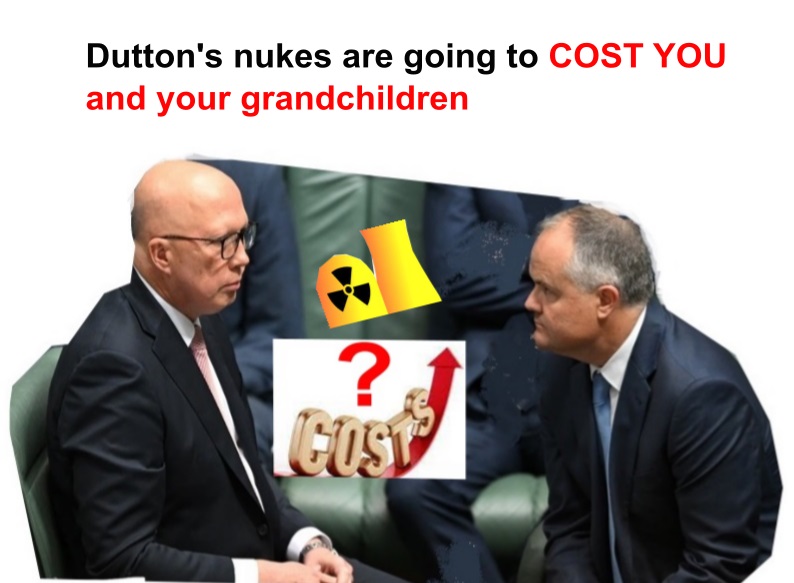
Opposition leader claims a 44% cost reduction compared with Labor’s plan would be passed on to Australian household bills, but not everyone agrees
Graham Readfearn, 4 Feb 25, https://www.theguardian.com/australia-news/2025/feb/04/no-idea-what-hes-talking-about-duttons-nuclear-plan-could-raise-not-cut-electricity-bills-experts-warn
Energy experts have rubbished claims by Peter Dutton that his plan to slow the rollout of renewable energy while waiting more than a decade for taxpayer-funded nuclear plants could bring down electricity bills in the short term.
Dutton said if there was “a 44% reduction in the model of delivering an energy system, you would expect a 44% reduction, or of that order, being passed through in energy bill relief”.
However, that was a “complete misunderstanding “of the Coalition’s own policy, according to Dr Dylan McConnell, an energy systems expert at the University of New South Wales. “He has no idea what he is talking about,” McConnell said.
Speaking to the ABC’s Insiders program on Sunday, Dutton said “power prices will be cheaper under us in the near term as well as in the medium to longer term as well”.
If elected, the Coalition would have to overturn federal and state bans on nuclear power; it claims it could have the first plants built by 2037. Experts, including the CSIRO, say the early 2040s is a more realistic timeframe.
The Coalition has not revealed any details on its near-term plans for electricity generation but Dutton said “we’re going to have to do a lot more with gas, with coal, in the system”.
Analysis by McConnell suggested the Coalition’s reliance on more coal and gas would add 1.7bn tonnes of CO2 to the atmosphere by 2050, compared with Labor’s plan.
Data from the CSIRO suggests using gas for power generation is more expensive than coal, and solar and wind. Nuclear electricity would be at least 50% more expensive than renewables, the CSIRO has said.
Gas prices tripled when the Coalition was in power, according to Tristan Edis, an analyst at Green Energy Markets.
He said energy prices were likely to fall over the next two years after the inflation caused by Russia’s invasion of Ukraine subsides.
“Beyond this two-year period, it is difficult to understand how the Coalition will lower power prices if they intend to simply rely on the power plants which are already in place and not foster additional competition,” he said.
“The coal plants are getting old and banks are reluctant to finance refurbishment costs. If we rely on additional gas, that will push up power prices, not reduce them – because gas is expensive.
Edis said the Coalition’s costs for building a 1GW nuclear plant had been set at $1bn, which was “unrealistically low” and could be at least double that. This would push up wholesale electricity prices and household bills, he said.
Frontier Economics released modelling, backed by the Coalition, that compared the cost of Labor’s preferred renewables-based plan with an electricity system that anticipates less demand for electricity and includes nuclear.
Of Dutton’s claim that modelling showed the Coalition’s approach would cost 44% less than Labor’s plan, McConnell was doubtful.
“That’s a clear misunderstanding of what makes up an electricity bill and what the [modelling report] shows.”
He said only about 45% of a household electricity bill related to the cost of the electricity system and the wholesale costs that relate to the cost of the system referred to by Dutton. The rest related to the costs of local poles and wires, retail costs and environmental charges.
Danny Price, managing director of Frontier Economics, defended Dutton’s comments, saying if he was referring to the energy costs portion of people’s bills then the lower cost should transfer to households.
But on the impact on households’ overall electricity bills, “it’s a much more complicated question” he said, because of uncertainties around how prices are set in the market.
For that reason, his company had not attempted to forecast what the Coalition’s plan would do for people’s electricity bills or to electricity prices.
New UK data sends nuclear warning for Australia

February 4, 2025, https://esdnews.com.au/new-uk-data-sends-nuclear-warning-for-australia/
By Tristan Edis and Johanna Bowyer, Institute for Energy Economics and Financial Analysis (IEEFA)
The UK’s Financial Times recently reported that the 3,260MW Sizewell C project —expected to be the UK’s next nuclear power plant—is now likely to cost around GBP40 billion, or $80 billion in Australian dollars, to construct. That equates to $24,540 per kilowatt of capacity.
Related article: The Coalition reveals the cost of its nuclear power plan—but the devil is in the missing detail
Sizewell C’s latest cost blow-out offers further confirmation that the opposition Liberal-National Coalition’s costing for its proposal to build nuclear power plants in Australia is far too low at $10,000 per kilowatt, and completely unrealistic. It supports IEEFA’s findings on the cost of construction for other nuclear power plants, detailed in our September 2024 report Nuclear in Australia would increase household power bills. The Sizewell C reactor’s newly estimated capital cost is about 2.5 times the capital cost used in the Frontier Economics modelling that has underpinned the Coalition’s plans.
At present, the UK Government is yet to commit to construction of Sizewell C and an official costing for the project is yet to be released. But the latest information in Financial Times, which has reportedly come from government and industry sources close to the project, reinforces the findings from our prior report: that for nuclear power to be viable in Australia, large increases in power prices would be required.
If the reported $80 billion cost only covers the plant’s construction and doesn’t account for the substantial debt interest costs likely to be accumulated over the targeted nine-year construction period, then Sizewell C would need the wholesale power price to rise to average out at around $300/MWh to be commercially viable. Even if this debt interest cost is accounted for in the $80 billion cited by the Financial Times, then it would still need the wholesale power price to rise to around $230/MWh.
By comparison, according to the Australian Competition and Consumer Commission (ACCC), over the 2023-24 financial year electricity retailers across Australia’s National Electricity Market needed to pay $132/MWh on average for wholesale energy to service their household customers.
Shadow Treasurer Angus Taylor has asserted on repeated occasions that any government investment in nuclear power plants would be made on the requirement that they were “commercially viable”, with no subsidies provided that would hit the government’s budget.
So, for a nuclear plant with similar costs to those reported for Sizewell C to be commercially viable in Australia, wholesale energy prices would need to rise by $98 to $168/MWh, relative to 2023-24 levels, to enable cost recovery. This equates to a 74% to 127% rise in wholesale prices, which would be charged on to household electricity consumers.
Related article: Not in my green backyard: Only 5% of people in renewables zones would live near nuclear
Such wholesale prices would mean that average household power bills across the states in the National Electricity Market would increase by between $510 and $874 per year prior to application of GST. Once GST is added then the increase will be between $561 and $961 – assuming electricity retailers don’t add a margin on top. This is based on ACCC data, which indicates average household annual consumption is 5.2MWh.
1 This month

of the week – Australians for War Powers Reform (AWPR)
To see nuclear-related stories in greater depth and intensity
 Antinuclear
