Trident nuclear submarine project rated “unachievable” third year running

A new submarine programme, known as Aukus, to eventually replace the Astute-class boats, is under development with the US and Australia. Its budget for 2023-24 was £495m, but its total cost and delivery date have been kept secret to protect “national security” and “international relations”.
Aukus was rated as amber for 2023-24 and 2022-23. The IPA suggested that the MoD might be over-stretching itself on the project.
The IPA’s latest report for 2023-24 was published in January 2025, six months late. It assessed the feasibility of 227 major government projects, including 44 run by the MoD with a total cost of £298bn.
Rob Edwards, The Ferret 10th Feb 2025
A £4bn project to help replace nuclear-armed Trident submarines on the Clyde has been branded as “unachievable” for the third year running by a UK government watchdog.
The Infrastructure and Projects Authority (IPA) has again given the manufacture of new reactors to power replacement submarines its lowest rating of “red” for 2023-24. There are “major issues” that do not seem to be “manageable or resolvable”, it said.
The IPA has badged eight other major UK nuclear weapons projects, with a combined overall cost of over £55bn, as “amber”. This means they are facing “significant issues” which require “management attention”.
These include building new facilities at the Faslane nuclear base, near Helensburgh, and dismantling nuclear submarines at Rosyth in Fife. The construction of the entire future nuclear-powered fleets of submarines – Astute, Dreadnought and Aukus – was also rated amber.
Campaigners attacked the UK nuclear weapons programme as “an unaffordable shambles” and a “disastrous money pit”. They have demanded its cancellation, and asked for the money saved to be spent on public services.
The Scottish National Party (SNP) accused the Ministry of Defence (MoD) of being “totally unable” to deliver a cost-effective replacement for Trident on time. The Scottish Greens said that public money shouldn’t be wasted on “deadly Cold War hangovers.”…………………………………..
The IPA’s latest report for 2023-24 was published in January 2025, six months late. It assessed the feasibility of 227 major government projects, including 44 run by the MoD with a total cost of £298bn.
Nine of the MoD projects were related to nuclear weapons and submarine programmes, with a total cost of at least £59bn. The one that was given a red rating was to construct reactors to be installed in four Trident-armed Dreadnought submarines to replace ageing Vanguard submarines at Faslane in the 2030s.
The project was also rated as red in 2022-23 and 2021-22, as The Ferret reported. According to the IPA, that means that “successful delivery of the project appears to be unachievable” and it may need its “overall viability reassessed”.
It said: “There are major issues with project definition, schedule, budget, quality and/or benefits delivery, which at this stage do not appear to be manageable or resolvable.”
The Dreadnought reactors, which are being built by Rolls-Royce in Derby, faced “ongoing challenges associated with achieving the required delivery date” in 2028, the IPA added. This was an “important milestone” for the UK’s policy of keeping at least one nuclear-armed submarine on patrol all the time, known as “continuous at sea deterrent”.
Among the eight other nuclear projects rated as amber, was a £1.9bn scheme to build new facilities at Faslane and nearby Coulport, on the Clyde, to support new submarines. Its rating was kept secret in 2022-23 and it was red in 2021-22.
Amber is defined by the IPA as: “successful delivery appears feasible but significant issues already exist, requiring management attention”. The issues “appear resolvable at this stage” and should not cause delay or increased costs “if addressed promptly”.
The Clyde infrastructure project was entering its “most complex phase” over the next four years, the IPA said. It highlighted “two main issues affecting delivery confidence”.
One was rebuilding existing facilities while they continue to be used for submarine operations. The other was attracting and retaining suitably skilled staff “to a remote site in a very tight labour market in western Scotland.”
Costs of some nuclear projects kept secret
A £362m project to begin dismantling defunct nuclear submarines at the Rosyth naval base on the Firth of Forth, was also rated as amber for 2023-24, as it was for 2022-23 and 2021-22. “This is a novel and complex project and learning by doing encounters difficulty and challenge that cannot necessarily be planned for,” commented the IPA.
A £37bn project to build the four Dreadnought submarines, other than the reactors, has been rated as amber for the last six years. An £11bn project to finish building seven nuclear-powered but conventionally-armed Astute submarines has been amber for the last three years.
A new submarine programme, known as Aukus, to eventually replace the Astute-class boats, is under development with the US and Australia. Its budget for 2023-24 was £495m, but its total cost and delivery date have been kept secret to protect “national security” and “international relations”.
Aukus was rated as amber for 2023-24 and 2022-23. The IPA suggested that the MoD might be over-stretching itself on the project.
There was “a degree of risk relating to the ability of the defence nuclear enterprise and the wider UK supply chain to resource the programme with the necessary skills, experience and infrastructure to deliver against a demanding schedule, without adversely impacting the delivery of the Dreadnought programme,” it said.
A new programme repackaging previous projects for making and storing nuclear materials at Aldermaston in Berkshire has been rated as amber for the last two years. Its total cost and delivery date have been kept under wraps.
The rating, costs and comments on another project to test nuclear weapons in France and England, known as Teutates, have also been kept secret for national security and international relations reasons.
The SNP highlighted the MoD’s record of radioactive leaks and rising costs on the Clyde. “It is disappointing but not surprising that the MoD seems to be totally unable to manufacture a replacement for Trident in a timely or cost-effective manner,” said SNP MSP Keith Brown.
“The UK’s nuclear weapons aren’t safe for workers and wildlife, they don’t work when tested, and their manufacture is not efficient. Nor are they delivering a good deal for taxpayers.”
The Scottish Greens described nuclear weapons as a “moral abomination” that should be opposed. “The fact that they have also proven to be a disastrous money pit only underlines the urgent need to remove them for good,” said Green MSP Maggie Chapman.
“We could do so much good with this money, investing in services that make our lives safer and better, rather than wasting it on these deadly Cold War hangovers.”
The Scottish Campaign for Nuclear Disarmament (SCND) blasted the UK’s nuclear weapons as “a colonial hangover, an unaffordable shambles, a danger to us and the world”.
SCND chair, Lynn Jamieson, said: “The combined cost of keeping the nuclear weapon system going and of building a replacement escalates while public services are drastically cut.”
The Nuclear Information Service, which researches and criticises nuclear weapons, argued that the UK nuclear programme was unsustainable. “The case for cancelling badly run and unaffordable weapons projects is compelling,” said research manager, Tim Street……………………
https://theferret.scot/trident-nuclear-unachievable-third-year/
Australia’s technocratic drive to nuclear ignorance
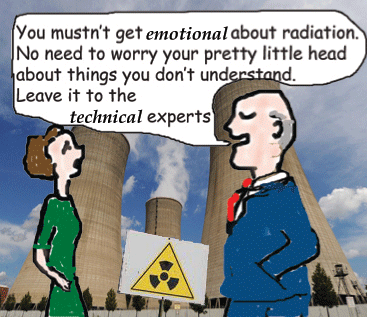
The worshipped role of the expert has excised public debate from nuclear policy. The expert’s validation exonerates the government from the onus of explanation, excluding constituents from relevant information and thus precluding commentary. Nuclear science, a field shrouded in esotericism, marks the summit of techno-scientific rationality, in which utter destruction is intellectually atomised out of politics to the realm of the expert/executive.
ARENA, Sybilla George, 11 Dec 2024
Australia is ‘going nuclear’. The addition of nuclear-powered submarines to Australia’s defence arsenal through the $368 billion AUKUS deal passes a threshold of nuclear legitimisation that Oceania’s anti-nuclear activists have been battling for decades. Nuclearisation used to be an eco-ethical debate, as with the anti- vs pro-uranium mining battles since the 70s that have seen wins and losses on both sides. The rapid increase of Australia’s nuclear involvement, however, signals the reframing of national nuclear rhetoric as techno-scientific rationality that precludes dialogue and authorises executive ruling.
While the AUKUS deal plays out in the limelight, at RAAF Tindal in the Northern Territory the building of facilities to host six United States B-52H Stratofortress bombers on rotational deployment, alongside ‘up to 75’ US Armed Force permanent staff, is underway. The facility renovations are funded through the Force Postures Initiative, the most recent phase of the Force Postures Agreement which since 2014 has defined the United States’s military agenda in Australia, with the consent of successive Australian governments. The Enhanced Air Cooperation branch of the US Alliance was recently ratified when Australian Defence provided ‘air-to-air refuelling’ to B-2 Spirit bombers involved in the US’s October strike on Houthi targets in Yemen.
More than half of the United States’s stock of 76 active B-52 bombers is capable of carrying and deploying nuclear weapons; the remainder is conventionally armed. These jets have been flying over Australian airspace for half a century; however, stationing them at RAAF Tindal signals a significant escalation in nuclear involvement, as it will produce for the first time the conditions ‘to support potential nuclear combat missions from Australian soil’, according to a Nautilus Institute Special Report published in August.
This would be illegal under the United Nations Treaty on the Prohibition of Nuclear Weapons (TPNW), an agreement on which Australia under Labor has abstained since 2022 when it rescinded the Coalition government’s ‘No’ vote. Signing and ratifying the treaty features as a goal in Labor’s 2023 National Platform. Yet progress seems unlikely, given Australia’s third abstention on the TPNW on 1 November 2024 and the persistent silence from the government on the United States’s policy to ‘neither confirm nor deny’ the presence of nuclear arms aboard aircraft or ships. Under this policy, Australia will not be informed whether B-52 bombers on deployment at RAAF Tindal are carrying nuclear weapons.
The public interest in the disclosure of the presence of nuclear weapons includes matters of security, ethics and democratic transparency. Of great concern is the Albanese government’s passive concession to a foreign state’s policy that conflicts with its own commitment to ‘full knowledge and concurrence’ of foreign activities conducted in Australia. Restricted speech has been increasingly utilised as a tactic to expedite pro-nuclear policy in the rush towards technological rationality.
Another example is Albanese’s Nuclear Power Safety Bill, which was rammed through the Senate without debate in October 2024. It stipulates two dumping ‘zones’ for highly irradiated ‘spent nuclear fuel’, to be located within dozens of kilometres of Perth and Adelaide—Western and South Australia being selected once again to play host to nuclear, as during the United Kingdom’s nuclear testing campaign. Indeed, Defence recently withdrew its environmental approval application for developments to prepare HMAS Stirling to host nuclear-powered submarines, and The Australian has reported that the government will resubmit the application with an additional request for the rights to store irradiated waste materials at the facility, which would thus be ‘subject to a single round of community feedback’.
Deferral to the United States’s ‘neither confirm nor deny’ nuclear weapons policy is an appeal to ignorance, and thus innocence, which in turn forecloses systems of accountability, since governments’ denial of information renders their constituents ignorant. The current government’s silence on the presence of nuclear weapons on US aircraft stationed at RAAF Tindal eerily resembles Robert Menzies’ ‘extreme’ commitment to the United Kingdom’s ‘need to know’ policy during the nuclear testing campaign from 1952 to 1963. As prime minister, Menzies exclusively assented without consulting Cabinet or scientific advisers to the use of the Montebello Islands as the site of Operation Hurricane, the nuclear bomb detonation that cemented the United Kingdom as the world’s third nuclear power. The program was not announced until 1952, prior to which Menzies deliberately misled the media about plans for nuclear testing on Australian soil, claiming he had ‘heard nothing’ about it.
The worshipped role of the expert has excised public debate from nuclear policy. The expert’s validation exonerates the government from the onus of explanation, excluding constituents from relevant information and thus precluding commentary. Nuclear science, a field shrouded in esotericism, marks the summit of techno-scientific rationality, in which utter destruction is intellectually atomised out of politics to the realm of the expert/executive.
. The UK nuclear testing campaign caused massive human and ecological suffering to Aboriginal communities in Western and South Australia. It was not until the publication of the 1985 Royal Commission into British Nuclear Tests in Australia, more than two decades after the final tests, that the extent of Australian government collusion was revealed, typified by Menzies’ ‘complete’ acceptance that Australia be entirely excluded from technical information about the tests. This submission to an allied foreign state enacts the technocratic power of nuclear, which pitches influence disproportionally towards those with technical knowledge and renders those without it mute and nakedly vulnerable to, in the case of nuclear arms, annihilation………………………………
The Albanese government’s silence on the presence of nuclear weapons aboard B-52s at RAAF Tindal regurgitates the United States’s policy so as to allow it to skirt its democratic responsibility to inform the public of potential nuclear escalation. Extensive control of messaging and media across the decade-long nuclear testing campaign by Menzies on behalf of the United Kingdom, particularly regarding its true health risks, denied Australians the opportunity to establish informed opinions on the tests. The drive to ignorance common to both Menzies’s and Albanese’s nuclear policy strategies has been achieved via the interiorisation of allied foreign states’ intelligence protocols. This techno-scientific rationale dangerously licences executives to accelerate nuclear proliferation beyond the forum of public debate to which it belongs, and into reality. https://arena.org.au/australias-technocratic-drive-to-nuclear-ignorance/
1 This month

of the week – Australians for War Powers Reform (AWPR)
To see nuclear-related stories in greater depth and intensity
 Antinuclear