Nuclear advocates: Splitting atoms and spinning agendas
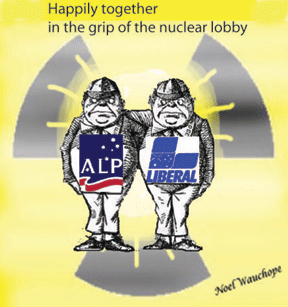
Ed COMMENT. I can’t help noticing how the Liberal ad Labor agendas overlap here – in this carefully controlled pro-nuclear event -described by Sybilla George.
Labor is pushing on with the AUKUS nuclear submarine folly. Liberal is pretending that jt really intends to start nuclear power in Australia.
Both in the grip of USA militarism and the nuclear lobby
Despite having three women on stage – including Stanke – for the panel event, the Celebrity Room at Moonee Valley Racing Club was dominated by men on Saturday night. Opening the evening, Shackel said his charity aimed to “enable civil debate”, yet panels on the tour featured only pro-nuclear views.
By Sybilla George | 6 February 2025, https://independentaustralia.net/environment/environment-display/nuclear-advocates-splitting-atoms-and-spinning-agendas,19407
Former Miss America and nuclear energy activist Grace Stanke‘s Melbourne visit saw a pro-nuclear panel push persuasion over debate, with filtered questions and few dissenting voices, writes Sybilla George.
FOLLOWING EVENTS in Perth and Brisbane, Nuclear for Australia’s ‘An Evening with Miss America 2023 Grace Stanke’ took place last Saturday at the Moonee Valley Racing Club.
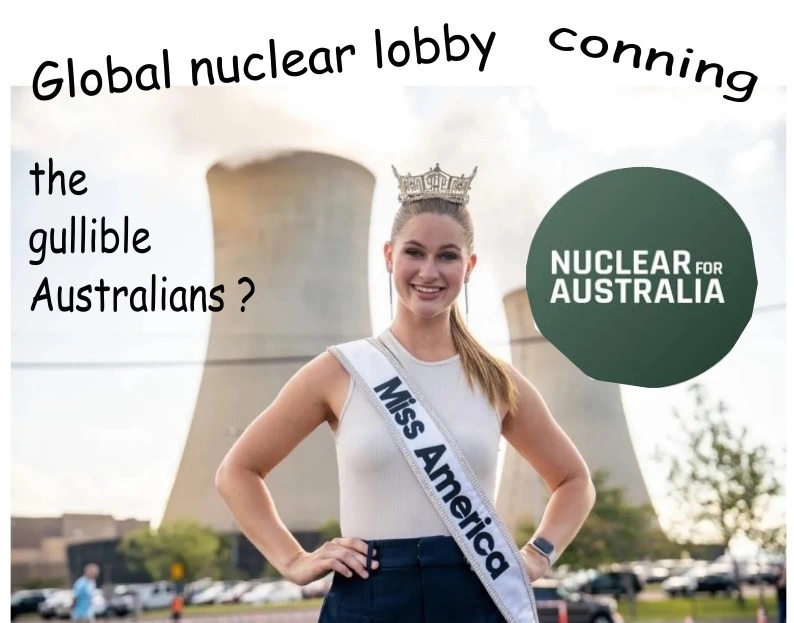
Nuclear for Australia is a nuclear power advocacy charity started in 2023 by teenager Will Shackel and patronised by electronics entrepreneur Dick Smith. The Miss America 2023 Australia Tour is also supported by Smith, according to the Nuclear for Australia website which has served as a platform for Smith’s response to The Guardian’s fact-checking of his anti-renewables arguments.
Nuclear for Australia is a nuclear power advocacy charity started in 2023 by teenager Will Shackel and patronised by electronics entrepreneur Dick Smith. The Miss America 2023 Australia Tour is also supported by Smith, according to the Nuclear for Australia website which has served as a platform for Smith’s response to The Guardian’s fact-checking of his anti-renewables arguments.
The tour aims to ‘help bridge the current divide between men and women for nuclear energy’ and cites the Australian Conservation Foundation statistic that 51% of men versus 21% of women support nuclear energy.
Despite having three women on stage – including Stanke – for the panel event, the Celebrity Room at Moonee Valley Racing Club was dominated by men on Saturday night. Opening the evening, Shackel said his charity aimed to “enable civil debate”, yet panels on the tour featured only pro-nuclear views. Questions put to the panel were selected from those sent in before and during the event, omitting the opportunity for live questions.
Stanke, who has an undergraduate degree in nuclear engineering, advocates for clean energy, including wind, solar and nuclear power. She began working for the United States’ largest nuclear energy provider, Constellation Energy, in 2024. Of Constellation’s energy capacity, 60% derives from nuclear power, while 25% comes from oil and natural gas fossil fuels.
The panel portion of the event featured Stanke alongside fellow American Mark Schneider, former operator of U.S. civil and defence nuclear reactors and current chief nuclear officer for UBH Group — an Australian defence consultancy firm angling for a ‘piece of the AU$368 billion nuclear sub [AUKUS] pie’.
They were joined by energy and resources lawyer Kirsty Braybon and Global Nuclear Security Partners’ (GNSP) Australia branch managing partner Jasmin “Jaz” Diab.
Army officer and nuclear engineer Jaz Diab is a star of the pro-nuclear media circuit. She’s made several appearances on Sky News and spoke at The University of New South Wales (UNSW) Navigating Nuclear conference in May 2024 alongside Coalition Shadow Energy Minister Ted O’Brien, before the Coalition’s nuclear energy plan announcement in July 2024.
Diab joined the business group AUKUS Forum, suggesting GNSP will be making a play for the AUKUS pie and nuclear energy contracts should the Coalition get into government at the next federal election.
As reported by the Australian Financial Review in December 2024, the Australian Department of Defence spent AU$811 million on just the big five consultancy firms in 2022-23.
Braybon, who teaches a subject on nuclear law at the University of Adelaide, responded to a question about the current illegality of nuclear power in Australia under the 1998 Radiation Protection and Nuclear Safety Act.
Some legal barriers to nuclear energy have already been watered down to accommodate AUKUS nuclear-powered submarines, Braybon said, and “no one noticed”, pointing to the entwined framework of defence and civil nuclear programs.
The defence backgrounds of panel members Diab and Schneider also attest to this. Braybon did not specify which law changes she was referring to, however, the Australian Naval Nuclear Power Safety Act 2024, which was pushed through the Senate in October 2024 – designating waste “zones” in Adelaide and Perth for AUKUS-related nuclear waste – was reported on by Independent Australia, Michael West Media, The Advertiser and The Guardian.
While anti-nuclear protesters attended the Perth and Brisbane events – including a community action projecting ‘Nuclear energy distracts from the climate emergency’ outside the Gabba – there were no visible objectors in Melbourne.
However, Latrobe Valley Sustainability Group (LVSG) members attended the Moonee Valley Racing Club ahead of the Morwell event the next evening. The Coalition selected Loy Yang – a coal-fired power station in the Latrobe Valley – as one of seven sites around Australia for proposed nuclear power plants.
LVSG is concerned about the questions that Nuclear for Australia will not answer regarding the impact of nuclear power in fighting climate change and the economic cost of constructing and maintaining nuclear power plants. It points out that renewables have surpassed nuclear energy production in the U.S. in just 15 years and that there is a lack of private investment in nuclear power because of its unprofitability.
Indeed, a popular argument in favour of nuclear power appealing to the increasing energy demands of artificial intelligence data centres took a blow in recent days with the announcement that the Chinese AI program DeepSeek performs a similar function to the U.S. program ChatGPT, at a fraction of the cost and energy.
According to LVSG member Dan Caffrey, the Nuclear for Australia Morwell event attracted 240 attendees, but panel members “expressed a complete ignorance” of issues in the local area that reduce the viability of nuclear power, such as water availability and rehabilitation of the existing coal-fired station. The avoidance of challenging questions about nuclear power was “very disheartening”.
Sybilla George is a freelance writer with an interest in nuclear policy and the Pacific region.
Dutton’s nuclear policy is a Coalition scam
By Steve Bishop | 10 February 2025, https://independentaustralia.net/life/life-display/duttons-nuclear-policy-is-a-coalition-scam,19427
Overwhelming evidence is proving the Coalition’s nuclear plan to be a scam, writes Steve Bishop.
OPPOSITION LEADER Peter Dutton is scamming Australians with a nuclear power promise he knows he cannot deliver.
LNP research would have revealed the impossibility of providing nuclear power by the Coalition’s target of the mid-2030s.
This means a Dutton government would continue the years of Coalition ineptitude in tackling climate change and failing to provide a workable energy policy.
Coalition Senator Matt Canavan has revealed it’s nothing more than a “fix”.
Canavan said:
“Nuclear is not going to cut it. But we’re latching on to it… because it fixes a political issue for us… But it ain’t the cheapest form of power.”
In other words, it’s a con. Or to use a good Aussie word: a rort.
It’s why an internet search has found no trace of an authoritative nuclear body or expert endorsing the Coalition’s nuclear timeframe.
It’s simply a version of the old-time medicine show that peddled worthless cures to the gullible. The evidence demonstrates that the flimflammery of Mr Dutton’s Miracle Nuclear Elixir cannot work.
Mr Dutton promised:
‘A Federal Coalition Government will initially develop two establishment projects using either small modular reactors or modern larger plants such as the AP1000 or APR1400. They will start producing electricity by 2035 (with small modular reactors) or 2037 (if modern larger plants are found to be the best option).’
The CSIRO found in its GenCost 2023‐24 report that the earliest deployment for large-scale nuclear rectors would not occur until after 2040.
In the U.S., which has a nuclear power industry, AP1000 units at Vogtle, Georgia took 15 years to build, more than twice the projected timeline.
In Finland, the 1600mw Olkiluoto 3 was completed in 2023 — 18 years after construction started.
Even in China, with fewer hurdles to jump and a massive nuclear industry, it took 14 years for the Sanmen1 nuclear power station to be completed with plans for two units approved in 2004 and the first 1200mw reactor starting commercial operation on September 2018.
So it would be impossible to switch on a large plant in Australia before 2040. Is it feasible for the Coalition to build small modular reactors (SMRs) by 2035 as projected?
The ANU Institute for Climate, Energy and Disaster Solutions suggests it would be more like 15 years before the first reactor could start producing.
It says:
In Western countries… recent construction times have far exceeded a decade.
Before any nuclear power plant can be built here, we would first need to establish a regulatory system. That could take up to five years.
The Institute for Energy Economics and Financial Analysis (IEEFA) has found:
‘SMRs would not be operating before the 2040s in Australia, too late to replace coal.’
It also revealed construction delays of 12 to 13 years had occurred in four of the few completed SMRs in Argentina, China and Russia.
Similarly, the Australian Academy of Technological Sciences and Engineering (ATSE) has found
‘…a mature market for the technology may emerge in the late 2040s.’
Professor Hugh Durrant-Whyte, a nuclear engineer, told a NSW inquiry in 2020 that it would be naïve to think a power plant could be built in less than two decades.
The UK, which already has nuclear power stations, claims it is running the world’s fastest process to deliver an operational SMR by the mid-2030s. But it started this process in 2021 with a target date of the early 2030s and that has already blown out to the mid-2030s — some 16 years on from 2021.
This process aims to invest in demonstration SMRs in 2029. But a research paper filed on Social Science Research Network (SSRN) has found that if it then takes only two years to deploy resources ready for construction, only three years to build the plant and a further two years to demonstrate successful operation, any follow-on capacity would only come online well after 2040.
Even if a Coalition government was able to emulate this “fastest” process it would be after 2040 before an SMR is built. But a graph on page 7 of the plan released by Mr Dutton shows about 1,750mw of nuclear power being produced by 2036.
That would require six reactors having gone through the planning process, built, tested and commissioned — an impossibility based on the expert evidence.
In June, Mr Dutton said:
“I’m very happy for the Election to be a referendum on energy, on nuclear, on power prices…”
The overwhelming evidence means the Coalition scam should be rejected at the ballot box.
1 This month
15 April – Zoom –Nuclear Power is Not the Solution
Apr 15, 2026 01:00 AM in Canberra, Melbourne, Sydney

Join the International Physicians for the Prevention of Nuclear War (IPPNW) on Tuesday, April 14th for a timely webinar exploring the risks associated with nuclear power and challenging the myth that it offers a simple, safe, carbon-free solution to the climate crisis

of the week – Australians for War Powers Reform (AWPR)
To see nuclear-related stories in greater depth and intensity
 Antinuclear