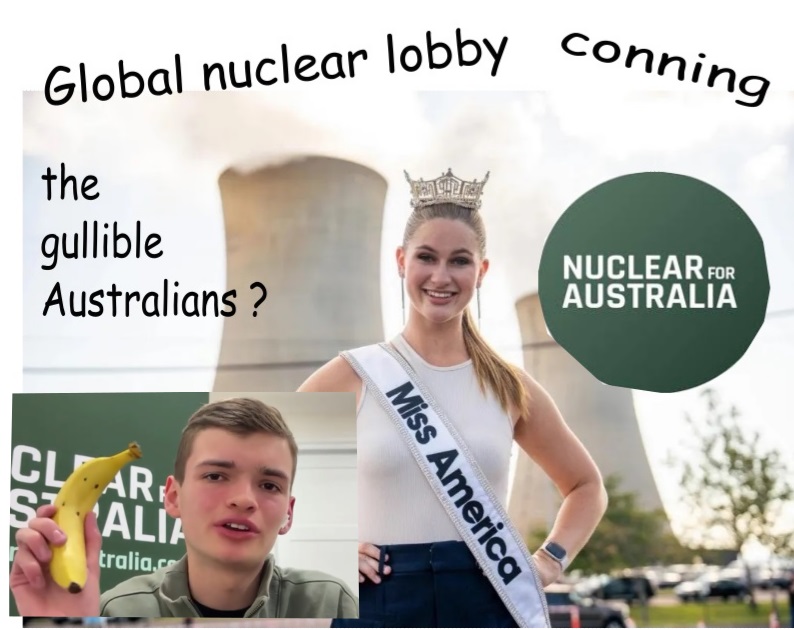
Why are young people like this 18-year-old fronting the pro-nuclear push in Australia?
SBS News, 13 February 2025
The regional sessions were not publicised beforehand on Nuclear for Australia’s social media accounts or the tour page on its website — you could only register for tickets if you knew the URL for the event’s webpage.
Campaigns director for the Conservation Council of Western Australia, Mia Pepper, said when she tried to get tickets for the Perth event online, she was denied. She said a colleague also failed to get tickets using their real name, but able to get in using an alias.
Shackel said Nuclear for Australia Googles people’s names beforehand to determine whether they are “likely going to cause a disruption or a threat”
Some polling suggests older Australians are more supportive of nuclear power than their younger counterparts. So why are young people fronting a pro-nuclear push?
SBS News, By Jennifer Luu, 13 February 2025
In a function room at Brisbane’s The Gabba sports ground, around 600 people have gathered to hear Miss America 2023 try to convince Australians nuclear power is a good idea.
Sporting a blue cocktail dress, blonde hair and a wide smile, 22-year-old Grace Stanke looks the part of a beauty pageant contestant.
She’s also a nuclear engineer touring the country with Nuclear for Australia: a pro-nuclear lobby group founded by teenager Will Shackel and funded by donors that include entrepreneur Dick Smith.
The event — billed as an information evening featuring a panel of experts — is off to a rocky start. A protester steps in front of the audience and speaks into a microphone.
“All of the organisers, presenters and sponsorship of this event tonight has a very deep vested interest — ” he says, before he’s drowned out in a chorus of boos and the mic is seized from his hand.
Audience members continue to disrupt last month’s event, raising their voices and speaking to the crowd before being herded out by security.
Among them is Di Tucker, a retired psychologist concerned about climate change. She said she became upset after submitting half a dozen questions online to be answered by the panel — and felt like they were being deliberately ignored.
“I felt so frustrated by the lack of factual information in that so-called information session forum on the safety, the timescale and the reality of nuclear energy,” Tucker told The Feed.
“I did stand up and I addressed the crowd, and I said something like: ‘You people need to go away and do your own research … it’s glossing over facts’.”
Nuclear for Australia founder Will Shackel, who was emceeing, estimated there were 20 to 30 protesters heckling the room.
He labelled their behaviour “simply unacceptable and … not in the interest of a fair discussion”.
“They were yelling abuse at us on stage. We had people come up to Grace at the end, call her a clown,” he claimed.
Shackel told The Feed: “We had people [who] had to be physically dragged out because they were resisting security … it was pretty ugly and pretty disturbing.”
Tucker disputes this: “Nobody I saw leave the room was hostile or aggressive, physically aggressive towards the security guards.”
“In fact, it was the opposite. The security guards were shoving the people outside.”
Outside, a separate group of protesters wields banners warning against the dangers of radioactive waste.
The words “Nuclear energy distracts from the climate emergency” are projected onto The Gabba over the image of a red herring.
The teen and the beauty queen
Tucker said the audience was mostly male and over 60. So why are two young people fronting the pro-nuclear movement in Australia?………………………….
As well as launching Nuclear for Australia — which describes itself as “the largest nuclear advocacy organisation in Australia” with over 80,000 supporters — he’s addressed a Senate committee and interviewed French President Emmanuel Macron for his organisation’s social media at the COP28 climate conference in Dubai in 2023.
Shackel first became fascinated with the nuclear debate while in high school in Brisbane.
“I’d just done a school assignment on nuclear energy when I realised it was banned. And that, as a 16-year-old kid, was pretty shocking to me,” he said.
Australia is one of the few countries where using nuclear energy to produce electricity is illegal. The ban was introduced in 1998, when the Howard government made a deal with the Greens in order to build a nuclear reactor in Sydney for research purposes.
At 16, Shackel launched a petition calling on Australia to lift its nuclear energy ban, garnering a flurry of media attention……….
As well as launching Nuclear for Australia — which describes itself as “the largest nuclear advocacy organisation in Australia” with over 80,000 supporters — he’s addressed a Senate committee and interviewed French President Emmanuel Macron for his organisation’s social media at the COP28 climate conference in Dubai in 2023……………………………
Nuclear power is still a contentious topic, but more Australians have become supportive of the idea over time.
A 2024 Lowy Institute poll of 2,028 Australians
indicates 61 per cent support Australia using nuclear power to generate electricity, while 37 per cent were opposed.
Among the 18- to 29-year-olds surveyed, 66 per cent supported nuclear power while 33 per cent were opposed.
In contrast,
a December 2024 poll of 6,709 people conducted for the Australian Conservation Foundation suggests young people were less likely to agree that nuclear is good for Australia, compared to older respondents. For example, 42 per cent of males aged 18-24 agreed, while 56 per cent of males over 54 agreed.
There’s also a gender gap — in the same poll, just over a quarter of women thought nuclear would be good for Australia, compared to half of men.
Nuclear for Australia hopes Grace Stanke can convince the sceptics. Dubbed “the real-life Barbenheimer”, she works for the operator of the largest fleet of nuclear power plants in the US, Constellation. (The company operates 21 of the US’s 94 nuclear reactors).
Now 18, Shackel suggests young Australians are more open-minded towards nuclear power than older generations and are more likely to support parties that are concerned about climate change……..
Physicist Ken Baldwin speculates the rise in support for nuclear power is due to shifting demographics.
He said older generations are more likely to have historical hangups around the dangers of nuclear power, having lived through the British and French weapons tests in the Pacific and nuclear catastrophes like the 1986 accident in Chernobyl and the 2011 accident in Fukushima. ……
“The younger generation … doesn’t have that particular historical baggage, and perhaps they’re more attuned to thinking about the need to do something about climate change,” he said.
Nuclear for Australia hopes Grace Stanke can convince the sceptics. Dubbed “the real-life Barbenheimer”, she works for the operator of the largest fleet of nuclear power plants in the US, Constellation. (The company operates 21 of the US’s 94 nuclear reactors)…………….
Nuclear for Australia has been drumming up public support for nuclear power over the past fortnight, touring every capital city (except Darwin) and holding a parliamentary briefing in Canberra.
It also targeted regional areas near the Coalition’s proposed sites for future nuclear power stations — including Morwell in Victoria, Collie WA, Port Augusta SA, Callide and Tarong in Queensland and Lithgow in NSW. The Coalition says its taxpayer-funded plan is for five large and two smaller reactors, with the smaller ones to come online in 2035 and the rest by 2037.
Nuclear for Australia was slow to reveal all the names for a total number of regional locations for the tour. During the first week of the tour, Nuclear for Australia told The Feed there would only be two regional stops.
The regional sessions were not publicised beforehand on Nuclear for Australia’s social media accounts or the tour page on its website — you could only register for tickets if you knew the URL for the event’s webpage.
Campaigns director for the Conservation Council of Western Australia, Mia Pepper, said when she tried to get tickets for the Perth event online, she was denied. She said a colleague also failed to get tickets using their real name, but able to get in using an alias.
She accused Nuclear for Australia of blacklisting known anti-nuclear activists and trying to avoid criticism by attempting to “creep around the country”.
“If they were really genuine about having a mature debate, they would do their best to invite some people like myself that have engaged really respectfully in the debate over many years to answer the tough questions,” she said.
Shackel said Nuclear for Australia Googles people’s names beforehand to determine whether they are “likely going to cause a disruption or a threat”, and that regional events aren’t publicised on social media because they are not relevant to city-based audiences.
“We care about the safety of our attendees, we care about the safety of our experts,” Shackel said.
“If we believe that someone is a known protester … someone who could cause a physical threat to people in there, we will not allow them in.”
Pepper said: “I have never been physically aggressive to anybody in my entire life.”
“The idea that because you are opposed to nuclear power, you somehow would be aggressive or violent is absolutely outrageous.”
Locals left with more questions than answers
South of Perth, around 100 of the 9,000 residents of the tiny coal mining town of Collie showed up to the Nuclear for Australia event, hoping to learn more about how living next to a nuclear reactor could affect them.
The Coalition has proposed converting Collie’s coal-powered station into a nuclear power plant. But the state government is vowing to phase out coal by 2030 and there’s little chance nuclear power could come online by then, leaving coal workers in limbo.
Resident Jayla Anne Parkin said the information session was “an utter waste of time”, and she came away with more questions than answers. “Their whole speech was very generic. They were probably using the same speech for every single area,” she said.
Parkin asked one of the experts where the water for a nuclear power plant would come from — with large amounts needed to cool the radioactive core.
“He gave a long-winded speech about how we can take any body of water, whether it be the ocean, the river, pool, sewage, and treat it and turn it into the water. But at the end of him answering it, he still didn’t tell me what source of water in Collie they were going to use,” she said.
“We’re very limited with water here as it is.”……………………………………………
there have been reports about Shackel’s alleged political ties.
A 2024 research report from progressive activist group GetUp on nuclear disinformation in Australia
analysed Shackel’s LinkedIn connections and reported that their political party affiliation leant heavily towards Liberal Party MPs, Senators and advisors.
GetUp reported at least 36 of Shackel’s connections, including 11 current or former politicians, were directly linked to the Liberal Party — with the party having the highest concentration of current employees from a single organisation in his network…………………………………..
Lobby groups are allowed to have political party affiliations. While registered charities can participate in campaigning and advocacy, they “cannot have a purpose of promoting or opposing a particular political party or candidate”, according to the Australian Charities and Not-for-profits Commission.
……………………………………………………… Professor Ken Baldwin said nuclear is “not really viable” as an option for decarbonising Australia by 2050, as it would take 15 years at the very minimum to develop the necessary regulations and build a nuclear power station.
“We will have, according to the current plans, converted our current energy system to almost an entirely renewable energy system by that time,” Baldwin said.
“Australia is at the leading edge of the renewable energy transition. We’re installing solar and wind at one of the fastest rates per capita of any country in the world.”…………… https://www.sbs.com.au/news/the-feed/article/will-shackel-australia-pro-nuclear-movement-young-people/gucu0iefz
No comments yet.
1 This month

of the week – Australians for War Powers Reform (AWPR)
To see nuclear-related stories in greater depth and intensity
 Antinuclear
Leave a comment