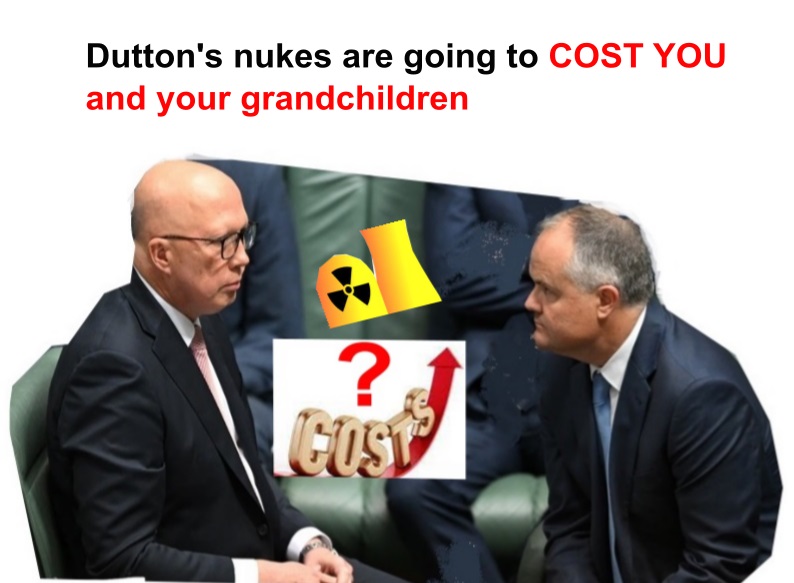
Dutton’s HALF-BAKED plans for dealing with global heating and Australia’s energy future.

Dr Tony Webb, 20 February 25
Coalition’s plans for our energy future including Nuclear power plants are based on:
Delivering half the electricity anticipated as needed to power homes and industry
and transition to zero carbon emissions.
Assuming cost of building nukes in Australia which has no experience of doing this
will be about half what the most nuke-favourable evidence world-wide from
countries that do have the experience suggests is needed.
Assuming these can be built in less than half the time evidence suggests they take to
build.
Ignoring the evidence that current official radiation-induced cancer-risk-estimates,
on which standards for worker OH&S are based, are less than half what the evidence
from nuclear power plant workers in Europe and North America suggests is the
inevitable and unavoidable reality. Also, ignoring that the cardio-vascular and heart
disease risk from such exposures is double that expected and the childhood
leukaemia risk in the community near these plants has been similarly under-
estimated.
Not to mention that the coalition’s costings ignore the long-term costs of
decommissioning these plants, the management, and (perhaps . . . . Dutton dream
on!) eventually finding a solution for long-term storage (never ‘disposal’) of the
highly radioactive wastes –
Nor to mention the fact that state and federal legislation currently prohibits such
nuclear power plants and is unlikely to be overturned any time in the near future.
And – despite this overwhelming evidence that the whole silly idea is half-baked – in
fact a smokescreen for continuing climate denial and extending use of polluting and
planet life-threatening fossil fuels, inface of this the Coalition doubles down on it
with backing from sections of the media and the fossil fuel lobby.
And finally, we are so far only half-baked. Global warming is passing the climate
catastrophe 1.5 degree centigrade target and now heading to at least 3 degrees and
possibly more.
Australian nuclear news headlines 17 – 24 February

Headlines as they come in:
- Peter Dutton’s nuclear accounting trick #4: Assume climate change has no cost.
- Peter Dutton’s nuclear accounting trick #3: Hide the costs of keeping coal.
- Carbon time bomb: Dutton’s nuclear plan will blow up Paris and emissions targets, CCA says.
- Dirty deed: Dutton’s nuclear scheme locks in 20 years of higher climate pollution
- New report confirms nuclear fears: Higher bills, higher emissions
- Peter Dutton’s nuclear accounting trick #3: Hide the costs of keeping coal
- Dutton hints at privatising nuclear – one day.
- Where’s the policy?’: Coalition criticised over ‘pipedream’ nuclear plan
- Community consultation kicks off for submarine yard, but don’t mention nuclear.
- Peter Dutton’s nuclear accounting trick #1: Assume you can halve the cost of nuclear power.
- Dutton’s HALF-BAKED plans for dealing with global heating and Australia’s energy future.
- Before we decide where to dump nuclear waste, let’s answer the bigger questions,
- Peter Dutton sidesteps questions on state-funded nuclear disaster insurance plan.
- The election could be called any day – but Peter Dutton still hasn’t explained how his nuclear proposal will work.
- Taxpayers should not foot the bill for nuclear risk.
- Nuclear gamble is an economic wrecking ball.
- The four accounting tricks behind Peter Dutton’s nuclear cost claims.
Before we decide where to dump nuclear waste, let’s answer the bigger questions
February 19, 2025 AIMN Editorial, Australians for Affordable Energy, https://theaimn.net/before-we-decide-where-to-dump-nuclear-waste-lets-answer-the-bigger-questions/
Australians for Affordable Energy is urging caution following calls for South Australia to become a nuclear power hub and waste storage site, warning fundamental questions about nuclear remain unanswered.
Alexander Downer’s comments advocating for nuclear power plants in South Australia and positioning the state as a nuclear waste storage site are deeply concerning given there has been no comprehensive discussion around nuclear power.
The nuclear debate must go beyond location discussion and first address economic and logistic concerns, Australians for Affordable Energy spokesperson Jo Dodds said.
“Before we even talk about where to dump nuclear waste, we need to ask some hard questions. How much will nuclear really cost Australian taxpayers? What will it do to energy prices and the cost of living? How long will it take to build? Who funds insurance?” Ms Dodd said.
“There are global examples of nuclear projects that have blown out in cost and time frames and just fallen over, leaving consumers to foot the bill. Australians deserve transparency on these issues before any commitments are made.”
The practical implications of nuclear power for everyday Australians remain unclear. Australians deserve a full and open discussion of nuclear power’s real impacts rather than ideological endorsements from political figures.
“We know nuclear energy requires massive upfront investment, long construction times, intensive oversight, expensive insurance, and creates long-term waste management challenges. These factors could seriously impact affordability – for the country and individuals who will have to pay the bills since private investment won’t go near nuclear,” Ms Dodds said.
“We need an evidence-based national conversation about our energy future before committing to specific locations for waste storage. We can’t afford to let political enthusiasm override economic and practical considerations.
“If politicians are serious about nuclear, let’s see the full breakdown of costs, risks and alternatives before making any decisions.”
AFAE warns against locking into costly or uncertain energy options and calls for a transparent review of nuclear power in Australia before any site is considered for waste storage.
The election could be called any day – but Peter Dutton still hasn’t explained how his nuclear proposal will work.
Adam Morton Guardian, 18 Feb 25
His claim that nuclear power would lead to cheaper bills in the near future isn’t supported by the modelling released to back it up. But the soundbite survives.
The election is just weeks away and Peter Dutton has still not answered any of the key questions about how his nuclear energy pitch would work beyond naming the seven sites where the Coalition says it might eventually – mostly in the 2040s – use taxpayer funding to build power plants.
He is rarely even asked. Polling suggests he has a reasonable chance of moving into the Lodge in a few weeks.
If he’s good as his word, Dutton would attempt to put the brakes on investment in large-scale solar and windfarms and battery storage, which has just taken off and begun to approach the pace needed to get close to Labor’s goal of 82% renewable energy by 2030 and replace a fleet of coal-fired power plants nearing the end of their lives.
The election could be called any day – but Peter Dutton still hasn’t explained how his nuclear proposal will work

His claim that nuclear power would lead to cheaper bills in the near future isn’t supported by the modelling released to back it up. But the soundbite survives …
- Follow our Australia news live blog for latest updates
- Get our breaking news email, free app or daily news podcast
Tue 18 Feb 2025 01.00 AEDTShare283
The election is just weeks away and Peter Dutton has still not answered any of the key questions about how his nuclear energy pitch would work beyond naming the seven sites where the Coalition says it might eventually – mostly in the 2040s – use taxpayer funding to build power plants.
He is rarely even asked. Polling suggests he has a reasonable chance of moving into the Lodge in a few weeks.
If he’s good as his word, Dutton would attempt to put the brakes on investment in large-scale solar and windfarms and battery storage, which has just taken off and begun to approach the pace needed to get close to Labor’s goal of 82% renewable energy by 2030 and replace a fleet of coal-fired power plants nearing the end of their lives.
It would require billions of dollars of taxpayer funding to maintain the old, run-down coal plants in an effort to keep them functioning for longer. Experts say there is no guarantee it would succeed.
Over the past year, coal-fired power on the national grid has on average cost 2 ½ times more for each megawatt hour of electricity than solar energy and 60% more than wind energy. Gas-fired power was even more expensive – about twice as much as coal.
Dutton’s claim that his plan would lead to cheaper power bills in the near future isn’t supported by the modelling that was released to back it up. But the soundbite survives.
The Coalition’s approach of burning more coal and gas for longer would also substantially increase greenhouse gas emissions from the electricity grid for at least the next two decades, just as scientists are stressing – again – the need for urgent action and investors are highlighting the potential benefits of developing green industries that may no longer see a future in the US.
Dutton appears immune to these arguments. He has opposed and said he would review, and possibly abolish, measures introduced to limit climate pollution from heavy industry and transport (which, together, are responsible for more than 50% of Australia’s emissions). Both skyrocketed in the Coalition’s near decade in power last time around………………………………………………………………………………………………………… more https://www.theguardian.com/environment/commentisfree/2025/feb/18/peter-dutton-nuclear-power-soundbite-australia-election
1 This month
15 April – Zoom –Nuclear Power is Not the Solution
Apr 15, 2026 01:00 AM in Canberra, Melbourne, Sydney

Join the International Physicians for the Prevention of Nuclear War (IPPNW) on Tuesday, April 14th for a timely webinar exploring the risks associated with nuclear power and challenging the myth that it offers a simple, safe, carbon-free solution to the climate crisis

of the week – Australians for War Powers Reform (AWPR)
To see nuclear-related stories in greater depth and intensity
 Antinuclear