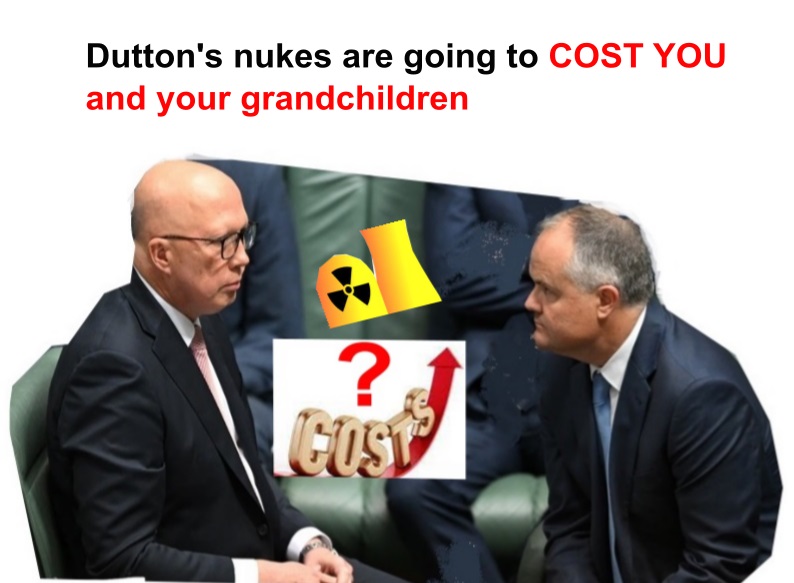
Peter Dutton’s nuclear accounting trick #3: Hide the costs of keeping coal
RENEW ECONOMY. Tristan Edis, Feb 21, 2025
This is part 4 of a five part series of articles examining the four accounting tricks that the Liberal-National Party employed in the costing of their energy plan to slow the roll-out of renewables and rely instead on nuclear power. The first article, which provides the overarching context is published here. Part 2 is here. Part 3 is here.
These four accounting tricks act to mislead voters that the Liberal-National Party could lower energy bills through a shift to nuclear when in reality it is likely to increase power bills.
This article focuses on accounting trick three of four: Hide most of the cost of replacing coal with nuclear to outside the time period considered in the costing.
It’s very important to note that the Coalition’s costing of its electricity system cuts out in the year 2051. It only accounts for costs incurred between 2025 to 2051 and anything after that date is ignored.
The LNP’s claim of a 44% saving does not represent the cost of two alternative systems for achieving near zero emissions once they are both completed to see how nuclear might reduce the cost of the system.
Instead, a heavy influence on the cost estimates in the model is the degree to which the scenarios can delay incurring costs in replacing the old, highly polluting and likely to be increasingly unreliable coal power plants.
How is this a problem?
Coal power stations are much like a car – they are exposed to extreme heat, pressure and general mechanical stress that means they wear out and become unreliable as they get old. That’s physics.
Many of us will have experience with an old car that has got to the point where it increasingly encounters mechanical problems and the mechanic is warning us that it really needs some major repairs but these would cost more than the car is worth.
At this point many of us can be tempted to take a gamble by putting off such repairs, and go for temporary, less costly patch-ups and hope the car keeps going. That will be a lot cheaper than buying a new car, at least for as long as we can keep the old car going. But it comes with the risk that it could leave us stranded with a broken-down car at an extremely inconvenient point in time and even pose a danger to our safety and that of others.
The Coalition’s modeled plan chooses to take that gamble with our electricity system. But it doesn’t account for the risks and potentially extreme costs this involves if the gamble goes wrong.
Clare Savage, the head of the Australian Energy Regulator has repeatedly warned that failing to replace aging coal plants risks both power system reliability and also affordability observing, “Coal can’t last until you have nuclear power available.”……………………………………………………………………
Unless Peter Dutton has a secret plan to prioritise curtailment of rooftop solar in favour of coal generators, this is likely to get worse over time.
Now, the way that the consultant, Frontier, constructed Dutton’s costing is that they space out the cost of constructing new power stations as an annualised payment – a bit like how you’d purchase a new car not by paying for it upfront but rather by taking out a loan and then paying it back incrementally over time.
Except in this case the annualised payment for a new power station is spaced out over several decades and for nuclear it is 50 years. Meanwhile for the existing, very old power plants the original cost of constructing those plants is omitted from the annualised costs.
By pushing out the point at which they replace the old power stations with new ones until the 2040’s, the Coalition gets to hide much of the cost of the nuclear plants until towards the very back end of the projection period. We’ll still have to pay for these nuclear power stations well after 2051, but that’s conveniently left out of the costing period.
Meanwhile, in the scenario said to represent Labor Policy, the coal-fired power stations are replaced quite quickly, so the cost of the new, replacement power stations is taken into account across almost the entire time period considered in the model. …………………………
The nuclear plants aren’t really delivering any meaningful saving in the unit cost of energy relative to relying on renewables and storage. Instead, the savings are coming from the Liberal Party delaying the point at which the coal power plants are replaced. ………………………………………. more https://reneweconomy.com.au/peter-duttons-nuclear-accounting-trick-3-hide-the-costs-of-keeping-coal/
No comments yet.
1 This month
15 April – Zoom –Nuclear Power is Not the Solution
Apr 15, 2026 01:00 AM in Canberra, Melbourne, Sydney

Join the International Physicians for the Prevention of Nuclear War (IPPNW) on Tuesday, April 14th for a timely webinar exploring the risks associated with nuclear power and challenging the myth that it offers a simple, safe, carbon-free solution to the climate crisis

of the week – Australians for War Powers Reform (AWPR)
To see nuclear-related stories in greater depth and intensity
 Antinuclear
Leave a comment