Nuclear news – week to 25 February

Some bits of good news. Nine Asian countries have halved child mortality since 2000. The Global South is deploying renewables twice as fast as the Global North. Arctic Cleanup removes 130 tons of trash and aims to improve trash cleanups worldwide
—very difficult now to stay off the subjects of Ukraine and Israel, but I have tried… (both are so on the nuclear brink)
TOP STORIES. Democrats want nothing to do with making peace in Ukraine and possibly preventing nuclear war.
President Trump Wants to Cut the Pentagon Budget in Half. How?Trump Looks to Correct a Disastrous 1990’s Mistake.
Conveniently forgotten and ignored – the 8 years war in Ukraine up to 2022 – https://www.youtube.com/watch?v=NYKetrodpoY
From the archives. Restless radioactive remains are still stirring in Chernobyl’s nuclear tomb.
Climate, World’s glaciers melting faster than ever recorded.
Noel’s notes. A dramatic development in the Ukraine situation.
NUCLEAR ITEMS
ECONOMICS
- UK’s Hinkley Point C nuclear plant yet to attract new investors, says EDF boss. UK government in “poor negotiating position” as Centrica vague about investing in the new Sizewell C nuclear power station.
- Uncertain nuclear partnership: Negotiations between ČEZ and Rolls-Royce.groups raise $1.5bn amid race to power AI boom. At Great Cost: The companies building nuclear weapons and their financiers show 260 profiteers from the nuclear weapons industry.
- X-Energy threatens to pull out of building nuclear plants in Britain. Amazon-backed nuclear power developer X-Energy threatens to move investment away from UK.
- Rolls-Royce ‘resists pressure’ to put Czech parts in mini-nuclear reactors. .
| MEDIA. Film Review- Special Operation: The Invasion of Chornobyl. |
| PERSONAL STORIES. Heartbreaking tale of American deformed by nuclear radiation who was abandoned and viewed as a ‘monster’. |
| POLITICS. French State Spars With EDF Over Multibillion-Euro Reactor Plan . UK Government Revisiting the nuclear roadmap Inquiry, UK’s first new nuclear site since the 1970s begins licensing. Starmer’s shortsighted push for more nuclear power. Louth MP welcomes council’s decision to pull out of nuclear waste dump group. Greens opposed to nuclear power plant plans. UK to Partner with Big Tech on Nuclear Powered Data Centers . Technogarchy Goes to Washington.. |
| POLITICS INTERNATIONAL and DIPLOMACY. Amid ‘clear’ threat of nuclear war, Guterres tells Security Council multilateral off-ramp is essential. Trump can’t denuclearize North Korea. South Korea’s next leader should pursue risk reduction instead. Hating Trump no reason to oppose Trump Ukraine peace initiative. |
| SAFETY. Incidents. IAEA Director General Statement on Situation in Ukraine. Efforts continue to eliminate fires in Chernobyl shelter’s roof. Nuclear expert issues Chernobyl update after it emerges fires are still burning. Damage to Chernobyl shelter being assessed after drone strike – https://www.youtube.com/watch?v=oC3Wz5oX68I “Radioactive Russian Roulette” at San Onofre: Exposing Critical Safety Failures. NFLA Policy Briefing 313: Correspondence with the Nuclear Regulator over AGR Extensions .5.0-magnitude quake strikes off Japan’s Fukushima: JMA. |
| SECRETS and LIES. Burying The CIA’s Assange Secrets. |
| TECHNOLOGY. Dr. Gordon Edwards Testifies on the BWRX-300 Reactor Design Feb 9 2025. Pioneering micro nuclear reactors to be built in Britain, |
| WASTES. Debris extracted from Fukushima nuclear plant revealed to media. So Called Small Modular Reactors Would Be Nuclear Nightmares. Nuclear waste dump agency pumps money into community projects in Mablethorpe. Ancient historic sites under threat from South Copeland nuke waste dump- ALSO AT https://nuclear-news.net/2025/02/19/1-b-ancient-historic-sites-under-threat-from-south-copeland-nuke-waste-dump/NWMO closing Teeswater office, to dispose of DGR site lands. |
| WAR and CONFLICT. US Strategic Bombers Fly Near Gaza as Israel Threatens To Open ‘Gates of Hell’ |
| WEAPONS and WEAPONS SALES. New Zealand’s Rocket Lab ‘ready to serve’ Pentagon. Why it would be a bad idea for the Trump administration to conduct a “rapid” nuclear test. Donald Trump wants to end nuclear weapons funding. |
Peter Dutton’s nuclear accounting trick #4: Assume climate change has no cost

Tristan Edis, Feb 23, 2025 https://reneweconomy.com.au/peter-duttons-nuclear-accounting-trick-4-assume-climate-change-has-no-cost/
This is the final part of a five part series of articles examining the four accounting tricks that the Liberal-National Party employed in the costing of their energy plan to slow the roll-out of renewables and rely instead on nuclear power. The first article, which provides the overarching context is published here. Part 2 is here. Part 3 is here, and part 4 is here.
These four accounting tricks act to mislead voters that the Liberal-National Party could lower energy bills through a shift to nuclear when in reality it is likely to increase power bills.
This article focuses on number four and the last of the accounting tricks covered: Assume climate change is not an important and urgent problem that is worthy of costing.
Most types of greenhouse gases last decades to centuries once released in the atmosphere and so the overall level of global warming the planet experiences will be a function of our cumulative emissions over time.
While it would be great if we can reach net-zero emissions in 2050, the level of warming we’re in for will be a result of not just emissions in 2050, but also the years prior to 2050.
The Liberal-National Party’s preferred plan for the electricity system involves slowing the replacement of coal with renewable energy over the next decade and instead waiting until the 2040’s to undertake a concerted replacement of coal with nuclear power. This leads to almost 1 billion extra tonnes of CO2 emissions compared to the so called Labor Scenario (AEMO’s Step Change) from the electricity sector.
There’s also substantial additional emissions from outside the electricity sector due to the Coalition’s preference to maintain consumption of petroleum for transport and natural gas for heating in homes and industry.
The Coalition’s consultant didn’t elect to provide any information to calculate these extra non-electricity emissions. However as detailed in part 3 of this series, it’s possible using AEMO data and the average fuel efficiency of EVs and petroleum-fueled vehicles to estimate extra petrol consumption in the Liberal Party scenario of 203 billion litres. This would add an extra 466 million tonnes of CO2 to atmosphere.
The extra CO2 carries a cost in terms of the damage global warming is expected to inflict on people.
It is interesting to note that the consultant who prepared the Liberal-National Party costing has acknowledged the existence of data prepared by the Australian Energy Regulator that would allow them to attribute an economic cost on this extra CO2.
Yet the consultant explicitly chose to place no economic value at all on carbon emissions. If they had applied the value recommended by the regulator then it would have added $392 billion in extra cost to the Liberal Party Scenario compared to an extra $75 billion to the Labor Scenario.
The end result for the aggregate cost (also taking into account the extra petrol expense to consumers) of the Liberal-National Party’s system versus that of Labor is shown in the chart below.
Overall, the Liberal-National Party system ends up close to $400 billion more expensive than that claimed to be the Labor system (AEMO’s Step Change scenario). Note this doesn’t correct for the fact that the Liberal-National costing has vastly understated the cost of nuclear power plants, which means it’s cost disadvantage is far higher than $400 billion.
No doubt for many people all of this modelling of possible alternative power systems and their cost 25 years into the future is a bit abstract and theoretical. They are right to be sceptical given the uncertainty which surrounds these estimates.
But one thing that isn’t at all uncertain is that the Liberal-National Party decided it was sensible to place a value of zero on avoiding carbon emissions in an economic evaluation of different policy options.
This is potentially far more informative about their energy and climate change policies than the 45 pages of economic modelling that supports their claimed energy policy costs.
Tristan Edis is director of analysis and advisory at Green Energy Markets. Green Energy Markets provides analysis and advice to assist clients make better informed investment, trading and policy decisions in energy and carbon abatem
Dirty deed: Dutton’s nuclear scheme locks in 20 years of higher climate pollution

February 24, 2025 AIMN Editorial, Climate Council https://theaimn.net/dirty-deed-duttons-nuclear-scheme-locks-in-20-years-of-higher-climate-pollution/
Federal Opposition leader Peter Dutton is keeping Australians in the dark about his risky nuclear scheme. An explosive new report from Australia’s independent Climate Change Authority reveals the Federal Coalition’s nuclear scheme would see climate pollution blow out for more than 20 years, leading to up to 2 billion tonnes of additional climate pollution by 2050.
The Climate Council says Mr Dutton’s nuclear scheme risks locking Australia into worsening climate catastrophes, with no credible plan to cut pollution from coal, oil or gas.
Climate Council CEO Amanda McKenzie said: “Mr Dutton knows most Australians want their government to be making progress on climate action. But modelling from the Climate Change Authority shows his nuclear scheme would massively drive up climate pollution and put Australia in breach of its own national law, and international law. Mr Dutton himself has warned that failing to meet our global climate commitments would hurt our own economy and cost Australians jobs.
“The Coalition is out of step and out of touch with the majority of everyday Australians, who overwhelmingly voted for climate action at the last election and want to ditch climate pollution for clean power.”
Climate Councillor Greg Bourne said: “The Federal Coalition has spent the past three years actively blocking policies that cut climate pollution in our electricity, industrial and transport sectors, and now they’re trying to sell an energy scheme to Aussies that could add more than two billion tonnes of pollution and blow up our targets as a credible climate policy.
“Records show the Federal Coalition voted against capping pollution from big industrial polluters. They opposed cleaner and more efficient vehicles being made available to Australians by voting against the National Vehicle Efficiency Standard. And they opposed key policies for making clean energy more accessible, affordable and reliable like the Capacity Investment Scheme. The Coalition’s policies obstruct climate progress.”
Climate Council CEO Amanda McKenzie said: “Dutton’s risky nuclear scheme would burden our kids with more unnatural disasters, rising pollution and higher power bills. All Australians deserve a bright future. We need proven solutions like renewable power, backed by big batteries, that cut pollution now, not a reckless delay that locks us into climate catastrophe.”
Peter Dutton’s nuclear accounting trick #3: Hide the costs of keeping coal
Tristan Edis, Feb 21, 2025, https://reneweconomy.com.au/peter-duttons-nuclear-accounting-trick-3-hide-the-costs-of-keeping-coal/
This is part 3 of a five part series of articles examining the four accounting tricks that the Liberal-National Party employed in the costing of their energy plan to slow the roll-out of renewables and rely instead on nuclear power. The first article, which provides the overarching context is published here. Part 2 is here. Part 3 is here.
These four accounting tricks act to mislead voters that the Liberal-National Party could lower energy bills through a shift to nuclear when in reality it is likely to increase power bills.
This article focuses on accounting trick three of four: Hide most of the cost of replacing coal with nuclear to outside the time period considered in the costing.
It’s very important to note that the Coalition’s costing of its electricity system cuts out in the year 2051. It only accounts for costs incurred between 2025 to 2051 and anything after that date is ignored.
The LNP’s claim of a 44% saving does not represent the cost of two alternative systems for achieving near zero emissions once they are both completed to see how nuclear might reduce the cost of the system.
Instead, a heavy influence on the cost estimates in the model is the degree to which the scenarios can delay incurring costs in replacing the old, highly polluting and likely to be increasingly unreliable coal power plants.
How is this a problem?
Coal power stations are much like a car – they are exposed to extreme heat, pressure and general mechanical stress that means they wear out and become unreliable as they get old. That’s physics.
Many of us will have experience with an old car that has got to the point where it increasingly encounters mechanical problems and the mechanic is warning us that it really needs some major repairs but these would cost more than the car is worth.
At this point many of us can be tempted to take a gamble by putting off such repairs, and go for temporary, less costly patch-ups and hope the car keeps going. That will be a lot cheaper than buying a new car, at least for as long as we can keep the old car going. But it comes with the risk that it could leave us stranded with a broken-down car at an extremely inconvenient point in time and even pose a danger to our safety and that of others.
The Coalition’s modeled plan chooses to take that gamble with our electricity system. But it doesn’t account for the risks and potentially extreme costs this involves if the gamble goes wrong.
Clare Savage, the head of the Australian Energy Regulator has repeatedly warned that failing to replace aging coal plants risks both power system reliability and also affordability observing, “Coal can’t last until you have nuclear power available.”
The bulk of Australia’s operating coal power stations commenced operation more than 30 years ago. By the 2030’s these power stations, particularly in NSW and Victoria, will be close to, or exceeding, the point when coal power stations are typically retired from service. At this point they are likely to be increasingly unreliable and suffering from mechanical wear and tear that can even lead to dangerous explosions and fires that pose a serious risk to worker safety.
This is not theoretical – several Australian coal power stations have suffered from explosions and fires over the years. It’s also important to note that coal power stations over the next decade will face a level of output ramping to work around rooftop solar that is far more stressful than Australian coal plants have typically faced in the past.
Unless Peter Dutton has a secret plan to prioritise curtailment of rooftop solar in favour of coal generators, this is likely to get worse over time.
Now, the way that the consultant, Frontier, constructed Dutton’s costing is that they space out the cost of constructing new power stations as an annualised payment – a bit like how you’d purchase a new car not by paying for it upfront but rather by taking out a loan and then paying it back incrementally over time.
Except in this case the annualised payment for a new power station is spaced out over several decades and for nuclear it is 50 years. Meanwhile for the existing, very old power plants the original cost of constructing those plants is omitted from the annualised costs.
By pushing out the point at which they replace the old power stations with new ones until the 2040’s, the Coalition gets to hide much of the cost of the nuclear plants until towards the very back end of the projection period. We’ll still have to pay for these nuclear power stations well after 2051, but that’s conveniently left out of the costing period.
Meanwhile, in the scenario said to represent Labor Policy, the coal-fired power stations are replaced quite quickly, so the cost of the new, replacement power stations is taken into account across almost the entire time period considered in the model.
You can get a glimpse of how this works in a chart the modelling consultant provides of the annualised cost, which is provided below [on original] (they’ve refused to provide the actual underlying numbers in the chart).
The red solid line is the scenario the Liberal Party claims represents its policy. What the red line shows is that annualised costs grow only slightly up until 2039 with the one exception of a blip upward in 2036. But after 2039 costs grow very quickly.
This growth in costs – both the blip in 2036 and the rapid growth from 2040 onwards corresponds exactly to the timing of replacement of the old coal power plants with new nuclear power plants.
The nuclear plants aren’t really delivering any meaningful saving in the unit cost of energy relative to relying on renewables and storage. Instead, the savings are coming from the Liberal Party delaying the point at which the coal power plants are replaced.
No matter which party is in government, physics still takes its toll on power stations and very old ones will need to be replaced. This will incur costs no matter which technologies we chose to go with.
If we choose to take a gamble that we can string out the life of the old coal power stations, we might save some money in the short-run, but if it doesn’t work out the costs to electricity bills will be very severe.
While building power stations is costly, not having enough power stations is far more costly. We can see that cost through the fact that when coal power stations break down unexpectedly when supply is short then electricity prices typically spike to many multiples of the price needed to pay for a new power plant. That is tolerable if it happens only occasionally, but if frequent we would be far better off building the new replacement plant.
This becomes a particularly significant risk if we choose to go down the path of nuclear power stations. This is not just because we’ll have to wait longer for them to be built, but also because the nuclear industry has been hopeless at accurately estimating their construction timeframes and they come in such large chunks of capacity.
If a utility-scale battery plant comes in late it is unlikely to exceed a year delay, and they come in blocks of a few hundred megawatts. But nuclear power stations come in units of at least a thousand megawatts and can be more than 10 years late (as France has just experienced with its most recently built reactor).
This could create a no-man’s land where multiple coal units are repeatedly out of service and unable to provide reliable supply, but no one is prepared to step into the breach to invest in technologies that are reasonably quick to build. That’s because once the nuclear plant is eventually completed, financial returns in these fast-build power plants will be undermined.
Tristan Edis is director of analysis and advisory at Green Energy Markets. Green Energy Markets provides analysis and advice to assist clients make better informed investment, trading and policy decisions in energy and carbon abatement markets.
Carbon time bomb: Dutton’s nuclear plan will blow up Paris and emissions targets, CCA says

ReNew Economy Rachel Williamson, Feb 24, 2025
Choosing a nuclear power future over renewables will blow up Australia’s carbon emissions budget and create a carbon time bomb of up to 2 billion tonnes in extra greenhouse gases by 2050, a new analysis from the federal government’s Climate Change Authority says.
The analysis, released on Monday, poses a grim picture of what the nuclear future, as painted by Opposition leader Peter Dutton and analysed in a controversial and contested Frontier Economics’ report in December, would look like from an emissions perspective.
Extra emissions from the electricity sector alone would spike by a cumulative 1 billion tonnes come 2050, and this number would double when adding emissions from a broader economy unable to use zero-carbon electricity.
Australia would miss its 82 per cent emissions-free electricity target by more than a decade, reaching that target by 2042, and those emissions would also be consistent with global warming of 2.6ºC, rather than the 1.8ºC currently forecast for a renewables-led transition.
It will also ruin short term targets, causing Australia to miss its legislated 43% national emissions reduction target for 2030 by more than five percentage points, and still not achieving this level of reduction by 2035.
The Coalition plans to build nuclear plants at seven sites across Australia for an estimated $331 billion over 25 years. The locations are all old or current coal power plant sites of Mount Piper and Liddell in New South Wales, Loy Yang in Victoria, Tarong and Callide in Queensland, Port Augusta in South Australia, and Collie in Western Australia.
Retaining coal fired power stations to hold space for the first nuclear generators, which would come fully online in the late 2040s, means the worst years for emissions will be 2034-2040……………………………
“What comes next is the fork in the road we are in the middle of. The market knows we are on a renewables road, supported by storage and where needed, gas. The Opposition has proposed a nuclear diversion, which provides a dramatic shift in momentum and direction.”
The former NSW Liberal treasurer says the choice as to which road Australia takes – nuclear or renewables – is now “imminent” but the consequences of that choice can be estimated.
“We will find out soon what Australians think of this proposed change in direction for the country’s energy source. The RBA considers the pressures nudging prices up or down and it is the Climate Change Authority’s role to do the same for emissions,” Kean says.
Breaching commitments
The emissions bill from switching to nuclear means Australia will need to re-negotiate national and international commitments, including the legislated national target of reducing emissions by 43 per cent by 2030.
Australia can’t meet this target, due in just five years, if it chooses nuclear as economy-wide emissions would be about 34 million tonnes higher in 2030 than under the current trajectory.
Instead, Australia would hit an emissions reduction below 2005 levels of just 37.1 per cent.
New Paris Agreement targets for 2035 are due this year, although Australia has already formally missed the deadline to issue these and Opposition leader Peter Dutton says while he wants to keep Australia in the global agreement, he won’t participate in the target-led pathway that it mandates. ……………………………………………………………………………………The current renewables-first energy transition has its own challenges and the nuclear debate is a distraction from focusing on ways to deal with these and other energy-related problems, The Australia Institute research director Rod Campbell said in a statement.
……………….“Nuclear is a distraction that avoids scrutiny of Australia’s real climate problems.” https://reneweconomy.com.au/carbon-time-bomb-duttons-nuclear-plan-will-blow-up-paris-and-emissions-targets-cca-says/
New report confirms nuclear fears: Higher bills, higher emissions
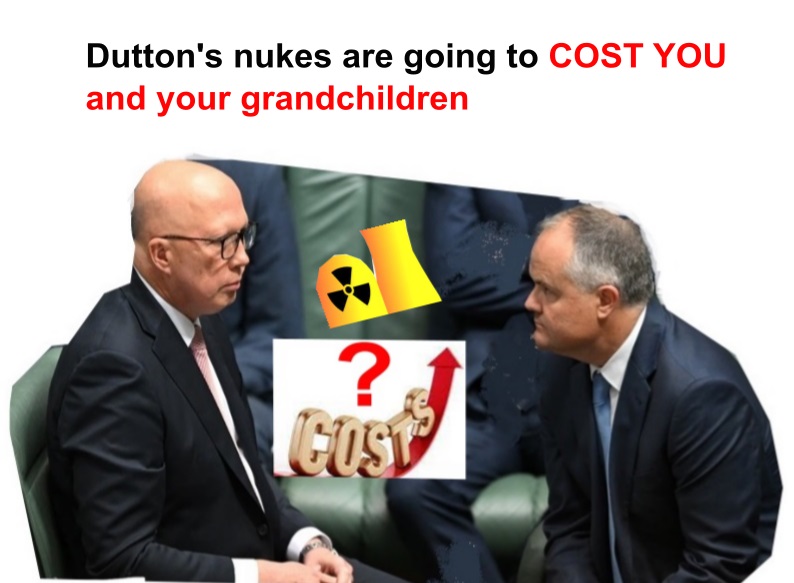
Australians for Affordable Energy February 24, 2025, https://theaimn.net/new-report-confirms-nuclear-fears-higher-bills-higher-emissions/
The Climate Change Authority’s latest report confirms the risks of delaying a clean energy future in favour of nuclear power will lead to higher emissions and increased costs for households.
The report warns that the Coalition’s nuclear energy proposal could add a staggering 2 billion tonnes of emissions while increasing costs for households, resulting in Australia missing its 2030 emissions targets and delaying the transition to clean energy until 2042.
“This report confirms our worst fears – betting on nuclear power isn’t just expensive, it’s a lose-lose for Australian families. Every year we waste waiting on nuclear means higher power bills and more emissions,” Jo Dodds, spokesperson for Australians for Affordable Energy, said.
“The Climate Change Authority has done the hard numbers. They’re telling us that going down the nuclear path means we’ll miss our 2030 targets and won’t get clean energy until 2042. That’s an extra 2 billion tonnes of emissions while we sit around waiting for nuclear plants that might never show up.
“Guess who pays for the delay? Everyday Australians – through their power bills and taxes.”
Crucial questions about the impact nuclear power will have on household budgets remain unanswered.
“Australians still need answers to fundamental questions: What is it going to cost? When will it actually deliver? What happens to our bills while we wait? What happens to our emissions?” Ms Dodds said.
“Families are already struggling with the cost of living and they can’t afford to bankroll expensive nuclear experiments that won’t deliver for decades all while their bills continue to rise. Every year we spend chasing nuclear dreams instead of getting on with real solutions is another year of higher costs for Australian households.
“We need to have a serious talk about our energy choices. This report makes it crystal clear – nuclear means paying more to get less and waiting longer to get it.
“Australian families deserve better.”
Australians for Affordable Energy is urging policymakers to focus on practical, cost-effective energy solutions that can deliver cleaner, more affordable power right now – not in decades.
1 This month
15 April – Zoom –Nuclear Power is Not the Solution
Apr 15, 2026 01:00 AM in Canberra, Melbourne, Sydney

Join the International Physicians for the Prevention of Nuclear War (IPPNW) on Tuesday, April 14th for a timely webinar exploring the risks associated with nuclear power and challenging the myth that it offers a simple, safe, carbon-free solution to the climate crisis

of the week – Australians for War Powers Reform (AWPR)
To see nuclear-related stories in greater depth and intensity
 Antinuclear