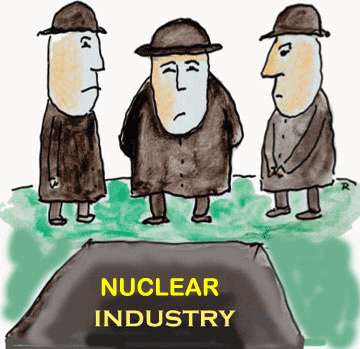
New report skewers Coalition’s contentious nuclear plan – and reignites Australia’s energy debate
John Quiggin, Professor, School of Economics, The University of Queensland: February 26, 2025, The Conversation
Debate over the future of Australia’s energy system has erupted again after a federal parliamentary inquiry delivered a report into the deployment of nuclear power in Australia.
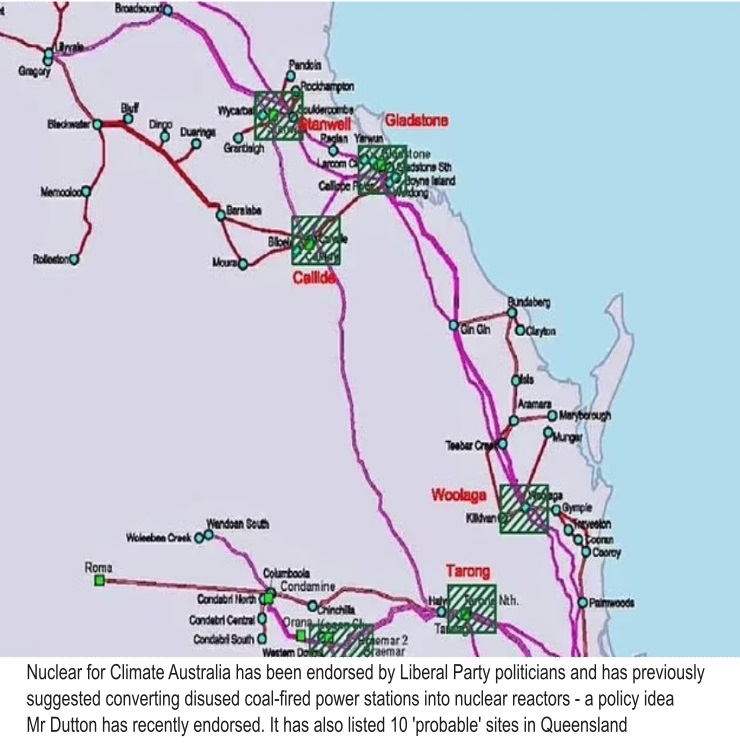
The report casts doubt on the Coalition’s plan to build seven nuclear reactors on former coal sites across Australia should it win government. The reactors would be Commonwealth-owned and built.
The report’s central conclusions – rejected by the Coalition – are relatively unsurprising. It found nuclear power would be far more expensive than the projected path of shifting to mostly renewable energy. And delivering nuclear generation before the mid-2040s will be extremely challenging.
The report also reveals important weaknesses in the Coalition’s defence of its plan to deploy nuclear energy across Australia, if elected. In particular, the idea of cheap, factory-built nuclear reactors is very likely a mirage.
A divisive inquiry
In October last year, a House of Representatives select committee was formed to investigate the deployment of nuclear energy in Australia.
Chaired by Labor MP Dan Repacholi, it has so far involved 19 public hearings and 858 written submissions from nuclear energy companies and experts, government agencies, scientists, Indigenous groups and others. Evidence I gave to a hearing was quoted in the interim report.
The committee’s final report is due by April 30 this year. It tabled an interim report late on Tuesday, focused on the timeframes and costs involved. These issues dominated evidence presented to the inquiry.
The findings of the interim report were endorsed by the committee’s Labor and independent members, but rejected by Coalition members.
What did the report find on cost?
The report said evidence presented so far showed the deployment of nuclear power generation in Australia “is currently not a viable investment of taxpayer money”.
Nuclear energy was shown to be more expensive than the alternatives. These include a power grid consistent with current projections: one dominated by renewable energy and backed up by a combination of battery storage and a limited number of gas peaking plants…………………………..
What about the timing of nuclear?
On the matter of when nuclear energy in Australia would be up and running, the committee found “significant challenges” in achieving this before the mid-2040s.
This is consistent with findings from the CSIRO that nuclear power would take at least 15 years to deploy in Australia. But is it at odds with Coalition claims that the first two plants would be operating by 2035 and 2037 respectively.
The mid-2040s is well beyond the lifetime of Australia’s existing coal-fired power stations. This raises questions about how the Coalition would ensure reliable electricity supplies after coal plants close. It also raises questions over how Australia would meet its global emissions-reduction obligations.
Recent experience in other developed countries suggests the committee’s timeframe estimates are highly conservative.
Take, for example, a 1.6GW reactor at Flamanville, France. The project, originally scheduled to be completed in 2012, was not connected to the grid until 2024. Costs blew out from an original estimate of A$5.5 billion to $22 billion.
The builder, Électricité de France (EDF), was pushed to the edge of bankruptcy. The French government was forced to nationalise the company, reversing an earlier decision to privatise it…………………………………………………………………..
Looking ahead
Undoubtedly, existing nuclear power plants will play a continued role in the global energy transition.
But starting a nuclear power industry from scratch in Australia is a nonsensical idea for many reasons – not least because it is too expensive and will take too long.
In the context of the coming federal election, the nuclear policy is arguably a red herring – one designed to distract voters from a Coalition policy program that slows the transition to renewables and drags out the life of dirty and unreliable coal-fired power.
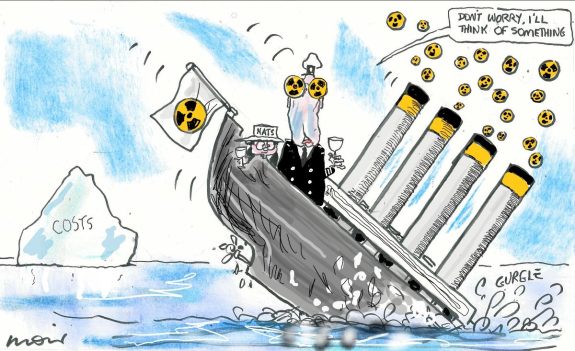
Parliamentary inquiry finds nuclear is high risk, zero reward.
RenewEconomy, Jim Green, Feb 26, 2025
An Interim Report was released on Tuesday by the House Select Committee on Nuclear Energy, and splits on party lines, with the independent MP Monique Ryan listing a myriad reasons why nuclear is unsuitable for Australia.
Labor MPs have the numbers on the committee and their majority report states that nuclear power “cannot be deployed in time to support Australia’s critical energy transition targets and climate commitments, or to assist the coal workforce and communities in their transition away from the coal industry.”
The interim report says the committee “received compelling evidence nuclear power would cost consumers more to use”. The report continues:
“Evidence received about the private sector’s lack of interest in investing in nuclear power in Australia and the history of issues with private investment in nuclear power internationally highlights the financial challenges for this source of power, making taxpayer funding of an uncertain nuclear venture during a cost-of-living crisis a significant risk.”
The report notes that the evidence the committee received “strongly indicated SMR [small modular reactor] technology is not yet commercially available and so is not a viable option for Australia’s energy needs.”
Climate Change and Energy Minister Chris Bowen commented on the report’s findings:
“Peter Dutton is determined to ignore the experts, reverse policies that bring the cost of energy down, and stick his head in the sand until the 2040s wishing his $600bn nuclear scheme will fix everything. It’s a disaster for our energy system now, and a guaranteed recipe for big bills, blackouts, and bad investments. “
“We already have a solution that works for today, and for this critical decade, that delivers jobs for people transitioning away from coal now, that reduces emissions, and that gets more of the cheapest form of energy into the grid. That solution is reliable renewable energy and the Albanese Government is delivering it.”
Independent MP Monique Ryan
If the Coalition hoped to sway independent MP and committee member Dr. Monique Ryan, they were sorely disappointed. Dr. Ryan said in her ‘Additional Comments’ to the main report that an “ongoing pursuit of nuclear energy options will only perpetuate and increase Australia’s reliance on coal and gas”.
Dr. Ryan reached the following conclusions:
* There are considerable roadblocks to nuclear energy in this country
* Necessary regulatory framework for health, safety, security, environmental impacts, and transport of fuels and waste would likely take some years to develop
* Australia currently lacks the workforce and technical capability required for building multiple large-scale nuclear reactors
* Independent experts (including from the CSIRO and Australian Energy Regulator) repeatedly told the Inquiry that it would take at least 15 years to build a single nuclear reactor — possibly as long as 25 years
* The Coalition’s proposal would provide only 15% of the country’s electricity requirements by 2050
* Under current projections, by 2030 more than 84% of the main national electricity grid will be powered by renewables; 96% by 2035
* Nuclear power is the most expensive form of energy
* Nuclear power does not compete economically
* Australians would pay more for electricity generated from nuclear plants
* Nuclear energy lacks social licence in many parts of Australia
* The impact of nuclear power generation on Australia’s water supplies has been inadequately considered by the Coalition in its proposal.
Coalition dissenting report
The Coalition committee member’s dissenting report goes to some lengths to defend that Coalition’s indefensible claim that nuclear power would reduce energy costs and power bills. Those claims have been thoroughly debunked…………………………………………..
Australian nuclear news week to 4th March.
Headlines as they come in:
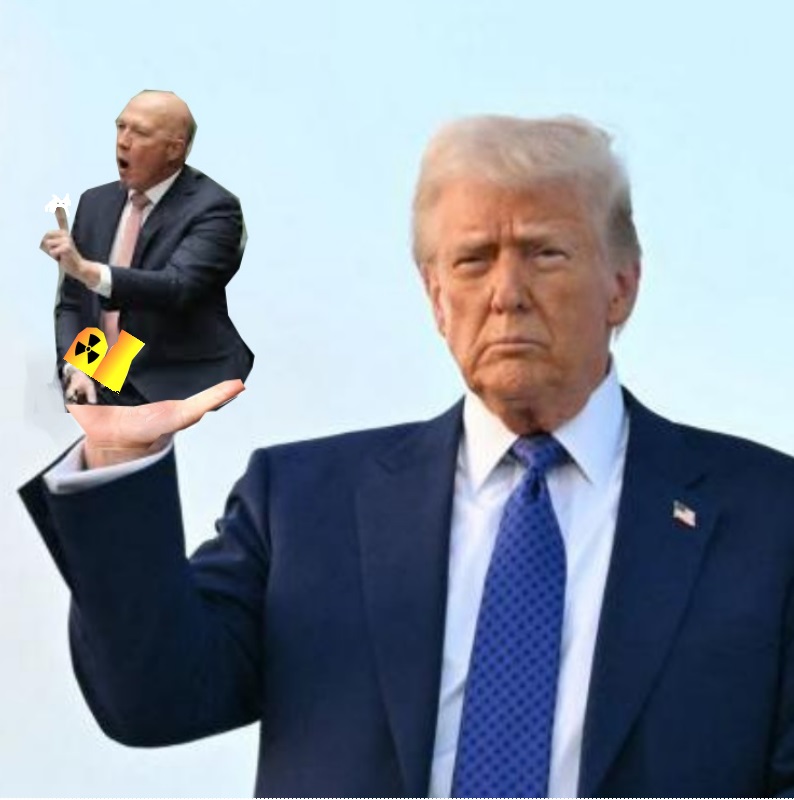
- Dutton’s nuclear gamble short on detail, but voters don’t seem to care
- Nuclear power struggling to maintain current level of stagnation, let alone achieve any growth
- New report details nuclear power’s demise.
- Peter Dutton’s nuclear plan is off in the never-never, but our power bills and emissions pledge are not
- Nuclear powers down as global reactor numbers shrink.
- AUKUS ‘impact assessment’ report ignores nuclear submarine risks in South Australia.
- Why the Coalition should stop trying to silence nuclear power critics
- Nuclear reactors could become targets of war, defence experts warn.
- Chinese warships sailing the Tasman Sea expose AUKUS folly.
- Not everyone knows acronyms’: Australian politicians shrug off Trump blunder on AUKUS.
- If China can’t scale nuclear, Australia’s got Buckley’s
- New report skewers Coalition’s contentious nuclear plan – and reignites Australia’s energy debate.
- Too slow, too risky, too impractical: Interim senate report pans nuclear.
- Parliamentary inquiry finds nuclear is high risk, zero reward.
- Fake fight over nuclear a distraction from real climate issues.
- Nuclear power would push Australia’s net zero back 12 years.
- Trump-lite: Coalition promises purge of experts who call out nuclear bunkum.
- Peter Dutton abandons global ‘Paris Agreement’ to phase out climate pollution by 2050
Nuclear Thuggery and Threats: Response to Interim Report of the House Select Committee on Nuclear Energy

February 26, 2025 AIMN Editorial, https://theaimn.net/nuclear-thuggery-and-threats-response-to-interim-report-of-the-house-select-committee-on-nuclear-energy/
Friends of the Earth (FoE) welcomes the Interim Report released by the House Select Committee on Nuclear Energy.
The Interim Report states that nuclear power “cannot be deployed in time to support Australia’s critical energy transition targets and climate commitments, or to assist the coal workforce and communities in their transition away from the coal industry.” It warns that “taxpayer funding of an uncertain nuclear venture during a cost-of-living crisis is a significant risk.”
In ‘Additional Comments’ to the Committee’s report, Kooyong MP Dr. Monique Ryan concludes that an “ongoing pursuit of nuclear energy options will only perpetuate and increase Australia’s reliance on coal and gas”.
FoE Australia’s national nuclear campaigner Dr. Jim Green said:
“The House Select Committee has found that nuclear power is too expensive and too slow. The Coalition hid its bogus economic costings until the Committee’s work was nearly complete, but the absurdity of those costings has now been thoroughly exposed.
“The simple fact is that recent reactor projects in the US, the UK and France have cost A$27-45 billion per reactor ‒ several times higher than the Coalition’s absurd assumption. No amount of sophistry and creative accounting changes the plain facts.
“This week the Climate Change Authority released a detailed analysis concluding that the Coalition’s energy plan would result in an additional two billion tonnes of greenhouse emissions. The Coalition’s response was to threaten to sack the Authority’s chair Matt Kean (a former NSW Liberal energy minister and treasurer) and to scrap the Authority just as a previous Coalition government defunded the independent Climate Commission and tried to kill off the Climate Change Authority and the Australian Renewable Energy Agency.
“The threat to the independent, expert Climate Change Authority is pure thuggery, as is Peter Dutton’s threat to use compulsory acquisition laws to acquire sites to build nuclear reactors from energy companies that are openly critical of the Coalition’s nuclear plan. Those companies are planning their exit from coal and its replacement with renewables and storage projects.
“The Dutton Coalition’s threat to override state governments and state laws is nuclear thuggery. And the threat to override community opposition is nuclear thuggery. Peter Dutton says it is in “the national interest to proceed” with nuclear reactors even in the face of adamant public opposition.
“The Dutton Coalition’s all-embracing nuclear thuggery stands in stark contrast to shadow energy minister Ted O’Brien’s comments in 2019 that a future government should only proceed with nuclear power on the condition that it make ‘a commitment to community consent as a condition of approval for any nuclear power or nuclear waste disposal facility’.”
Peter Dutton abandons global ‘Paris Agreement’ to phase out climate pollution by 2050

February 24, 2025, https://theaimn.net/peter-dutton-abandons-global-paris-agreement-to-phase-out-climate-pollution-by-2050/#comment-1882 Solutions for Climate Australia
New analysis from the national Climate Change Authority shows the Liberal and National Parties’ nuclear scheme would breach Australia’s commitment to international climate pollution targets and break their promise to phase out climate pollution by 2050.
“This independent analysis confirms earlier assessments that under opposition leader Peter Dutton’s nuclear scheme Australia will not reduce climate pollution by 43% by 2030, which would breach our international commitments,” said Senior Campaigner at Solutions for Climate, Elly Baxter.
“The Frontier Economics modelling the Liberal and National Parties are relying on shows the electricity grid would not reach net zero climate pollution until 2049 and would be 44% smaller than the government’s proposed grid. This would make it impossible to decarbonise the rest of our economy – all our transport, all our manufacturing and all our homes.
“Australians voted overwhelmingly for action on climate change and renewable energy at the last election. Mr Dutton insists that he will maintain our international commitment to the Paris Agreement and reach no net climate pollution by 2050, but the proof is in numbers. As we head to the polls in the coming months, voters need to be aware that Mr Dutton’s words do match his scheme.
“This matters enormously for all Australians. Yet again we are facing increasing climate disasters this summer – fires in the south and floods in the north. More Australians would be killed and homes and livelihoods lost if we push billions more tonnes of climate pollution into the air,” Baxter concluded.
The Coalition’s nuclear scheme includes nuclear reactors at seven sites across Australia. Modelling by Frontier Economics, released by the Coalition, shows an electricity grid that is 44% smaller than the government’s plan to use renewable energy like wind and solar with storage. The scheme would cap renewable energy at 54% when our grid was already powered by 46% renewable energy in the December quarter.
On the first sitting day of the year, over 80 community groups representing tens of thousands of Australians endorsed a statement objecting to Dutton’s nuclear push:
“We object to the Liberal and National parties’ nuclear proposal as it is incapable of cutting climate pollution this decade and upgrading our electricity grid in a timely manner,” the statement reads.
“We call for Peter Dutton and the Opposition to abandon the pursuit of nuclear reactors. It’s never too late to do the right thing.”
Nuclear power would push Australia’s net zero back 12 years
Energy Source Distribution, 25 Feb 25,
New analysis from the Climate Change Authority shows pursuing the deployment of nuclear in Australia’s grid could add at least 2 billion tonnes to national emissions.
This approach would involve a pace of climate action consistent with a global pathway to around 2.6°C of warming, a level at which scientists, economists and governments anticipate major social, economic and environmental harm.
The Climate Change Authority has compared published modelling by the Australian Energy Market Operator (AEMO) and Frontier Economics to understand how the adoption of a nuclear pathway could impact national efforts to reduce emissions.
The analysis finds that a nuclear pathway could see Australia miss the legislated 43% emissions reduction target for 2030 by over five percentage points, and still not achieve this level of reduction by 2035.
Australia would not reach 82% zero emissions electricity until 2042—more than a decade later than current national plans.
“Australia faces a fork in the road and we need to be clear about the choices in front of us,” Climate Change Authority chair Matt Kean says.
“Continuing on Australia’s current pathway and accelerating our progress can deliver rapid cuts to emissions by overhauling our grid with renewables, firming and storage in the next 15 years.
“On the other hand, the nuclear pathway would delay Australia’s necessary transition— keeping coal in the grid for longer and leading to billions of tonnes more emissions in the process………………………… https://esdnews.com.au/nuclear-power-would-push-australias-net-zero-back-12-years/
1 This month

of the week – Australians for War Powers Reform (AWPR)
To see nuclear-related stories in greater depth and intensity
 Antinuclear