New report skewers Coalition’s contentious nuclear plan – and reignites Australia’s energy debate
John Quiggin, Professor, School of Economics, The University of Queensland: February 26, 2025, The Conversation
Debate over the future of Australia’s energy system has erupted again after a federal parliamentary inquiry delivered a report into the deployment of nuclear power in Australia.
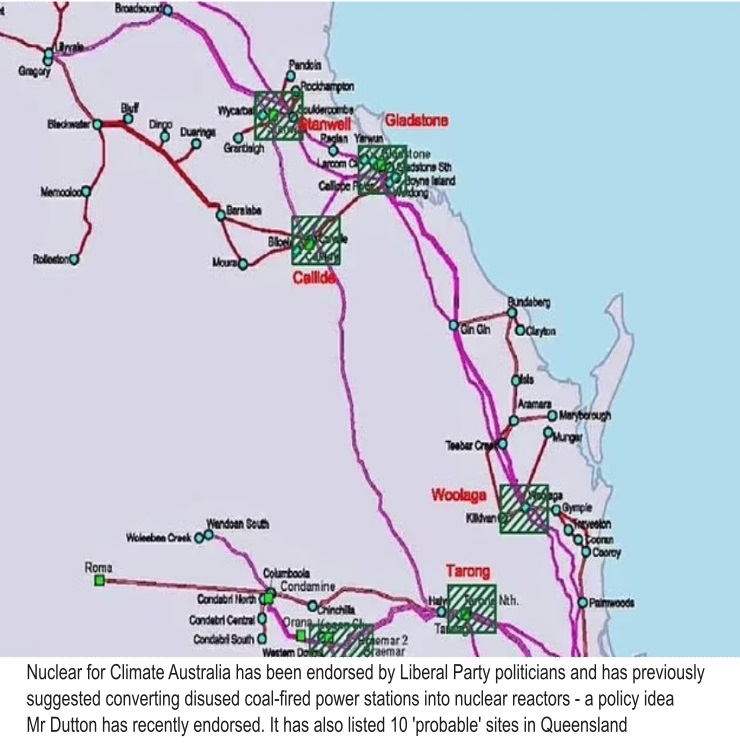
The report casts doubt on the Coalition’s plan to build seven nuclear reactors on former coal sites across Australia should it win government. The reactors would be Commonwealth-owned and built.
The report’s central conclusions – rejected by the Coalition – are relatively unsurprising. It found nuclear power would be far more expensive than the projected path of shifting to mostly renewable energy. And delivering nuclear generation before the mid-2040s will be extremely challenging.
The report also reveals important weaknesses in the Coalition’s defence of its plan to deploy nuclear energy across Australia, if elected. In particular, the idea of cheap, factory-built nuclear reactors is very likely a mirage.
A divisive inquiry
In October last year, a House of Representatives select committee was formed to investigate the deployment of nuclear energy in Australia.
Chaired by Labor MP Dan Repacholi, it has so far involved 19 public hearings and 858 written submissions from nuclear energy companies and experts, government agencies, scientists, Indigenous groups and others. Evidence I gave to a hearing was quoted in the interim report.
The committee’s final report is due by April 30 this year. It tabled an interim report late on Tuesday, focused on the timeframes and costs involved. These issues dominated evidence presented to the inquiry.
The findings of the interim report were endorsed by the committee’s Labor and independent members, but rejected by Coalition members.
What did the report find on cost?
The report said evidence presented so far showed the deployment of nuclear power generation in Australia “is currently not a viable investment of taxpayer money”.
Nuclear energy was shown to be more expensive than the alternatives. These include a power grid consistent with current projections: one dominated by renewable energy and backed up by a combination of battery storage and a limited number of gas peaking plants…………………………..
What about the timing of nuclear?
On the matter of when nuclear energy in Australia would be up and running, the committee found “significant challenges” in achieving this before the mid-2040s.
This is consistent with findings from the CSIRO that nuclear power would take at least 15 years to deploy in Australia. But is it at odds with Coalition claims that the first two plants would be operating by 2035 and 2037 respectively.
The mid-2040s is well beyond the lifetime of Australia’s existing coal-fired power stations. This raises questions about how the Coalition would ensure reliable electricity supplies after coal plants close. It also raises questions over how Australia would meet its global emissions-reduction obligations.
Recent experience in other developed countries suggests the committee’s timeframe estimates are highly conservative.
Take, for example, a 1.6GW reactor at Flamanville, France. The project, originally scheduled to be completed in 2012, was not connected to the grid until 2024. Costs blew out from an original estimate of A$5.5 billion to $22 billion.
The builder, Électricité de France (EDF), was pushed to the edge of bankruptcy. The French government was forced to nationalise the company, reversing an earlier decision to privatise it…………………………………………………………………..
Looking ahead
Undoubtedly, existing nuclear power plants will play a continued role in the global energy transition.
But starting a nuclear power industry from scratch in Australia is a nonsensical idea for many reasons – not least because it is too expensive and will take too long.
In the context of the coming federal election, the nuclear policy is arguably a red herring – one designed to distract voters from a Coalition policy program that slows the transition to renewables and drags out the life of dirty and unreliable coal-fired power.
No comments yet.
1 This month
15 April – Zoom –Nuclear Power is Not the Solution
Apr 15, 2026 01:00 AM in Canberra, Melbourne, Sydney

Join the International Physicians for the Prevention of Nuclear War (IPPNW) on Tuesday, April 14th for a timely webinar exploring the risks associated with nuclear power and challenging the myth that it offers a simple, safe, carbon-free solution to the climate crisis

of the week – Australians for War Powers Reform (AWPR)
To see nuclear-related stories in greater depth and intensity
 Antinuclear
Leave a comment