Nuclear power struggling to maintain current level of stagnation, let alone achieve any growth
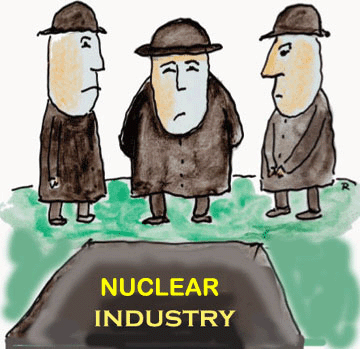
Alongside the risk of Fukushima-scale disasters, the weapons proliferation risks, the risk of attacks on nuclear plants (and the reality of attacks on nuclear plants in Ukraine), and the intractable nuclear waste legacy, the reality is that nuclear power just can’t compete economically.
The industry’s greatest problem at the moment is a recognition of this by investors, resulting in a capital strike.
Darrin Durant, Jim Falk & Jim Green, Mar 3, 2025, https://reneweconomy.com.au/nuclear-power-struggling-to-maintain-current-level-of-stagnation-let-alone-achieve-any-growth/
The current push in Australia to deploy nuclear power reactors once again contrasts an excessive optimism by nuclear proponents against the continuing stagnant situation of nuclear power worldwide. That contrast is the subject of our new report for the EnergyScience Coalition.
The latest nuclear proposals are built on three speculations.
First, projected AI-related energy demand where – as with nuclear power proponents in the 1970’s who projected huge demand that never eventuated – there are already signs demand is overblown. For example the new leading AI entrant DeepSeek requires just 10 per cent of the energy of competitors.
Second, speculative techno-optimism that new technologies such as small modular reactors will resolve industry project management issues. Yet these small reactors are unproven.
Third, prospective wish-fulfilment, where dozens of nuclear ‘newcomer’ countries are offered as saviours, despite not having reactor approvals and funding in place in a large majority of cases.
So what is the state of nuclear power in 2024? A review by the World Nuclear Industry Status Report notes that seven new reactors were connected to grids last year while four reactors were permanently closed. The net increase in operating nuclear capacity was 4.3 gigawatts (GW).
Worldwide nuclear power capacity was 371 gigawatts (GW) at the end of 2024. That figure is near-identical to capacity of 368 GW two decades earlier in 2005.
As of 1 January 2025, the mean age of the nuclear power reactor fleet was 32.1 years. In 1990, the mean age was just 11.3 years. Due to the ageing of the reactor fleet, the International Atomic Energy Agency projects the closure of 325 GW of nuclear capacity from 2018 to 2050 – that’s 88 per cent of current worldwide capacity. Thus the industry faces a daunting challenge just to maintain its pattern of stagnation, let alone achieve any growth.
There were no ‘small modular reactor’ (SMR) startups in 2024. Indeed there has never been a single SMR startup unless you count so-called SMRs not built using factory ‘modular’ construction techniques, in which case there is one each in China and Russia.
The SMR sector continues to go nowhere with setbacks in 2024 including the suspension of the Nuward project in France (following previous decisions to abandon four other SMR projects) and the bankruptcy of US company Ultra Safe Nuclear.
Nuclear growth dwarfed by renewables
In striking contrast to nuclear power’s net gain of 4.3 GW in 2024, the International Energy Agency’s October 2024 ‘Renewables 2024’ report estimates 666 GW of global renewable capacity additions in 2024. Based on the Agency’s estimate, renewables capacity growth was 155 times greater than that of nuclear power.
The International Energy Agency expects renewables to jump sharply from 30 per cent of global electricity generation in 2023 to 46 per cent in 2030.
Conversely, nuclear power’s share of global electricity generation has fallen steadily since the 1990s. As of 1 January 2025, nuclear power accounted for 9.15 per cent of global electricity production, barely half of its peak of 17.5 per cent in 1996.
A Bloomberg analysis finds that renewable energy investments reached $A1.17 trillion in 2024, up 8 per cent on the previous year, whereas nuclear investment was flat at $A55.1 billion. Thus renewable investments were 21 times greater than nuclear investments.
In contrast to massive cost overruns with nuclear projects, renewable costs have fallen sharply.
Lazard investment firm data shows that utility-scale solar and onshore wind became cheaper than nuclear power from 2010-2015. From 2009-2024, the cost of utility-scale solar fell 83 per cent; the cost of onshore wind fell 63 per cent; while nuclear costs increased 49 per cent.
Nuclear newcomer countries
Claims that 40-50 countries are actively considering or planning to introduce nuclear power, in addition to the 32 countries currently operating reactors, do not withstand scrutiny.
As of 1 January 2025, reactors were under construction in just 13 countries, two less than a year earlier. Seven percent of the world’s countries are building reactors; 93 percent are not.
Of the 13 countries building reactors, only three are potential nuclear newcomer countries building their first plant: Egypt, Bangladesh and Turkiye. In those three countries, the nuclear projects are led by Russian nuclear agencies with significant up-front funding from the Russian state.
The World Nuclear Association observes that apart from those three countries, no countries meet its criteria of ‘planned’ reactors, i.e. “approvals, funding or commitment in place, mostly expected to be in operation within the next 15 years.”
The number of potential newcomer countries with approvals and funding in place, or construction underway, is just three and those projects are funded heavily by the Russian state. That is the underwhelming reality underlying exaggerated claims about 40-50 countries pursuing nuclear power.
There is no evidence of a forthcoming wave of nuclear newcomer countries in the coming years and decades. At most there will be a trickle as has been the historical pattern with just seven newcomer countries over the past 40 years and just three this century.
The number of countries operating power reactors in 1996–1997 reached 32. Since then, nuclear newcomer countries have been matched by countries completing nuclear phase-outs and thus the number is stuck at 32. And less than one-third of those countries are building reactors (10/32).
It is doubtful whether the number of nuclear newcomer countries over the next 20-30 years will match the number of countries completing phase-outs.
Capital strike
Alongside the risk of Fukushima-scale disasters, the weapons proliferation risks, the risk of attacks on nuclear plants (and the reality of attacks on nuclear plants in Ukraine), and the intractable nuclear waste legacy, the reality is that nuclear power just can’t compete economically.
The industry’s greatest problem at the moment is a recognition of this by investors, resulting in a capital strike. Even with generous government/taxpayer subsidies, it has become difficult or impossible to fund new reactors – especially outside the sphere of China and Russia’s projects at home and abroad.
Who would bet tens of billions of dollars on nuclear power projects when the recent history in countries with vast expertise and experience has been disastrous?
In France, the latest cost estimate for the only recent reactor construction project increased seven-fold to A$39.4 billion for just one reactor. Construction took 17 years. No reactors are currently under construction in France.
In the US, one project in South Carolina, comprising two Westinghouse AP1000 reactors, was abandoned in 2017 after $A14.3 billion was spent. Westinghouse declared bankruptcy and its debts almost forced its parent company Toshiba into bankruptcy. All that remains is the nukegate scandal: an avalanche of legal action including criminal cases.
The only other reactor construction project in the US – the twin-reactor Vogtle project in the state of Georgia – reached completion at a cost 12 times higher than early estimates. The final cost was at least $A27 billion per reactor. Completion was six to seven years behind schedule.
No power reactors are currently under construction in the US. Thirteen reactors have been permanently shut down over the past 15 years.
The situation is just as bleak in the UK where there have been 24 permanent reactor shut-downs since the last reactor startup 30 years ago, in 1995.
The 3.2 GW twin-reactor Hinkley Point project in Somerset was meant to be complete in 2017 but construction didn’t even begin until 2018 and the estimated completion date has been pushed back to 2030-31.
The latest cost estimate – A$46.6 billion per reactor – is 11.5 times higher than early estimates. The UK National Audit Office estimates that taxpayer subsidies for the Hinkley Point project could amount to $A60.8 billion and the UK Parliament’s Public Accounts Committee said that “consumers are left footing the bill and the poorest consumers will be hit hardest.”
The estimated cost of the planned 3.2 GW twin-reactor Sizewell C project in the UK has jumped to $A81 billion or $A40.5 billion per reactor, twice the cost estimate in 2020. Securing funding to allow construction to begin is proving to be difficult and protracted despite a new ‘Regulated Asset Base’ funding model which foists the enormous risk of enormous cost overruns onto taxpayers and electricity ratepayers.
Lessons for Australia
Those three countries – France, the US and the UK – have vast nuclear expertise and experience. They all enjoy synergies between civil and military nuclear programs – President Macron said in a 2020 speech that without nuclear power in France there would be no nuclear weapons, and vice versa.
All of the above-mentioned construction projects were (or are) on existing nuclear sites. All projects were (or are) long delayed and tens of billions of dollars over-budget.
Claims that potential nuclear newcomer countries such as Australia, without any of those advantages, could build reactors quickly and cheaply are not credible.
Our report expanding on these issues is posted at the EnergyScience Coalition website.
Darrin Durant is Associate Professor in Science and Technology Studies at the University of Melbourne. Jim Falk is a Professorial Fellow in the School of Geography, Earth and Atmospheric Sciences at the University of Melbourne and Emeritus Professor at the University of Wollongong. Dr. Jim Green is the national nuclear campaigner with Friends of the Earth Australia and a member of the Nuclear Consulting Group.
Global Ocean Treaty two years on: Australia’s chance for international cooperation
Greenpeace SYDNEY, Tuesday 04 March 2025 – Two years after the United Nations agreed to bring the historic Global Ocean Treaty into force, Greenpeace is urging the Australian government to make good on its pledge for ocean protection and finally ink the treaty into law.
The UN treaty to protect the high seas was agreed two years ago today in 2023. It is a legally binding pact to conserve international waters, a crucial component in global efforts to protect 30% of the world’s oceans and lands by 2030. While 110 countries have signed the treaty, only 18 countries have ratified the treaty into law so far.
Greenpeace Australia Pacific Senior Campaigner Georgia Whitaker said:
“The government has been sitting on the Global Ocean Treaty for two years while other countries rapidly move to ratify and bring the treaty into force. We are an ocean-loving nation, and the Australian government could act as a proud leader on the world stage by making good on its promise to protect the high seas now. Our oceans don’t have the luxury of time – we need to ratify now, then deliver protected ocean sanctuaries in our big blue backyard: the Tasman Sea.”
Once the treaty is in force, governments can propose ocean sanctuaries for the high seas. A 2023 scientific report by Greenpeace identified the South Tasman Sea and Lord Howe Rise – the high seas between Australia and New Zealand – as being of critical importance for protection.
Until the treaty enters into force, the management of our global oceans is very fragmented. There is no legal global instrument that allows for the creation of sanctuaries in international waters. To this day, less than 1% of the high seas – the largest habitat on Earth, comprising 64% of the world’s ocean – is fully or highly protected from human activities.
The countdown is on, as the pivotal UN Ocean Conference (UNOC) will take place in Nice, France, in less than 100 days.
“UNOC is a unique chance for Governments to show global leadership for ocean protection. Australia must use this opportunity and ratify the treaty before arriving in Nice,” added Whitaker.
Another troubling week in nuclear news

Some bits of good news –
10 Ways Investing in Children’s Well-Being Changed the World
China is Rewiring the Global South With Clean Power. We’re making child marriages a thing of the past in Malaysia.
TOP STORIES.
Zelensky needs to go …been risking nuclear war far too long.
What Trump got right about nuclear weapons—and how to step back from the brink.
Global security arrangements “unravelling”, UN chief warns nuclear disarmament conference.
The Supreme Court faces the absurdly difficult problem of where to put nuclear waste.
More powerful than Hiroshima: how the largest ever nuclear weapons test built a nation of leaders in the Marshall Islands.
Climate. A Lawsuit Against Greenpeace Is Meant to Bankrupt It and Deter Public Protests, Environmental Groups Warn. Total collapse of vital Atlantic currents unlikely this century, study finds.
Noel’s notes. Ukraine to soon jump back out of the fire and into the frying-pan?
AUSTRALIA.
- AUKUS ‘impact assessment’ report ignores nuclear submarine risks in South Australia. Not everyone knows acronyms’: Australian politicians shrug off Trump blunder on AUKUS.
- If China can’t scale nuclear, Australia’s got Buckley’s. Nuclear reactors could become targets of war, defence experts warn.
- New report skewers Coalition’s contentious nuclear plan – and reignites Australia’s energy debate. Too slow, too risky, too impractical: Interim senate report pans nuclear. Chinese warships sailing the Tasman Sea expose AUKUS folly.
- Parliamentary inquiry finds nuclear is high risk, zero reward. Peter Dutton abandons global ‘Paris Agreement’ to phase out climate pollution by 2050. Trump-lite: Coalition promises purge of experts who call out nuclear bunkum.
- More Australian nuclear news at https://antinuclear.net/2025/02/26/australian-nuclear-news-week-to-4th-march/
NUCLEAR ITEMS
ECONOMICS.
- New report details nuclear power’s demise. Nuclear power struggling to maintain current level of stagnation, let alone achieve any growth.
- Stop government handouts to EDF for Hinkley Point C. Rachel Reeves eyes cuts to nuclear in spending review. Small modular reactor plans edge closer, amid claims that the technology makes no economic sense .
- EDF appears to consider reduced final stake in Sizewell C to as low as 10% Sellafield nuclear site plans cuts as chief says £2.8bn funding ‘not enough’. Nuclear site warns £2.8bn budget is ‘not enough’. UK construction and engineering firm Costain has secured a multi-millionpound contract to support the construction of the Sizewell C nuclear powerplant -ALSO AT https://nuclear-news.net/2025/02/28/2-b-uk-construction-and-engineering-firm-costain-has-secured-a-multi-millionpound-contract-to-support-the-construction-of-the-sizewell-c-nuclear-powerplant/
- We can’t afford Doug Ford’s nuclear fantasy.
ENERGY. UK Energy Secretary Signals China Pivot.
ENVIRONMENT. ‘Fish disco’ row risks fresh delays to Hinkley Point nuclear plant.
ETHICS and RELIGION. Archbishop Gallagher: Nuclear weapons pose existential threat.
EVENTS. Nuclear Ban Week – the UN Treaty on the Prohibition of Nuclear Weapons (TPNW). 1 March -Remembering All Nuclear Victims. 6 March – WEBINAR –Arming for Armageddon: How US Militarism could lead to Nuclear War
HEALTH. Nuclear reactors killing Americans at accelerating rate.
LEGAL. SCOTUS goes nuclear: Justices’ decision could seal spent fuel storage options for decades. Beyond Nuclear files two relicensing legal actions.
OPPOSITION to NUCLEAR . 93% say NO: latest polls in Lincolnshire condemn nuke dump plan
PERSONAL STORIES. The island priest who fought a nuclear rockets range.
POLITICS.
- Techno-Fascism Comes to America. German election results tilt EU back toward nuclear energy.
- How the Warfare State Paved the Way for a Trumpist Autocracy.
- The Guardian view on UK PM’s gamble: exploiting crisis to remake Labour was a step too far for an ally.
POLITICS INTERNATIONAL and DIPLOMACY. Donald Trump was rude to Zelensky, but he did tell him the hard truths. Zelensky: Victim of Colosseum Politics.
The National goes to the UN: The fight for nuclear disarmament– ALSO AT https://nuclear-news.net/2025/02/27/1-b1-scotus-goes-nuclear-justices-decision-could-seal-spent-fuel-storage-options-for-decades/
US correct to vote against UN resolution solely condemning Russia for Ukraine war. The pro-war lobby in the West needs to come up with new ideas, rather than saying the same old things.
SAFETY. United States: White House Threatens Nuclear Regulatory Commission‘s Independence. IAEA Director General Statement on Fire Situation in Chernobyl nuclear station. Ontario’s outdated nuclear vision poses serious safety and financial risks.
A Single Trumputin Drone Can Turn the “Peaceful Atom” Into World War 3. Vladimir Putin right now has in his sights nearly The physical hazards of nuclear energy. IAEA mission arrives at nuclear plant in Ukraine through Russia.
URANIUM. As tensions rise, Canada to lean on U.S. for uranium enrichment.
WASTES. Tonnes of nuclear waste to be sent back to Europe. Hinkley Point C will be a Sellafield waste dump . Nuclear Decommissioning Authority budget raises Sellafield safety concerns. Public concern increasing about nuclear waste shipments west of Sudbury. Election candidates should face nuclear waste questions: group.
WAR and CONFLICT. Israel seen as likely to attack Iran’s nuclear sites by midyear.
WEAPONS and WEAPONS SALES.
The Pentagon and Starlink Satellites.
Nuclear weapons are ‘one-way road to annihilation’ warns Guterres.
Iran on ‘high alert’ amid fears of attack on nuclear sites. Starmer drags
Britain deeper into war drive. Reawakening a Nuclear Legacy: The Potential Return of the
US Nuclear Mission to RAF Lakenheath. John Swinney: UK’s nu
clear deterrent offers ‘no tangible benefit’. As Freed Palestinians Describe Torture,
Trump OKs $3 Billion Arms Package for Israel.
Peter Dutton’s nuclear plan is off in the never-never, but our power bills and emissions pledge are not

Peter Dutton’s nuclear plan is off in the never-never, but our power bills and emissions pledge are not
Lenore Taylor, Guardian 28th Feb 2025 https://www.theguardian.com/australia-news/commentisfree/2025/mar/01/peter-duttons-nuclear-plan-is-off-in-the-never-never-but-our-power-bills-and-emissions-pledge-are-not
The nuclear plan handily leapfrogs the next 10 years – when a Dutton government might actually hold office – a critical time for emissions reduction.
I don’t often agree with Matt Canavan on matters to do with global heating. But when the senator labelled the Coalition’s nuclear plan a “political fix” last year, I think he was speaking the truth.
For 15 gruelling years the Coalition has been trying to distract a voting public, ever more aware of the climate crisis, from its inability to get a credible climate and energy policy past the climate sceptics and do-nothing-much-to-reduce-emissions exponents in its own ranks (including the Queensland senator).
Peter Dutton’s nuclear policy is the latest iteration, framing the “debate” as one between two different technological means to get to the same goal of net zero emissions by 2050, and those critical of nuclear power as “renewables only” ideologues who blindly refuse to consider a credible solution.
But even under the Coalition’s very optimistic calculations nuclear power cannot come onstream for a decade, so this is also a framing that handily leapfrogs the next 10 years; the decade when a Dutton government might actually hold office, and also a decade when today’s voters will still need to pay power bills and require a reliable energy supply, and when the world must reduce emissions to avoid the most disastrous impacts of heating.
Having so carefully set up the nuclear-in-the-never-never policy for some time now, the Coalition can be quite aggressive when anyone points out its many near-term deficiencies.
This week’s target was the Climate Change Authority, which found the Coalition’s plan – to slow the roll-out of renewable energy and somehow keep crumbling coal-fired power plants running until after 2040 when taxpayer-funded nuclear reactors might become available – would massively increase Australia’s carbon dioxide emissions, by more than 2bn tonnes.
It’s pretty obvious, really, that continuing to burn coal will produce more emissions, and it certainly wasn’t an outlandish estimate, being based on the Coalition’s own modelling, and broadly in line with estimates from energy experts at the University of New South Wales.
But the Coalition chose not to address it, but rather to shoot the messenger; in this case the independent authority and its chair, the former NSW Liberal minister Matt Kean. The authority, it said, had become “a puppet of Anthony Albanese and [energy minister] Chris Bowen”. There were strong hints that under a Dutton government Kean himself might be sacked.
Dutton’s claim that power prices will be 44% cheaper in the near term under his plan are also unsubstantiated and somehow also less scrutinised than all the competing assessments of what nuclear may or may not cost in the long term, if it is ever eventually built.
Experts say Dutton’s pronouncements on near-term costs show he clearly doesn’t know what he is talking about.
The opposition leader routinely cites modelling from Frontier Economics, itself contested, which did find that nuclear power would reduce the energy system costs in the longer term by 44%. Frontier’s managing director, Danny Price, confirms his work did not forecast household power bills or electricity prices, and that nearer term reductions in system costs were not quantified.
And then there are the deep fears, from the Australian Energy Market Operator, among others, about how the ageing coal-fired power system would hold together in the 10 years or more during which nuclear power was being developed.
Canavan’s criticism of his own party’s policy was made in the context of his argument that neither major party was being upfront about the challenges of keeping the energy system running while reaching net zero by 2050.
I disagree with him there. Australia is just starting to shake off the decades of stultifying climate wars to achieve a necessary and long-delayed energy transition. The east coast grid now runs on about 43% renewable energy. The lights are staying on. Investment is increasing.
As the AGL chief executive, Damien Nicks, said last week: “Both time and cost won’t allow nuclear to be done on time … the question right now is about getting on and getting this done as soon as we can.”
If Dutton wants to discuss nuclear as a long-term option, that’s fine, but it’s no substitute for knowing what his plan means for the here and now, for power bills, and emissions, and the promises we have made on the international stage. That is, if it is actually a serious policy rather than another tactic for delay.
Earth’s strongest ocean current could slow down by 20% by 2050 in a high emissions future
In a high emissions future, the world’s strongest ocean current could
slow down by 20% by 2050, further accelerating Antarctic ice sheet melting
and sea level rise, an Australian-led study has found. The Antarctic
Circumpolar Current – a clockwise current more than four times stronger
than the Gulf Stream that links the Atlantic, Pacific and Indian oceans –
plays a critical role in the climate system by influencing the uptake of
heat and carbon dioxide in the ocean and preventing warmer waters from
reaching Antarctica.
Guardian 3rd March 2025, https://www.theguardian.com/environment/2025/mar/03/antarctic-circumpolar-current-slow-down-ice-melting-climate
1 This month
15 April – Zoom –Nuclear Power is Not the Solution
Apr 15, 2026 01:00 AM in Canberra, Melbourne, Sydney

Join the International Physicians for the Prevention of Nuclear War (IPPNW) on Tuesday, April 14th for a timely webinar exploring the risks associated with nuclear power and challenging the myth that it offers a simple, safe, carbon-free solution to the climate crisis

of the week – Australians for War Powers Reform (AWPR)
To see nuclear-related stories in greater depth and intensity
 Antinuclear