Australian nuclear news 10-17 March.
Headlines as they come in:
- The end of coal and the fake nuclear energy ‘red herring’
- Greens leader Adam Bandt says Australia should walk away from AUKUS in wake of Trump’s tariffs.
- Bandt says Australia should cancel Aukus payments and leave pact.
- Australia’s Trump cards.
- The Lizard’s Revenge
- Silent vigil against nuclear.
- There’s a bipartisan conspiracy of silence on AUKUS — and it flies in the face of democracy
- “Nothing but broken promises”: ICAN Ambassador, Karina Lester calls out Australia’s inaction on the Treaty for the Prohibition of Nuclear Weapons.
- New tool to cut through energy debate as price hike prompts new questions about nuclear
- Coalition’s Canavan forgets he’s backing nuclear, calls for new coal power as election looms .
- Radioactive secrets: Fight to hide AUKUS nuclear waste sites gets absurd .
- US report discusses possibility of nuclear submarine accident, if subs supplied to Australia.
- Higher household bills by 2030 under nuclear: report.
- Coalition’s nuclear plan most expensive option for Australia, former US climate official says.
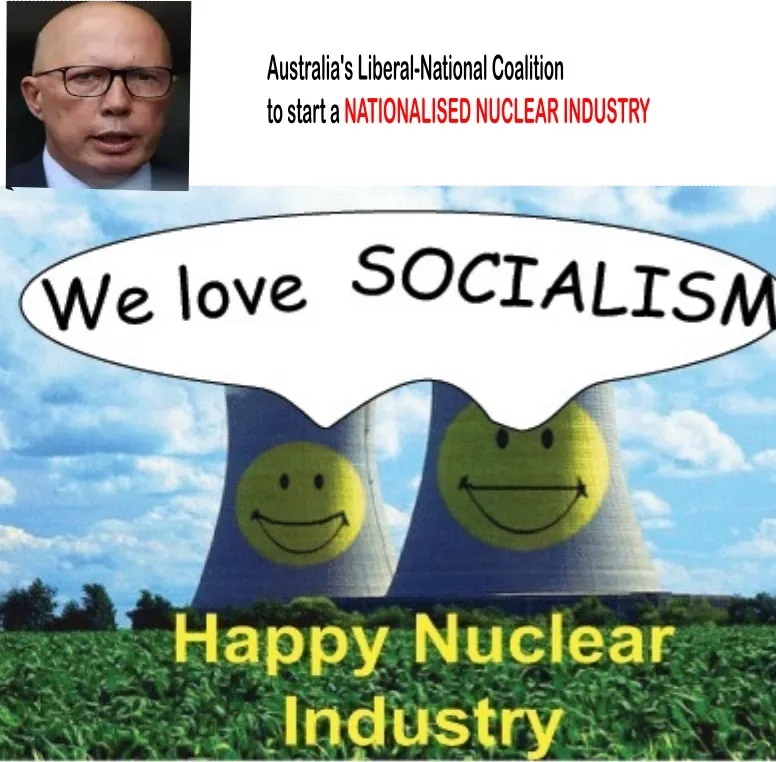
- Climate Authority head Matt Kean says Liberals ‘socialist’ for ‘nonsense’ nuclear policy.
- What if a Fukushima-sized nuclear accident happened in Australia? –
Radioactive secrets. Fight to hide AUKUS nuclear waste sites gets absurd
by Rex Patrick | Mar 11, 2025 | https://michaelwest.com.au/radioactive-secrets-fight-to-hide-aukus-nuclear-waste-sites-gets-absurd/
Where to store nuclear waste from AUKUS submarines is a decision which will impact us for millennia, but they are going to extraordinary lengths to hide it from the public. Rex Patrick reports.
Somewhere deep inside a locked government filing cabinet within Australia’s labyrinthine Defence bureaucracy, there’s a document intended to advise the Government on what locations in Australia might be suitable to store high-level nuclear waste and how to select one of those locations.
It’s a roadmap to where the most toxic material on our planet may be dumped for tens of thousands of years. The report itself is just paper, but it’s red hot. It’s politically radioactive.
The document in question is the result of a $360,000 February 2023 contract to a company called SG Advice. The principal of SG Advice was tasked with coordinating the Australian Nuclear Science and Technology Organisation, the Australian Radioactive Waste Agency, the Australian Submarine Agency, Defence, and Geoscience Australia to produce a “significant piece of policy advice” for the government.
The document is being held secret despite the obvious fact that a decision on a location for a high-level nuclear waste facility will be a decision with impacts which will last for millennia.
The government doesn’t want the public to see it – it’s just too controversial. All the more reason then for me to seek access to it using our Freedom of Information laws.
A Cabinet document
When I requested the report, the newly minted Submarine Agency told me I couldn’t have it because it was a cabinet document. But when I thought about the nature and purpose of the report, this didn’t make sense.
The Cabinet Handbook, the authoritative rules governing all matters relating to Cabinet, states that “… Cabinet documents are … not the property of … [the] department. Access to them by succeeding governments is not granted …”
If this ‘significant piece of policy work’ dealing with the problem of high-level nuclear waste in a multi-decade program was a Cabinet document, it would only be available to the Department for the period that the Albanese Government was in power. If there was a change of Government, the work that was done would go into the archives and would not be available for reference by future governments, at least not for 20 years. So, the nuclear waste planning would have to be revisited from scratch.
But the Submarine Agency went to the Administrative Review Tribunal with its taxpayer funded lawyers to argue that the report was a Cabinet document and consequently must remain secret.
Government Ministers and bureaucrats love Cabinet-in-confidence exemptions because if they’re upheld, it’s ‘all over red rover’ as far as any public access is concerned. First Assistant Director-General of the Submarine Agency, Alexandra Kelton, deposed:
… “my understanding at all times was that the final Review report would be a document submitted to the [National Security Committee of Cabinet] for its consideration.“
If it was intended for Cabinet, then the Submarine Agency had engaged in wasteful administrative folly.
Document purpose
In order for the Tribunal to find that the report was a Cabinet document, it needed more than just evidence that it has been to Cabinet. The FOI Act demands that the Agency must show, with probative evidence, that the report was
“brought into existence for the dominant purpose of submission for consideration by the Cabinet.“
The only evidence before the Tribunal that the document was born with Cabinet submission in mind was in the $360,000 contract to SG Advice Pty Ltd which stated, “Any decision related to locations for the storage and disposal of radioactive waste is a decision for the Australian Government.”
Ms Kelton deposed, “The capitalised reference to ‘Australian Government’ in the [contract] is synonymous with Cabinet. That is a common expression in Defence and [the Submarine Agency] when referring to Cabinet.”
Instead of using the word ‘Cabinet’, Ms Kelton used the broader multi-definitional word “Australian Government”. She could have used “Cabinet” but she chose to be ambiguous.
The contract to commence the report was signed in late February 2023. The report was completed in November 2023. Only after the document was finalised was it sent to the Defence Minister, suggesting it should go to Cabinet. In the covering brief, the Submarine Agency raised the political sensitivity of the content of the report.
Despite the attempt by the agency to wrap the report in a 20-year-long secrecy blanket, it’s likely the Tribunal will rule in my favour and we will all get to see the report. It should not otherwise be kept secret.
Reckless conduct
The Submarine Agency will bear the ultimate responsibility for Australia’s nuclear stewardship under the AUKUS agreement and in relation to our nuclear non-proliferation obligations with the International Atomic Energy Agency. Those stewardship obligations include commissioning, operating, maintaining, and decommissioning reactors and disposing of their high-level waste.
The Submarine Agency promotes the idea that it will manage all nuclear activities safely, informed by international best practices. Yet its approach to the nuclear waste report shows otherwise.
If we indulge the Submarine Agency for a moment and believe that the nuclear waste report was for Cabinet, their conduct and care of this report has been reckless. They’ve been playing fast and loose with rules that are laid down at the highest level of the Australian Government; rules approved by Prime Minister Albanese and the Cabinet Secretary, Attorney-General Dreyfus, and endorsed by Cabinet itself.
Ignoring the rules for convenience
The Cabinet Handbook states that it is inappropriate to provide copies of, or access to, final or draft Cabinet documents to sources external to government. Yet, in total disregard for that rule, the Submarine Agency contracted the consulting company SG Advice PTY LTD to lead the review and the report writing team.
Moving on, there exists a real-time, highly secure, whole of Australian government information and communications technology system used to support the Commonwealth’s end-to-end Cabinet process. It’s called CabNet+.
The Cabinet Handbook states Cabinet documents, including pre-exposure drafts, exposure drafts, drafts for coordination comments, final submissions, and drafting comments (including coordination comments), must only be circulated via the CabNet+ system to ensure that they are circulated securely and that copies of the documents can be accounted for.
It is important, therefore, that exposure drafts, drafts or finals (either in the template or in a document which looks like a Cabinet submission) are not circulated by any other means.
It goes on to state: Similarly, substantive comments on submissions should only be transmitted via CabNet+.
“And yet all the work associated with the nuclear waste site report was carried out on standard departmental networks.“
Much of the communication was only marked official (unclassified), including emails that contained drafts of the report. In response to the argument that the report could not be a Cabinet document because it was not prepared and stored on CabNet+ Ms Kelton deposed, “The process for planning and drafting the Review report was collaborative and iterative. As a matter of practicality for communicating and formatting parts of the draft, that process occurred outside the CabNet system.”
So, one of the most senior people in an Agency responsible for stewardship of high-level nuclear waste has indicated that it’s OK to depart from mandatory requirements.
How’s that for knocking people’s confidence in an organisation’s ability to manage highly radioactive nuclear material.
In the lead up to the hearing, the government’s lawyers threatened me not to reveal these details.
Stop the secrecy!
Yes, the report I’m after relates to a highly controversial topic and one of great importance. It relates to the location of an AUKUS spent nuclear fuel repository. But it’s a document that ought to be made public … and especially so because of its controversy.
“Prime Minister Albanese insisted that Opposition Leader Dutton be transparent about the sites of his seven proposed nuclear power reactors.“
Dutton obliged.
Yet Albanese has obstinately resisted disclosure of documentation about the location of a future High Level Nuclear Waste facility. It’s almost certainly politically radioactive, but politics is no justification for secrecy.
Moreover, this is a document that will inform government decisions of an indefinite character. Wherever the nuclear waste goes, it will go there for good.
“The need for full public and expert scrutiny of this report is absolutely compelling.“
Before he won high office, Anthony Albanese promised openness and transparency. Even if the nuclear waste report were a Cabinet document, he could authorise its release. That’s always in his power.
That he has refused to do so, sends my secrecy Geiger Counter way into the red zone; maxed out by wilful obstruction and shameless hypocrisy.
Rex PatrickRex Patrick is a former Senator for South Australia and earlier a submariner in the armed forces. Best known as an anti-corruption and transparency crusader, Rex is running for the Senate on the Lambie Network ticket next year – www.transparencywarrior.com.au.
Higher household bills by 2030 under nuclear: report

by News Of The Area – Modern Media – , https://www.newsofthearea.com.au/higher-household-bills-by-2030-under-nuclear-report
HOUSEHOLDS could fork out an extra $450 a year for power by 2030 if policymakers pursue nuclear and a slower renewable rollout, modelling suggests.
An analysis commissioned by the Clean Energy Council found the additional pricey gas needed under a nuclear pathway would drive bills higher by 2030 than if the renewables-led grid transition continues.
The modelling mirrors the energy policies on offer from the major federal parties – the Labor government is vying for 82 per cent of renewable energy in the grid by 2030, while the coalition is promising to build nuclear power plants.
Renewable energy would make up about half the energy grid by 2050 and nuclear power 38 per cent under the opposition plan.
Opposition leader Peter Dutton has promised cheaper electricity long-term based on calculations it commissioned from consultancy Frontier Economics.
Using AEMO’s “progressive change” scenario for the nation’s energy mix, Frontier found including nuclear energy would reduce costs from $437 billion to $331 billion – or slash costs by 44 per cent compared to the “step change” scenario.
Yet numbers crunched by professional services firm Jacobs on the clean energy industry body’s behalf found households could expect a 30 percent average increase by 2030 under the nuclear pathway.
This would amount to an $449 annual increase for the typical consumer ser
viced by the main energy grid.
Small businesses could expect a $877 increase in their bills by 2030 if the clean energy rollout slows down while waiting for nuclear to be built.
Even bigger price jumps were possible were a coal generator to unexpectedly fail – something that becomes more likely as they age – as more gas would be needed to make up the shortfall.
Voters are set to go to the polls May 17, at the latest, and cost of living will be front of mind following a prolonged stint of high interest rates aimed at taming inflation.
Clean Energy Council chief executive officer Kane Thornton said halting renewable energy deployment and relying on coal and gas before nuclear comes online would be a “disaster” for power prices.
“Australia would have to increase its reliance on increasingly expensive and unreliable old coal generation, as well as significantly increase gas generation, which is a much more expensive energy source,” he said.
“Getting more renewables into our system, such as solar and wind and backed by pumped hydro, batteries and small amounts of gas, is the cheapest and most reliable way to keep energy bills as low as possible for Australians.
The analysis considered the influence of wholesale electricity prices on power bills for households and small businesses under each scenario.
Network costs and other components of electricity bills were not included in the modelling.
Tuesday’s power bill numbers follow the Climate Change Authority’s report highlighting the nuclear power plan could push Australia’s 2030 climate target out until 2042 and add two billion tonnes of carbon emissions to the environment by 2050.
1 This month

of the week – Australians for War Powers Reform (AWPR)
To see nuclear-related stories in greater depth and intensity
 Antinuclear