US report discusses possibility of nuclear submarine accident, if subs supplied to Australia

A report to the US Congress discusses the possibility of an accident with a nuclear-powered submarine if it supplies one to Australia.
This comes amid renewed questions over whether an AUKUS submarine deal would leave the US vulnerable, and an accident off the English coast where a tanker carrying jet fuel for the US military has hit a cargo ship.
The risk of a marine accident is one of three risks looked at around the submarines deal that is central to the the AUKUS Pillar One pact.
The congressional research report said an accident “might call into question for third-party observers the safety of all US Navy nuclear-powered ships”.
That could erode US public support and the ability of US nuclear-powered ships to make port calls around the world.
The 111-page report by the Congressional Research Service discussed the US not handing over the subs at all – although Canberra just made a $870m downpayment on them.
Keeping them might make up for the US sub fleet hitting “a valley or trough” around now till the 2030s, and shipbuilding being at a low point, it said.
Donald Trump’s pick for the top defence policy role at the Pentagon, Elbridge Colby, has said AUKUS could leave the US short and “it would be crazy to have fewer SSN Virginia-class [attack submarines] in the right place and time”.
The new research report to Congress said Pillar One was launched in 2021 without a study of the alternatives.
One alternative “would keep all US-made SSNs under the control of the US Navy, which has a proven record extending back to 1954 of safely operating its nuclear-powered ships”.
The original Pillar One pact is for the US to sell between three and five subs to Australia, then Australia to use US and UK nuclear propulsion technology to build another three-to-eight nuclear powered, conventionally armed submarines itself, for a total fleet of eight.
Australia’s Defence Minister Richard Marles said on Monday that Elbridge Colby was broadly supportive of AUKUS, if enough subs were available.
Canberra was aware of the challenge in the US around producing submarines, “and that’s why we’re contributing to the US industrial base”.
“And it’s a significant contribution and it’s going to increase the availability of Virginia class submarines for the United States.
“That’s a point which has been accepted and understood by the US Defence Secretary, Pete Hegseth, in the meeting that I had with him.”
Australia was last year included as a “domestic source” of US military production for the first time, and is aiming to ramp up making ammunition and missiles, as well as test hypersonic weapons with the US and UK.
“That’s going well in the sense that we are making the contributions, we are seeing an increase in production rates, and over the time frame in which we are looking to have our Virginia class submarines transferred to us, we are confident that this challenge can be met,” Marles told the ABC.
In the US, Trump appears most focused on building an ‘Iron Dome’ missile defence system, as he mentioned in his speech to Congress. This would be another huge pressure on military spending.
The report to Congress covered three big risks – accidents and whether Pillar One was the best option for deterrence and “warfighting cost-effectiveness”, and how the tech – the “crown jewels of US military technology” – could be kept secret, especially from China.
It debated a different “military division of labour”.
“Australia, instead of using funds to purchase, build, operate, and maintain its own SSNs, would instead invest those funds in other military capabilities – such as … long-range anti-ship missiles, drones, loitering munitions, B-21 long-range bombers, or other long-range strike aircraft” to conduct “missions for both Australia and the United States”.
The general rule was programmes should not go ahead without a sound business case, it noted.
“There is little indication that, prior to announcing the AUKUS Pillar 1 project in September 2021, an analysis of alternatives … or equivalent rigorous comparative analysis was conducted to examine whether Pillar 1 would be a more cost-effective way to spend defence resources for generating deterrence and warfighting capability”.
The report made no mention of how New Zealand, Japan, Korea and others might join AUKUS Pillar Two, an agreement for sharing advanced military tech.
Coalition’s nuclear plan most expensive option for Australia, former US climate official says
Dr Jonathan Pershing, a former US special envoy for climate change and climate negotiator under Democratic presidents, says few countries building nuclear power plants
Adam Morton Climate and environment editor, Tue 11 Mar 2025 , https://www.theguardian.com/australia-news/2025/mar/11/coalitions-nuclear-plan-most-expensive-option-for-australia-former-us-climate-official-says
A longtime senior US climate official has weighed in on Australia’s energy debate, saying “very, very few people” internationally are building new nuclear power plants and, in most cases, the combination of solar and batteries delivers “higher reliability than gas”.
Dr Jonathan Pershing, a former US special envoy for climate change and climate negotiator under Democratic presidents, was in Sydney on Monday to speak at the city’s climate action week. Asked whether nuclear power as proposed by the Coalition was a viable option for Australia, he said “almost all the numbers that I have seen suggest that that’s a more expensive option than other choices”.
“What’s really interesting is the global community’s progress on nuclear with, frankly, a bigger head start than Australia’s had, because the ban here has been in place for a long time,” he told Guardian Australia.
“Very, very few people are building new nuclear.”
Pershing, who is program director at the William and Flora Hewlett Foundation, said even if Australia was able to overcome two immediate hurdles to nuclear energy – the legislated ban and an historical lack of public support for the technology – it then faced asking taxpayers to pay “holding costs” for 10 to 20 years when it could be building the same amount of generating capacity sooner.
“The cheapest one still globally, and I think here as well, is probably a combination of solar plus batteries – and that’s firm capacity, by the way,” he said. “If we look at the way that’s been analysed, the combination of the two [solar and batteries] gets you higher reliability than you get from gas.
He cited the example of the 40-year-old Diablo Canyon nuclear plant, in California. He said it was not likely to be replaced with a new nuclear generator once it reached the end of its life because of the cost. “They’ll do some life extensions, but they don’t think it is even plausible to imagine building new capacity there,” he said. “It’s just too expensive.”
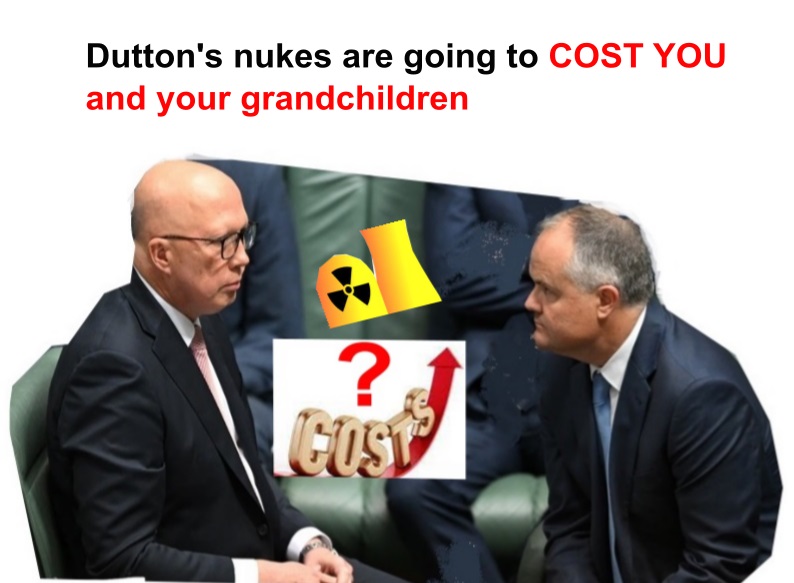
The Coalition has claimed that its proposal to slow the rollout of renewable energy, extend the life of ageing coal plants, rely more on gas-fired power and later build publicly funded nuclear plants at seven sites, mostly after 2040, would be cheaper and more reliable than Labor’s promise of sourcing 82% of Australia’s electricity from renewable energy by 2030.
Peter Dutton has said the Coalition’s claim is supported by a report by consultants at Frontier Economics. But several other independent energy experts have argued the Coalition’s plan would, in relative terms, be likely to be more expensive for consumers over the next decade, at least, and less reliable and lead to substantially higher greenhouse gas emissions.
Pershing said a another problem for Australia would be training personnel for a nuclear power industry. Technical experts would have to be brought from overseas, which isn’t the case for other types of energy generation, he said.
That expertise could come from Canada, China, France or Russia, adding that in the case of Russia, “I’m not so convinced that that’s where you’d want to go”.
Pershing said the Trump administration’s anti-climate action stance would have an effect “but, I think, less than people might imagine”. He said the change in the US was an opportunity for Australia, “depending on how it chooses to engage”.
“The thing that’s most salient is that the rest of the world has decided that the least-cost solution to provide for more energy, particularly for electricity, is through some combination of renewables technologies plus batteries,” he said, citing International Energy Agency data showing it was the cheapest and faster solution “for about 80% of the world”.
“In much of the world, demand [for energy] is rising and you’re going to have to supply that demand from something. That means transition minerals, and that means technology, and that means investment. Those are places that the Australian economy is well positioned to deliver.”
Based on Trump’s language and early actions, the US was likely to slow the construction of wind and solar power and electric vehicles while increasing its demand for critical minerals, he said. But the US was “not the primary place where things are happening”.
“The place where things are happening is across Asia, broadly, with enormous continued demand from China, demand from India, demand from Indonesia and then actually others around the world who are building on that capacity,” he said.
Regarding fossil fuel exports, Pershing said the question for Australia was how it replaced the economic value of the coal and gas it sells with other exports, and what commitments it has made that were consistent with keeping global heating to less than 2C.
Australia could, for example, build a new mutually beneficial trade relationship with Japan where Australia produced and sold zero carbon steel and other metals. Pershing said Australia would also have to deal with the future of communities, such as in the Hunter Valley and its nearby port of Newcastle, that rely heavily on coal mining and coal exports.
“I think these are difficult questions, and they’re legitimate ones for the whole society to take up,” he said. “[A change] is coming. It’s not that it won’t come, but if we don’t manage it, it’ll have enormously negative consequences for communities, and I think that’s on the collective government, civil society and thought leadership to resolve and to address”.
Climate Authority head Matt Kean says Liberals ‘socialist’ for ‘nonsense’ nuclear policy
In short:
Matt Kean, a former NSW treasurer and energy minister, has launched a broadside at his own party for backing nuclear energy.
Mr Kean now chairs the Climate Change Authority, which argues nuclear reactors will result in more emissions than renewable energy.
But Liberal senator Hollie Hughes told Q+A nuclear energy promised zero emissions and jobs for coal plant communities.
A former Liberal state treasurer has branded his own party “socialist” in an extraordinary broadside at the opposition’s plan to build nuclear power reactors.
Matt Kean, who now chairs the government’s Climate Change Authority, has also warned parts of Australia will become “uninhabitable” from worsening climate events such as the ongoing emergency from ex-Cyclone Alfred.
Mr Kean told the ABC’s Q+A on Monday the federal Liberal Party proposal for replacing coal-fired power plants with nuclear reactors was too expensive for governments and consumers.
“I’m not anti-nuclear, but I am anti-nonsense,” he said.
“There’s no private investors knocking down anyone’s door to build a nuclear reactor.
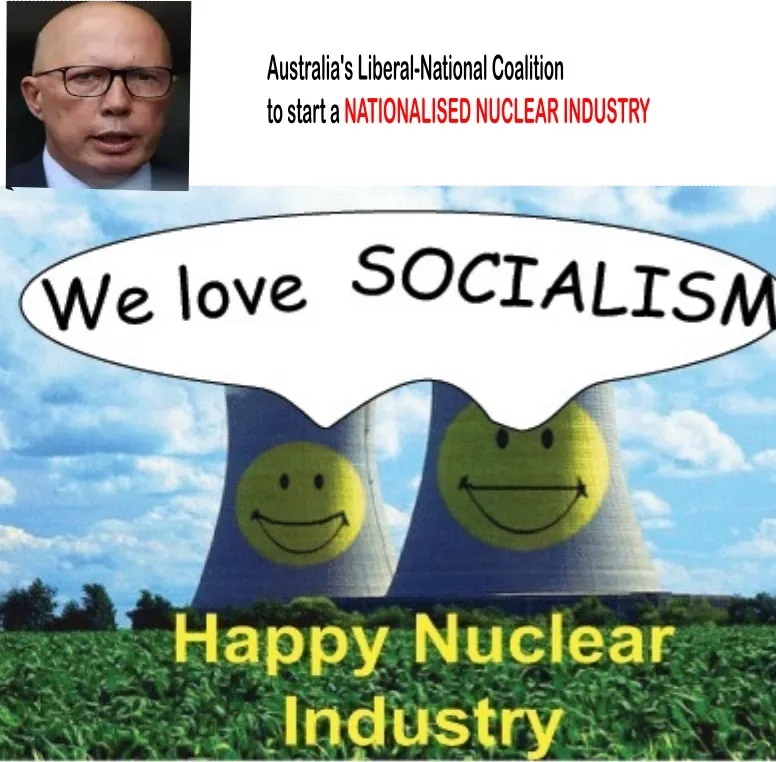
“In fact, under Peter Dutton’s nuclear plan, it won’t be the national energy market, it will be the nationalised energy market, because it will only be funded by the government.
“Now I forgot when the Liberal Party decided to be socialist in how it operates.”
Mr Kean is in a public spat with the federal branch of his party, with Liberal frontbencher Jane Hume suggesting he would be sacked from a Climate Change Authority (CCA) that had been “badly politicised”.
The CCA has modelled the potential impacts of the Coalition’s promise to build seven nuclear power plants by 2050, concluding it would result in an additional 2 billion tonnes of emissions…………………………………………………….
Mr Kean argued smaller reactors as proposed by the Coalition “aren’t even invented yet” and offered no short-term cost relief for consumers.
“People talking about building nuclear today are the same people that are sort of arguing that we should be building a Blockbuster Video complex when Netflix is already here,” he said.
“I don’t think anyone in this audience believes that a nuclear power station that’s not going to be built ’till at least 2035 — and that’s the most heroic assumption anyone has ever said, right? — is going to help anyone with their power bills today.
“It’s just not, OK?”
Senator Hughes said of the Liberal nuclear proposal, “I own it,” prompting Mr Kean to point out: “Not the NSW Liberals.”
Both NSW Liberal leader Mark Speakman and Queensland Liberal Premier David Crisafulli have rejected nuclear as a short-term fix for energy cost and reliability.
‘Poor planning’ on disaster risks
With ex-Cyclone Alfred still posing major a flood risk to parts of Queensland and New South Wales, Mr Kean warned of “whole communities being disrupted” by worsening climate conditions.
“There will be some parts of the coastline, there’ll be some parts that are flood prone, that will be uninhabitable,” he said.
“We need to make sure that we’re protecting those vulnerable people and dealing with the issue of carbon emissions, but also building in policies that help communities adapt to the new reality, which is a changing climate.”………………………………………….. more https://www.abc.net.au/news/2025-03-10/matt-kean-nuclear-energy-liberal-party-slammed-socialist/105033754
Coalition’s Canavan forgets he’s backing nuclear, calls for new coal power as election looms
RenewEconomy Rachel Williamson, Mar 10, 2025
The Coalition just can’t kick its coal habit, with renegade Nationals senator Matt Canavan ignoring the new nuclear talking points to return to his favourite hobby horse: to build new coal power plants.
Canavan made his oft-repeated pitch for new coal power on X, citing a move in Wyoming, USA, to gift $10 million in taxpayer funds for a new coal power station.
But the Australian politician’s contribution to the energy debate was pooh-poohed by Matt Kean, the former New South Wales energy minister and current chair of the Climate Change Authority.
“It appears there is a new update to the Coalition’s energy policy for the coming election: new coal fired power plants in Australia to complement the nuclear power plants. It will be interesting to see the full details on this new “coal first” policy,” Kean deadpanned on X……………………………..
The cost of building new coal is around double the price of wind and solar, even with storage and transmission, according to CSIRO’s GenCost report, which compares the cost of building probable and existing energy sources, as well as nuclear, which is even more expensive………………………………………………………….. more https://reneweconomy.com.au/coalitions-canavan-forgets-hes-backing-nuclear-calls-for-new-coal-power-as-election-looms/
1 This month

of the week – Australians for War Powers Reform (AWPR)
To see nuclear-related stories in greater depth and intensity
 Antinuclear