International ‘nuclear tombs’ are being built, but how do we warn future generations of what’s inside?
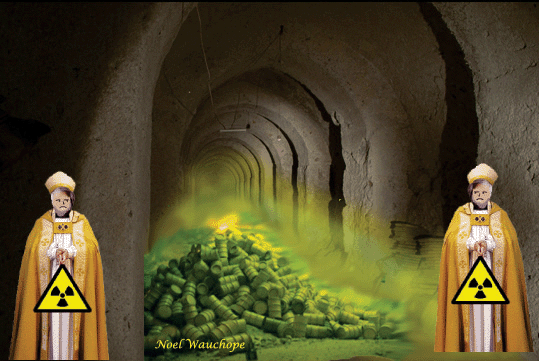
in November 2024, Adelaide residents said they were “blindsided” when federal parliament legislation allowed for nuclear waste to be stored and disposed of at a shipping yard in Osborne — 25 kilometres north-west of the CBD and seaside suburbs.
The plans are part of the $368 billion AUKUS project, which will involve building nuclear submarines in South Australia, and include a commitment from the federal government that it would secure storage for nuclear waste produced.
By Megan Macdonald for Future Tense, 20 Mar 25, https://www.abc.net.au/news/2025-03-20/nuclear-tombs-overseas-offer-warning-for-future-generations/105024144
Earth is no spring chicken.
In fact, based on scientific dating, it’s considered to be 4.5 billion years old.
Coincidentally, that’s also how long depleted uranium (a by-product of the process of enriching uranium for use in nuclear power reactors and weapons) remains dangerous.
And so, as the idea of using nuclear energy as an alternative power source dominates headlines, the safe storage of toxic waste produced by nuclear power and how we warn future generations about its dangers is being considered.
Dr Shastra Deo, a nuclear semiotics expert and author at the University of Queensland, tells ABC Radio National’s Future Tense this is a quandary at the centre of nuclear semiotics.
“Nuclear semiotics is obsessed with this idea of creating a sign to warn us about the dangers of nuclear waste into deep time … The main timeline we’re working with is 10,000 years, but that’s frankly not enough to keep us safe,” she says.
Nuclear on the mind
In June 2024, in response to Australia’s cost-of-living crisis and an upcoming federal election, Opposition Leader Peter Dutton announced his proposal for nuclear power in Australia.
Promising zero emissions and lower power prices, the announcement named seven locations for the nuclear power plants across Australia, which would be built next to existing infrastructure.
These included Mount Piper Power Station in New South Wales, Loy Yang Power Stations in Victoria and Tarong Power Station in Queensland.
While the announcement didn’t include a plan for how the toxic waste produced from nuclear power would be managed, it did state that a community engagement process would occur alongside “a comprehensive site study including detailed technical and economic assessments”.
Mr Dutton’s announcement added that currently, “32 countries [are] operating zero-emissions nuclear plants. Another 50 countries are looking to do so”.
Yet, while nuclear energy is a source of power for many countries, the question of what to do about the highly toxic waste that nuclear energy produces is not settled.
Toxic tension
The rolling hills of France’s Champagne region are known for their green landscapes and quaint villages.
But nearly 500 meters beneath the small village of Bure, France, large tomb-like chambers are being constructed by France’s national radioactive waste agency, Andra, so that they can demonstrate their suitability for building a geological disposal facility (GDF).
GDFs are built to store intermediate to high-level nuclear waste safely for thousands of years.
Andra’s chambers are part of a huge international engineering effort to build giant underground nuclear tombs for waste storage across the United Kingdom (UK) and Europe
Finland was the first country to build a deep GDF to store spent nuclear fuel for 100,000 years, and initial testing has already begun.
Mark Piesing, a UK-based freelance journalist, reported on the European and UK GDF plans last year.
He says GDFs take many years to get approved and built, and their long-term success relies on decades of future political stability.
“The security of them depends on the continuation of governments and states as we know it … If there is a political upheaval, if there [are] revolutions, if climate change brings about social chaos, then the security of these installations will be compromised,” he says.
Mr Piesing visited the Andra testing facility in Bure, France, and he describes the scale of the proposed GDF as “quite awe-inspiring”.
“The scale of it … you could imagine the pharaohs building something similar, the workers working for years,” he says.
While impressive, the construction and plans for GDFs across Europe haven’t been without controversy.
The Andra project underneath Bure, France (with a population of only 82 residents) has sparked protests — some violent — from anti-nuclear activists over the company’s plans to build a GDF for nuclear storage.
In Sweden, the Swedish Nuclear Fuel and Waste Management Company commenced test drilling across the country in the 1980s to find suitable locations for potential nuclear waste storage, a move that didn’t go down well.
“The Swedish authorities perhaps didn’t consult the community enough. So this caused protests in a number of locations where they’re trying to do their test drilling,” Mr Piesing said.
And here in Australia, proposed sites for storage of toxic nuclear waste have also received backlash.
Where would we store nuclear waste in Australia?
The storage of nuclear waste has been a long-held issue of national contention, particularly in South Australia.
In 2023, the Barngarla traditional owners of SA’s Eyre Peninsula won a legal challenge to stop the federal government from building a nuclear waste facility near Kimba.
The plans were to store low and intermediate-level radioactive waste at the proposed facility.
Then, in November 2024, Adelaide residents said they were “blindsided” when federal parliament legislation allowed for nuclear waste to be stored and disposed of at a shipping yard in Osborne — 25 kilometres north-west of the CBD and seaside suburbs.
The plans are part of the $368 billion AUKUS project, which will involve building nuclear submarines in South Australia, and include a commitment from the federal government that it would secure storage for nuclear waste produced.
Ted O’Brien, Shadow Minister for Climate Change and Energy, tells the ABC that the Coalition has a long-term plan for nuclear waste storage if it wins the upcoming election.
“Spent fuel from nuclear power plants will be temporarily stored on-site before being transported to a permanent waste repository, where spent fuel from our AUKUS nuclear submarines will also be stored,” he says.
Mr O’Brien says the permanent site’s location is a matter for the federal government.
The location of the permanent site under the AUKUS deal has not been addressed since late last year by the federal government.
However in January it was revealed by former senator Rex Patrick that documents obtained via Freedom of Information (FOI) show South Australia’s Defence Industries Minister met with a defence company in the UK for the “specific purpose of being briefed” on the dismantling of nuclear reactors and the waste associated with them.
“[The government is] yet to clarify the location … It is now Labor’s responsibility for identifying a long-term waste repository,” Mr O’Brien says.
“We stand ready to cooperate constructively.”.
A warning for generations to come
While the future for Australia’s nuclear waste remains unclear, Dr Shastra Deo says we can look back at history to inform the need for warnings surrounding toxic waste storage for future generations.
“You see the [Egyptian] pyramids and they’re very intriguing to us … There was a warning message on them from one of the pharaoh’s viziers that said, ‘If you intrude on my tomb, I will curse you and you will die,’ — and we went in anyway,” he explains.
“We’re curious people. That’s what humanity is … we want to find out what’s in these spaces.
n Ms Deo’s field of nuclear semiotics, several ideas have been raised to warn future generations of the dangers of toxic waste stored below ground.
These include hostile architecture (an urban design strategy that uses elements of a built environment to purposefully guide behaviour of humans), the use of symbols and an “atomic priesthood” of knowledge keepers.
Rounding out the list is the “black hole” which, as Ms Deo explains, would involve “putting granite over the area and the sun would heat it up to a point where you just couldn’t walk across it”.
Ms Deo says the ongoing challenge lies in the length of time these warnings are required, which can be hundreds of thousands of years.
“How can we create a message that will last this long? Already you can kind of see the impossibility in that.”
Ms Deo says that regardless of the challenges, we must consider our accountability to those who come after us.
“We need to send a message to ourselves about this technology and how we’re going to move forward with it — and how we’re going to store it.”
It’s a question that we’ve yet to answer.
The “Great Era of Nuclear Decommissioning” begins – well, sort of, even in Australia

https://theaimn.net/the-great-era-of-nuclear-decommissioning-begins-well-sort-of-even-in-australia/ 20 Mar 25
Nuclear is big news for Australia. For the coming election, the federal Opposition party – the Liberal-National Coalition, has as its major, indeed, pretty much its only, policy – to establish the nuclear power industry at 7 sites across the continent. At the same time, a Liberal group has sprung up – Liberals Against Nuclear, vowing to ditch that policy.
Meanwhile the AUKUS plan, (beloved of both major parties) to buy super-expensive nuclear submarines, has run into problems, and is at risk of being ditched.
Also now, on March 4th the Australian Nuclear Science and Technology Organisation (ANSTO) announces that it is embarking on a major decommissioning project , getting into the wonderful new Era of Nuclear Decommissioning. This Era was predicted by The Ecologist, back in 2019, but only now is it reported to be getting underway.
Japan, one of the top nuclear nations, has just announced the first dismantling of a commercial nuclear reactor – ‘signifying that the so-called “great era of decommissioning” has begun in earnest in Japan.’ They have another 59 to go (10 cleared for operation, 23 described as “operable” , and 26 shut-down ones).
So what indeed is the “great era of decommissioning”? What does “decommissioning” actually mean?
According to the European Union – “ It involves all activities starting from the shutdown of the facility and the removal of all nuclear material right down to the environmental restoration of the site. The whole process is complex and typically takes 20 to 30 years to complete.“
So, in Japan, they really mean business – “dismantling of the reactor, which began on March 17, is considered the main part of the decommissioning work“
In Australia -not so much. It means that ANSTO, a few weeks ago, got a licence from the Australian Radiation Protection and Nuclear Safety Agency (ARPANSA), to begin Phase A, Stage 1, and is now beginning to remove peripheral equipment from the the 67 year old Hifar nuclear reactor, now 18 years out of action. More Phases and Stages to go.
Both the Japanese and Australian news items give short shrift to that final problem – nowhere to put the radioactive remains. ANSTO’s at pains to stress how small an amount it is “be managed and stored safely onsite at Lucas Heights” . The Japanese article concludes “While Japan has entered an era of decommissioning, decommissioning plans continue to be postponed due to the lack of a finalized waste disposal site.”
The World Nuclear Association goes into much detail on the decommissioning of 700 nuclear reactors, but only a few of these have been completely dismantled, and still no way of permanently disposing of their radioactive remains.
Meanwhile the International Atomic Energy Agency, and the governments of the most powerful nations are all complacently touting the need for new nuclear reactors. Australian authorities, keen to stress Australia’s nuclear know-how are joining in this happy disregard of the importance of dangerous radioactive trash.
That famous old Australian character “blind Freddy” would immediately know that this is an unreasonable and immoral attitude.
The “era of nuclear decommissioning” is not really underway at all. If it were happening, there’d be no more hype about new nuclear. I fear that the sad reality is that the men in charge realise that nuclear decommissioning is just too expensive, too fraught with problems “best to just leave it alone, until we are comfortably superannuated out, or dead. “
Liberal supporters launch election ad campaign against Peter Dutton’s plan to build nuclear power plants
Liberals Against Nuclear say the policy would increase bureaucracy and impose ‘massive taxpayer-backed risk’
Adam Morton Climate and environment editor, 18 Mar 25, https://www.theguardian.com/australia-news/2025/mar/18/liberal-supporters-launch-election-ad-campaign-against-peter-duttons-plan-to-build-nuclear-power-plants
A group of Liberal supporters has launched an advertising campaign against the party’s plan to build taxpayer-funded nuclear power plants, arguing it “betrays Liberal values”, divides the party and “hands government back to Labor”.
The new advocacy group Liberals Against Nuclear says it rejects the Coalition’s policy as it would require the government to borrow tens of billions of dollars, swell the bureaucracy and impose “massive taxpayer-backed risk”.
Peter Dutton’s proposal would involve eventually building nuclear reactors at seven sites across the country, mostly after 2040. In the short term, the Coalition says it would slow the rollout of renewable energy, attempt to extend the life of ageing coal-fired power plants and rely more on gas-fired power.
The Liberals Against Nuclear spokesman is Andrew Gregson, a former Tasmanian Liberal director and candidate who said he was not currently a party member but remained a supporter. He declined to say how many supporters the group had or name other members, but said those involved were concerned the nuclear policy was driving “free market and middle ground voters” to support “teal” and other independent MPs in seats the Coalition must win to return to government.
“We’re trying to save the party from a policy that will gift seats to their opponents,” he said. “Nuclear technology itself isn’t the issue. It’s the socialist implementation being proposed that trashes Liberal values.
“If nuclear energy is so good then the market will back it without massive government intervention.”
The group is running television, digital and billboard ads that argue “many Liberals are against nuclear”. One of the ads shows a woman reading a newspaper article that quotes the Nationals senator Matt Canavan as saying “nuclear fixes a political issue for us but ain’t the cheapest form of power” and cites a report by the Institute for Energy Economics and Financial Analysis that found the Coalition proposal would lead to a $665 increase in average power bills. The ads ask the opposition leader, Peter Dutton, to “please dump nuclear”.
Gregson said they would run across the country and be particularly targeted in marginal seats, including those held by teal MPs. He said the ads were aimed at the party, not voters.
Liberals Against Nuclear said polling had suggested only 35% of Australians backed nuclear energy, and that support collapsed once voters understood the policy details. Its website raises concerns about the policy driving up national debt and creating safety and security risks.
Gregson said dropping the policy would cause the Coalition a “couple of days’ worth of negative publicity” but would not cost it the election. “Nuclear power is the big roadblock preventing the Liberals getting to The Lodge,” he said.
Asked about the campaign on the Seven Network, Dutton said his policy was “based on the international experience” and claimed it would bring electricity costs down by 44% and provide “stability in the market”.
The Climate Change Authority, a government agency, found the Coalition’s proposal would add an extra 2bn tonnes of carbon dioxide to the atmosphere and make it “virtually impossible” for Australia to reach net zero by 2050, a position the opposition claims to support.
Labor has a target of 82% of generation coming from renewable energy by 2030, up from the current level of nearly 45%. The authority said that under the Coalition’s plan there would probably not be 82% of electricity from zero emissions technology – renewables and nuclear – until 2042.
Independent experts have suggested the Coalition policy would likely lead to household power bills being higher than under Labor’s policy as there would be less generating capacity competing in the grid. They have also said it would increase the risk of the electricity supply becoming unreliable at peak times as it was more reliant on old coal power plants that are nearing the end of their expected operating lives.
Peter Dutton interrupted mid-speech by anti-nuclear protesters
By Josh Hohne Mar 20, 2025, 9 News
Opposition Leader Peter Dutton and Shadow Treasurer Angus Taylor have been interrupted by anti-nuclear energy protestors today in Sydney.
Dutton was addressing the Lowy Institute think tank when two protestors began heckling him.
“Why are you lying to the Australian people about the cost of nuclear,” one of the protesters said as he was escorted out by security and federal police.
He held a banner reading “Nuclear lies cost us all”.
After a pause, Dutton continued with his address.
Later in his speech about the Coalition’s election priorities, he was interrupted again by a man speaking from the sidelines……………………………………..
The protesters were part of the Rising Tide environmental group.
“The Coalition’s scheme to force nuclear into Australia’s energy grid is going to cost $600 billion to the taxpayer, add up to $1200 to people’s energy bills, and produce 1.6 billion tonnes of climate pollution by 2050,” Zack Schofield, one of the protesters, said afterwards.
Hours after interrupting Dutton, the same protesters disrupted another press conference, this time forcing Shadow Treasurer Angus Taylor to relocate his media opportunity.
Schofield again interrupted Taylor.
Taylor quickly packed up his team and began relocating to another location.
Dutton and Taylor aren’t the first to be interrupted by protesters this week, with climate activists cutting off Treasurer Jim Chalmers during a pre-budget speech on Tuesday. https://www.9news.com.au/national/peter-dutton-interrupted-mid-speech-protesters-nuclear-energy/eaed0bf8-0e02-4617-b2de-1cab1c419830
1 This month
15 April – Zoom –Nuclear Power is Not the Solution
Apr 15, 2026 01:00 AM in Canberra, Melbourne, Sydney

Join the International Physicians for the Prevention of Nuclear War (IPPNW) on Tuesday, April 14th for a timely webinar exploring the risks associated with nuclear power and challenging the myth that it offers a simple, safe, carbon-free solution to the climate crisis

of the week – Australians for War Powers Reform (AWPR)
To see nuclear-related stories in greater depth and intensity
 Antinuclear