Nuclear Power In Australia: A Little More Conversation?
March 21, 2025 by Michael Bloch, https://www.solarquotes.com.au/blog/nuclear-ban-australia-mb3142/
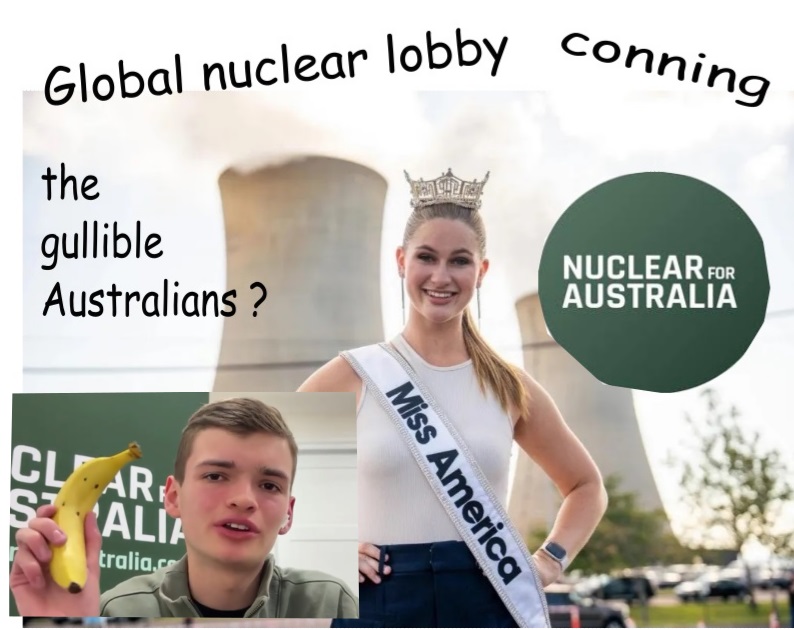
Self-described grassroots movement Nuclear for Australia is calling for policy makers to kick off a science-driven conversation about including nuclear power in Australia’s future energy mix.
The group announced yesterday that more than 100,000 Australians (101,334 at the time of writing) have signed their petition calling for removing a ban on nuclear power here.
Nuclear for Australia was founded in December 2022 and is chaired by the former CEO of Australia’s Nuclear Science and Technology Organisation (ANSTO) Dr Adi Paterson. Also involved with the organisation is founder of Dick Smith Electronics, Dick Smith, who is a patron.

“Australians are tired of distractions and misinformation,”1 said Will Shackel, Founder of the group. “Over 100,000 signatures show that people want nuclear power on the table as a practical solution for Australia’s energy needs.”
As for the call for a science-based conversation on nuclear power, if only there was a suitable organisation policy makers could turn to for pretty reliable information.
How about the CSIRO? It’s in their name: Commonwealth Scientific and Industrial Research Organisation. Science *and* Industrial research – it seems like a suitable candidate to lead this. Now, if only CSIRO would weigh in on the thorny topic.
What’s that you say? They have?
Nuclear Not A Timely, Cost-Competitive Or Efficient Solution
The answer to the question of nuclear in Australia’s electricity sector is answered on this CSIRO page. The CSIRO is pretty clear in its view, last updated in early December 2024.
- Currently, nuclear power doesn’t offer the most cost-competitive solution for low emission electricity in Australia.
- Long development lead times mean nuclear can’t make a significant contribution to achieving net zero emissions by 2050.
- While nuclear power plants have a long operational life, this offers no unique cost advantage over shorter-lived technologies.
CSIRO’s draft2 GenCost 2024-25 Report found renewables continue to have the lowest cost range of any new build electricity generation technologies (for the seventh year in a row). That’s including the cost of firming – taking into consideration storage, transmission, system security and “spilled” energy.
Reversing The Ban A Pointless Distraction
As for other countries pursuing nuclear power; some are setting a good example of what *not* to do in Australia – and that is pursue nuclear energy.
A recent example is the latest reported cost blow-out for the UK’s proposed Sizewell C nuclear plant3; which has doubled since 2020 to around $80 billion Australian dollars. Along with large-scale firmed renewables, that could buy a lot of rooftop solar power systems and home batteries.
According to the Institute for Energy Economics and Financial Analysis (IEEFA), Sizewell C’s current estimated costs are about 2.5 times the capital cost used in the Coalition’s modelling for its nuclear dreams in Australia.
“For an Australian nuclear plant with similar costs to those reported for Sizewell C to be commercially viable, average household power bills would need to increase by between $561 and $961 per year,” states IEEFA.
It makes the electricity price rises on the cards for many Australians in 2025/26 seem like chump change.
As for mature and scientific conversation, we can do that until the cows come home and we have been; along with plenty of other types of conversations (including some here on SQ). But it’s not really a complicated thing to grasp – reversing a ban wouldn’t change the fact that:
Nuclear power is too expensive for Australia.
But cost alone isn’t a good reason for maintaining a ban. So what harm is there in removing it?
Given all the other issues associated with nuclear energy when there are more appropriate solutions already good to go and being implemented (renewables), just going through the motions and its impacts would turn into a huge time-sucking exercise and dangerous distraction. Time is a luxury we don’t have given all the faffing about with fossil fuels over the years – and that would be extended too.
To have nuclear power on the table as an energy solution in Australia, you’d first need to scrape it off the floor. Maintaining the ban helps save us from ourselves.
Never forget’: Pacific countries remember nuclear test legacy as weapons ban treaty debated.

Supporters of the UN treaty prohibiting nuclear weapons gathered this month in New York to call for wider ratification
Jon Letman, Guardian, 21 Mar 25
Growing up in the Pacific nation of Kiribati, Oemwa Johnson heard her grandfather’s stories about nuclear explosions he witnessed in the 1950s. The blasts gave off ferocious heat and blinding light. He told her people were not consulted or given protective gear against bombs detonated by the US and UK at Kiritimati Island, now part of Kiribati, decades ago.
People in Kiribati suffered grave health consequences as a result of exposure to radiation from the tests in the late 1950s and early 1960s, a legacy they say continues to this day. Johnson says there’s a lack of accountability and awareness of how nuclear testing by foreign countries has harmed her people and homeland.
“It doesn’t matter if they’re very small island nations, their stories matter,” the 24-year-old says.
Between 1946 and 1996, the US, the UK and France conducted more than 300 underwater and atmospheric nuclear tests in the Pacific region, according to Pace University International Disarmament Institute. Kiribati, French Polynesia, and the Republic of the Marshall Islands were among the most affected.
For decades the countries have called for justice for the ongoing environmental and health impacts of nuclear weapons development. The push intensified this month as supporters of the UN treaty on the prohibition of nuclear weapons (TPNW) – including many from Pacific nations – met to discuss the treaty and call for wider ratification.
The treaty imposes a ban on developing, testing, stockpiling, using or threatening to use nuclear weapons – or helping other countries in such activities. It entered into force in 2021 and has 98 countries as parties or signatories. In the Pacific region 11 countries have backed the treaty. Treaty supporters want universal global support but many countries – including the US, the UK and France – oppose the treaty.
The nine nuclear armed countries argue that nuclear weapons are critical to their security. Likewise, Nato nations, Japan, South Korea and others are not yet party to the treaty. Australia, where the UK conducted nuclear tests in the 1950s, has not ratified the TPNW despite the prime minister, Anthony Albanese, saying in 2018 that Australia would do so the treaty when his party was in power…………………………..
‘Nuclear risks rising’
Against this backdrop, politicians, activists and other representatives gathered at UN headquarters in New York this month for week-long discussions on how to secure more support for the TPNW.
Hinamoeura Morgant-Cross, a representative of the French Polynesia assembly, was among the parliamentarians. She says her family was significantly affected by French nuclear detonations at Moruroa and Fangataufa atolls between 1966 and 1996. Morgant-Cross told the forum high rates of radiation-induced cancer in her family had motivated her to become an anti-nuclear activist and assembly member.
“It started with my grandma with thyroid cancer,” she said. “Then her first daughter – my auntie – with thyroid cancer. She also got breast cancer. My mom and my sister have thyroid disease. I got chronic leukemia when I was 24 years old. I’m still fighting against this leukemia.”
New Zealand’s UN representative in Geneva, Deborah Geels, stressed the treaty’s “special importance in the Pacific”, warning: “Tensions between nuclear-armed states and nuclear risk are rising, and no region is immune – even the South Pacific.”……………………………….. more https://www.theguardian.com/world/2025/mar/21/never-forget-pacific-countries-remember-nuclear-test-legacy-as-weapons-ban-treaty-debated
‘Vandals in the White House’ no longer reliable allies of Australia, former defence force chief says
Henry Belot and Ben Doherty, Guardian, 21 Mar 25
Chris Barrie says Donald Trump’s second term is ‘irrecoverable’, but stops short of calling for end to Aukus pact.
A former Australian defence force chief has warned “the vandals in the White House” are no longer reliable allies and urged the Australian government to reassess its strategic partnership with the United States.
Retired admiral Chris Barrie spent four decades in the Royal Australian Navy and was made a Commander of the Legion of Merit by the US government in 2002. He is now an honorary professor at the Australian National University.
“What is happening with the vandals in the White House is similar to what happened to Australia in 1942 with the fall of Singapore,” Barrie said. “I don’t consider America to be a reliable ally, as I used to.
“Frankly, I think it is time we reconsidered our priorities and think carefully about our defence needs, now that we are having a more independent posture … Our future is now in a much more precarious state than it was on 19 January.
“Trump 1.0 was bad enough. But Trump 2.0 is irrecoverable.”
Barrie said it was “too soon” to say whether Australia should end its multibillion-dollar Aukus partnership, but raised concerns about a lack of guarantee that nuclear-powered submarines would actually be delivered. He also warned about an apparent lack of a back-up option.
Pillar One of the Aukus deal – which would see the US sell Australia nuclear-powered submarines before the Aukus-class submarines were built in Australia – is coming under increasing industry scrutiny and political criticism, with growing concerns the US will not be able, or will refuse, to sell boats to Australia, and continuing cost and time overruns in the development of the Aukus submarines.
“Let’s define why we really need nuclear submarines in the first instance, given a new independent defence posture for Australia,” Barrie said. “If they still make sense in that context, fine. But they might not. There might be alternatives. There might be alternatives with conventional submarines if we didn’t want to go any further than the Malacca Straits.”
Barrie’s warning comes after former foreign affairs minister Bob Carr said Australia would face a “colossal surrender of sovereignty” if promised US nuclear-powered submarines did not arrive under Australian control.
Carr, the foreign affairs minister between 2012 and 2013, said the Aukus deal highlighted the larger issue of American unreliability in its security alliance with Australia.
“The US is utterly not a reliable ally. No one could see it in those terms,” he said. “[President] Trump is wilful and cavalier and so is his heir-apparent, JD Vance: they are laughing at alliance partners, whom they’ve almost studiously disowned.”………………………. https://www.theguardian.com/australia-news/2025/mar/21/vandals-in-the-white-house-no-longer-reliable-allies-to-australia-former-defence-force-chief-says-ntwnfb?CMP=share_btn_url
Liberals must abandon unpopular nuclear policy and return to winning formula
Liberals Against Nuclear, 21 Mar 25
The Liberal Party’s conspicuous silence on nuclear energy in its advertising confirms the policy does not have internal party support, is electoral poison and must be dumped.
The Liberal Party’s conspicuous silence on nuclear energy in its advertising confirms the policy does not have internal party support, is electoral poison and must be dumped.
An analysis of Meta’s advertising library published today in the Nine newspapers reveals the Liberal Party has not used the word “nuclear” in any of its 24 paid social media advertisements currently running, having last funded promotion of its nuclear power policy in November 2024. Additionally, it was revealed earlier this week that only nine of the Coalition’s candidates for the upcoming election are promoting nuclear energy on their campaign websites.
“The Liberal Party’s actions speak louder than words,” said Andrew Gregson, spokesperson for Liberals Against Nuclear. “They avoid mentioning nuclear in their advertising because they know voters don’t want it. If the party leadership knows this policy is unpopular enough to hide from voters, they should abandon it so they can win the election and put Peter Dutton in the Lodge.
Recent Resolve Political Monitor polling shows just 21 percent of voters favor government subsidies for nuclear energy.
“The party’s silence on nuclear in its advertising suggests internal polling matches what we’re seeing publicly – nuclear is a losing proposition. People just don’t want to be lumbered with public debt and massive government intrusion.”
Liberals Against Nuclear is calling on party leadership to return to the winning formula that has historically delivered electoral success for the Liberal Party: lower taxes and strong borders.
“The Liberal Party knows how to win elections – by focusing on economic management through tax relief for hardworking Australians and ensuring our national security through strong border protection,” Gregson said.
“The absence of nuclear policy from almost all candidate websites says loudly what no one wants to say out loud – candidates know it’s either electoral poison in their electorates or, more likely, they realise the building and running seven government-owned nuclear plants is a terrible policy that contradicts core liberal values. Building a massive socialist project will force them to raise taxes, grow the debt, and have government running an enterprise that belongs in the private sector. It’s a bit awkward when your signature policy – nuclear – is the one policy you’re trying to avoid. The simple answer is to dump it
“Voters are desperate for immediate relief on power bills, not a $600 billion nuclear scheme that delivers nothing for decades. The Liberal Party should focus on immediate tax relief for struggling families and businesses while developing practical energy solutions that align with liberal values of smaller government and free markets.
“If the Liberal Party leadership feels they have to hide this policy in their advertising, they should take the next logical step and formally abandon it before it costs them the election.”Media contacts:
Andrew Gregson +61 432 478 066
www.liberalsagainstnuclear.au
1 This month
7 April – WEBINAR – Australia and the Doomsday Clock – Preventing nuclear war through NoFirstUse and other policies
Online | Tuesday April 7, 4:00-5:30pm, Australian Eastern Time / 8:00-9:30am Central Europe Time
– Access the registration link
15 April – Zoom –Nuclear Power is Not the Solution
Apr 15, 2026 01:00 AM in Canberra, Melbourne, Sydney

Join the International Physicians for the Prevention of Nuclear War (IPPNW) on Tuesday, April 14th for a timely webinar exploring the risks associated with nuclear power and challenging the myth that it offers a simple, safe, carbon-free solution to the climate crisis

21 April Webinar: No Nuclear Weapons in Australia
Start: 2026-04-21 18:00:00 UTC Canberra, Melbourne, Sydney (GMT+10:00)
End: 2026-04-21 19:30:00 UTC Canberra, Melbourne, Sydney (GMT+10:00)
Event Type: Virtual
A virtual link will be communicated before the event.
Host Contact Info: australia@icanw.org

of the week – Australians for War Powers Reform (AWPR)
To see nuclear-related stories in greater depth and intensity
 Antinuclear