Energy election: How nuclear power is already costing Australians
The New Daily Ken Baldwin, Mar 24, 2025,
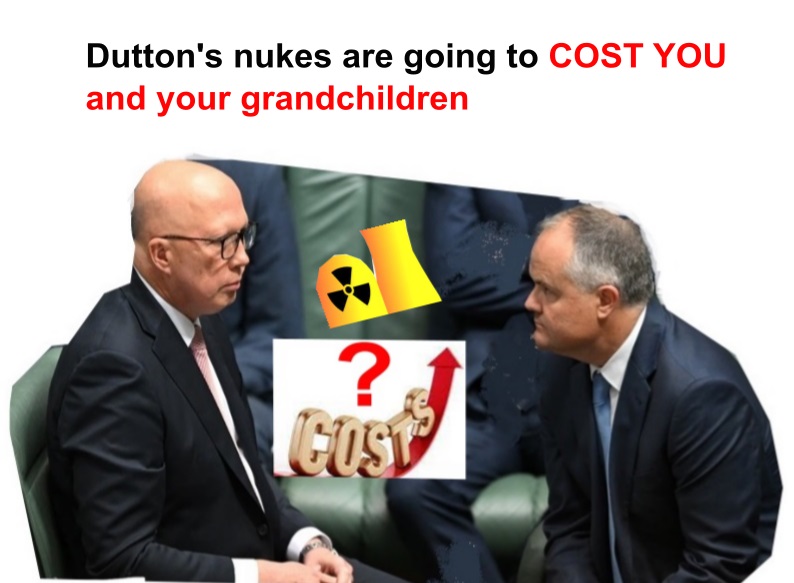
Taxpayers have already paid a price for the political division over Australia’s energy future — and now the Coalition’s nuclear policy is effectively hitting their hip pocket even before voters get their say on whether it’s part of the nation’s energy transition.
All Australians pay for the lack of a bipartisan approach to meeting national and global emissions targets. This is because uncertainty creates risk for investors and this risk adds a premium to the financing costs of energy megaprojects — a cost that has to be recouped.
Throwing the Coalition’s nuclear plans into that mix just fuels the uncertainty even before analysis of which path is the cheaper, more appropriate or most timely for our energy transition……………………..
Where are we now?
In the lead-up to the federal election, Australia again finds itself at a party-political crossroads in its response to climate change.
Despite more than a decade of debate driven by political parties, we still have no unified approach on energy or reaching emissions targets. This election we still have to choose between two pathways to decarbonise Australia’s electricity sector.
The Labor government is maintaining its target of 82 per cent renewable electricity by 2030, even though the trajectory is under some strain. Renewable installations have plateaued, even if 2024 is expected to show a record 4.3 gigawatts of approved large-scale solar and wind projects and 3.2GW of small-scale rooftop solar installed.
The reason for the slowdown is complex but is partly caused by connection difficulties for large-scale renewables and community pushback on transmission lines and wind and solar farms.
The Coalition plan
The Coalition has the same 2050 net-zero goal as Labor but has yet to provide interim targets.
It has instead promised to include nuclear power as part of the energy mix, starting with two small modular reactors, which are typically under 300 megawatt capacity, to come online in 2035 in South Australia and Western Australia.
No commercial small modular reactors have been built in the Western world and the only examples are in China and Russia.
If large-scale reactors are shown to be the better option, the Coalition plans for these to start producing electricity from 2037 in two locations in each of Queensland and NSW and one in Victoria.
There are also doubts the Coalition’s nuclear timetable is achievable. International experience shows that recent construction times in the West far exceed a decade, although in countries like the United Arab Emirates with different regulatory and governance systems it’s under nine years……………………
Realistically, if the Coalition started a nuclear energy program after the 2025 election, nuclear power stations could not be expected to start producing electricity in Australia until the 2040s.
This would be a problem for a Coalition government wanting to build nuclear plants to replace ageing coal-fired power stations on the same site.
The Australian Energy Market Operator projects all coal-fired power stations will have retired by 2037 — 90 per cent of them within a decade. Under this scenario, solar and wind will have replaced all coal-fired power stations well before 2040.
And if the Coalition plans to subsidise coal plants to extend their life, then reaching the 2050 net-zero emissions target will become much harder.
The emissions realities
Modelling by Frontier Economics for the Coalition uses the ‘Progressive Change’ scenario — one of three scenarios used by AEMO for Australia’s energy transition — which will take longer to decarbonise the electricity sector than the ‘Step Change’ scenario favoured by Labor.
The result will be greater emissions for the planet. Recent modelling by the Climate Change Authority calculated that the Coalition nuclear plan would yield at least an additional two billion tonnes of emissions, consistent with a global pathway to 2.6 degrees warming and missing Australia’s 2030 Paris emissions reduction commitment (43 per cent) by more than 5 per cent.
There are also doubts around the Coalition’s claims its plans are cheaper.
The Frontier Economics modelling says yes, largely because of savings from delaying coal plant closures, the additional systems costs for renewables and the shorter lifetimes of wind and solar plants.
The most recent CSIRO-AEMO GenCost annual report disagrees. It takes into account all the factors that Frontier Economics says makes nuclear cheaper — and still comes out with nuclear being twice as expensive as renewables, consistent with similar studies overseas.
It also doesn’t include the government subsidies needed to encourage Australia’s ageing coal-fired power stations to limp along until the 2040s.
Those coal-fired stations will have reluctant owners competing head-to-head with much cheaper renewables, particularly during the middle of the day when solar could literally eat both coal and nuclear’s lunch.
The choice for voters therefore boils down to this: A continuation of our energy transition to cheaper renewables already underway to keep below 2 degrees; or an uncertain nuclear future from 2040 resulting in more emissions and default on our Paris targets…………………….. https://www.thenewdaily.com.au/finance/consumer/2025/03/24/energy-election-nuclear
—
Shadow Treasurer Angus Taylor appears to struggle sharing cost of Coalition’s nuclear policy
Shadow Treasurer Angus Taylor appeared to repeatedly stumble over the cost of the Coalition’s flagship nuclear policy.
Jessica Wang, March 23, 2025, news.com.au
Shadow Treasurer Angus Taylor has repeatedly refused to directly answer questions around the cost of the Coalition’s nuclear policy, in a confusing pre-budget interview on the Opposition’s flagship policies.
Appearing on ABC’s Insiders on Sunday, Mr Taylor was repeatedly questioned by host David Speers on the cost of the Coalition’s plan to build seven state-owned reactors by 2050, with the first two reactors set to come online by 2035.
Despite the Opposition releasing its costing policies conducted by Frontier Economics in December, which said the Coalition’s energy plan would cost $331bn, Mr Taylor repeatedly avoided giving a figure.
Instead he stuck to the Coalition’s attack lines, stating: “44 per cent less than the alternative (Labor’s plan)”.
“I’m just asking what it’s going to cost Australia to build nuclear power?” said Speers, for asked Mr Taylor for the costing details 14 times.
Sharing multiple variations of the same answer during the three-minute grilling, Mr Taylor responded with: “44 per cent less than the alternative,” before comparing the costings between the two policies.
The Frontier modelling suggested the total cost of Labor’s policy, which includes its renewables rollout, transmission lines and gas would cost about $642bn to 2050, figures Labor has rejected.
The figures contradicts $122bn figure put forward by the Australian Energy Market Operator, which covers generation, storage and transmission infrastructure……………………………………………………. https://www.news.com.au/national/politics/shadow-treasurer-angus-taylor-appears-to-struggle-sharing-cost-of-coalitions-nuclear-policy/news-story/cd3cd5cf13ea68b8fc33fb7bd80c0ea4
1 This month
15 April – Zoom –Nuclear Power is Not the Solution
Apr 15, 2026 01:00 AM in Canberra, Melbourne, Sydney

Join the International Physicians for the Prevention of Nuclear War (IPPNW) on Tuesday, April 14th for a timely webinar exploring the risks associated with nuclear power and challenging the myth that it offers a simple, safe, carbon-free solution to the climate crisis

of the week – Australians for War Powers Reform (AWPR)
To see nuclear-related stories in greater depth and intensity
 Antinuclear