Campaign against nuclear heats up with attack ads aiming at hip pocket
Rachel Williamson, Mar 27, 2025 https://reneweconomy.com.au/campaign-against-nuclear-heats-up-with-attack-ads-aiming-at-hip-pocket/
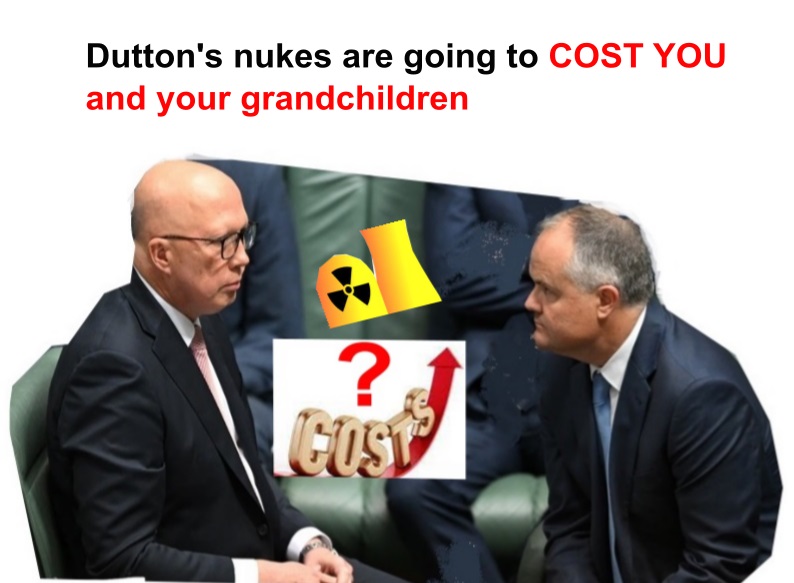
The 2025 federal election will be all about cost of living pressures, and that is exactly where the Smart Energy Council is aiming with a $1 million spend to tell Australians how much their power bills will go up if Dutton’s nuclear dreams come to fruition.
If the Coalition’s price tag of $600 billion for seven reactors is correct – and there are plenty who dispute it – then in today’s money that comes to $30,000 per Australian taxpayer, Smart Energy Council CEO John Grimes said in a statement.
That figure doesn’t take into account the higher power bills Australians will need to pay in order to fund the reactor rollout, he says.
Their accounting suggests that households without rooftop solar will see a potential power bill increase of an average of $665 a year, while households with rooftop solar can expect a bill increase as high as $1400 a year.
Last year, the Smart Energy Council estimated rooftop solar would need to be off for about 67 per cent of the year to make room for the proposed 14 gigawatts (GW) of nuclear power, a fact the nuclear lobby has already accepted.
In June last year Robert Barr, a member of the lobby group Nuclear for Climate, told the ABC that rooftop solar would need to make way for nuclear.
“I think what will happen is that nuclear will just tend to push out solar,” he said.
“I think it wouldn’t be that difficult to build control systems to stop export of power at the domestic level. It’d be difficult for all the existing ones but for new ones, it just might require a little bit of smarts in them to achieve that particular end — it can be managed.”
Given the “white hot rage” of consumers faced with the introduction of emergency stop buttons in South Australia, Victoria, Queensland and now New South Wales (NSW), it’s fair to say the nuclear lobby has underestimated how attached Australians are to their rooftop solar systems.
To give an idea of what they’re up against, the nuclear lobby is today pitting itself against the little over a third of Australia households who already have rooftop solar.
Slightly more than half of houses in Queensland have rooftop solar, the highest penetration in Australia. In South Australia it’s almost half, Western Australia has 45 per cent of homes topped by solar and in NSW it’s 35 per cent, according to a Climate Council report last year.
“Australians will be outraged to know that despite investing thousands of dollars to increase their energy independence and slash power bills, they’ll be forced to pay for their panels to be switched through nuclear power,” Grimes says.
This election is a sliding door moment for millions of Australians that have invested in renewable energy.”
Grimes points out that under the Coalition’s proposal nuclear power plants would be commercially protected, while there is no such law for Australians who’ve invested in rooftop solar systems.
Dutton’s nuclear plan would see large scale renewables capped at 54 per cent of the grid, compared to the minimum-82 per cent target currently in place under the Labor government.
But that would do harm to all Australians, regardless of whether they have been able to install their own solar system, says a report today from the Clean Energy Investor Group.
It found that in 2024, without wind, solar and battery storage, Australian households and businesses would have faced wholesale electricity prices up to between $30/MWh and $80/MWh higher than they actually were in 2024, and paid an estimated $155 – $417 more for household electricity bills.
But it also found that without rooftop solar the 2024 cost of electricity would have increased by a whopping $400-$3,000/MWh.
No comments yet.
1 This month
15 April – Zoom –Nuclear Power is Not the Solution
Apr 15, 2026 01:00 AM in Canberra, Melbourne, Sydney

Join the International Physicians for the Prevention of Nuclear War (IPPNW) on Tuesday, April 14th for a timely webinar exploring the risks associated with nuclear power and challenging the myth that it offers a simple, safe, carbon-free solution to the climate crisis

of the week – Australians for War Powers Reform (AWPR)
To see nuclear-related stories in greater depth and intensity
 Antinuclear
Leave a comment