The Australian Electoral Commission is having words with Nuclear for Australia as the group spends $100,000s on its campaign.
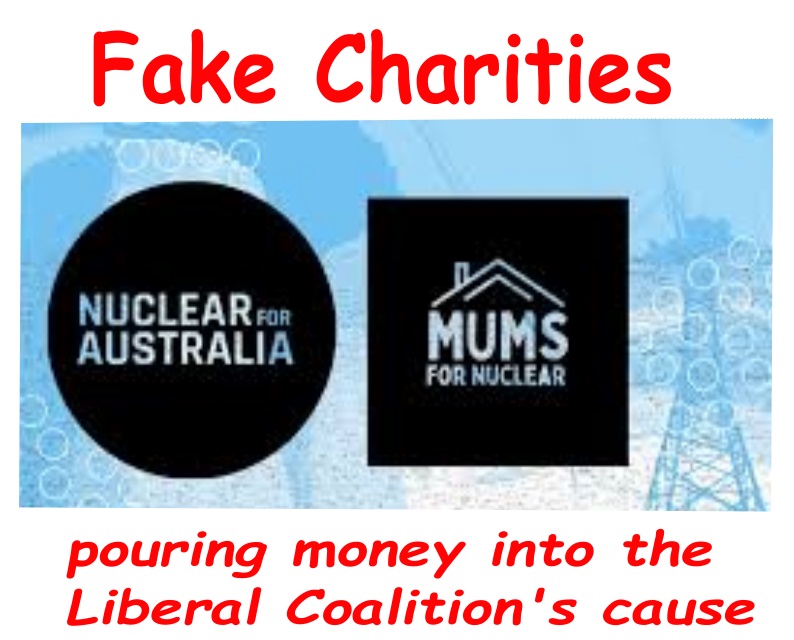
A ‘non-partisan’ pro-nuclear lobby group has ramped up its spending ahead of the federal election — but has not declared what spending is on ‘electoral matters’.
Cam Wilson, Mar 28, 2025, https://www.crikey.com.au/2025/03/28/nuclear-for-australia-mums-for-nuclear-aec-campaign-spending/
Australia’s election regulator has reminded a Nuclear for Australia-affiliated group of its legal obligations, as the pro-nuclear lobby group spends hundreds of thousands of dollars to support a policy promoted by the Coalition.
In the past week, “Mums for Nuclear” ran more than $16,000 of Facebook and Instagram advertisements, in addition to a newspaper advertisement in The Age. None featured electoral authorisations, although the digital advertisements were classified as pertaining to “social issues, elections or politics” on Meta’s platform.
The group is an offshoot of Nuclear for Australia (NfA), a purportedly “nonpartisan” group started by then 16-year-old Will Shackel in 2022. Last year, Crikey reported that the group’s website listed Liberal Party-linked “digital political strategist” James Flynn as an author on some of its content. Flynn had also liked the group’s tweets on his personal account and criticised Labor’s energy policy on Sky News.
Nuclear for Australia did not respond to repeated requests for comment.
Since then, there have been other connections between NfA and Liberal politicians. Tony Irwin, one of its “expert working group” members, appeared at an August Liberal Party state fundraising event. Lenka Kollar, who featured in Mums for Nuclear’s newspaper advertisement and is also on NfA’s expert group, leads a firm that reportedly ran a “grassroots community engagement program” for shadow minister for climate change, energy, energy affordability and reliability Ted O’Brien.
In the lead-up to the federal election, NfA has emerged as one of the loudest advocacy groups on energy and climate policy, kicking off a blitz of advertising. In the past 90 days, the group has spent more than $156,575 on Meta ads on its account (out of $195,002 spent since it started). In January, the group paid for Miss America 2023, Grace Stanke, to come to Australia and do a publicity tour promoting nuclear energy. The campaign was promoted by PR agency Markson Sparks!’ Max Markson.
The group says it received charity status in March 2024 and that, up to that point, its primary funding was from patron Dick Smith, “who covered establishment legal fees and our founder’s trip to COP28”. In March this year, Smith claimed he had donated “more than $80,000” to the group and previously said in July 2024 that it was “more than $100,000”.
Since NfA received charity status, it has accepted donations from the public. Shackel says the group does not “accept funds from any political party, nor any special interest group, including the nuclear industry, including any think tanks”.
A financial statement filed with the charity regulator states that the group received $211,832 in donations and bequests between October 31, 2023, and June 30, 2024. In that time, the group spent $125,489 on “other expenses/payment”, which does not include employee salaries or payments.
However, the group did not file an AEC third-party return for this period. According to the AEC, any group that spent more than $12,400 on “electoral expenditure” in the 2023-24 financial year would be required to disclose its expenditure and donors. Whether NfA would qualify is unclear. The group has an electoral authorisation on its website and social media accounts.
Out of the $125,000 the group spent that year, it’s unknown how much — if any — is considered “electoral expenditure”. The AEC defines this as expenses with the dominant purpose of creating and communicating electoral matters to influence the way electors vote in a federal election. Complicating this further, charities like NfA are allowed to advocate on policy issues but can be deregistered for promoting or opposing a party or candidate.
The AEC can investigate and warn groups it suspects have not correctly authorised communications about an electoral matter. An AEC spokesperson did not disclose whether it considered Mums for Nuclear’s advertisement to be on an electoral matter, only that it had communicated with the group.
“The AEC is addressing disclosure and authorisations considerations directly with the entity Mums for Nuclear. Should this entity be required to register as a significant third party or an associated entity, they will appear on the AEC’s Transparency Register,” they said.
No comments yet.
1 This month
15 April – Zoom –Nuclear Power is Not the Solution
Apr 15, 2026 01:00 AM in Canberra, Melbourne, Sydney

Join the International Physicians for the Prevention of Nuclear War (IPPNW) on Tuesday, April 14th for a timely webinar exploring the risks associated with nuclear power and challenging the myth that it offers a simple, safe, carbon-free solution to the climate crisis

of the week – Australians for War Powers Reform (AWPR)
To see nuclear-related stories in greater depth and intensity
 Antinuclear
Leave a comment