Littleproud’s great pretence on nuclear insurance, as sparkies attack Coalition nuke proposals
Ketan Joshi, Apr 2, 2025, https://reneweconomy.com.au/littleprouds-great-pretence-on-nuclear-insurance-as-sparkies-attack-coalition-nuke-proposals/
Just prior to the election being called, Nationals leader David Littleproud was pressed on ABC’s Radio National breakfast on whether insurance costs were included in the modelling exercise putting a dollar figure on the Coalition’s nuclear plans.
It has been tough for the Coalition: nuclear power is notoriously expensive, and so trying to present a narrative of it being cheap has been tricky. Littleproud had a confident answer in response to being challenged about insuring nukes:
“Well, as many countries around the world do that is actually factored in and in fact, self insurance is normally what they undertake. So it’s not a significant amount of anything that goes into the running cost”.
The majority of the Coalition’s claims regarding nuclear power come from a December 2024 report published by Frontier Economics, which itself has been widely criticised by experts.
It pulls off the trick of presenting an expensive approach to energy transition as cheap by a variety of accounting tricks, previously covered at RenewEconomy. But what it doesn’t seem to do is actually incorporate the costs of insurance, as claimed by Littleproud.
In fact, the Frontier Economics modelling does not mention insurance at all. Not in any context, or even in passing, or in footnotes (nor is it mentioned in the Coalition’s ‘blueprint‘). The Frontier report simply declares an assumption about the capital costs of nuclear power ($10,000 per kilowatt). RenewEconomy emailed Frontier asking for more details, but received no response.
The 2024-25 CSIRO GenCost consultation draft does contain an assumption around the insurance costs of nuclear, and ultimately concludes that “nuclear power does not currently provide the most cost competitive solution for low emission electricity in Australia”, and that “while nuclear technologies have a long operational life, this factor provides no unique cost advantage over shorter-lived technologies”. Notably, GenCost actually assumes a problematically low cost for nuclear power, as discussed here recently.
It is bad enough that Littleproud seems to be making a false claim about it being ‘factored in’ to the modelling, but insuring extremely risky technologies prone to massive cost blowouts and very vulnerable to worsening climate disasters is not going to be cheap.
This ain’t no April fools: Nuclear support melts down in proposed nuclear communities.

These communities weren’t asked if they want nuclear reactors in their backyard, and have been told it’s happening whether they like it or not.
“Proposed nuclear communities are asking key questions about nuclear reactors which have not been answered: Where is the water coming from? Where is the waste being stored? Where is the detail?“
These communities weren’t asked if they want nuclear reactors in their backyard, and have been told it’s happening whether they like it or not.
“Proposed nuclear communities are asking key questions about nuclear reactors which have not been answered: Where is the water coming from? Where is the waste being stored? Where is the detail?
https://www.re-alliance.org.au/nuclear_support_melting_down, 1 April 2025
Nuclear support has melted down in proposed nuclear communities, new polling released by a not-for-profit organisation working with regional communities for more than a decade, RE-Alliance, revealed today.
Energy attitudes polling by respected research firm 89 Degrees East and commissioned by the Renew Australia for All campaign has revealed support for building nuclear reactors at just:
- 27% in Gladstone
- 24% in the rest of Central Queensland
- 24% in Bunbury
- 22% in Central West NSW which includes Lithgow
- 32% in Hunter
- 31% Gippsland.
Further, the same polling showed just 13% of people polled thought nuclear reactors would bring down their bills the fastest (see table below on original ).
The sample size for the polling was 200 local residents in Gladstone, 151 in Central West NSW, 151 in Bunbury, 145 in Central Queensland excluding Gladstone, 301 in Hunter, 300 in Gippsland. Those polled were asked: How do you feel about developing large-scale nuclear energy infrastructure?
RE-Alliance National Director, Andrew Bray, said he was not surprised support for nuclear had bombed, because community engagement is key.
“RE-Alliance stands by the principle that all energy developments in regional Australia need broad community support – whether it’s for solar, wind, batteries, coal, coal seam gas or nuclear reactors,” Mr Bray said.
“Support for nuclear reactors seems to be melting down in the regions who’ve been told they are hosting them.”
These communities weren’t asked if they want nuclear reactors in their backyard, and have been told it’s happening whether they like it or not. Community engagement is by no means easy, but you’ve got to at least try. It’s no surprise support is so low.
“Proposed nuclear communities are asking key questions about nuclear reactors which have not been answered: Where is the water coming from? Where is the waste being stored? Where is the detail?
“Communities also don’t believe that nuclear power is capable of bringing down their energy bills anytime soon and see renewable energy solutions as a better bet. 72% of people said renewables would bring down bills faster, compared to just 13% who said nuclear.
“We see multiple polls from Porter Novelli, CSIRO, 89 Degrees East and more showing strong support for renewable energy on local farmland, between 66% and 71%. Now the polling shows us support for nuclear reactors in these regions is between 22% and 32%.
“Regional communities have enough uncertainty already. Let’s stop with the whiplash and stay the course on a shift to renewable energy which is already almost halfway done.”
Full results of the two poll questions can be found in the Appendix below (on original).
Note: The difference between a poll and a survey is survey respondents select themselves whereas respondents to a poll are selected by the pollster, weighted so the sample accurately represents the population being sampled, by gender, age group, occupation, and so on.
The Australian Press Council’s Advisory Guideline on Opinion Polls says:
“Editors and reporters should carefully evaluate whether to report online surveys, having regard to their scope and methodology. They should be cautious of open-access online polls where the sample size and the exact questions asked are unknown and the results have been generated by self-selecting respondents.”
Media contact: Kitty Walker 0438900117 kitty@re-alliance.org.au or media@re-alliance.org.au
Methodology
The polling was administered online with recruitment sourced from a consumer opt-in panel provided by Pure Profile, weighted to ensure a representative sample in line with ABS proportions for age, gender and location.
This study was conducted by the research firm 89 Degrees East as part of a larger poll with a total sample size of 5,952 Australians. The sample included a nationally representative poll of 2,014 Australians, with an additional boost sample of 1,900 Australians residing in Renewable Energy Zones (REZs). To ensure robust representation within each REZ, quotas and targeted postcode sampling boosts were applied.
The confidence level of the general population sample is +/- 2.14% at the 95% confidence level. Fieldwork was conducted by 89 Degrees East in March 2025. 89 Degrees East is a member of The Research Society of Australia and the Australian Polling Council.
Nuclear campaigners target mothers
CommsDeclare, March 26, 2025
If you’re a middle aged female with an interest in solar power, nuclear campaigners want you.
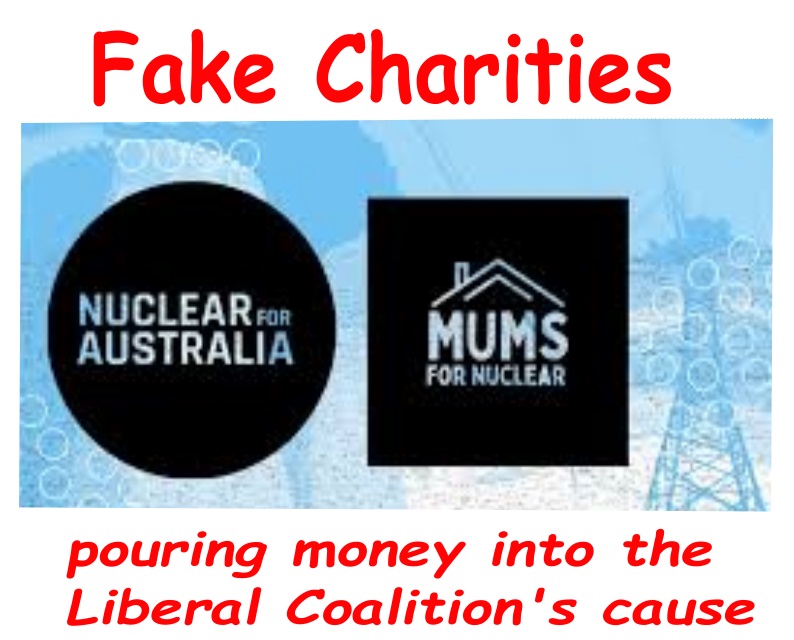
In the week 15th to the 21st of March, Nuclear for Australia and its offshoot astroturfing group, Mums For Nuclear, spent a combined $89,233 on Meta ads, according to online political database WhoTargets.Me.
Mums for Nuclear targets mothers with claims that nuclear power will reduce power bills and is essential to a “clean energy future for our children”. The ads claim “We’re not activists or lobbyists, but we know nuclear is our future”. Nuclear for Australia, which is backed by mogul Dick Smith, is the contact email address on the account.
Download the browser extension at WhoTargets.Me to see if you’re being targeted by political advertisers
While men and women saw the ad, around 18% of the budget was spent targeting women only. The group is also running print ads and issued a media release.………………..
Belinda Noble, founder of climate communications group, Comms Declare said, “Targeting mums with false promises of cheap power bills and climate solutions is as manipulative as it is cynical. The CSIRO has confirmed that only renewables can provide the cuts in climate pollution that we need this decade.”
People classified as being interested in renewables, sustainable energy or efficient energy were among the top contested audiences between climate and nuclear campaigners, Independent candidates and the Liberal Party. https://commsdeclare.org/2025/03/26/nuclear-campaigners-target-mothers/
Response to Submarine Construction Yard Environmental Impact Statement

Friends of the Earth Adelaide 31 Mar 2025
Our submission raised questions about assumptions made about the nuclear submarine agreements:
“The Environmental Impact Statement (EIS) is premised on the assumption that the proposed AUKUS nuclear submarines are in Australia’s strategic interest (pp. 9-10) and South Australia’s economic interests (pp. 12-13). Both these premises are false.
Many highly qualified defence experts argue that nuclear submarines are not in Australia’s strategic interest. [1]
Along with these experts, and retired senior politicians like Paul Keating, Gareth Evans and Malcolm Turnbull, we believe that Australia will be less safe if it acquires nuclear powered submarines. Although it is the federal government that has made this strategic blunder, the EIS should not lend it any credence (as in section 1.5.4).…
AUKUS submarines will also be prejudicial to our economic interest. Some of the abovementioned analysts don’t think Australia will actually ever get the promised nuclear submarines, certainly not in a reasonable time frame. This is a view not restricted to left-leaning people. Conservative commentator Greg Sheridan has criticised AUKUS for this reason.[2]”
[1] Hugh White, “From the submarine to the ridiculous”, The Saturday Paper, 18 September 2021 https://www.thesaturdaypaper.com.au/2021/09/18/the-submarine-the-ridiculous/163188720012499#mtr
Major General Michael G Smith AO (Ret’d), ‘How should Australia defend itself in the 21st century? Silencing the drums and dogs of war’, The New Daily, May 26, 2023 https://thenewdaily.com.au/news/world/2023/05/26/how-should-australia-defend-itself-in-the-21st-century-silencingthe-drums-and-dogs-of-war/
Sam Roggeveen, ‘Spiky questions remain for AUKUS proponents’, Inside Story, 19 March 2024 https://insidestory.org.au/spiky-questions-remain-for-aukus-proponents/[2] Greg Sheridan, ‘Our nuclear subs fantasy adds up to military net zero’, The Australian, 6 October 2021. https://www.theaustralian.com.au/commentary/our-nuclear-subs-fantasy-adds-up-to-military-net-zero/newsstory/cec3b5e94c5bacac405a5eb535b3a628
Read our full submission: 250314AUKUS EIS – FoEAdelaide
Response to Osborne Submarine Construction Yard Strategic Assessment
Friends of the Earth Adelaide 1 April 25
Our recommendations:
1. Correct the factual errors regarding the effects of radiation.
2. Include active commissioning in the assessment.
3. Include the disposal of radioactive waste in the assessment and publish plans for management, storage and disposal of all streams of radioactive waste, including intermediate and high-level waste and spent nuclear fuel.
4. Include a proper analysis of the risks and consequences of incidents and accidents that could lead to a release of radioactive material into the environment.
5. Inform the public about the potential for exposure to radiation and the levels of radiation they could be exposed to.
6. The Commonwealth Government should consult with other levels of government, the Australian Radiation Protection and Nuclear Safety Agency, emergency services and with the general public to develop a response plan for radiological emergencies.
7. Publish the Strategic Assessment Plan before finalizing the Strategic Impact Assessment Report.
Read our full submission: https://adelaidefoe.org/wp-content/uploads/2025/03/250314AUKUS-SIA-FoEAdelaide.pdf
1 This month
15 April – Zoom –Nuclear Power is Not the Solution
Apr 15, 2026 01:00 AM in Canberra, Melbourne, Sydney

Join the International Physicians for the Prevention of Nuclear War (IPPNW) on Tuesday, April 14th for a timely webinar exploring the risks associated with nuclear power and challenging the myth that it offers a simple, safe, carbon-free solution to the climate crisis

of the week – Australians for War Powers Reform (AWPR)
To see nuclear-related stories in greater depth and intensity
 Antinuclear