Why can’t Iran have nuclear weapons?
8 Apr 25, https://theaimn.net/why-cant-iran-have-nuclear-weapons/
Yes. Shock horror! https://www.youtube.com/watch?v=oRLON3ddZIw
We can’t have Muslims getting The Bomb, can we?
Although, if you look at their philosophy – they might be safer with it than some others are –
Ayatollah Khamenei said the Islamic Republic considers the pursuit and possession of nuclear weapons “a grave sin” from every logical, religious and theoretical standpoint.
Christian countries see nuclear weapons as tools for maintaining peace through deterrence, to be used as a last resort – (blah blah). Exception – The Catholic church regards nuclear weapons as inherently immoral.
The Jewish state of Israel views nuclear weapons as necessary to prevent the recurrence of the Holocaust.
The history of the development of nuclear weapons begins with the Nazi period in Germany, but moves quickly to the UK and USA. Jewish scientists promoted The Bomb, including Leo Szilard and Albert Einstein, (who both later fought against the bomb project,) believing that the USA would never actually use the bomb.
Despite the fact that Hitler’s onslaught on Europe was defeated by Russian troops, the international politics of the Allies after World War 2 was dominated by Russophobia. That was well understood by the Russians – so the inevitable next step was The Russian Bomb. An uneasy situation developed -peace through stalemate? -with the doctrine of MAD – Mutually Assured Destruction. And onward – as those two nations escalated their nuclear weapons – Fear of other nations led to this quasi-religious belief in Deterrence. International fears spread, and consequently other nations acquired The Bomb .
Deterrence clearly doesn’t work, to prevent war in one sense, as attacks and wars continue.
But you could ponder that Vietnam, Iraq, Afghanistan might have been safe from USA attack, had they possessed nuclear weapons. However odious the North Korean regime may be, it is certainly safer from USA attack because they have nuclear weapons.
Israel has at least 90 nuclear weapons:
“Above all else, our submarine fleet acts as a deterrent to our enemies who want to destroy us. – They need to know that Israel can attack, with great might, anyone who tries to harm it.” – Benjamin Netanyahu.
Zionist Jews consider the Samson option – the D-Day strategy to annihilate the whole region by employing nuclear weapons in case Israel as a state is on the verge of collapse. Unlike MAD, Israel’s Samson Option specifically threatens its non-nuclear opponents.
Is it any wonder, with Israel’s paranoid fear of Iran, that now, some Iranian ministers are arguing for Iran to get nuclear weapons? And of course, the Western world is in an anxious dither about this, and Donald Trump is threatening Iran with bombing, “if a deal is not reached”. All this is despite the fact that the Iranian Supreme Leader maintains the fatwa, and US intelligence agencies reaffirmed that Iran is not building a nuclear weapon.
Given the stupidity of the species, it is a miracle that nuclear weapons have not yet been used, since 1945. There really is a good argument for Iran to have nuclear weapons, seeing that Iran has for a long time been lined up by Christian American patriots for “regime change”, and by Israeli extremists for existing at all.
However, still the Iranian leadership is sticking to their religious belief against having nuclear weapons. And – oh dear – it mightn’t matter, because even if Iran did have “the deterrent”, it might not deter Israel, if the Samson option were to be put into action.
The military atom was never envisaged as a classic form of deterrence, but as an assurance that Israel would not hesitate to commit suicide to kill its enemies rather than be defeated. This is the Masada complex . This way of thinking is in line with the “Hannibal Directive”, according to which the IDF must kill its own soldiers rather than let them become prisoners of the enemy . – Is the possibility of a World War real?

So, we’d better hope there will soon be a new Joint Comprehensive Plan of Action (JCPOA) agreement between Iran, the United States, and five other global powers, even if Donald Trump is urging for this, in his customary bullying way.
As the debate around renewables and nuclear continues, here is what the experts say

It’s ludicrous to suppose that nuclear energy will have a resurrection. It’s akin to saying that film cameras will take over from digital cameras.“
“Nuclear is being deployed at about two gigawatts per year around the world. Solar and wind last year did 700 gigawatts,”
By Adam Shirley, Stateline, ABC News 10 Apr 25
Russell Mowbray lives in one of the 39 per cent of all Australian homes that have solar panels.
His house renovation doesn’t include loads of energy features, that are in his words “the bee’s knees”, but what his growing family can afford.
Installing solar was a priority.
“That’s the big one. As soon as you go and do all these new fancy things they come with bills, but offsetting those costs helps massively,” Mr Mowbray said.
“Most of the roof is covered, apart from the odd skylight here and there, but most of that’s covered with panels … We’re getting a fair bit [of power] and not paying a great deal.
“We’re not actually paying anything in summer. So summers are free!”
On how his energy use has changed, Mr Mowbray is blunt.
“It’s not like a conscious decision now that we have to go and turn the air conditioning off or … we can’t use the heating,” he said.
Mr Mowbray runs a house extension and renovation company.
He said every single customer asked him about solar power and electricity.
“There’s limits of costs on what [customers] want to put into their solar and energy efficiencies … Most are pretty comfortable putting solar on because that’s a nice, easy, quick way to help them out with bills. That’s the end game,” he said.
A heated debate
Modern day solar panels have their origins in suburban Canberra.
When ANU professor of engineering Andrew Blakers switched to studying solar energy in the 1980s, it was a little-known niche industry.
“When I started, solar energy was a very small endeavour, small panels in remote areas and on satellites … and today, it is a global juggernaut,” he said.
Professor Blakers has been a key influence in that industry.
He’s watched Australia’s current and future energy needs become a very hot topic.
The source — and cost — of our power is a key federal election issue, with the opposition arguing nuclear must be a key component of our energy mix.
It’s an issue Professor Blakers has a clear position on.
“Pure politics is driving the so-called debate on nuclear energy,” he said.
“It’s ludicrous to suppose that nuclear energy will have a resurrection. It’s akin to saying that film cameras will take over from digital cameras.”
Australian households don’t have the choice of nuclear power right now, and it’s unclear if there will ever be an option of household nuclear systems anywhere in the world.
Household solar systems have been around for a while, and costs have reduced significantly in the past 10 years.
Depending on which state or territory you live in, the payback period for a fully installed system is four-and-a-half to eight years.
And depending on the size of the system, a household will save anywhere from $510 to $1,120 every year on power bills.
……. UNSW associate professor Edward Obbard has decades of experience in nuclear engineering and design. He acknowledges that compared to other sources, nuclear power is “an expensive form of electricity”…………………..
We have renewable technology ‘that works’
Alison Reeve is the deputy program director of energy at the Grattan Institute.
Part of her job is to assess the most practical, cheapest and reliable energy that Australians need.
She said the vast majority of energy in Australia should come from solar and wind plus storage, with a small amount — two to 10 per cent — of gas……………………
“Two things to understand about nuclear power. One is that it’s the most expensive form of generation, and the second one, that it takes a long time to build.”
‘We’re going to live in a changed climate’
A challenge is the need to lay cables and connections for new power sources across the country.
Both Professor Blakers and Ms Reeve acknowledge this, but argue it’s a problem that can be solved.
They say that if Australia continues to follow the renewable path it’s on, there are significant economic benefits………………………………………………………..
The unstoppable momentum of solar
As Australians make day-to-day decisions about how to reduce their bills, Russell Mowbray says renovations and rebuilds are all going in one direction.
“It’s always part of the conversation with the clients we’re dealing with,” he said…………………
And Professor Blakers points to the broader numbers to illustrate what he says is unstoppable momentum.
“Nuclear is being deployed at about two gigawatts per year around the world. Solar and wind last year did 700 gigawatts,” he said.
“It’s game over.”
What Australians are saying about energy prices……………………………..https://www.abc.net.au/news/2025-04-10/act-solar-and-nuclear-experts/105155684
Lambie Promises Senate Inquiry into USA Relations
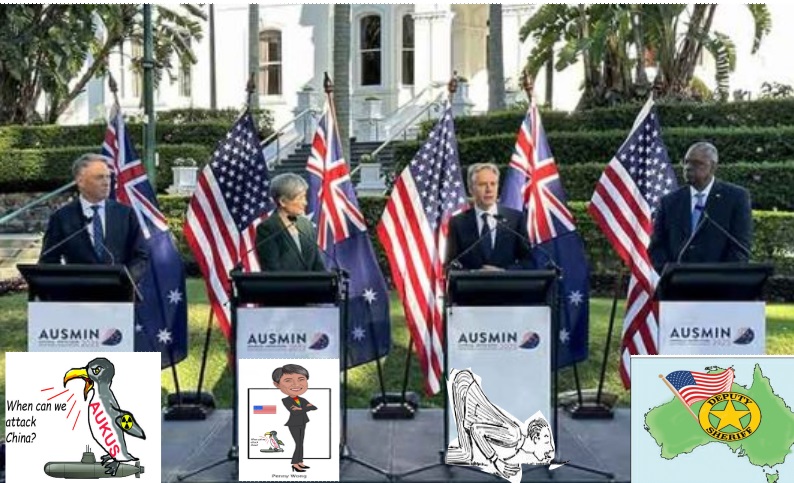
Lambie & Patrick AUS/US Senate Inquiry,
8 April 25 – Tasmanian Times
Jacqui Lambie, Senator for Tasmania and her South Australian Senate candidate, Rex Patrick, today announced that if returned to the Senate, they will establish a wide-ranging Senate inquiry into Australia’s relations with the United States, including the ANZUS Treaty and the AUKUS nuclear submarine scheme.
“Australia is facing global economic disruption on a scale not seen since WW2, it’s essential the Australian parliament do a top to bottom review of Australia’s relationship with the United States,” Senator Lambie said.
“For too long debate on Australia foreign and defence policy has been constrained by bureaucratic orthodoxy and the bipartisan straitjacket imposed by Labor and the Liberal National Coalition. However the international scene is now changing rapidly and radically in ways that destroy past assumptions, especially the notion that Australia can enjoy defence on the cheap while relying on the USA for protection. Those days are gone.” said former Senator Rex Patrick.
“President Trump’s tariff attack, in open violation of the Australia/ US Free Trade Agreement, calls into question the value of the ANZUS alliance, the cornerstone of Australian defence policy for more than 70 years. The AUKUS project, acknowledged by the Defence Department to be “very high risk”, now looks like a huge mistake.” said Senator Lambie
“It isn’t often a great power self-immolates through rank stupidity, but that’s the grim spectacle we’re now witnessing. Australia must be much more independent and self-reliant to successfully navigate the geopolitical turbulence that lies ahead.” Rex Patrick said.
The establishment of a Senate Select Committee inquiry into Australia’s alliance with the United States including the ANZUS alliance and the AUKUS nuclear submarine scheme will be moved in the first sitting week of the 48th Parliament. This will ensure an open and honest debate about Australia’s foreign affairs, defence and trade policies starting with a focus on the United States.
The recent strategic policy experts forum convened by former Prime Minister Malcolm Turnbull was a valuable beginning, but we must carry this debate forward through the next Parliament.
The terms of reference will be broad and representation on the Select Committee should span political opinion across the Senate……………………………………………………………….. https://tasmaniantimes.com/2025/04/lambie-promises-senate-inquiry-into-usa-relations/
Israeli Defence Force courts Australian universities amid anti-war protests
Michael West Media, by Wendy Bacon and Yaakov Aharon | Apr 5, 2025
Hundreds of university staff and students in Melbourne and Sydney called on their Vice-Chancellors to cancel pro-Israel events this week. Wendy Bacon and Yaakov Aharon with the story.
While Australia’s universities continue to repress pro-Palestine peace protests, they gave the green light to pro-Israel events this week, sparking outrage from anti-war protestors.
Israeli lobby groups ‘StandWithUs Australia’ (SWU) and ‘Israel-IS’ organised a series of university events this week which featured Israel Defense Force (IDF) reservists who served during the war in Gaza, two of whom lost family members in Hamas’ attack on October 7, 2023.
The events were promoted as “an immersive VR experience with an inspiring interfaith panel” discussing the importance of social cohesion, on and off campus.”
Hundreds of staff and students at Monash, Sydney Uni, UNSW and UTS signed letters calling on their universities to “act swiftly to cancel the SWU event and make clear that organisations and individuals who worked with the Israel Defense Forces did not have a place on UNSW campuses.”
SWU is a global charity organisation which supports Israel and fights all conduct it perceives to be ‘antisemitic’. It campaigns against the United Nations and International NGOs’ findings against Israel and is currently supporting actions to suspend United States students supporting Palestine. It established an office in Sydney in 2022 and Michael Gencher, who previously worked at the NSW Jewish Board of Deputies, was appointed as CEO.
The event’s co-sponsor Israel-IS is a similar propaganda outfit whose mission is to “connect with people before they connect with ideas” particularly through “cutting edge technologies like VR and AI.” Among their eighteen staff, one employee’s role is ‘IDF coordinator’’ by while two employees serve as ‘Heads of Influencer Academy’.
The events were a test for management at Monash, UTS, UNSW and USyd to see how far each would go in cooperating with the Israel lobby.
Events cancelled
At Monash, an open letter criticising the event was circulated by staff and students. The event was then cancelled without explanation.
At UNSW, 51 staff and postgraduate students signed an open letter to Vice Chancellor Atilla Brungs, calling for the event’s cancellation. It was signed on their behalf by Jessica Whyte, an Associate Professor of Philosophy in Arts and Law and Noam Peleg, Associate Professor in the Faculty of Law and Justice.
Prior to Wednesday morning’s scheduled event, MWM sent questions to UNSW. After the event was scheduled to occur, the university responded to MWM, informing us that it had not taken place.
As of today, two days after the event was scheduled, Vice-Chancellor Brungs has not responded to the letter.
UTS warning to students
The UTS branch of the Australasian Union of Jewish Students partnered with Israel-IS in organising the UTS event, in alignment with their core ‘pillars’ of Zionism and activism. The student group seeks to “promote a positive image of Israel on campus” to achieve its vision of a world where Jewish students are committed to Israel.
UTS Students’ Association, Palestinian Youth Society and UTS Muslim Student Society wrote to management but Deputy Vice-Chancellor Kylie Readman rejected pleas. She replied that the event’s organisers had guaranteed it would be “a small private event focused on minority Israeli perspectives” and that speakers would only speak in a personal capacity.
While acknowledging the conflict in the Middle East was stressful for many at UTS, she then warned students, “UTS has not received formal notification of any intent to protest, as is required under the campus policy. As such, I must advise that any protest activity planned for 2nd April will be unauthorised. I would urge you to encourage students not to participate in an unauthorised protest.”
Students who allegedly breach campus policies can face disciplinary proceedings that can lead to suspension.
UTS Student Association President Mia Campbell told MWM, “The warning given by UTS about protesting definitely felt intimidating and frightening to a number of students, including myself. Especially as a Law student, misconduct allegations can affect your admission to the profession… but with all other avenues of communication exhausted between us and the university, it felt like we didn’t have a choice.
“I don’t want to look back on what I was doing during this genocide and have done any less than what was possible at the time.“
A UTS student reads the names of Gaza children killed in Israel’s War on Gaza. Photo by Wendy Bacon.
The UTS protest was sombre but quietly angry. Speakers read from lists naming dead Palestinian children.
One speaker, who has lost 120 members of his extended family in Gaza, explained why he protested. We have to “be backed into a corner, told we can’t protest, told we can’t do anything. We’ve exhausted every single policy…Add to all that we are threatened with misconduct.”
“Do you think we can stay silent while there are people on campus who may have played a part in the killings in Gaza?”
SWU at University of Sydney
University of Sydney staff and students who signed an open letter received no reply before the event.
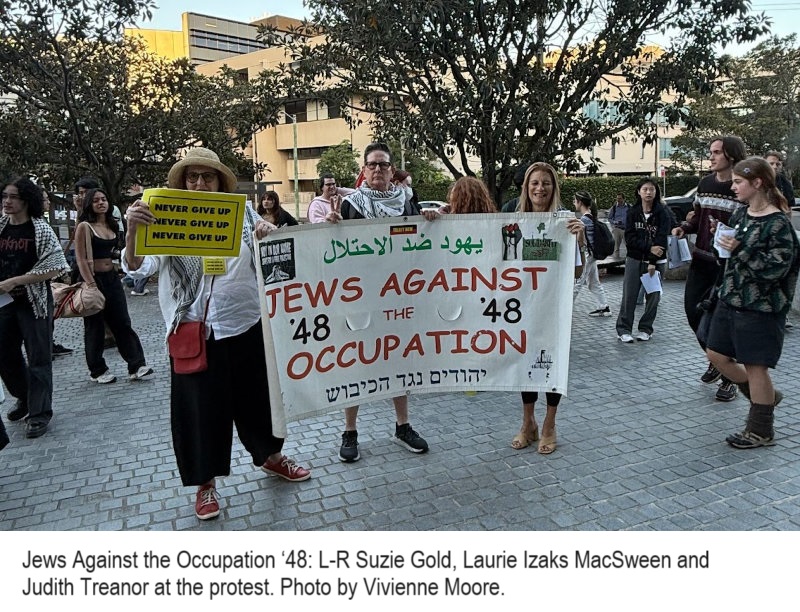
Activists from USyd staff in support of Palestine, Students Against War and Jews Against the Occupation ‘48 began protesting outside the Michael Spence building that houses the university’s senior executives on Wednesday evening.
Escorted by UTS security, three SWU representatives arrived. A small group was admitted. Soon afterwards, the participants could be seen from below in the building’s meeting room. A few protesters remained and booed the attendees as they left. These included Mark Leach, a far right Christian Zionist and founder of pro-Israeli group Never Again is Now. Later on X, he condemned the protesters and described Israel as a “multi-ethnic enclave of civilisation.”
Several student activists have received letters recently warning them about breaching the new USyd code of conduct regulating protests. USyd has also adopted a definition of anti-semitism which critics say could restrict criticism of Israel. It has been slammed by the Jewish Council of Australia as “dangerous” and “unworkable”.
A Jews against Occupation ’48 speaker, Judith Treanor, said, “Welcoming this organisation makes a mockery of this university’s stated values of respect, non-harassment, and anti-racism. In the context of this university’s adoption of draconian measures to stifle freedom of expression in relation to Palestine, the decision to host this event promoting Israel reveals a shocking level of hypocrisy and a huge abuse of power.”………………………………………………………………………. https://michaelwest.com.au/idf-courts-australian-universities-amid-anti-war-protests/
Australian nuclear news 7 – 14 April
Headlines as they come in:
- Dump nuclear, restore momentum – new poll shows opportunity for Coalition.
- Community groups furious Coalition nuclear plan would go ahead even if locals oppose it.
- The irrational optimism of the nuclear power lobby.
- Going nuclear will decimate jobs in regions first, stop billions in new investment
- Why is Peter Dutton shying away from nuclear power? – https://www.youtube.com/watch?v=12RE1WGl-VQ
- As the debate around renewables and nuclear continues, here is what the experts say.
- Coalition nuclear plan will plough $58bn wrecking ball through renewable energy projects, analysis warns.
- Lambie Promises Senate Inquiry into USA Relations
- Nuclear would funnel up to 200 Gigalitres away from Australian farms annually
- How US Dependence is Not in Our Best Interest.
- Australia’s submarine deal under scrutiny as global alliances shift.
- What if a Fukushima-sized nuclear accident happened near you? – https://www.youtube.com/watch?v=VIModFC_9kI
- Not enough water available for Coalition’s nuclear proposal to run safely, report finds.
Australia’s submarine deal under scrutiny as global alliances shift

The Age Rob Harris, April 9, 2025
London: Britain will scrutinise Australia’s nuclear submarines deal with the UK and the United States, as concerns are raised on the other side of the Atlantic about the continued reliability of the US as a security partner.
The UK House of Commons Defence Committee quietly announced a parliamentary inquiry last week into the contentious AUKUS defence pact, signed in 2021, which will cost Australian taxpayers $368 billion over the next 30 years. The inquiry – the first of its kind – will evaluate whether the program remains on track and consider the impact of global geopolitical shifts since the deal was signed.
With none of the original signatories – former leaders Boris Johnson, Joe Biden and Scott Morrison – still in office, the inquiry also reflects the changing dynamics in global alliances. Notably, the US recently distanced itself from its European NATO allies, complicating the context of the pact.
At a US Senate hearing on Tuesday (Wednesday AEST), Democrat senator Mark Warner said President Donald Trump’s decision last week to impose tariffs on US allies, including on Australia and the United Kingdom, “undermines our national security and frankly makes us not a good partner”.
“We’re supposed to be doing this major deal around jointly building submarines,” Warner said after the hearing. “I think [Australia] and all of our allies are rethinking whether we can be counted on as a partner.”………………………………………………………………………………
While AUKUS aims to strengthen defence ties in the Indo-Pacific, former Australian prime minister Malcolm Turnbull has voiced concerns, questioning whether Australia would ever receive a US nuclear-powered submarine. The US faces challenges in its own naval capabilities, with senior Pentagon officials also questioning the feasibility of the submarine deal, given current shipbuilding limitations………………………………………………………….
London-based foreign policy analyst Sophia Gaston, a senior fellow at the Australia Strategic Policy Institute, said the secret origins of AUKUS had “proven an impediment to building a wider scope of engagement around the pact”.
“This inquiry will bring new voices and energy into the conversation … but also confront the rapidly shifting geopolitical landscape in which AUKUS is seeking to make its mark,” she said……………………………………………………..https://www.theage.com.au/world/europe/australia-s-submarine-deal-under-scrutiny-as-global-alliances-shift-20250409-p5lqcq.html
1 This month

of the week – Australians for War Powers Reform (AWPR)
To see nuclear-related stories in greater depth and intensity
 Antinuclear