Coalition nuclear plan will plough $58bn wrecking ball through renewable energy projects, analysis warns

Going nuclear will cost ‘real dollars for farmers, real dollars for country towns and real blue-collar jobs’, Clean Energy Council says
Guardian, Adam Morton Thu 10 Apr 2025
Coalition nuclear plan will plough $58bn wrecking ball through renewable energy projects, analysis warns
Going nuclear will cost ‘real dollars for farmers, real dollars for country towns and real blue-collar jobs’, Clean Energy Council says
- Election 2025 live updates: Australia federal election campaign
- Polls tracker; election guide; full federal election coverage
- Anywhere but Canberra; interactive electorates guide
- Listen to the first episode of our new narrative podcast series: Gina
- Get our afternoon election email, free app or daily news podcast
Adam Morton Climate and environment editorThu 10 Apr 2025 01.00 AESTShare
A Coalition proposal to limit the rollout of renewable energy could stop at least $58bn of private investment in new developments and halt billions of dollars in flow-on spending in communities, new analysis has warned.
The estimation by consultants Green Energy Markets, on behalf of industry group the Clean Energy Council (CEC), assessed what would happen if renewable energy in Australia was capped at 54% of total use, the level assumed in Frontier Economics modelling relied on by the Coalition to support its nuclear power policy.
The analysis compared this with Labor’s promise to have 82% renewable energy by 2030. It found the 54% level would likely be met in 2028. Stopping industry expansion at that level would result in nearly 29 gigawatts of new large-scale solar and windfarms not being built.
Those developments would be expected to lead to 37,700 full-time-equivalent construction jobs and 5,000 ongoing jobs in operations and maintenance.
The CEC’s chief executive, Kane Thornton, said the Coalition’s position would cost “real dollars for farmers, real dollars for country towns and real blue-collar jobs that pay Australians’ bills”.
“The clean energy sector injected $40bn in essential electricity infrastructure into the national economy over the past five years alone,” Thornton said. “We need all sides of politics to embrace this private-sector investment into regional Australia.”
The analysis was released ahead of a debate between the climate change and energy minister, Chris Bowen, and the opposition shadow minister, Ted O’Brien, on Thursday…………………………………………………………………………………………………………………………..https://www.theguardian.com/australia-news/2025/apr/10/coalition-nuclear-plan-will-plough-58bn-wrecking-ball-through-renewable-energy-projects-analysis-warns
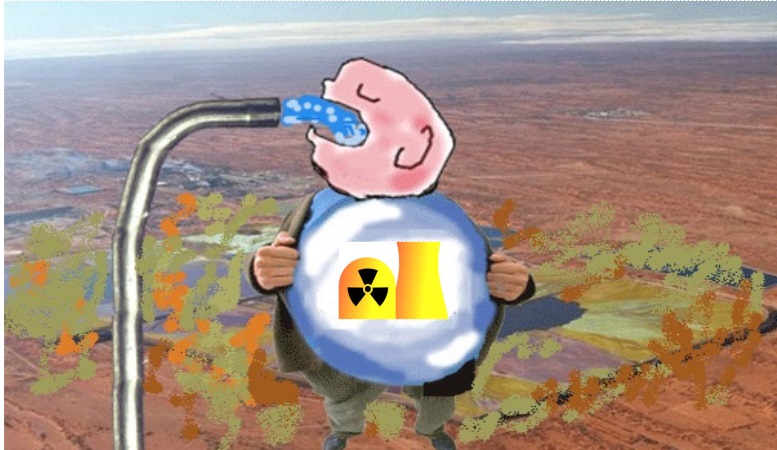
Nuclear would funnel up to 200 Gigalitres away from Australian farms annually.
Liberals Against Nuclear, 9 Apr 25
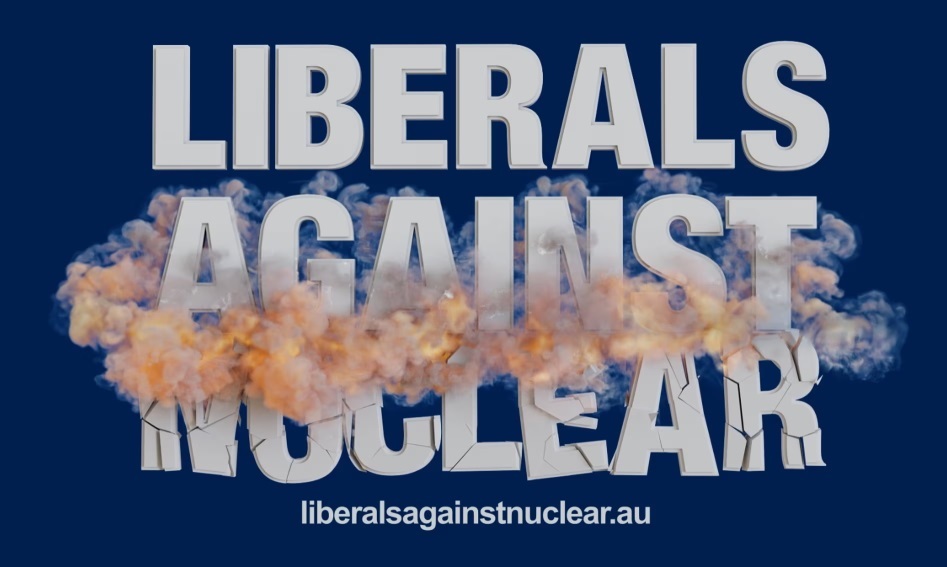
Peter Dutton’s nuclear plan would spark an Australian water crisis, potentially sucking a mammoth 200 gigalitres away from farmers in dry years through water buybacks and acquisitions, according to a new report by one of the nation’s leading subject matter experts. The Coalition bitterly opposes the current Labor Government buyback of 43 gigalitres of water allocation a year, less than a quarter of what its own nuclear plan would require. “The nuclear idea is toxic with voters,” said Liberals Against Nuclear spokesman Andrew Gregson, a former NSW Irrigators’ Council chief executive. “It will require enormous water buybacks from farmers – which the Coalition has fought bitterly against for 15 years.” |
The report, Australian nuclear energy proposals, water availability and acquisition options was commissioned by Liberals Against Nuclear and authored by former Land & Water Australia chief executive and ANU visiting fellow, Professor Andrew Campbell. It reveals the scale of water acquisitions required to run the Coalition’s proposed nuclear reactors by asking how much water would need to be acquired through buybacks or compulsory acquisitions to run them at the seven proposed sites.
Relying on the Coalition’s own modelling, the report assumes 13.8 gigawatts of nuclear capacity would replace the existing 8 gigawatts of coal-fired capacity. It estimates water consumption based on newly-commissioned nuclear reactors at Georgia USA, the same ‘off the shelf’ Westinghouse AP-1000 units proposed by The Coalition.
The report found:
- Annual high-security water allocation for a mammoth 200 gigalitres would potentially have to be acquired from farmers and other water users, such as coal mines and urban water supplies, to cool the nuclear reactors
- There is no guarantee farmers would give up this much water for sale. Compulsory acquisitions would likely be required
- Up to 39 gigalitres of annual allocation would need to be acquired each year in the Hunter, up to 25 GL around Mt Piper/Lithgow, up to 125GL in the Latrobe Valley (where the typical annual allocation to the local Macalister Irrigation District is just 32GL), 5GL in Callide and 7.5GL in Collie, WA
The report concludes that 50% of the proposed nuclear generation capacity is already infeasible due to lack of water, and a further 40% would need to be curtailed in dry seasons due to lack of water to cool the reactor, or the water becoming too warm- In short, at 5 of the 7 sites, representing 90% of the proposed generating capacity, nuclear power generation would be an unreliable source of electricity
- Most nuclear reactors overseas are near the ocean, large lakes or large rivers – in cold and wet places – due to the enormous amount of high-security water required. Six of Coalition’s seven proposed sites are inland.
“The Nationals have spent 15 years educating rural communities on how much water buybacks hurt them and fighting tooth and nail to protect our agricultural water,” Gregson said. “Now, there is a proposal to take water from the very farmers who grow our food.
“Making matters worse, this precious water will be used to create government-owned electricity companies to compete against private businesses. Forcing farmers to compete with the government when they buy water assaults every value that Liberal voters hold dear.
“We recently saw polling which showed support for nuclear in the political death zone in the proposed host sites. Support was 22% in Central West NSW, 27% in Gladstone, 24% in the rest of Central Queensland, 24% in south-west WA, just 32% in the Hunter and 31% in Gippsland. This policy is electoral poison.
“Nuclear must be dumped. It is already causing an electoral nightmare and in the long run, it is political and economic suicide. It will completely distort our economy, crowding out the private sector. It is the wrong thing to do and means destroying the livelihood of some of our most loyal supporters.
“This water grab threatens to sever the trust between the Coalition and agricultural communities permanently. We’ve spent decades building our reputation as champions of farmers’ rights – particularly water access. Why would we throw away that political capital for nuclear plants that most Australians don’t want?
“Mr Dutton must drop this toxic nuclear policy and focus on our winning strengths of small government, managing the economy and real liberal values. We can still win this election, but not with this nuclear proposal, which is diametrically at odds with our values.
How US Dependence is Not in Our Best Interest
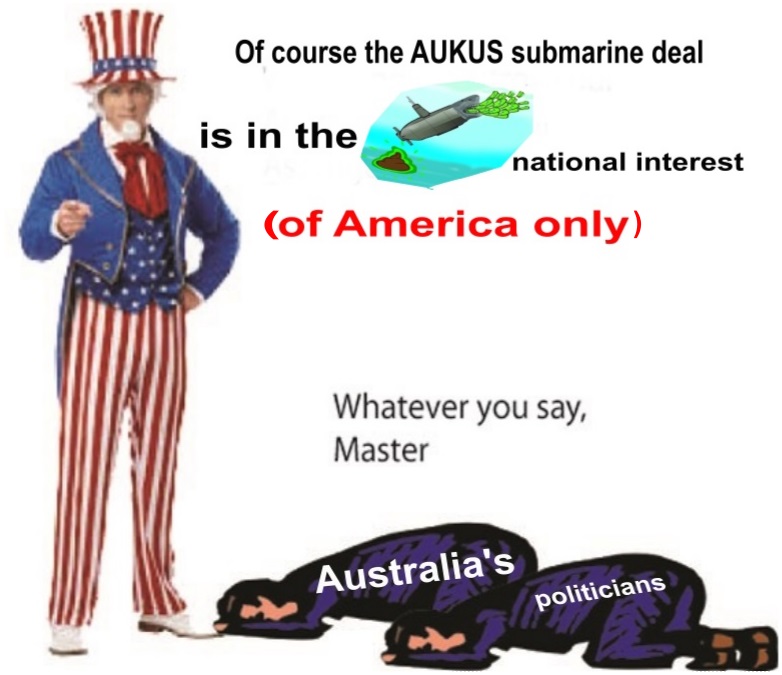
Real Example: The AUKUS submarine deal, projected to cost over $368 billion, ties Australia into US military logistics for decades – yet those funds could be spent on domestic defence innovation, regional aid, or green manufacturing.
Real Example: The AUKUS submarine deal, projected to cost over $368 billion, ties Australia into US military logistics for decades – yet those funds could be spent on domestic defence innovation, regional aid, or green manufacturing.
April 9, 2025 AIMN Editorial By Denis Hay
Description
US dependence. Discover real steps Australia can take to diversify defence, diplomacy & trade while using its currency power to reclaim sovereignty.
Introduction: A Turning Point for Australia
Location: Canberra, 2024. The Defence Minister stands before cameras, repeating familiar rhetoric: “The US alliance is central to Australia’s security.” But in community halls, cafés, and public forums across the nation, a growing number of Australians are beginning to ask: What if it’s not?
Thoughts: Many Australians feel a quiet unease about our nation’s strategic direction. We’ve followed the US into war zones, hosted its military bases, and allowed our foreign policy to align too closely with American interests. Yet few alternative paths are ever seriously discussed in public debate.
Emotions: There’s frustration, even disillusionment. Australia is a sovereign nation. Why then do we act like a client state?
Dialogue: “It’s not anti-American to want independence,” says Jenny, a retired diplomat. “It’s just good strategy.”
Problem: The Australia-US alliance has become a crutch. While it served a purpose post-WWII, the world has changed. The Indo-Pacific is more multipolar than ever. To secure a peaceful, just future, Australia must explore new defence partnerships, deepen regional diplomacy, and reshape trade alliances. Critically, we must use our monetary sovereignty to do this independently, not through the profit-driven mechanisms of public-private partnerships.
The Problem: Locked into a Narrow Strategic Path
Following WWII, Australia signed onto ANZUS, believing American power would guarantee our safety. But since then, Australia has:
• Participated in every major US-led conflict since Vietnam.
• Spent billions hosting US military infrastructure (like Pine Gap).
• Aligned its foreign policy with US military objectives, often at odds with neighbours.
Meanwhile, the security landscape has shifted:
• China, India, and ASEAN nations now influence the Indo-Pacific.
• US influence is declining, with unpredictable leadership changes.
• Regional cooperation, not superpower allegiance, is the new path to peace.
Real Example: The AUKUS submarine deal, projected to cost over $368 billion, ties Australia into US military logistics for decades – yet those funds could be spent on domestic defence innovation, regional aid, or green manufacturing.
Internal Reflections: “Why are we borrowing American power when we have the capacity to build our own?”
Note on Defence Think Tanks: When assessing defence strategies, it’s important to consider the source. The Australian Strategic Policy Institute (ASPI), often referenced by the government and media, receives funding from the Australian Department of Defence, foreign governments, and major US arms manufacturers such as Lockheed Martin and Northrop Grumman.
These financial ties raise serious concerns about bias in ASPI’s advocacy for militarised solutions and deepening reliance on the US military-industrial complex.
Heightened Risk Through US Dependence: By embedding ourselves in the strategic priorities of the United States, Australia risks becoming a target in conflicts that are not of our making.
Should tensions escalate between the US and China, Australia’s hosting of American military bases, integration into US-led command systems, and participation in initiatives like AUKUS make us more – not less – vulnerable to retaliation.
Instead of ensuring protection, over reliance on US dependence could make Australia a frontline state in the event of a major geopolitical confrontation. The risk is amplified when one considers the United States’ long and well-documented history of military interventions, regime change operations, and aggressive foreign policy – often justified under the banner of “freedom” but resulting in destabilisation, displacement, and long-term suffering in regions such as Iraq, Vietnam, Libya, and Afghanistan.
The Consequences of Strategic US Dependence
Imagine you’re a young Pacific Island leader sitting across from an Australian diplomat in 2030. Rising seas threaten your nation, yet Australia prioritises nuclear submarines over climate aid. “You talk about friendship,” she says, “but you act like a US outpost.”
This isn’t just geopolitical optics:
• Australia risks alienating regional neighbours.
• We are perceived as an extension of Western military ambitions.
• The economic burden of defence decisions like AUKUS will fall on future generations.
Stat: 56% of Australians in a 2024 Lowy Institute poll said Australia should remain neutral in a US-China conflict. The people are ahead of the policymakers.
Diversifying Alliances Through Sovereign Action
Diversifying Defence Partnerships………………………………………………………………………………………………………………………………. https://theaimn.net/how-us-dependence-is-not-in-our-best-interest/
Declassified MoD document reveals US Visiting Forces across Britain are exempt from nuclear safety rules
THIS MIGHT APPLY IN AUSTRALIA, TOO?

CND 7th April 2025
At a time of heightened nuclear dangers, the Campaign for Nuclear Disarmament has uncovered shocking evidence that US military bases across Britain are exempt from UK emergency radiation regulations.
This means that bases like RAF Lakenheath, which is being prepared to host deadly new US nuclear weapons, is under no legal obligation to have emergency radiation plans in case of nuclear accidents.
A declassified exemption order shows that the government is putting so-called ‘national security’ before people’s safety.
CND is calling on Prime Minister Keir Starmer to announce in Parliament that no US nuclear weapons will be welcomed in Britain and that the exemption on adhering to legally required safety standards is revoked.
A letter from CND’s lawyers Leigh Day has forced the Ministry of Defence to declassify a significant nationwide exemption certificate, issued in March 2021 by former Defence Secretary, Ben Wallace, on the grounds of ‘national security’.
The certificate exempts Visiting Forces – primarily US military personnel – engaged in work with ionising radiations, from any legal enforcement of safety standards, using powers under Regulation 40 of the Ionising Radiations Regulations 2017 and Regulation 25 of the Radiation (Emergency Preparedness and Public Information) Regulation 2019. This means they are not legally bound to have in place plans and measures for emergency situations involving radioactive materials and nuclear weapons.
This is particularly dangerous given US preparations at RAF Lakenheath in Suffolk for a new nuclear weapons mission. However, the exemption not only covers RAF Lakenheath but all US military bases across Britain.
There are at least 10,000 US Department of Defence personnel stationed at 13 RAF bases. Nuclear material for Britain’s own nuclear weapons programme is regularly transported through RAF Brize Norton and RAF Fairford regularly hosts the US B2 nuclear-capable stealth bomber.
The government’s exemption means that local councils will never be told about the presence of nuclear weapons at these bases – and are therefore not obliged to produce their own emergency plans for a radiological accident. This puts the British population at even greater risk.
CND is calling on Prime Minister Keir Starmer to announce in Parliament that no US nuclear weapons will be welcomed in Britain and that the exemption on adhering to legally required safety standards is revoked. The majority of the British public don’t want US nuclear weapons in this country.
CND is upping pressure on the government, supporting two weeks of protest actions from Monday 14 April, culminating in a blockade of the base on Saturday 26 April. The peace camp and actions are organised by the Lakenheath Alliance for Peace, of which CND is a member………………………………………………………………………………………………. https://cnduk.org/declassified-mod-document-reveals-us-visiting-forces-across-britain-are-exempt-from-nuclear-safety-rules/
1 This month

of the week – Australians for War Powers Reform (AWPR)
To see nuclear-related stories in greater depth and intensity
 Antinuclear