How US Dependence is Not in Our Best Interest
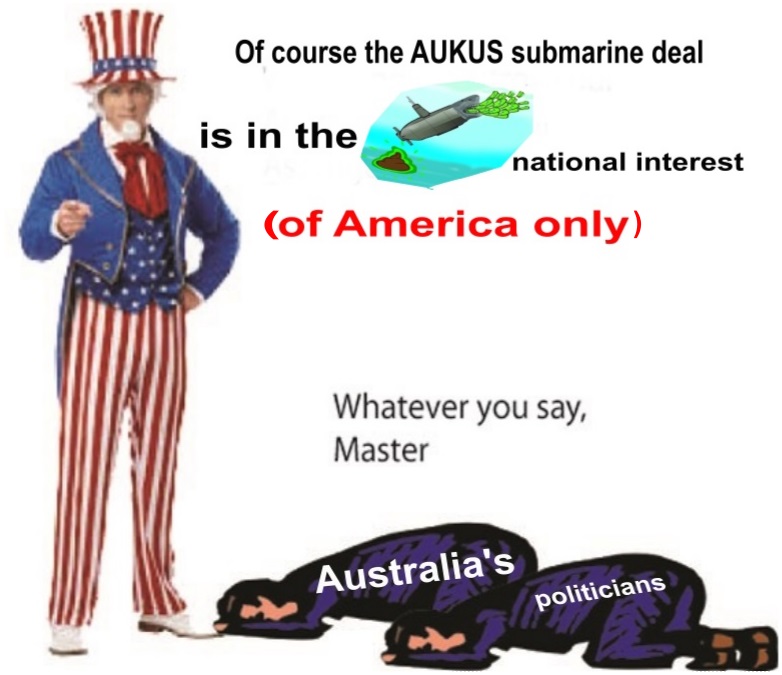
Real Example: The AUKUS submarine deal, projected to cost over $368 billion, ties Australia into US military logistics for decades – yet those funds could be spent on domestic defence innovation, regional aid, or green manufacturing.
Real Example: The AUKUS submarine deal, projected to cost over $368 billion, ties Australia into US military logistics for decades – yet those funds could be spent on domestic defence innovation, regional aid, or green manufacturing.
April 9, 2025 AIMN Editorial By Denis Hay
Description
US dependence. Discover real steps Australia can take to diversify defence, diplomacy & trade while using its currency power to reclaim sovereignty.
Introduction: A Turning Point for Australia
Location: Canberra, 2024. The Defence Minister stands before cameras, repeating familiar rhetoric: “The US alliance is central to Australia’s security.” But in community halls, cafés, and public forums across the nation, a growing number of Australians are beginning to ask: What if it’s not?
Thoughts: Many Australians feel a quiet unease about our nation’s strategic direction. We’ve followed the US into war zones, hosted its military bases, and allowed our foreign policy to align too closely with American interests. Yet few alternative paths are ever seriously discussed in public debate.
Emotions: There’s frustration, even disillusionment. Australia is a sovereign nation. Why then do we act like a client state?
Dialogue: “It’s not anti-American to want independence,” says Jenny, a retired diplomat. “It’s just good strategy.”
Problem: The Australia-US alliance has become a crutch. While it served a purpose post-WWII, the world has changed. The Indo-Pacific is more multipolar than ever. To secure a peaceful, just future, Australia must explore new defence partnerships, deepen regional diplomacy, and reshape trade alliances. Critically, we must use our monetary sovereignty to do this independently, not through the profit-driven mechanisms of public-private partnerships.
The Problem: Locked into a Narrow Strategic Path
Following WWII, Australia signed onto ANZUS, believing American power would guarantee our safety. But since then, Australia has:
• Participated in every major US-led conflict since Vietnam.
• Spent billions hosting US military infrastructure (like Pine Gap).
• Aligned its foreign policy with US military objectives, often at odds with neighbours.
Meanwhile, the security landscape has shifted:
• China, India, and ASEAN nations now influence the Indo-Pacific.
• US influence is declining, with unpredictable leadership changes.
• Regional cooperation, not superpower allegiance, is the new path to peace.
Real Example: The AUKUS submarine deal, projected to cost over $368 billion, ties Australia into US military logistics for decades – yet those funds could be spent on domestic defence innovation, regional aid, or green manufacturing.
Internal Reflections: “Why are we borrowing American power when we have the capacity to build our own?”
Note on Defence Think Tanks: When assessing defence strategies, it’s important to consider the source. The Australian Strategic Policy Institute (ASPI), often referenced by the government and media, receives funding from the Australian Department of Defence, foreign governments, and major US arms manufacturers such as Lockheed Martin and Northrop Grumman.
These financial ties raise serious concerns about bias in ASPI’s advocacy for militarised solutions and deepening reliance on the US military-industrial complex.
Heightened Risk Through US Dependence: By embedding ourselves in the strategic priorities of the United States, Australia risks becoming a target in conflicts that are not of our making.
Should tensions escalate between the US and China, Australia’s hosting of American military bases, integration into US-led command systems, and participation in initiatives like AUKUS make us more – not less – vulnerable to retaliation.
Instead of ensuring protection, over reliance on US dependence could make Australia a frontline state in the event of a major geopolitical confrontation. The risk is amplified when one considers the United States’ long and well-documented history of military interventions, regime change operations, and aggressive foreign policy – often justified under the banner of “freedom” but resulting in destabilisation, displacement, and long-term suffering in regions such as Iraq, Vietnam, Libya, and Afghanistan.
The Consequences of Strategic US Dependence
Imagine you’re a young Pacific Island leader sitting across from an Australian diplomat in 2030. Rising seas threaten your nation, yet Australia prioritises nuclear submarines over climate aid. “You talk about friendship,” she says, “but you act like a US outpost.”
This isn’t just geopolitical optics:
• Australia risks alienating regional neighbours.
• We are perceived as an extension of Western military ambitions.
• The economic burden of defence decisions like AUKUS will fall on future generations.
Stat: 56% of Australians in a 2024 Lowy Institute poll said Australia should remain neutral in a US-China conflict. The people are ahead of the policymakers.
Diversifying Alliances Through Sovereign Action
Diversifying Defence Partnerships………………………………………………………………………………………………………………………………. https://theaimn.net/how-us-dependence-is-not-in-our-best-interest/
No comments yet.
1 This month
15 April – Zoom –Nuclear Power is Not the Solution
Apr 15, 2026 01:00 AM in Canberra, Melbourne, Sydney

Join the International Physicians for the Prevention of Nuclear War (IPPNW) on Tuesday, April 14th for a timely webinar exploring the risks associated with nuclear power and challenging the myth that it offers a simple, safe, carbon-free solution to the climate crisis

of the week – Australians for War Powers Reform (AWPR)
To see nuclear-related stories in greater depth and intensity
 Antinuclear
Leave a comment