Donald Trump flounders about on the Ukraine situation
17 Apr 25 https://theaimn.net/donald-trump-flounders-about-on-the-ukraine-situation/
Trump’s previous presidency resulted in huge job losses, a massive increase in the national debt, and global uncertainty about economics. Still, the stock market went up, and the very wealthy got wealthier. His purpose then was perhaps to enrich himself and his rich mates. Apart from that, it all looked like incompetence. If the job of President is to preserve the security and well-being of the nation, his administration was floundering about.
So – no real surprise that this is now happening again.
And what better example of the flounder is there than Trump’s dithering about over the Ukraine war?
As far as the Ukraine war goes, Trump’s big advantage over his predecessor Joe Biden, is that he is willing to negotiate at all. But Donald Trump’s concept of “negotiation”really needs to be examined. He is inordinately and mistakenly proud of his “art of the deal”. But when we observe his actual behaviour, it’s more like a form of childish bullying, than any real method of negotiation.
Major tenets of negotiation, as explained by Herb Chen, to achieve a win-win situation, are to prepare well with information on the situation, seek out and understand the other side’s needs, respect the other side and establish trust.
To start with. Donald Trump aims to win, i.e to defeat the other side. Is Donald Trump even capable of going for a win-win situation? He is quoted as saying “My whole life is about winning” – though I could not find the source. https://www.youtube.com/shorts/YPg9sBtuMJw
So already it appears that Trump’s goal in negotiating is to get what he wants, in a bulldozing manner. And what he wants now is for USA business interests to win in Ukraine, rather than an acceptable peace agreement between Ukraine and Russia.
As to “preparing well with information on the situation”, Trump seems to have understood some of the critical facts – for example, that Putin will not tolerate Ukraine becoming a member of NATO, that Zelensky depends on USA military backing. But the more complex picture concerning the national borders, and the industries in the region seems to be beyond him. And this starts to matter when questions arise about the ownership of rare earths resources. This is a complicated story, but industry experts and economists warn that for the USA to gain control of Ukraine’s mineral resources is not likely to be a success, either commercially or geopolitically.
But Trump’s focus in the negotiations is on American business taking over Ukraine’s minerals. https://www.youtube.com/watch?v=Ya9WKaveRXU
The “deal” that Trump is pursuing also involves that very thorny question – which nation will own and control the Zaporizhzhia nuclear station. I have previously written about this. But suffice to say that the ownership of this particular NPP is a very fraught matter. All three nations, Ukraine, Russia, and USA, seem to want to take on this huge responsibility – massive out-of-action nuclear reactors, all very dangerous and lacking a dependable supply of cooling water.
So, squabbles over industrial resources, and nuclear facilities would be predictable to anyone who bothered to prepare for negotiations on ending the war in Ukraine.
Seeking out and understanding the other side’s needs? Has Donald Trump any concept of this? He might appreciate strongman Putin’s need to look tough and insistent on tough conditions – but Trump does not take account of Russia’s need for to have sanctions on it ended, nor to have Ukrainian troops gone from Russia’s Kursk region, nor to prrevent a pause that enables Ukraine to build up weapons. Trump doesn’t take any interest in the complex needs of the Ukrainian side either, – with many in the Donbass area especially desperate for the war to end.
Respecting the other side and establishing trust? Trump’s manner shows that he doesn’t even respect his own side – as evidenced by his recent rudeness to Ukraine’s President Zelensky. About the other side – he’s said that he’s “pissed off” with Putin, and has threatened to impose secondary tariffs on countries that buy from Russia. He has broadcast his anger with Putin, – but added that “the anger dissipates quickly … if [Putin] does the right thing”.
So much for Trump’s promise about quickly ending the carnage in Ukraine. Almost three months after he took office, Trump has achieved nothing. Thousands of soldiers and civilians continue to be injured or die each month.
Without going into the nightmare of the Trump tariffs situation, the economic effect of the current Trump administration is starting to look very like the economic effect of his previous one. Unless the purpose of it is solely the enrichment of Trump and billionaires, the whole operation looks like being massively incompetent. And, sadly, the Ukrainian people are prime victims of this incompetence.
The Coalition Nuclear Policy is a Fake
Arena Online, Darrin Durant, Jim Falk, Jim Green, 17 Apr 2025, https://arena.org.au/the-coalition-nuclear-policy-is-a-fake/
Calls for commercial nuclear power in Australia have historically all featured the Liberal National Party (LNP) promising nuclear power but later quietly shelving such plans. With a looming federal election date, that pattern seems to have returned with the Coalition running silent on nuclear power, despite the election being only weeks away. Why?
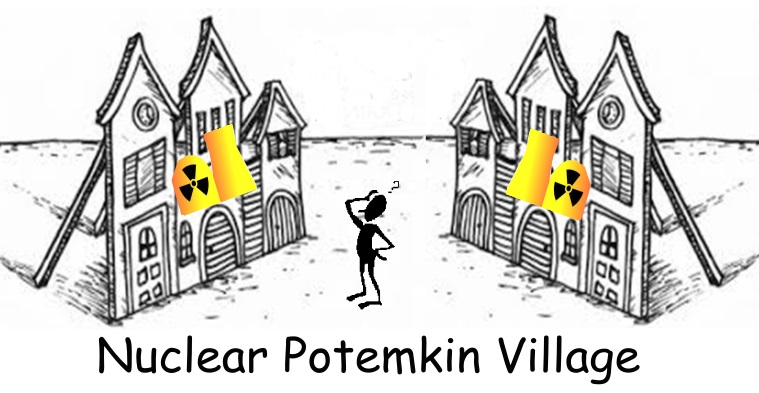
The Coalition’s policy is a bit like a Potemkin Village anyway—the fake villages said to be erected by Grigory Potemkin to impress Catherine the Great. Like them, the nuclear proposal is at best a facade, lacking essential content but acting to distract attention from division within the Coalition on emissions reductions.
Nuclear Potemkin villages
The Coalition has an electricity plan, but it is highly unlikely to actually involve nuclear reactors. The idea of nuclear reactors (large or small) with their low life-cycle emissions (at least compared to fossil fuels) provides a facade for misdirecting public attention. Behind the facade are continuing placeholders for fossil fuels, a stalling of renewables development, and a plan to keeping coal plants running as long as possible—probably switching to gas when those coal-fired power stations become technologically and economically unviable.
The long-promised Coalition nuclear plan was eventually outlined with minimal detail in June 2024 as seven reactor-site locations across New South Wales, Victoria, Queensland, South Australia and Western Australia, producing 14 gigawatt, or 38 per cent of electricity, with the first reactor supposedly coming on line by 2035–37. The claim was for an outcome ‘significantly’ cheaper than the Australian Labor Party (ALP) renewables plan. It invoked the myth of baseload power as the only route to grid reliability, and claimed it would ‘responsibly’ integrate with renewables.
On Friday 13 December 2024, when most news outlets would have already filed their stories, the Coalition released actual costings of their nuclear plan, using modelling by Frontier Economics. These costings were roundly criticized for sins of omission:
- mass under-estimations of the cost of keeping coal-plants running, the amount of planned curtailment of renewables, how much transmission nuclear would need, and the implications of not meeting net zero commitments;
- poor market-design assumptions, with the low projected cost ($263 billion less than the ALP renewables plan) being incompatible with lived experience of contemporary reactor costs. The claim of smooth renewables integration was undermined by Frontier’s own modelling suggesting solar would be curtailed to create room for nuclear;
- obfuscation of emissions, including the issue that the Coalition plan would emit more than 1.7 billion extra tonnes of carbon dioxide up to 2050 compared to the ALP renewables plan;
- assumptions about a contracted not expanded industrial manufacturing base (the Frontier scenario assumes 40 per cent less electricity use);
- systematic under-estimation of full costs of nuclear reactors (estimated in the Coalition plan to be $10 billion per gigawatt while real experience shows $15–28 billion per gigawatt).
Economic analysts have confirmed that the Coalition nuclear plan rests on accounting tricks, hiding the true cost of nuclear, ignoring the cost of petrol and gas, neglecting the cost of replacing coal-fired power stations—which will otherwise be permitted to pollute for decades—and failing to cost the damage from those higher emissions.
Astroturfing nuclear support
There is a strategic vagueness in the Coalition’s nuclear plan, which replicates a key pattern in the history of nuclear power proposals in Australia: make promises, provide insufficient detail, then walk away (rinse and repeat so long as nuclear can pretend to be a climate policy). The vagueness is strategic because the lack of essential detail in the LNP nuclear plan encourages other social actors to read their ideas into the plan. It is a form of astroturfing where the proponents of an orchestrated message attempt to hide its actual sponsors but make it appear that it is supported by unsolicited grassroots individuals.
The Frontier Economics Report purports to compare the ALP’s renewables and LNP’s nuclear plans, yet in fact compares apples to oranges, based on quite different energy-demand scenarios. The ALP scenario costs more because it serves a much higher energy consumption projection. Despite it being three years since the nuclear policy was first suggested, we have been offered no idea of what the socio-political contours of a nuclear industry would look like in Australia.
There are constitutional questions. How would the LNP garner parliamentary support to overturn both federal and state bans on nuclear facilities or impose nuclear on states? There are waste disposal questions: what confidence can publics have that vastly increasing the stock of nuclear waste to be managed would succeed, given a history of failed repository siting at Kimba, Muckaty and Woomera and a legacy of Indigenous distrust of government sowed by atomic bomb testing and the extractive industries?
There are proliferation questions. When will uncertainties in Small Modular Reactor designs be resolved in a way that permits open assessment of the proliferation risks in the nuclear fuel cycle for a nuclear-juvenile nation like Australia? There are integration questions: the Coalition assumes smooth integration of nuclear and renewables but research suggests nuclear does not ‘ramp’ well, that nuclear undermines carbon emissions mitigation strategies, and that cycling limitations and the high capital costs of nuclear make nuclear power poor fits within renewables-heavy grids.
Only half-baked answers by a flood of interest groups attempt to fill the empty policy space. Thus, the Minerals Council of Australia (MCA) has engaged in disinformation in their support of nuclear power, attacking renewables seemingly because adopting nuclear would diminish investor confidence in renewables. Whereas the MCA engages in corporate and parliamentary lobbying, media networks such as The Australian and Sky News have populated the mainstream media with repackaged climate denial and delay talk: renewables are economic black holes, solar and wind are unreliable, and decarbonization transitions need to be managed (glacially).
Popup nuclear groups, including Nuclear for Climate and WePlanet (an offshoot of the UK fossil-fuel funded RePlanet) litter the online social media spaces with new denialism. Old denialism denied anthropogenic warming. New denialism, a ‘regime of obstruction’, throws sand in the gears of the decarbonization transition to keep fossil capital in the driving seat. The effects and urgency of climate mitigation are sidelined, disarming the objection that nuclear is too slow and piecemeal. Renewables-based climate solutions are discredited. These popup public groups reinvent the rationalist critique of environmentalism, deriding anti-nuclear critics as emotional. The scientism of the popup nuclear groups is palpable.
The astroturfing effect—creating a perception of broad public support where little exists—is in part explained by an effect discussed by the experimental psychologist F.C. Bartlett in his Remembering (1932). His argument was that the complexity of a response is a function of the complexity of the responding agents, not the stimulant. Audiences fill a simple message with missing meaning. With the LNP plan, plural, polarized publics have loaded up the vague nuclear proposal (closer to a meme than a policy) with meanings. The LNP simply prodded audiences with rhetoric about ‘renewables will not cut it’ and ‘we need reliable power’, then let the existing regime of obstruction interest-groups jump in. In this way, public support for nuclear is manufactured. It’s astroturfing, via experimental psychology and the politics of division.
The Coalition nuclear plan: A Claytons policy
The Australian Coalition government has repeatedly advanced nuclear as the solution to a problem, falling in love with nuclear publicly, and then ghosting it after a brief flirtation.
The John Gorton-led Coalition Government sought to build a reactor at Jervis Bay in 1969, but the idea floundered by 1971. The John Howard-led Coalition government introduced legislation in 1998 to ban nuclear facilities in Australia, ostensibly to secure support for a new research reactor at Lucas Heights but also reflecting bipartisan agreement that commercial nuclear power lacked political legitimacy in Australia.
Yet in 2006 the Howard government commissioned a task force to spruik the potential for commercial nuclear power. The Report, authored by Ziggy Switkowski and released in 2007, suggested Australia could start in 2020 to build twenty-five reactors that by 2050 would supply one-third of Australia’s electricity. However, by 2007 the Coalition again tried to run dead on nuclear power. Having announced reactor siting would be decided according to commercial decisions, community backlash saw the Coalition first backtrack by promising binding local plebiscites for any proposed location, then shelve any nuclear legislation until after the election. Howard lost his seat, and the Coalition did not raise nuclear again.
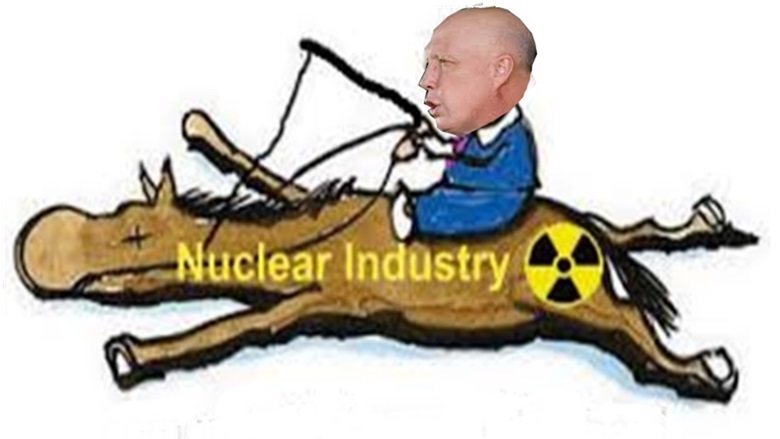
Until they did. The South Australian (SA) Liberals pushed for a nuclear power royal commission and the SA Labor Party obliged in 2016. In 2017 the New South Wales Liberals called for a debate on nuclear power. In 2019, the federal Liberals established a parliamentary commission to canvas what would be needed to introduce commercial nuclear power into Australia. In May 2022, Peter Dutton, then in government and (supposed) fan of nuclear power, stated that nuclear was ‘not on the table’, citing concerns to reduce costs rather than raise them. Yet in October 2022 the Liberals (now from opposition) introduced a bill to remove nuclear prohibitions.
What changed? One suggestion is to be found in a podcast that emerged in 2023, where the Coalition’s Minister Matt Canavan (who introduced the bill) admitted his colleagues were ‘not serious’ about nuclear power and only engaging with it ‘because it fixes a political issue for us’.
The Australian LNP has a plan for commercial nuclear power reactors in Australia that is a Claytons energy policy. Some may recall that Claytons was a non-alcoholic beverage, marketed in the 1970s and 1980s, and promoted as ‘the drink you have when you’re not having a drink’. To refer to ‘a Claytons’ means to refer to a shadow of the real thing, a substitute, an imitation. Nuclear power in Australia is the energy policy you have when you do not have a viable energy policy.
Australian nuclear news 14 – 21st April
Headlines as they come in :
- Fact Check: No, Mum, Nuclear Won’t Reduce Costs By 25%
- No walk in the park for nuclear reactors at life’s end.
- HALF-BAKED!
- Nukes kill kids.
- Dotty and Cretinous: Reviewing AUKUS.
- The real cost of living fix is renewables, not nuclear.
- Dutton’s nuclear revival smells rotten to Gens Y and Z
- 10 reasons why nuclear energy is a bad idea for Australia.
- Tim Wilson, secretive money and “think” tanks. Australia’s democracy is at stake.
- The Australian investors betting big on fusion – the “holy grail” of nuclear tech.
- Nuclear Fantasies and Migrant Fearmongering: Dutton’s Debate Playbook Is a Fact-Free Zone
- The Coalition Nuclear Policy is a Fake.
- Peter Dutton’s nuclear power plan could lead to major electricity shortages, analysis says.
- Peter Dutton insists there’s enough water for his seven nuclear plants, contradicting shadow frontbencher
- Forget nuclear, Australia is on fast lane to 100pc renewables.
- Dutton’s nuclear push will cost renewable jobs
- Victorian Liberal leader distances state party from Peter Dutton’s nuclear proposal: ‘Our focus is gas’
- Coalition’s nuclear power pitch falling flat with some voters, Vote Compass data suggests.
- Rightwing lobby group Advance says it makes ‘no apology’ for support given to anti-Greens groups
Forget nuclear, Australia is on fast lane to 100pc renewables
by Andrew Blakers | Apr 11, 2025 https://michaelwest.com.au/forget-nuclear-australia-is-on-fast-lane-to-100pc-renewables-solar/
Gas is the talk of the town, while nuclear is not, but a massive increase in solar power generation capacity has already put Australia on the fast track to a 100% renewable energy future. Solar cell engineer
Andrew Blakers explains.
An academic living in cold Canberra retired his gas heaters a few years ago and installed electric heat pumps for space and water heating. His gas bill went to zero. He also bought an electric vehicle, so his petrol bill went to zero.
He then installed rooftop solar panels that export enough solar electricity to the grid to pay for electricity imports at night, so his electricity bill also went to zero. That Canberra academic will get his money back from these energy investments in about eight years.
I am that academic.
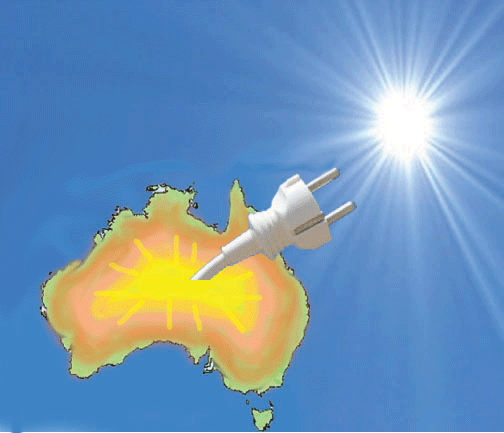
Solar energy is causing the fastest energy change in history. Along with support from wind energy, it offers unlimited, cheap, clean and reliable energy forever.
With energy storage effectively a problem solved, the required raw materials impossible to exhaust — despite some misconceptions in the community — and an Australian transition gathering pace,
“solar and wind are becoming a superhighway to a future of 100 percent renewable energy.“
While the technological arguments for solar and wind power are compelling, it’s clear renewables have to overcome obstacles.
One is the division over the impact of the rollout of renewable energy infrastructure. It has divided affected communities across the country and needs to be addressed. Generous compensation and effective education about large regional economic opportunities are good ways forward.
There is also the political debate about what form Australia’s energy transition should take.
Solar surge
Yet, beyond those issues, solar offers unlimited energy for billions of years and provides the cheapest energy in history with zero greenhouse gases, zero smog and zero water consumption.
That explains why solar energy generation is growing tenfold each decade and, with support from wind, dominates global power station construction markets, while global nuclear electricity generation has been static for 30 years and is largely irrelevant.
In 2024, twice as much new solar generation capacity — about 560 gigawatts — was added compared with all other systems put together. Wind, hydro, coal, gas and nuclear added up to about 280 gigawatts.
There will be more global solar generation capacity in 2030 than everything else combined, assuming current growth rates continue. Solar generation will pass wind and nuclear generation this year and should catch coal generation around 2031.
About 37 percent of Australia’s electricity already comes from solar and wind, with an additional 6 percent from hydroelectric power stations that were built decades ago.
“More solar energy is generated per person in Australia than in any other country.”
Solar is by far the best method of removing fossil fuels, which cause three-quarters of global greenhouse gas emissions, from the economy.
In Australia, 99 percent of new generation capacity installed since 2015 has been solar and wind, and it is all private money. The energy market is saying very clearly that solar and wind have won the energy race and energy policies are consistent with reaching the government target of 82 percent renewable electricity by 2030.
Solar on the roof coupled with energy storage in a hot water tank, an EV battery and a home battery allows a family to ride through interruptions to gas, petrol and electricity supply and that energy resilience can apply at domestic, city, state and national levels.
Managing the balance
Balancing high levels of solar and wind energy to avoid supply interruptions is straightforward at low cost using off-the-shelf technology available from vast production lines. New transmission brings new solar and wind power into the cities and also smooths out the vagaries of local weather by transmitting solar and wind electricity to where it is needed.
For example, if it is raining in Victoria and sunny in New South Wales, then electricity can be transmitted south. Storage comprises batteries for short-term storage of a few hours and pumped hydro energy storage for hours to days.
“Together, batteries and pumped hydro solve the energy storage issues.“
Pumped hydro energy storage provides about 95 percent of global energy storage. It typically comprises two reservoirs located a few kilometres apart and with an altitude difference of between 500 and 1,000 metres.
On sunny or windy days, renewable sources like solar or wind power are used to pump water into the uphill reservoir, and during the night, the water flows back downhill through the turbine to recover the stored energy.
The same water can go up and down between the reservoirs for 100 years. Global potential pumped hydro energy storage is equivalent to two trillion electric vehicle batteries.
Australia has about 300 times more pumped hydro energy storage potential than needed to support 100 percent renewable electricity. It already has three pumped hydro systems, with two more under construction.
Globally, the world has more than 820,000 potential pumped hydro sites, which is about 200 times more than we need to support a 100 percent renewable energy system.
When eventually complete, Snowy 2.0 will provide 85 percent of energy storage in the national energy market at a cost 10 times lower than equivalent batteries and with a lifetime that is five times longer.
Myths and misconceptions
There are those — often vested interests — who throw up arguments against solar energy, regardless of what the facts say about its merits.
Here are a few:
- It takes up valuable farmland. Most of the area in solar and wind farms remains in use for agriculture. The area withdrawn from agriculture to generate all our energy from solar and wind is very small, equating to about the size of a large living room per person.
- The rural landscape can’t fit in any more solar and wind farms. Heat maps developed by researchers at the Australian National University show the vast number of good locations for solar and wind farms.
- Renewable infrastructure is a blight on the landscape. Hosts of solar and wind farms (and their neighbours) are generously compensated, while hosts of transmission lines are paid more than $200,000 per km. All the solar farms, wind farms, transmission and pumped hydro are in regional areas, which means that vast amounts of money and employment are flowing into regional areas. Solar farms are usually invisible from other properties. Open-cut roads, buildings, open-cut coal mines and gas fields are also visible in the landscape. People in cities have a far more cluttered view from their windows than rural people.
- We will run out of critical minerals. No critical minerals are required, only substitutable minerals. Solar panels require silicon for the solar cells, glass, plastic and conductors, which are made from extremely abundant materials.
- We will drown in solar panel waste. The amount of solar panel waste generated when all energy (not just electricity) comes from solar amounts to about 16 kg per person per year (mostly glass). Panel waste is a small and solvable problem.
1 This month

of the week – Australians for War Powers Reform (AWPR)
To see nuclear-related stories in greater depth and intensity
 Antinuclear