The Coalition Nuclear Policy is a Fake
Arena Online, Darrin Durant, Jim Falk, Jim Green, 17 Apr 2025, https://arena.org.au/the-coalition-nuclear-policy-is-a-fake/
Calls for commercial nuclear power in Australia have historically all featured the Liberal National Party (LNP) promising nuclear power but later quietly shelving such plans. With a looming federal election date, that pattern seems to have returned with the Coalition running silent on nuclear power, despite the election being only weeks away. Why?
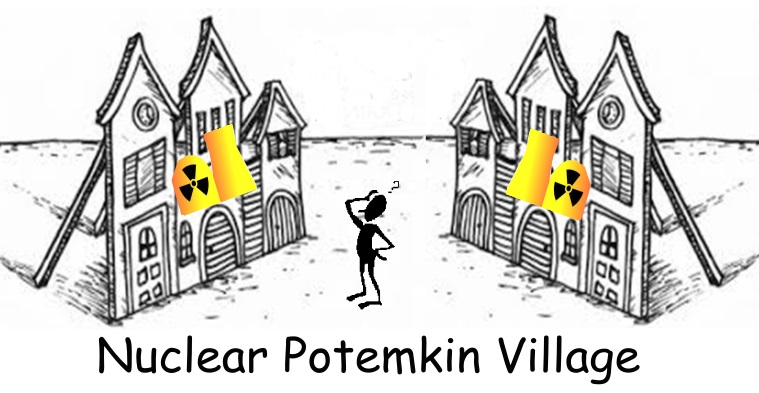
The Coalition’s policy is a bit like a Potemkin Village anyway—the fake villages said to be erected by Grigory Potemkin to impress Catherine the Great. Like them, the nuclear proposal is at best a facade, lacking essential content but acting to distract attention from division within the Coalition on emissions reductions.
Nuclear Potemkin villages
The Coalition has an electricity plan, but it is highly unlikely to actually involve nuclear reactors. The idea of nuclear reactors (large or small) with their low life-cycle emissions (at least compared to fossil fuels) provides a facade for misdirecting public attention. Behind the facade are continuing placeholders for fossil fuels, a stalling of renewables development, and a plan to keeping coal plants running as long as possible—probably switching to gas when those coal-fired power stations become technologically and economically unviable.
The long-promised Coalition nuclear plan was eventually outlined with minimal detail in June 2024 as seven reactor-site locations across New South Wales, Victoria, Queensland, South Australia and Western Australia, producing 14 gigawatt, or 38 per cent of electricity, with the first reactor supposedly coming on line by 2035–37. The claim was for an outcome ‘significantly’ cheaper than the Australian Labor Party (ALP) renewables plan. It invoked the myth of baseload power as the only route to grid reliability, and claimed it would ‘responsibly’ integrate with renewables.
On Friday 13 December 2024, when most news outlets would have already filed their stories, the Coalition released actual costings of their nuclear plan, using modelling by Frontier Economics. These costings were roundly criticized for sins of omission:
- mass under-estimations of the cost of keeping coal-plants running, the amount of planned curtailment of renewables, how much transmission nuclear would need, and the implications of not meeting net zero commitments;
- poor market-design assumptions, with the low projected cost ($263 billion less than the ALP renewables plan) being incompatible with lived experience of contemporary reactor costs. The claim of smooth renewables integration was undermined by Frontier’s own modelling suggesting solar would be curtailed to create room for nuclear;
- obfuscation of emissions, including the issue that the Coalition plan would emit more than 1.7 billion extra tonnes of carbon dioxide up to 2050 compared to the ALP renewables plan;
- assumptions about a contracted not expanded industrial manufacturing base (the Frontier scenario assumes 40 per cent less electricity use);
- systematic under-estimation of full costs of nuclear reactors (estimated in the Coalition plan to be $10 billion per gigawatt while real experience shows $15–28 billion per gigawatt).
Economic analysts have confirmed that the Coalition nuclear plan rests on accounting tricks, hiding the true cost of nuclear, ignoring the cost of petrol and gas, neglecting the cost of replacing coal-fired power stations—which will otherwise be permitted to pollute for decades—and failing to cost the damage from those higher emissions.
Astroturfing nuclear support
There is a strategic vagueness in the Coalition’s nuclear plan, which replicates a key pattern in the history of nuclear power proposals in Australia: make promises, provide insufficient detail, then walk away (rinse and repeat so long as nuclear can pretend to be a climate policy). The vagueness is strategic because the lack of essential detail in the LNP nuclear plan encourages other social actors to read their ideas into the plan. It is a form of astroturfing where the proponents of an orchestrated message attempt to hide its actual sponsors but make it appear that it is supported by unsolicited grassroots individuals.
The Frontier Economics Report purports to compare the ALP’s renewables and LNP’s nuclear plans, yet in fact compares apples to oranges, based on quite different energy-demand scenarios. The ALP scenario costs more because it serves a much higher energy consumption projection. Despite it being three years since the nuclear policy was first suggested, we have been offered no idea of what the socio-political contours of a nuclear industry would look like in Australia.
There are constitutional questions. How would the LNP garner parliamentary support to overturn both federal and state bans on nuclear facilities or impose nuclear on states? There are waste disposal questions: what confidence can publics have that vastly increasing the stock of nuclear waste to be managed would succeed, given a history of failed repository siting at Kimba, Muckaty and Woomera and a legacy of Indigenous distrust of government sowed by atomic bomb testing and the extractive industries?
There are proliferation questions. When will uncertainties in Small Modular Reactor designs be resolved in a way that permits open assessment of the proliferation risks in the nuclear fuel cycle for a nuclear-juvenile nation like Australia? There are integration questions: the Coalition assumes smooth integration of nuclear and renewables but research suggests nuclear does not ‘ramp’ well, that nuclear undermines carbon emissions mitigation strategies, and that cycling limitations and the high capital costs of nuclear make nuclear power poor fits within renewables-heavy grids.
Only half-baked answers by a flood of interest groups attempt to fill the empty policy space. Thus, the Minerals Council of Australia (MCA) has engaged in disinformation in their support of nuclear power, attacking renewables seemingly because adopting nuclear would diminish investor confidence in renewables. Whereas the MCA engages in corporate and parliamentary lobbying, media networks such as The Australian and Sky News have populated the mainstream media with repackaged climate denial and delay talk: renewables are economic black holes, solar and wind are unreliable, and decarbonization transitions need to be managed (glacially).
Popup nuclear groups, including Nuclear for Climate and WePlanet (an offshoot of the UK fossil-fuel funded RePlanet) litter the online social media spaces with new denialism. Old denialism denied anthropogenic warming. New denialism, a ‘regime of obstruction’, throws sand in the gears of the decarbonization transition to keep fossil capital in the driving seat. The effects and urgency of climate mitigation are sidelined, disarming the objection that nuclear is too slow and piecemeal. Renewables-based climate solutions are discredited. These popup public groups reinvent the rationalist critique of environmentalism, deriding anti-nuclear critics as emotional. The scientism of the popup nuclear groups is palpable.
The astroturfing effect—creating a perception of broad public support where little exists—is in part explained by an effect discussed by the experimental psychologist F.C. Bartlett in his Remembering (1932). His argument was that the complexity of a response is a function of the complexity of the responding agents, not the stimulant. Audiences fill a simple message with missing meaning. With the LNP plan, plural, polarized publics have loaded up the vague nuclear proposal (closer to a meme than a policy) with meanings. The LNP simply prodded audiences with rhetoric about ‘renewables will not cut it’ and ‘we need reliable power’, then let the existing regime of obstruction interest-groups jump in. In this way, public support for nuclear is manufactured. It’s astroturfing, via experimental psychology and the politics of division.
The Coalition nuclear plan: A Claytons policy
The Australian Coalition government has repeatedly advanced nuclear as the solution to a problem, falling in love with nuclear publicly, and then ghosting it after a brief flirtation.
The John Gorton-led Coalition Government sought to build a reactor at Jervis Bay in 1969, but the idea floundered by 1971. The John Howard-led Coalition government introduced legislation in 1998 to ban nuclear facilities in Australia, ostensibly to secure support for a new research reactor at Lucas Heights but also reflecting bipartisan agreement that commercial nuclear power lacked political legitimacy in Australia.
Yet in 2006 the Howard government commissioned a task force to spruik the potential for commercial nuclear power. The Report, authored by Ziggy Switkowski and released in 2007, suggested Australia could start in 2020 to build twenty-five reactors that by 2050 would supply one-third of Australia’s electricity. However, by 2007 the Coalition again tried to run dead on nuclear power. Having announced reactor siting would be decided according to commercial decisions, community backlash saw the Coalition first backtrack by promising binding local plebiscites for any proposed location, then shelve any nuclear legislation until after the election. Howard lost his seat, and the Coalition did not raise nuclear again.
Until they did. The South Australian (SA) Liberals pushed for a nuclear power royal commission and the SA Labor Party obliged in 2016. In 2017 the New South Wales Liberals called for a debate on nuclear power. In 2019, the federal Liberals established a parliamentary commission to canvas what would be needed to introduce commercial nuclear power into Australia. In May 2022, Peter Dutton, then in government and (supposed) fan of nuclear power, stated that nuclear was ‘not on the table’, citing concerns to reduce costs rather than raise them. Yet in October 2022 the Liberals (now from opposition) introduced a bill to remove nuclear prohibitions.
What changed? One suggestion is to be found in a podcast that emerged in 2023, where the Coalition’s Minister Matt Canavan (who introduced the bill) admitted his colleagues were ‘not serious’ about nuclear power and only engaging with it ‘because it fixes a political issue for us’.
The Australian LNP has a plan for commercial nuclear power reactors in Australia that is a Claytons energy policy. Some may recall that Claytons was a non-alcoholic beverage, marketed in the 1970s and 1980s, and promoted as ‘the drink you have when you’re not having a drink’. To refer to ‘a Claytons’ means to refer to a shadow of the real thing, a substitute, an imitation. Nuclear power in Australia is the energy policy you have when you do not have a viable energy policy.
No comments yet.
1 This month

of the week – Australians for War Powers Reform (AWPR)
To see nuclear-related stories in greater depth and intensity
 Antinuclear
Leave a comment