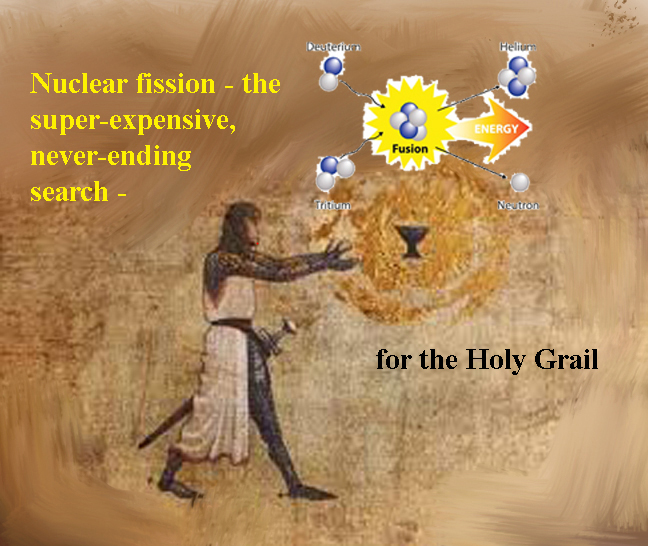
The Australian investors betting big on fusion – the “holy grail” of nuclear tech
ReNewEconomy, Rachel Williamson, Apr 17, 2025
One of Australia’s biggest super funds is backing nuclear tech – but not the kind being pitched by the federal Coalition.
Hostplus is investing in fusion energy.
CIO Sam Sicilia says a combination of tech advances in the last five years and a youthful member base means fusion is now a real option for big, patient investors…………………
Fusion power is the holy grail of energy technologies: it makes more energy than nuclear fission, produces less waste, doesn’t create anything that could be used in a weapon, and has zero risk of meltdown.
The truth is more complicated, not least because the longest ever sustained reaction was only achieved in January, when China’s “artificial sun” reactor in Heifei managed a whole 17 minutes. …………………..
And with almost half a billion dollars of funding sunk into the industry last year, the race is on for companies ranging from Commonwealth Fusion Systems – the MIT spinout that is leading so far and Hostplus’ investment pick – to Australian startup HB11………………………………………………………………………………
If this sounds ambitious for a technology that just five years ago was still wrestling with major functional problems, it isn’t to people in the industry – even in Australia.
Patrick Burr leads the student project to build a donut-shaped tokamak fusion reactor – just a little one – at University of New South Wales (UNSW). He also works with Australia’s only home-grown fusion company, HB11 Energy.
He says commercialisation of fusion energy is now an engineering problem that requires money and people…………………………………………………………………………..
Australia as a fusion power? Maybe
Matt Bungey is taking a bet that fusion energy will be ready for launch – in Australia – by the late 2030s.
Bungey is a partner at Western Australian venture fund Foxglove Capital and an investor in another fusion frontrunner, Type One, which recently set up an Australian subsidiary.
He believes fusion should be part of a diverse energy strategy even if by the late-2030s renewables and storage are the dominant generators.
But he does admit there is a deadline.
“There’s a timing element here, if you don’t get it right before the mid 2040s there’s a question of whether you really need it,” he says.
The other view is that Australia’s energy needs will scale in unimaginable ways as the demands of decarbonisation and AI require more electricity……………………………………………………………..
Today the global industry has attracted $US7 billion ($A11 billion) in funding, according to the FIA.
But even the $A130 billion Hostplus is merely dipping a toe in – its CFS investment is worth $US136 million.
Still, CFS CEO Bob Mumgaard says there is enough curiosity in the technology from within Australia to warrant a look here – even if nuclear power generally is still illegal. ……………………………………………………………………………………
Australia enters the chat, with HB11
Australia does have its own fusion startup in HB11. It is forging a technology path quite different to those pursued by CFS (a tokamak design) or Type One (a stellarator).
HB11 is using lasers and a proton-boron fuel, rather than the more common deuterium/tritium, deuterium/deuterium, or deuterium/helium3 combos.
“The key difference between what we’re doing and what most of the other private fusion companies are doing is we’re using [boron] which does not produce neutrons,” McKenzie says.
Boron is abundant and costs about a dollar a kilogram, and the method of firing a laser at small pellets to create an ongoing reaction doesn’t make the materials around them radioactive – more on this later.
McKenzie gently negs the tokamak and stellarator players, saying none have produced a net gain – more energy out than in – whereas laser fusion has, in December 2022 at the National Ignition Facility in California.
“The catch is it’s much harder to produce. Essentially we’ll need much bigger lasers [than we have now],” McKenzie says.
How big, you might ask?
Computer simulations suggest that, right now, they may need to be several football fields long and multiple storeys high. The National Ignition Factory’s laser is in a 10-story building about the size of three American football fields; China’s version in the southwest city Mianyang will be 50 per cent larger again, a size MxKenzie says “is about right”.
HB11 has a plan for its version of fusion to be widespread by the mid-2050s but it has a long way to go.
“When we achieve a neutronic hydrogen-boron fusion energy gain we’ll be on our way to Stockholm to pick up a Nobel prize,” McKenzie says.
Is it illegal or not?
Australia’s ban on nuclear fission technology for energy might apply to fusion – but also might not.
Experts spoken to by Renew Economy say there isn’t much interest within federal government to revisit nuclear rules and carve out a new area for fusion, somewhere between legal nuclear medicine and illegal fission.
But the UK and USare showing how fusion might be introduced, without dumping it in with fission.
Both countries say they won’t regulate fusion technology like fission, but instead treat the new reactors more like a particle accelerator.
That’s a framework that advocates like Bungey are pinning their hopes on, given almost every major hospital in Australia houses a particle accelerator to make nuclear medicines. These are controlled by the Australian Radiation Protection and Nuclear Safety Agency (ARPANSA) as well as a suite of other regulators.
McKenzie says the deuterium-tritium fuel might be difficult for nations to support, given both are fuels used in nuclear weapons, but generally fusion should not be affected by national bans on fission energy.
“My legal understanding is that it will not come under Australia’s nuclear ban. But yes … what the rest of the world is doing, fusion is a relatively new field with no regulations,” he says.
“The US and the UK very recently passed legislation where the nuclear fission and fusion regulators are different and they require different standards, so you’re starting to separate the two technologies and that makes a big difference.”
But it’s Italy that might be the most appropriate model for Australia because it’s coming from a total ban on nuclear energy as well, Mumgaard says.
But Italy is also un-banning fission technology after a 40-year hiatus, producing a draft law in March to set up both fission and fusion technologies.
Pros and cons
Fusion is now such a small sector in Australia that it’s hard to find one person who isn’t connected to one of the local or global companies competing to be first, cheapest, or most realistic.
UNSW’s Patrick Burr is involved with HB11 but happy to also cut through the marketing speak. Every technology, as Burr says, has its drawbacks.
The main problem today is talent. Burr says companies are already cannibalising each other’s staff, from fusion engineers, scientists, down to people in the supply chain, and educating new talent was one reason why UNSW launched the student-led tokamak project.
But there are some practical problems as well which are high on the ‘to solve’ list of the engineers.
One of the first dot points on any ‘why fusion is better’ powerpoint slide is the tiny amount of waste it produces from a reaction.
But this is misleading. The irradiated waste of a fusion plant is the whole internal structure, albeit with a hundreds of years half life instead of a thousands of years half life.
Dealing with concrete or equipment that is toxic for hundreds of years is manageable for a society, Burr says. The challenge will be figuring out how to handle the higher volumes of radioactive material.
Another drawback is the source of fuel.
The most common fuel pairing is deuterium and tritium – the former is abundant in nature, the latter is not and has a short half life. Other fuels have their own challenges, such as HB11’s boron-hydrogen method, which right now requires giant lasers to activate.
Taking a position on nuclear energy in a country like Australia, where it doesn’t exist outside the medical sector, is a bet on the distant future.
For Burr, it’s a question on whether Australia will have won the fight with hard-to-decarbonise sectors in 50 or 100 years’ time. And whether the country wants to make a bet today on a technology that may – or may not – be that solution. https://reneweconomy.com.au/the-australian-investors-betting-big-on-fusion-the-holy-grail-of-nuclear-tech/
Peter Dutton insists there’s enough water for his seven nuclear plants, contradicting shadow frontbencher
ABC By chief digital political correspondent Jacob Greber, 17 Apr 25
In short:
Voters are getting mixed messages about whether Peter Dutton’s nuclear power plan takes account of water needs.
The opposition insisted in Wednesday’s ABC Leaders Debate that allocations for all seven sites have been assessed.
What’s next?
But Nationals MP Darren Chester said water requirements would be based on experts’ “facts not opinions” and take up to 2 ½ years to determine.
The Coalition has sent voters contradictory messages about whether it has accounted for the vast water requirements of its seven proposed nuclear plants after Peter Dutton declared the issue all but resolved.
In Wednesday night’s ABC News Leaders Debate the opposition leader said he has already assessed water allocations for “each of the seven sites” where he plans to build nuclear power plants.
When challenged by ABC debate host David Speers whether “you need more” water for nuclear, Mr Dutton replied: “We’re comfortable with the analysis that we’ve done”.
The remarks undermine comments given just hours earlier by a senior Coalition frontbencher who represents one of the potential nuclear sites and who insisted the issue would first need to be resolved by water “experts in the field”.
Darren Chester, the member for the Victorian coastal seat of Gippsland, told local ABC radio that there would be a two- to two-and-a-half-year investigation to determine whether enough water was available.
They would also consider other risks, including the potential for earthquakes.
“What that means [is that] the experts in the field would be required to report on all seven sites around issues surrounding water and seismology, so earthquake risk … and the question around the viability in terms of access to the network” via transmission lines, he said.
“You have to do a full site characterisation study based on facts not opinions … to find out what water is available and what’s possible at each of the seven sites.
The Coalition’s mixed messaging on water comes amid signs the opposition is struggling to sell its vision of a nuclear powered future, including from groups that say they are close to the Liberal Party.
Part of the challenge is that nuclear power stations would require a large quantity of water in addition to what is already earmarked for agriculture, environmental flows and remediation of old coal sites, raising fears of major shortfalls during inevitable periods of drought.
A report this month by Australian National University visiting fellow Andrew Campbell, commissioned by Liberals Against Nuclear, found the Coalition’s plan would require 200 gigalitres of water a year.
Professor Campbell found that half of the proposed nuclear capacity would not secure enough water and that another 40 per cent of the proposed nuclear generation would be curtailed during dry seasons.
Mr Chester, who is a member of the Nuclear Energy Select Committee, indicated he supports nuclear energy as long as it stacks up…………………………………………………….https://www.abc.net.au/news/2025-04-17/dutton-insists-theres-enough-water-nuclear-plants-election-2025/105189220
The Conservative Argument Against Nuclear Power in Japan

It has been said that nuclear power stations are like nuclear weapons directed at your own country. I couldn’t agree more.
Getting rid of these “nuclear weapons directed at our own country” will not require huge defense spending or difficult diplomatic negotiations. All that is required is the ability to look square at the facts, and a conservative mindset determined to protect our rich and productive land and pass it on to the next generation.
Higuchi Hideak, Apr 15, 2025, https://www.nippon.com/en/in-depth/d01111/
A Devastating Loss of Territory
“Conservatism is essentially realism. A conservatism that refuses to confront reality is as worthless as a progressivism without ideals.”
This is how I opened my Hoshu no tame no genpatsu nyūmon (Nuclear Power: An Introduction for Conservatives), which came out last summer. In the book, I tried to bring attention to the contradictions inherent in the policies of the Liberal Democratic Party: a party that claims to support conservative values and uphold the ideals of patriotism but nevertheless advocates that Japan should continue or increase its reliance on nuclear power, even in the aftermath of the Fukushima disaster.
In the book, I made three main points. First, nuclear power is fundamentally incompatible with conservatism and patriotism. Second, nuclear power stations are inherently vulnerable to earthquakes, for structural reasons. And third, nuclear power stations are also vulnerable from a national security perspective.
The disaster at the Tokyo Electric Power Company’s Fukushima Daiichi Nuclear Power Station in March 2011 led to the evacuation of more than 150,000 people. More than 20,000 are still not able to return to their homes even today. And the state of emergency declared shortly after the disaster has still not been lifted, 14 years later.
In Fukushima Prefecture, evacuation orders are still in effect across more than 300 square kilometers, in what the government has designated as “closed to inhabitation indefinitely.” This is in spite of the fact that the annual safety limits for radiation exposure among the general population were lifted from 1 millisievert to 20 millisieverts. An area of more than 300 square kilometers—equivalent to the size of Nagoya, one of Japan’s key economic centers—is still effectively under evacuation orders. The country has effectively lost territory 50 times larger than the Senkaku Islands in Okinawa Prefecture, controversially claimed by China and the frequent focus of national security anxiety. As if this weren’t bad enough, more than 300 young people have been diagnosed with childhood thyroid cancer, a condition that would normally be expected to affect only around one in a million. Many of these have been serious cases requiring invasive surgery.
When I sat as presiding judge in the case brought before the Fukui District Court to stop the planned reactivation of the Ōi Nuclear Power Station, operated by the Kansai Electric Power Company, the argument put forward by the Liberal Democratic Party (then newly returned to power) and the business lobby was that shutting down nuclear plants would force Japan to import vast amounts of oil and natural gas to fuel thermal power stations. This would result in a massive outflow of the nation’s wealth and lead to national impoverishment.
On May 21, 2014, the court handed down its verdict. Even if shutting down the plant did lead to a trade deficit, the court rejected the idea that this would represent a loss of national wealth. True national wealth, the court held, consists of rich and productive land—a place where people can put down roots and make a living. The risk of losing this, and being unable to recover it, would represent a more serious loss of national wealth. Compare the arguments of the LDP and economic business lobby with the decision of the Fukui District Court. Which represents true conservatism, unafraid to look squarely at the facts about nuclear disasters? Which best represents the true spirit of patriotism?
Disaster Caused by a Power Failure
Let’s consider a few of the characteristics of nuclear power stations. First, they must be continuously monitored and supplied with a constant flow of water to cool the reactor. Second, if the supply of electricity or water is interrupted, there is the risk of an immediate meltdown. A serious accident could potentially mean the end of Japan as a nation.
The accident at Fukushima Daiichi came perilously close to rendering much of the eastern part of Japan uninhabitable. Yoshida Masao, the director in charge at the time, feared that radioactive fallout would contaminate all of eastern Japan when it looked as though the containment building at the Unit 2 reactor would rupture after venting became impossible. The chair of the Japan Atomic Energy Commission also expected it would be necessary to evacuate the population from a 250-kilometer radius of the plant, including Tokyo.
The accident at Fukushima did not happen because the reactor was damaged directly by the earthquake or tsunami. The initial earthquake interrupted the external supply of electricity, and the tsunami that followed cut off the emergency supply as well. Essentially, a power failure made it impossible to cool the reactor, and this was enough to trigger a catastrophe.
These characteristics mean that the resilience of nuclear power stations depends not on how physically robust the reactors and containment buildings are, but on the dependability of the electricity supplied to them. Nuclear power plants in Japan are designed to be able to withstand seismic activity between 600 to 1,000 gals (a gal being a unit of acceleration used in gravimetry to measure the local impact of an earthquake). But earthquakes over 1,000 gals are not unusual in Japan, and some have exceeded 4,000 gals. For this reason, some construction companies build housing that is designed to withstand seismic shocks up to 5,000 gals.
There are only 17 fully constructed nuclear power stations across the country. Six earthquakes exceeding the safety standards have already occurred at four of these: Onagawa, Shika, Kashiwazaki-Kariwa, and Fukushima Daiichi (twice each at Onagawa and Shika). Japan experiences more earthquakes than any other country on earth. Although the country accounts for just 0.3% of the world’s landmass, more than 10% of all the world’s earthquakes happen here. Despite the inherent dangers, there are 54 nuclear reactors along the coasts, around 10% of the world’s total.
Since it is impossible to forecast what scale of earthquake might hit a given site in an earthquake-prone country like Japan, construction companies operate on the principle that houses should be able to withstand seismic events equivalent to the strongest earthquake on record in the past.
The government ratified the Seventh Strategic Energy Plan at a cabinet meeting in February this year. This latest iteration of the plan removed references to an ambition to reduce the country’s dependence on nuclear power as much as possible, and signaled a clear intention to restore nuclear power to a more prominent position in the country’s energy strategy. Despite this, the seismic planning standards for nuclear power stations still assume that it is possible to accurately predict the maximum size of any earthquake that will hit in the future by analyzing past seismic data and running a site assessment of local geotechnical conditions. Whose position demonstrates better scientific judgement and a more realistic assessment of the facts—the government’s or the construction companies’?
Why Europe’s Biggest Nuclear Power Plant Fell into the Hands of the Enemy
TEPCO was a huge company, with annual revenue of around ¥5 trillion and a profit margin of 5%, meaning the company was making ¥250 billion every year. But the economic damages from the Fukushima accident came to at least ¥25 trillion, equivalent to 100 years in revenue for the company. What can we say about an approach to electricity generation in which a single accident can wipe out a century’s worth of revenue and essentially bankrupt a huge company like TEPCO? It is an energy source that is not just cost-ineffective but unsustainable.
For example, it is estimated that if an accident on a similar scale happened at the Tōkai Daini Nuclear Power Station in Ibaraki Prefecture, it would cause damage worth ¥660 trillion (compared to the national government budget of ¥110 trillion). As head of the Fukushima plant, Yoshida was resigned to losing the containment building of the unit 2 reactor to an explosion. He was saved by a “miracle” when a weakness somewhere in the structure of the building allowed pressure to escape and a rupture was avoided. Without this lucky intervention, it is estimated that the economic damages might have reached ¥2.4 quadrillion.
These figures make clear that the problem of nuclear power is not merely an energy issue. It has profound implications for national survival, and should be regarded as a national security priority. Russia’s war in Ukraine has provided a stark reminder of the seriousness of this threat. The Zaporizhzhia station on the Dnieper River is the largest nuclear power plant in Europe. A threat from Russia to attack it was enough to persuade Ukraine to hand over the plant to Russian control. If the plant really had been attacked, it might have caused a crisis with the potential to lay waste to large parts of Eastern Europe.
It has been said that nuclear power stations are like nuclear weapons directed at your own country. I couldn’t agree more. And in Japan we have 54 of these reactors bristling our shores, all but unprotected against earthquakes, potential enemies, and terrorist attacks. The LDP government mocks those who oppose Japan’s holding the offensive capability to attack enemy bases and argue for an exclusively defense-oriented posture as indulging in “flower garden” thinking. At the same time, the party is blind to the fact that nuclear power stations represent this country’s biggest national defense vulnerability.
Getting rid of these “nuclear weapons directed at our own country” will not require huge defense spending or difficult diplomatic negotiations. All that is required is the ability to look square at the facts, and a conservative mindset determined to protect our rich and productive land and pass it on to the next generation.
In my previous books and articles, I addressed the legal issues involved in nuclear power. In my Nuclear Power: An Introduction for Conservatives, I made clear that my own political stance is conservative. I was prepared for a backlash from progressives, who make up the bulk of the antinuclear movement, but in fact I received no pushback from that quarter all. In fact, I was taken aback by the resounding support I received.
Most of the criticism came from supposed conservatives who were apparently determined to discredit my sincere intentions and grumbled that it was unseemly for a former judge to be sticking his nose into politics. On Amazon, my reviews were flooded with apparently coordinated personal attacks and slander. But I am still convinced that true and fair-minded conservatives will understand my true intentions.
Geologists acknowledge that it is simply not possible to accurately predict earthquakes with today’s science. A huge earthquake could strike tomorrow, causing a catastrophe at one of the nation’s nuclear power stations that could wipe out or render inhabitable large parts of the country. My aim is simply to make as many people as possible aware of this terrifying fact.
(Originally written in Japanese. )
1 This month
15 April – Zoom –Nuclear Power is Not the Solution
Apr 15, 2026 01:00 AM in Canberra, Melbourne, Sydney

Join the International Physicians for the Prevention of Nuclear War (IPPNW) on Tuesday, April 14th for a timely webinar exploring the risks associated with nuclear power and challenging the myth that it offers a simple, safe, carbon-free solution to the climate crisis

of the week – Australians for War Powers Reform (AWPR)
To see nuclear-related stories in greater depth and intensity
 Antinuclear