Is Elon Musk a halfwit ?

April 19, 2025, https://theaimn.net/is-elon-musk-a-halfwit/
A silly insult! I hear your cry. Yes, as the Oxford Dictionary defines a “halfwit” as a”foolish or stupid person” And I do agree, it is stupid to call Elon Musk “stupid”.
But that’s not what I mean. I guess that I have invented a new interpretation of “halfwit”.
According to my view , one can be brilliantly clever with one kind of thinking, yet lacking in understanding of other important ways of thinking, as though half of one’s brain is sort of not functioning. I was prompted to ponder on this by Gautam Mukunda‘s article in The Business Standard – “Musk and the dangerous myth of “omnigenius“. Mukanda deplores “the Halo Effect” – a cognitive bias in which we revere someone for remarkable success in just one area, and assume that they will be equally great in other areas.
Mukunda gave a chilling example. “Musk’s Department of Government Efficiency (DOGE )fired hundreds of employees at the National Nuclear Security Administration, the agency responsible for the production and security of nuclear weapons and management of nuclear waste sites” (These cuts were soon reversed under the advice of Arms Control Association Executive Director Daryl Kimball).
Mukunda is exploring the attitude of people in general, towards valuing a high achiever So he’s not actually discussing Musk himself and Musk’s way of thinking.
But it looks as if Elon Musk had no insight into the potential negative consequences of the firing of nuclear safety staff.
This touches on Musk’s apparent lack of interest in some areas of life – employment relationships, social studies – the non-technical areas. We all know that Elon Musk is a genius in science and technology. He’s got all that impressive knowledge. And let’s not forget – his early, and no doubt continuing motivation – to save and benefit humanity. Hence his desire, and technical know-how – aimed at creating a safer home for humanity -on another planet.
And what about Musk’s undoubted knowledge of science? Does it include those “soft” sciences – biology, ecology, cytology, genetics, psychology, neuroscience….
Neuroscience comes up with some clues to human ways of thinking. For one example, the development of the frontal lobe of the brain comes at different ages between males and females. Complex research has also shown for example, the role of testosterone in embryonic development in both sexes. It may account for males having, on the whole, better abilities in spatial understanding, and for female thinking on the whole encompassing more regions of the brain at the one time. Now this is a terrible digression from the immediate topic, but just my attempt to indicate that individual brain function differs between people.
Getting back to Elon Musk, it is just my guess that he, for one reason or another, is really good at STEM thinking (Science, Technology, Engineering and Maths). And unfortunately, even within that STEM, those so-called “soft” sciences don’t seem to count. It would seem that Musk is uninterested both in those other sciences, and of humanities studies.
So – that’s what I’m calling being “half-witted” – terrific at the concrete technical stuff, but sadly lacking in that other half – those other, less well-defined , areas of thinking.
So I think that Gautam Mukunda is onto something, when he warns us “why do we listen to these people? And why should they get positions of power in areas where they have little knowledge or experience?”
10 reasons why nuclear energy is a bad idea for Australia
There’s a lot of information and disinformation out there on nuclear energy. These are my 10 reasons why nuclear energy would be a bad idea for Australia
By Arthur Wyns, University of Melbourne, https://pursuit.unimelb.edu.au/articles/10-reasons-why-nuclear-energy-is-a-bad-idea-for-australia 16 April 2025
As always seems to be the way, energy and climate policy is proving to be an area of contention between the major parties in Australia’s 2025 election.
One issue that’s provoked a lot of discussion and confusion is the Liberal-National Coalition’s proposal to build seven nuclear power plants across Australia.
It’s a controversial idea that’s opposed by Labor, the Greens, many independent MPs and some Liberal groups.
Both the Climate Change Authority and Australia’s Commonwealth Scientific and Industrial Research Organisation (CSIRO) concluded that the deployment of nuclear energy in Australia would significantly increase the country’s energy prices and cause us to miss our climate change targets.
1. Too expensive
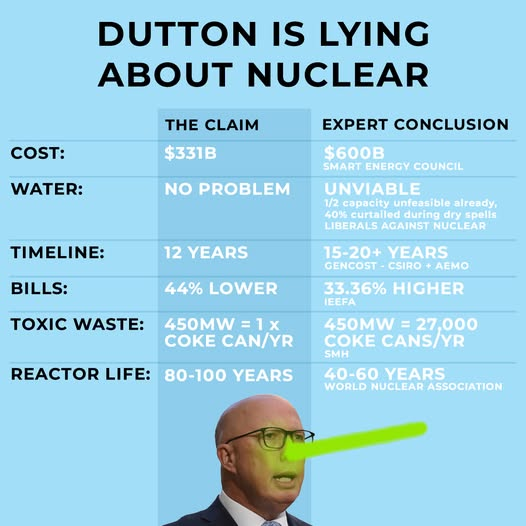
It’s extremely expensive to build and operate nuclear power plants anywhere in the world. Independent analysis by the Institute for Energy Economics and Financial Analysis (IEEFA) found that building nuclear power in Australia could see average household electricity bills rise by $AUD665 a year.
Estimates by CSIRO and the Australian Energy Market Operator (AEMO) for the 2024-2025 GenCost Report also found renewables are the cheapest option for any new electricity generation.
2. Too slow
Even if we drop everything else and throw all our weight behind nuclear energy, it wouldn’t play a role in Australia’s energy grid for more than a decade.
It took an average of 11 years to build the nuclear reactors that came online around the world in 2023 – largely in countries with a well-established nuclear industry, like China.
In Australia, CSIRO estimates it would take at least 15 years before we’d reach the first nuclear generation.
3. Too risky
Nuclear accidents are rare but they have devastating consequences.
The Chernobyl disaster in 1986 and the Fukushima disaster in 2011 contaminated large areas and continue to impact the health of hundreds of thousands of people. Both disasters caused a rise in anti-nuclear sentiments in the Australian public.
They also led to the majority of German citizens supporting an end to nuclear power in the country, with the three last remaining nuclear power plants in Germany taken offline in 2023.
4. Hard to build
Nuclear power stations are huge and complicated infrastructure projects that almost never stay on schedule.
The UK’s Hinkley Point C nuclear plant construction is now running 14 years late and is costing three times more than it was estimated: a whopping $AUD90 billion.
Smaller nuclear power plants, known as Small Modular Reactors (SMRs), have been proposed as an alternative, but there are no known commercial SMRs operational anywhere in the world.
The only company to have a small modular nuclear power plant approved in the US has since cancelled its first project due to rising costs.
5. Produces nuclear waste
Once in operation, nuclear reactors continuously produce radioactive waste. Generally, this waste is buried underground, where it remains radioactive for thousands of years.
Australia already produces a relatively small amount of low-level radioactive waste for some medical and research activities.
However, Australia currently doesn’t have any waste storage facilities to process high-level radioactive waste that would be produced by nuclear reactors – and recent efforts to build the country’s first radioactive waste storage facility have failed.
6. Uses lots of water
Nuclear reactors need to be cooled constantly, which requires high volumes of water.
It might not make sense to switch to a water-intensive energy source in the driest inhabited continent in the world, which is already facing increasing droughts and extreme heat.
Even countries like France and Sweden – with dramatically cooler climates compared to Australia – are increasingly being forced to shut down their nuclear power plants during warm periods when their cooling water heats up.
This means they then have to import energy from neighbouring countries.
7. No energy security
Australia’s remaining coal-fired power stations are old and increasingly breaking down, with over 60 per cent of our coal-generating capacity now more than 40 years old.
Even in the most optimistic scenarios, nuclear power is unlikely to come online before 2040, by which time all of Australia’s coal plants will have retired, according to the National Electricity Market.
In other words, the timelines for a coal-to-nuclear transition don’t add up.
Extending the life of these ageing coal-power plants would mean spending billions to prop up coal rather than investing in updating the electricity grid and expanding more cost-effective and readily available forms of energy like renewables.
8. No expertise
While nuclear generation is well established in many countries, it has never been deployed in Australia.
We currently lack the trained workforce and technical capability required for building a large-scale nuclear reactor.
Any attempt to go nuclear would leave Australia reliant on foreign companies and expertise. This is something we’re seeing play out in building and maintaining the nuclear submarines Australia agreed to host as part of the AUKUS deal.
In comparison, the renewable energy industry already creates more than 25,000 local jobs in Australia and this is expected to grow.
9. We’ll miss our climate goals
While nuclear energy is a form of low-emissions energy in many countries with established pre-existing nuclear facilities, focusing on the development of new nuclear energy in Australia is a diversion from taking real climate action.
Australia’s Climate Change Authority (CCA) recently released a detailed analysis concluding that a nuclear pathway for Australia would result in an additional two billion tonnes of greenhouse gas emissions.
It would extend the use of some coal-fired generators, slow down the uptake of clean technologies, and obstruct existing national plans to deliver 82 per cent renewable electricity by 2030.
10. Illegal in Australia
In the late 1990s, the Australian Federal Government introduced several new laws banning nuclear energy, including the National Radiation and Nuclear Safety Act (1998).
This Act prohibited the development of any new nuclear power sites in Australia.
The Commonwealth Environment Protection and Biodiversity Conservation Act (1999) also introduced rules preventing the construction or operation of any facilities that generate nuclear power.
Building nuclear reactors is currently illegal in every Australian state and territory.
Ultimately, pursuing a lengthy, expensive and potentially harmful energy source is a misguided step for Australia, particularly when we have all the resources and potential to make us a renewable energy superpower.
Arthur Wyns is a research fellow at Melbourne Climate Futures, University of Melbourne. He has written widely on climate change and global health issues, and regularly advises national governments and UN agencies. In 2023-2024, Arthur was the senior health advisor to the government of the United Arab Emirates as the host of the COP28 UN climate conference. He was a climate change advisor to the World Health Organization during 2019-2023, where he represented WHO at the UN climate negotiations, authored several UN reports on climate change and health, and acted as WHO’s speechwriter on climate change. Arthur is an editor of the Journal of Climate and Health and sits on the editorial board of ClimaHealth, the knowledge platform of the WHO-WMO Joint Office for Climate and Health.
1 This month

of the week – Australians for War Powers Reform (AWPR)
To see nuclear-related stories in greater depth and intensity
 Antinuclear