Fact Check: No, Mum, Nuclear Won’t Reduce Costs By 25%
April 21, 2025 by Ronald Brakels, https://www.solarquotes.com.au/blog/fact-check-no-mum-nuclear-wont-reduce-costs-by-25/
A group called “Mums for Nuclear” has spent a lot of money on newspaper and online ads in the lead-up to the federal election, claiming that “Nuclear energy in the mix with renewables reduces cost by 25%“. I’ve investigated this claim and found it to be false. Hopefully, this will prompt all groups that have made unrealistic claims about nuclear affordability to take them back and spark a chain retraction.
“Mums for Nuclear” has made variants of this claim on multiple occasions, citing Frontier Economics as the source.
Here’s an example from March 6th:
“Nuclear in the mix alongside renewables reduces cost by 25%”
Another claim that sounds very similar but which is potentially very different depending on how it’s interpreted is:
“Nuclear energy reduces energy costs by at least 25%.”
I’m guessing they mean electricity, which is not the same as “energy”. Their source is the same — Frontier Economics.
The person who posted the above newspaper ad on unsocial media asked if the lobby group Nuclear for Australia, which is behind this supposed grassroots band of mums, should authorise it. Apparently, the Australian Electoral Commission was wondering the same thing because they had a chat with Mums for Nuclear.
I’m not going to concern myself with whether or not they’re correctly following election advertising law. I’m just going to fact check the claim itself — the one about nuclear energy reducing costs by 25%. But I do want people to be clear they are spending large amounts of money to spread their message and aren’t just a group of mums with a Facebook page.
My Verdict: False
First off, I should tell you I’m not Doctor Who. Due to this personal shortcoming, it’s not possible for me to make absolute statements about events that haven’t yet come to pass. I’m unable to say with absolute certainty that building nuclear power stations in Australia won’t reduce costs because we’ve never tried it and been able to say, “Yep, that didn’t work”.
What I can do is say whether it’s reasonable to conclude that building nuclear power will lower costs: it absolutely is not.
The Frontier Economics Report
The source Mums for Nuclear give for their claims is a pair of reports by Frontier Economics, also used by the Coalition to cost its nuclear policies. It’s not exciting reading, so luckily there’s a Renew Economy article by Alan Rai that summarises a lot of the claims and debunks some. One key issue is that despite the mums claiming that nuclear in the mix “alongside renewables” reduces costs, these reports don’t actually factor in the true cost to the people responsible for much of Australia’s renewables output — owners of rooftop solar.
Nuclear Needs More Curtailment Of Rooftop Solar
The reports assume there’ll be no change in rooftop solar or home and business battery uptake, despite the assumption that nuclear power will often curtail renewables. Something that’s unrealistic if rooftop solar and batteries will often be shut down to benefit nuclear.
On page 15 of report 2, section 3.1, it says…
“It is important to note the modelling does not include any behind the meter supply or storage options. It’s assumed that this is likely to be roughly constant across the scenarios.”
This means they’ve assumed people will install the same amount of solar and battery capacity for their homes and businesses if nuclear energy is used. The reports rely on this occurring for Australia’s electricity demand to be met. But if people are often required to shut down their solar systems, and likely home batteries, it’s not reasonable to expect them to install just as much.
Nuclear could be ramped up and down as needed, but can’t do it economically. A nuclear power station operating at 50% capacity has almost identical costs to one run at 100%. This makes it a poor partner for solar. Because curtailing nuclear instead of solar would be awful for the economics of nuclear, every report in favour of nuclear power in Australia, including the Frontier Economics ones, assumes that renewables will be shut down, and not the other way around.
You Can’t Shut Down The Sun
Curtailing rooftop solar to favour nuclear won’t only be intolerable to many Australians — enforcing it will be next to impossible. The planned curtailing of solar doesn’t only involve preventing homes and businesses from exporting surplus solar power to the grid. It also requires maintaining demand for grid electricity by having rooftop solar shut down completely and stop supplying power to its home or business. Additionally, once there’s enough home and business battery storage — which there will be well before any nuclear power stations are built — it will also involve preventing batteries from supplying power at these times.
This will not only piss off people who have invested in solar and batteries, it will be almost impossible to enforce, as most with batteries could simply go off-grid at these times and remove the electricity demand that nuclear is relying on to control its costs. Without draconian enforcement that voters are unlikely to stand for, this curtailment won’t happen. As it will be worse in regions close to nuclear power stations, it gives locals an excellent reason to block their construction.
How often home solar and batteries would need to shut down depends on how much is installed before the first nuclear power plant becomes operational. But rooftop solar can already meet all demand at times in South Australia, and all other states are heading in that direction. Even if Frontier Economics is right and we’ll have nuclear power within 11 years, a massive amount of rooftop solar and home battery capacity will be installed in that time. Eleven years ago, rooftop solar supplied under o.1% of Australia’s electricity, while over the past 12 months it supplied 13.3%. This could easily more than double by the time 2036 rolls around. So for Frontier Economics’ figures to work, solar and potentially home batteries would need to be curtailed on most days.
I’m guessing they mean electricity, which is not the same as “energy”. Their source is the same — Frontier Economics
Extending Coal Power Is Costly
The Frontier Economics reports assume coal power stations will operate well past their currently planned retirements until nuclear is ready to replace them, but makes no allowances for the extra costs of keeping them going. Australia’s coal fleet is old and worn out and can’t be reasonably expected to keep going without additional spending on either refurbishment or extra firming from batteries/open cycle turbines. If these costs aren’t paid, we will simply pay in another way through random blackouts when coal power stations break down.
This alone is enough to reasonably conclude that the Mums for Nuclear statement is unlikely to be correct. But I also think it’s reasonable for me to keep going and point out other issues that push “unlikely” into “not bloody likely” and beyond.
Transmission Savings Likely Less
Depending on which of their two scenarios are considered, Frontier Economics says either 15% or 17% of the savings from using nuclear will come from reduced transmission costs. But some of the transmission lines counted as savings are already under construction, and because we’re unlikely to get money back for work done, this is likely to reduce savings. Renewables also aren’t the only reasons for increasing transmission capacity. Even if we had zero solar and wind generation, we’d still need additional long-distance transmission to deal with a growing population and increased demand, as well as to shore up existing interconnectors as they grow older and less reliable.
Only 11 Years To Build Nuclear
Frontier Economics assumes Australia’s first nuclear power station will be fully operational by 2036, which is less than 11 years away. Another will be completed the year after that, the next in a couple more years, and so on.
Given that Australia hasn’t even decided to build nuclear power stations yet, this assumption is almost, but not quite, completely unreasonable. Here are some examples of recent construction times in countries I consider reasonably comparable to Australia:
- UK Hinkley Point C: Planning began in 2010 with approval in 2016. Construction began in 2017 with completion expected in 2025, but it’s still going and the earliest one of the two reactors will be operational is 2029 if there are no further delays. This would make it 19 years from the start of planning.
- France Flamanville 3: Construction started in 2007 with planned completion in 2012, but it’s only entering normal operation this year. So France, a country with extensive nuclear experience, took 18 years to construct their latest reactor.
- US Vogtle 3 & 4: Planning began in 2006 and construction in 2009. One reactor entered service in 2023 and the other in 2024, giving construction periods of 14 and 15 years.
- Finland Olkiluoto 3: Construction started in 2005 and it entered operation in 2023, giving a construction period of 18 years.
So, reasonably comparable countries with experience in building nuclear capacity took around 13-18 years to construct their latest reactors. As we haven’t even entered the planning stage and have no experience with nuclear generation, it’s not reasonable to expect Australia’s first nuclear power station to be operating inside of 11 years.
While things went wrong with the construction of all the above reactors, we don’t have the ability to decide not to have things go wrong. If we had magic pixie dust we could sprinkle on large complex projects to make them go without a hitch, we would have used it on Snowy 2.0.
I’m happy to acknowledge it’s possible to build reactors faster than this. Americans, plus immigrants fleeing prosecution, built one in two months. But I’m willing to bet one million dollars we won’t have an operational nuclear power station in 2036.
Operating Costs Will Be Over 3c/kWh
On page 7 of report 2, Frontier Economics gives its assumption for the running costs of nuclear power:
“variable and non-capital fixed costs of $30 per megawatt-hour, including decommissioning costs.”
This is 3c per kWh, which is very low. The only place this figure could have come from that I can think of is if they took the United States’ best year for operations and maintenance, while leaving out a number of costs. It’s not reasonable to assume Australia, a country with no nuclear experience, will exceed the best results of the Americans, who took decades to reach their operating costs.
Nuclear Won’t Be Cheaper Than Overseas
It costs a lot of money to build nuclear power and Frontier Economics’ figure isn’t high enough. On page 7 of report 2, they give their assumptions for nuclear’s capital cost…
“Capital costs are $10,000 per kilowatt of capacity”
This means a 1 gigawatt nuclear power station would cost $10 billion in Australia. But countries I consider reasonably comparable to Australia, with existing nuclear industries, haven’t been able to build them that cheaply this century. Here are examples of overseas nuclear costs in today’s dollars:
- UK Hinkley Point C: $94 billion for 3.26GW or around $28,800/kW.
- France Flamanville 3: $25 billion for 1.6GW or around $15,600/kW
- US Vogtle 3 & 4: $38 billion for 2.23GWor around $17,000/kW
- Finland Olkiluoto 3: $21 billion for 1.6GW or around $13,100/kW
As you can see, they’re all considerably over $10,000 per kW.
In case you think the figures above are all bizarre aberrations and the next nuclear plants these countries build will be far cheaper, then I’ll point out the Sizewell C nuclear power station in the UK that has just begun construction and is the same design as Hinkley C, may cost around $83 billion. That’s $25,500 per kW. This is only 11% less than Hinkley Point C before even having a chance to rack up cost overruns.
If the capital costs are around $13,000 then even if all of Frontier Economics other assumptions are true, it would wipe out their predicted savings from lower transmission costs. Even if we can build nuclear here at the same cost Finland did, and everything else in the Frontier Economics reports turns out to be right, it would only likely increase electricity costs.
Nuclear Will Be Even More Expensive Here
The countries above all had experience with nuclear, and the new capacity was built at existing nuclear power sites. But because Australia does not have a nuclear power industry and will have to decide on and develop new nuclear sites, it will cost more here.
Another factor that will have a much larger effect is Australia’s high labour costs. While the US has us beat, on average we’re paid much more than the Brits, French, and Finns. This will unavoidably raise costs because Australian workers will demand Australian-level compensation. Also, bringing in foreign nationals to do the work while paying them less than Australians is not a realistic option. It’s exactly the sort of thing that results in industrial action.
What About Less Comparable Countries?
There are also countries I consider less comparable to Australia with nuclear industries. Three of them are:
- South Korea
- China
- India
It’s difficult to work out exactly how much nuclear costs in these countries, but as all three still import large amounts of thermal coal from Australia, it’s clearly not cheap. I’d expect a much faster nuclear buildout for all three if it was saving them money.
What is clear is they’re building nuclear for less than in Europe or the US. But this doesn’t mean we can get them to build it for the same price here. Just because you can buy a curry for 50c from a street vendor in Bengaluru doesn’t mean you can get the same thing in Australia. The last time I bought a street curry in Adelaide it cost me $21.95. You won’t get Indian prices in Australia for anything with a significant labour component.
There’s No Reasonable Way Nuclear Will Reduce Costs
According to the Frontier Economics reports, many ducks have to be in a row for this statement by Mums for Nuclear…
“Nuclear energy in the mix with renewables reduces cost by 25%“
…to be correct.
I’m going to list all the duckies that will have to turn out in their favour and state whether or not I consider them reasonable:
Solar curtailed in favour of nuclear — not bloody likely- No extra cost for coal power extensions: not reasonable
- Transmission cost savings: Not reasonable — any savings likely less than figures given.
- Nuclear operational inside 11 years — just short of impossible
- Nuclear non-capital costs of 3c/kWh — not going to happen, almost impossible
- Nuclear capital costs of $10,000 — far from reasonable
That’s way too many ducks for a linear formation to be realistic. For this reason, I have no problem at all saying the Mums for Nuclear statement that there’s a 25% cost reduction from including nuclear in the mix is false. I will also say it’s not reasonable to expect any savings at all from building nuclear. It’s only likely to increase costs, no matter what your nuclear mum tells you.
For energy solutions that do actually slash your bills, take a look at our guides on solar panels and home battery storage instead.
Navy’s nuclear submarine hiring crisis as sailors forced to spend record 204 days underwater

By MARY O’CONNOR, 20 April 2025
Naval experts have sounded the alarm over a recruitment crisis plaguing
Britain’s submarine fleet. The Royal Navy is struggling to hire and hold on
to sailors manning the Trident nuclear deterrent, resulting in shortages of
engineers and other critical roles. Sailors are quitting amid a raft of
challenges, including maintaining ageing boats. There are increasingly long
patrols underwater, with sailors cut off from contact with loved ones for
months.
Daily Mail 19th April 2025,
https://www.dailymail.co.uk/news/article-14628517/sailors-forced-spend-record-days-underwater.html
Nukes kill kids.
Dr Tony Webb, 17 Jan 25
One moment from my work in the USA in the early 1980s stands out in my memory. I’d driven from Chicago to Cleveland at the invitation of the Health and Safety Officer of the US Boilermakers Union to speak to the members meeting held on the night ahead of the recruitment of members for work on the annual ‘clean-up’ of the local Nuclear Power plant. The hired workers would be ‘radiation sponges’ – short-term casuals recruited for the ‘dirty jobs’ that would result in significant radiation exposures sometimes up to the permitted annual exposure limit and ‘let go’ if they reached that limit. The practice offered some protection to the company’s full -time employees whose skills would be needed on an ongoing basis and whose exposures needed to be kept below the limit. The meeting was well attended , rowdy, with a lot of questions and discussion which spilled over into the carpark after the meeting closed. I noticed one man hanging back from the circle and invited him to join and share his thoughts. As I recall them the essences was:
“I will be going in to apply for work tomorrow. I understand what you shared about the risks . . . no safe level of exposure and chance of getting cancer perhaps 20 years from now . . . It will put a roof over my family’s heads and food on the table . . . BUT my wife and i have had all the family we want. If we hadn’t, what you shared about the genetic risks, the damage to our children and future generations . . . no I wouldn’t be going . . . “
It is a sad fact that workers, both men and women will choose, often from necessity, to put their health at risk from the work environment. What is however consistent in my experience of working on radiation and other occupational health and safety issues is that they are far more concerned, cautious and likely to prioritise safety when it comes to risks to their children.
We now have solid evidence that workers in nuclear power plants routinely exposed to radiation face significantly increased cancer risks, risks of cardiovascular disease including heart attacks and strokes, dementia and potentially other health effects. There is also an increased risk of genetic damage that can be passed on to their children and future generations. But perhaps most significant of all there is now solid evidence of increased rates of leukaemia in children living close to nuclear power plants.
To put it simply and in language that will resonate with workers and their families in the communities around the seven nuclear power plant sites the federal Liberal-National Coalition proposes to build if elected to government; nuclear kills kids. It matters little whether or not these nuclear plants can be built on time, within budget, make a contribution to climate change, reduce electricity prices, or secure a long-term energy future; these nuclear power plants will kill kids who live close by. They cannot operate without routine releases of radioactive material into the environment and our young will be exposed and are particularly susceptible to any exposure that results.
Now add to that if you care that women are more susceptible than men, that workers in these plants face greater exposure and health risks than adults in the community, that nuclear plants have and will continue to have both major accidents and less major ‘incidents’ resulting in radiation releases, community exposures and consequent health damage. Add also that quite apart from the workers and others exposed when these plants need to be decommissioned, the radioactive wastes resulting from perhaps 30-50 years life will need to be safely stored and kept isolated from human contact for many thousands of years longer than our recorded human history. And, again if you care, also add in the concerns around proliferation of nuclear weapons which historically has occurred on the back of, enabled by and sometimes concealed by countries’ developing so called peaceful nuclear power.
All these arguments add weight to the absurdity of Australia starting and the world continuing down this nuclear power path. But if we want a single issue that strikes at the heart of human concerns it is this – and forgive me saying it again, it needs to be repeated many times until the electorate in Australia hears it loud and clear – Nuclear Kills Kids
Small nuclear reactors are no fix for California’s energy needs

I know all too well that the hype is built on quicksand …….. many of those “building support for small modular reactors” are putting forward “rhetorical visions imbued with elements of fantasy.”
SMRs are just one of several wildly overhyped false promises on which the world is poised to spend hundreds of billions of dollars by 2040
Joseph Romm, April 18, 2025 , https://www.latimes.com/opinion/story/2025-04-18/small-modular-reactors-cost-california
It might seem like everyone from venture capitalists to the news media to the U.S. secretary of Energy has been hyping small modular reactors as the key to unlocking a nuclear renaissance and solving both climate change and modern data centers’ ravenous need for power.
On Monday, the Natural Resources Committee of the California Assembly will consider a bill to repeal a longstanding moratorium on nuclear plants in the state, which was meant to be in place until there is a sustainable plan for what to do with radioactive waste. Defeated multiple times in the past, this bill would carve out an exception for small modular reactors, or SMRs, the current pipe dream of nuclear advocates.
SMRs are typically under 300 megawatts, compared with the combined 2.2 gigawatts from Diablo Canyon’s two operating reactors near San Luis Obispo. These smaller nukes have received so much attention in recent years mainly because modern reactors are so costly that the U.S. and Europe have all but stopped building any.

The sad truth is that small reactors make even less sense than big ones. And Trump’s tariffs only make the math more discouraging.
I’ve been analyzing nuclear power since 1993, when I started a five-year stint at the Department of Energy as a special assistant to the deputy secretary. I helped him oversee both the nuclear energy program and the energy efficiency and renewable energy program, which I ran in 1997.
So I know all too well that the hype is built on quicksand — specifically, a seven-decade history of failure. As a 2015 analysis put it, “Economics killed small nuclear power plants in the past — and probably will keep doing so.” A 2014 journal article concluded many of those “building support for small modular reactors” are putting forward “rhetorical visions imbued with elements of fantasy.”
But isn’t there a nuclear renaissance going on? Nope. Georgia’s Vogtle plant is the only new nuclear plant the U.S. has successfully built and started in recent decades. The total cost was $35 billion, or about $16 million per megawatt of generating capacity — far more than methane (natural gas) or solar and wind with battery storage.
As such, Vogtle is “the most expensive power plant ever built on Earth,” with an “astoundingly high” estimated electricity cost, noted Power magazine. Georgia ratepayers each paid $1,000 to support this plant before they even got any power, and now their bills are rising more than $200 annually.
The high cost of construction and the resulting high energy bills explain why nuclear’s share of global power peaked at 17% in the mid-1990s but was down to 9.1% in 2024.
For decades, economies of scale drove reactors to grow beyond 1,000 megawatts. The idea that abandoning this logic would lead to a lower cost per megawatt is magical thinking, defying technical plausibility, historical reality and common sense.
Even a September report from the federal Department of Energy — which funds SMR development — modeled a cost per megawatt more than 50% higher than for large reactors. That’s why there are only three operating SMRs: one in China, with a 300% cost overrun, and two in Russia, with a 400% overrun. In March, a Financial Times analysis labeled such small reactors “the most expensive energy source.”

Indeed, the first SMR the U.S. tried to build — by NuScale — was canceled in 2023 after its cost soared past $20 million per megawatt, higher than Vogtle. In 2024, Bill Gates told CBS the full cost of his 375-megawatt Natrium reactor would be “close to $10 billion,” making its cost nearly $30 million per megawatt — almost twice Vogtle’s.
All of this has played out against a backdrop of historically cheap natural gas and a rapid expansion of renewable energy sources for electricity generation. All that competition against nuclear power matters: A 2023 Columbia University report concluded that “if the costs of new nuclear end up being much higher” than $6.2 million per megawatt, “new nuclear appears unlikely to play much of a role, if any, in the U.S. power sector.” R.I.P.
SMRs are just one of several wildly overhyped false promises on which the world is poised to spend hundreds of billions of dollars by 2040, including hydrogen energy and direct air carbon capture.
But nuclear power is the original overhyped energy technology. When he was chairman of the Atomic Energy Commission, Lewis Strauss — the Robert Downey Jr. character in “Oppenheimer” — predicted in 1954 that our children would enjoy nuclear power “too cheap to meter.”
Yet by the time I joined the Department of Energy in 1993, nuclear power costs had grown steadily for decades. Since then, prices for new reactors have kept rising, and they are now the most expensive power source. But solar, wind and battery prices have kept dropping, becoming the cheapest. Indeed, those three technologies constitute a remarkable 93% of planned U.S. utility-scale electric-generating capacity additions in 2025. The rest is natural gas.
China is the only country building many new nuclear plants over the next five years — about 35 gigawatts. Less than 1% of this projected capacity would be from small reactors — while more than 95% will be from reactors over 1,100 megawatts. Now compare all that to the 350 gigawatts of solar and wind China built — just in 2024.
For the U.S., President Trump’s erratic tariffs make small modular reactors an even riskier bet. If the U.S. economy shrinks, so does demand for new electric power plants. And the twin threats of inflation and higher interest rates increase the risk of even worse construction cost overruns.
Also, China, Canada and other trading partners provide critical supply chain elements needed to mass-produce SMRs — and mass production is key to the sales pitch claiming this technology could become affordable. That logic would apply only if virtually all of the current SMR ventures fail and only one or two end up pursuing mass production.
So, can we please stop talking about small modular reactors as a solution to our power needs and get back to building the real solutions — wind, solar and batteries? They’re cheaper and cleaner — and actually modular.
Joseph Romm is a former acting assistant secretary of Energy and the author of “The Hype About Hydrogen: False Promises and Real Solutions in the Race to Save the Climate.”
Peter Dutton insists there’s enough water for his seven nuclear plants, contradicting shadow frontbencher.

ABC News, By chief digital political correspondent Jacob Greber, 17 Apr 25
In short:
Voters are getting mixed messages about whether Peter Dutton’s nuclear power plan takes account of water needs.
The opposition insisted in Wednesday’s ABC Leaders Debate that allocations for all seven sites have been assessed.
What’s next?
But Nationals MP Darren Chester said water requirements would be based on experts’ “facts not opinions” and take up to 2 ½ years to determine.
The Coalition has sent voters contradictory messages about whether it has accounted for the vast water requirements of its seven proposed nuclear plants after Peter Dutton declared the issue all but resolved.
In Wednesday night’s ABC News Leaders Debate the opposition leader said he has already assessed water allocations for “each of the seven sites” where he plans to build nuclear power plants.
When challenged by ABC debate host David Speers whether “you need more” water for nuclear, Mr Dutton replied: “We’re comfortable with the analysis that we’ve done”…………………………………….
The Coalition’s mixed messaging on water comes amid signs the opposition is struggling to sell its vision of a nuclear powered future, including from groups that say they are close to the Liberal Party.
Part of the challenge is that nuclear power stations would require a large quantity of water in addition to what is already earmarked for agriculture, environmental flows and remediation of old coal sites, raising fears of major shortfalls during inevitable periods of drought.
A report this month by Australian National University visiting fellow Andrew Campbell, commissioned by Liberals Against Nuclear, found the Coalition’s plan would require 200 gigalitres of water a year.
Professor Campbell found that half of the proposed nuclear capacity would not secure enough water and that another 40 per cent of the proposed nuclear generation would be curtailed during dry seasons…………………………………….
Mr Dutton was also under pressure to explain whether he would use federal powers to override community and potential state opposition to nuclear power.
“If we can’t find consensus then we’ll do what’s in our country’s best interests,” he said…………………………………………………………………………. https://www.abc.net.au/news/2025-04-17/dutton-insists-theres-enough-water-nuclear-plants-election-2025/105189220?utm_campaign=abc_news_web&utm_content=facebook&utm_medium=content_shared&utm_source=abc_news_web&fbclid=IwY2xjawJxL1RleHRuA2FlbQIxMQABHmHPsgVOo6Uz9Yr3ZWf15QmjweMROqNxdmS8gyIkjOYfN9f5ywdwGVn-ibIM_aem_l8Clv5SwBwgY5pBtNlEZ5g
Lots of nuclear news this week – not industry handouts

Some bits of good news – The Eastern Tropical Pacific Marine Corridor is now bigger and better, thanks to international cooperation. Heartening’ reduction in Australian ocean plastic.
TOP STORIES.Murder in Broad Daylight :REPORTING FROM THE CLIMATE WAR ZONE.
The Conservative Argument Against Nuclear Power in Japan.
AI’s Energy Demands and Nuclear’s Uncertain Future.
How climate change could disrupt the construction and operations of US nuclear submarines -ALSO AT https://nuclear-news.net/2025/04/19/1-a-israel-still-eyeing-a-limited-attack-on-irans-nuclear-facilities/
Website of the week. Nuclearisation of the Irish Sea, N. subs and Civilian vessels
Climate. Eco anxiety – environment doom- ALSO AT https://nuclear-news.net/2025/04/16/2-b1-eco-anxiety-environment-doom/
The climate crisis has tripled the length of ocean heatwaves. Flood warnings as Europe named as the fastest-warming continent in the world.
Noel’s notes. Is Elon Musk a halfwit ? Donald Trump flounders about on the Ukraine situation.
AUSTRALIA.
- “The System” needs to change: War crimes whistleblower David McBride.
- Dotty and Cretinous: Reviewing AUKUS.
- Dutton’s nuclear revival smells rotten to Gens Y and Z. 10 reasons why nuclear energy is a bad idea for Australia.
- Tim Wilson, secretive money and “think” tanks. Australia’s democracy is at stake.
- Forget nuclear, Australia is on fast lane to 100pc renewables. The Coalition Nuclear Policy is a Fake. More Australian nuclear news at…….. https://antinuclear.net/2025/04/17/australian-nuclear-news-14-21st-april/
NUCLEAR ITEMS
| ART and CULTURE. Elon Musk and the dangerous myth of omnigenius. |
| ATROCITIES. ‘Only Hellfire’: Israel Says Lifesaving Aid, Troop Withdrawal Off the Table for Gaza. |
| CLIMATE. Nuclear Energy Means Climate Action Delay: O’Donnell and Winfield. |
ECONOMICS. UPENN REPORT: TARIFFS LIKELY NAIL IN COFFIN OF U.S. SMALL NUCLEAR REACTORS. – ALSO AT https://nuclear-news.net/2025/04/18/2-b1-upenn-report-tariffs-likely-nail-in-coffin-of-u-s-small-nuclear-reactors/
Chinese firm ‘will not bid’ to run Essex nuclear plant- ALSO AT https://nuclear-news.net/2025/04/17/1-b1-chinese-firm-will-not-bid-to-run-essex-nuclear-plant/
Third tender submitted in UK Small Nuclear Reactor selection process.
Framatome and Sizewell C sign contract for EPR reactor instrumentation.
CND Cymru has highlighted the continued lack of investment in communities and people, while billions are to be spent subsidising the nuclear industry.
‘Risk of insolvency’ at parent company of N.B. nuclear developer. A nuclear play in New Brunswick is facing a fragile outlook.
| EDUCATION. Westinghouse and McMaster University deepen eVinci microreactor collaboration. Ministry of Defence awards £2.6m contract for nuclear apprentice training. |
| EMPLOYMENT. Navy’s nuclear submarine hiring crisis as sailors forced to spend record 204 days underwater. |
| ENERGY. TIDES, NUKES AND BIRDS. |
ENVIRONMENT. Uranium Hot Particles Detected in Soil Samples from Site of Israel Bomb in Beirut– https://www.youtube.com/watch?v=Esd2e-UcFe4
Trump’s Latest Executive Order is Blatant Attack on States’ Rightful Action to Protect Communities and the Climate.
Sellafield Construction of new “Box Encapsulation Plant” Requires Dumping Nearly 1 Million Litres of Contaminated Water into the River Calder Every Day For An Unknown Length of Time.
| ETHICS and RELIGION. What Would Jesus Do?Saying It’s Antisemitic To Oppose Genocide Is Like Saying It’s Anti-Catholic To Oppose Pedophilia – https://www.youtube.com/watch?v=gWgBxGWxqLM |
| EVENTS. Campaign for Nuclear Disarmament (CND), to blockade RAF Lakenheath after US exemption to British nuclear safety rules revealed – 26 April. Second Annual WIPP Plutonium Trail Caravan on Saturday, April 26th. |
| HEALTH. Almost 7 months underwater pushes UK nuclear submariners to the limit – ALSO AT https://nuclear-news.net/2025/04/21/1-b1-almost-7-months-underwater-pushes-uk-nuclear-submariners-to-the-limit/No such thing as ‘clean’ nuclear energy.Uranium’s hazardous effects on humans and recent developments in treatment.Doncaster prisoners could sue government over exposure to radon gas. |
| LEGAL. GOP states sue NRC to deregulate SMR licensing. Lawsuit on Nuclear Regulation. |
| MEDIA. Documentary – “Atomic Secrets“. A picture paints a thousand words: Shocking aerial images of Sizewell C devastation. Why Is The BBC Middle East Desk Run By A Mossad Collaborator? |
| OPPOSITION to NUCLEAR . Germany’s New federal government wants nuclear fusion instead of nuclear power plants – no word on nuclear energy in the coalition agreement- ALSO AT https://nuclear-news.net/2025/04/16/2-b-1-germanys-new-federal-government-wants-nuclear-fusion-instead-of-nuclear-power-plants-no-word-on-nuclear-energy-in-the-coalition-agreement/ Protester for life. Peace camp protestors hand in letter to US airbase commanders at Lakenheath. CND Cymru condemns billions for nuclear industry. |
PERSONAL STORIES. “I Want A Death That The World Will Hear” — Journalist Assassinated By Israel For Telling The Truth
– https://www.youtube.com/watch?v=fNG5dyZXpZ8
| POLITICS. Ukrainian-born US lawmaker says Ukraine should cede land to Russia, demand Zelensky’s resignation. Ukraine’s Extension Of Martial Law Exposes Zelensky’s Fear Of Losing Re-Election. DOGE’s staff firing fiasco at the nuclear weapon agency means everything but efficiency. During Canada’s leaders’ debate, Carney praised a nuclear firm he bought while at Brookfield. Canada’s Liberal energy plan: more corporate, less climate? The removal of Trident must remain a core SNP policy. |
| POLITICS INTERNATIONAL and DIPLOMACY. Germany: One exit and back? The role of nuclear power in the Merz coalition. Trump playing Dr. Jekyll Mr. Hyde. Saudi Arabia, US on ‘pathway’ to civil nuclear agreement. Iranian minister says nuclear deal possible if US does not make ‘unrealistic demands’. US Energy Secretary says. Hopes for Iran nuclear talks tempered by threats and mixed messages. Trump envoy demands Iran eliminate nuclear programme in apparent U-turn. |
| SAFETY. Kyiv working to repair Chornobyl nuclear site damaged by drone attack |
| SECRETS and LIES. CIA: Undermining and Nazifying Ukraine Since 1953. |
| SPACE. EXPLORATION, WEAPONS. Gender Stunts in Space: Blue Origin’s Female Celebrity Envoys. |
| TECHNOLOGY. California Nuclear Plant Integrates AI for Efficiency.Bill Gates enters race to build mini-nuclear reactors in Britain.Aerial photos show state of Sizewell C preparatory works. |
| WASTES. DOE report: Cost to finish cleaning up Hanford site could exceed $589 billion.Robot starts 2nd mission to retrieve debris at Fukushima nuclear plant. |
| WAR and CONFLICT. Israel’s escalating West Bank assault is part of a larger plan to split the territory in two.UK deeply involved in Ukraine conflict – The Times. |
| WEAPONS and WEAPONS SALES.Unprecedented number of B-2 bombers amassed for Iran strike.Zelensky started the war then begged for missiles – Trump.U.S. advances microreactor program for military sites. https://dorseteye.com/why-is-the-bbc-middle-east-desk-run-by-a-mossad-collaborator/ |
WOMEN. I’ve got a rocket for these space cadets and their pantomime of feminism.
I’ve got a rocket for these space cadets and their pantomime of feminism

They do not operate the spaceship. They dress sexy for the spaceship flight.
pseudo-feminism.. which wrinkles its nose if you look grey, ugly or old
The Age, Jacqueline Maley, April 20, 2025
“……………………………………………………………….. We didn’t want to look but we found we couldn’t look away when, on Wednesday, Jeff Bezos’ Blue Origin – a space technology company – launched an all-female, B- and C-list celebrity crew of six into space, wearing skintight designer spacesuits and heavy make-up. It was the first fully-lady-mission since Russian astronaut Valentina Tereshkova’s solo space flight in 1963.
The team consisted of the billionaire Bezos’ fiancée, the television journalist and children’s book author Lauren Sanchez; pop star Katy Perry; television host and Oprah-bestie Gayle King; former NASA rocket scientist Aisha Bowe; activist, sexual assault survivor and scientist Amanda Nguyen; and film producer Kerianne Flynn.
“I was like, ‘What am I going to wear?’” Perry told Elle of her initial reaction to the invitation. “But seriously, I have wanted to go to space for almost 20 years.”
In terms of publicity for space tourism for the rich and (dubiously) famous, it was a bonanza. But the heavily girlified nature of the rhetoric around the mission (if we can call it that – the trip lasted for 11 minutes), and its explicit branding as an exercise in empowering girls to aspire to careers in space exploration, well, that made it a very dark day for feminism.
The whole exercise was emblazoned with such drippy femininity and lame girlboss-ery that all womankind was implicated. It was a test of the implicit feminist pact to Support Women. I suspect I failed it.
It’s not something that Virginia Woolf or Betty Friedan ever prepared us for – an all-woman space crew which served quotes like: “I think it’s so important for people to see … this dichotomy of engineer and scientist, and then beauty and fashion. We contain multitudes. Women are multitudes. I’m going to be wearing lipstick.”
Despite not having any direct link to the Trump administration, it all felt so very Trumpy – a symbol of the dark end-days of American democracy; the great American project of aspiration and exploration reduced to a commercialised stunt, obscenely wasteful and vulgar beyond words. …………..
… the moral emptiness of the mission was underscored by leaked documents showing the Trump administration plans to gut key science programs funded by the federal government.
Under the leaked plans, NASA’s science budget for the fiscal year 2026 would be nearly halved. As Nature reported: “At risk is research that would develop next-generation climate models, track the planet’s changing oceans and explore the Solar System.”
Separately, NASA’s Diversity, Equity and Inclusion chief Neela Rajendra was sacked, in compliance with Trump’s executive order to “terminate” all people employed under “DEI” programs.
Business Standard reported Rajendra “played a key role in national initiatives like the Space Workforce 2030 pledge, aimed at increasing representation of women and minorities in STEM fields”.
Sure, but did she put the glam into space? The girlstronauts represent a pantomime of feminism found everywhere across Trump-land.
It’s in the robotically doll-like women who sit behind the men of the administration, nodding and smiling as they announce powerful new assaults on the rule of law.
It’s in the milquetoast “Be Best” initiatives of first lady Melania Trump.
It’s in the administration’s persecution of trans people in the name of “women’s rights”, and in its rollback of abortion rights…………
But at least the women are on stage, right? Women can be treated as a special category as long as they uplift and adorn – that seems to be the message the girl crew have absorbed and then promoted. But there is little point in them being on view if they are not looking “glam”.
Such women equate a certain kind of physical presentation with self-respect, and they defend it as their “right”. They fail to realise, or are too rich to care, that the companies which sell them their version of beauty are exploiting them. They do not operate the spaceship. They dress sexy for the spaceship flight.
It is a nihilistic form of pseudo-feminism that insists on women’s right to “take up space” (as the astronaut women chanted when they reached the zero-gravity part of their adventure), but which wrinkles its nose if you look grey, ugly or old while doing so.
It is a way of reducing women to the status of a pretty distraction, while insisting, straight-faced, that at least that means we are being “seen”. https://www.theage.com.au/politics/federal/i-ve-got-a-rocket-for-these-space-cadets-and-their-pantomime-of-feminism-20250417-p5lslv.html
No walk in the park for nuclear reactors at life’s end
Canberra Times, By Poppy Johnston, April 20 2025
It may feel far, far away but the energy sources getting hooked up to the grid today will eventually need to be put out to pasture.
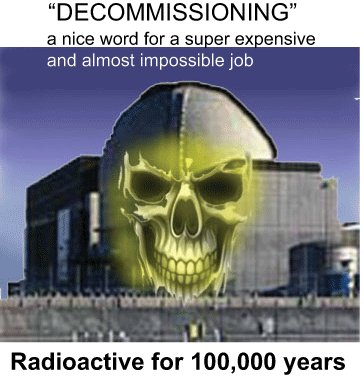
Decommissioning is a major undertaking for any industrial facility yet for nuclear power plants – on the table under the federal coalition’s alternative pathway to net zero – Australia’s lack of experience raises a host of unknowns.
Walking through the process of dismantling a nuclear power plant, Australian National University energy transition expert Ken Baldwin says the first step is removing the used radioactive fuel and coolant to be stored safely elsewhere.
Next is dismantling the rest of the plant, with some of the components surrounding the reactor made slightly radioactive during a lifetime of operation.
That radioactivity is “relatively short-lived” compared to the human lifespan-defying decay rates of more potent nuclear waste.
“Often what happens is the nuclear plant might be left in a safe state with the fuel and the coolant removed for a number of years to allow that radioactivity to decay,” Professor Baldwin tells AAP.
After that time has lapsed, work begins on removing what’s left.
Globally, the 2024 World Nuclear Industry Status Report has 213 closed power reactors on its count and 23 fully decommissioned.
Dismantling reactors takes 20 years, on average.
Retiring nuclear plants is a “horses for courses” proposition, Prof Baldwin says, with costs and timelines dependent on the type of facility, decommissioning plans and regulations.
A rule of thumb is 10-15 per cent of the total capital cost of the facility, equivalent to somewhere between $780 million and $3 billion for a standard 1 gigawatt nuclear plant, and adding roughly five per cent to electricity bills.
End-of-life costs are covered in a variety of ways, including putting aside funds before the plant is built………………….
For the United Kingdom’s 3260MW Hinkley Point C, developers were required to set aside 7.2 billion pounds, or almost 15 billion Australian dollars, for clean-up in 2016.
However the agency noted there was uncertainty about the actual bill and taxpayers could be on the hook if the cap was exceeded.
The threat of higher-than-expected decommissioning costs was raised by mining billionaire and green steel and renewables proponent Andrew Forrest at a business breakfast in Perth earlier in the month.
“You see France spending $60 billion to bring up two gigawatts but they’re not talking about the 14 nuclear power plants they’re having to completely take down and try and return to the environment,” he said.
“I go to the best engineers in the world and they’ve got no idea what that’s going to cost.”
Opposition leader Peter Dutton highlighted the costs of dismantling wind turbines when asked for clarity on his plan for decommissioning the seven nuclear power plants his party plans to build if it wins the federal election………………………………… https://www.canberratimes.com.au/story/8946374/no-walk-in-the-park-for-nuclear-reactors-at-lifes-end/
HALF-BAKED!

Tony Webb
New Community Journal, Vol 23 (1) Issue 89 p 37
The Coalition’s plan for our energy future including Nuclear power plants is based on:
Delivering half the electricity anticipated as needed to power homes and industry
and transition to zero carbon emissions.
Assuming cost of building nukes in Australia which has no experience of doing this
will be about half what the most nuke-favourable evidence world-wide from
countries that do have the experience suggests is needed.
Assuming these can be built in less than half the time evidence suggests they take to
build.
Ignoring the evidence that current official radiation-induced cancer-risk-estimates,
on which standards for worker OH&S are based, are less than half what the evidence
from nuclear power plant workers in Europe and North America suggests is the
inevitable and unavoidable reality. Also, ignoring that the cardio-vascular and heart
disease risk from such exposures is double that expected and the childhood
leukaemia risk in the community near these plants has been similarly under-
estimated.
Not to mention that the coalition’s costings ignore the long-term costs of
decommissioning these plants, the management, and (perhaps . . . . Dutton dream
on!) eventually finding a solution for long-term storage (never ‘disposal’) of the
highly radioactive wastes –
Nor to mention the fact that state and federal legislation currently prohibits such
nuclear power plants and is unlikely to be overturned any time in the near future.
And – despite this overwhelming evidence that the whole silly idea is half-baked – in
fact a smokescreen for continuing climate denial and extending use of polluting and
planet life-threatening fossil fuels, inface of this the Coalition doubles down on it
with backing from sections of the media and the fossil fuel lobby.
1 This month
15 April – Zoom –Nuclear Power is Not the Solution
Apr 15, 2026 01:00 AM in Canberra, Melbourne, Sydney

Join the International Physicians for the Prevention of Nuclear War (IPPNW) on Tuesday, April 14th for a timely webinar exploring the risks associated with nuclear power and challenging the myth that it offers a simple, safe, carbon-free solution to the climate crisis

of the week – Australians for War Powers Reform (AWPR)
To see nuclear-related stories in greater depth and intensity
 Antinuclear