Traditional owner says “over my dead body” to the Coalition’s nuclear policy
The scars of Australia’s nuclear past stain Coalition proposal for First Nations voters
The Age, By the Indigenous affairs team’s Kirstie Wellauer, Mon 28 Apr 25
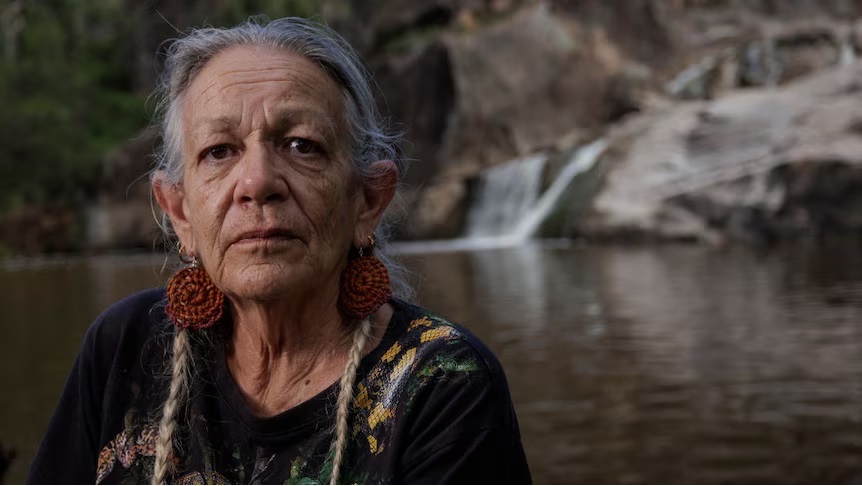
In the 70s, Aunty Janine Smith protested against nuclear power on foreign shores.
“The contamination and the consequences of the bombings in Hiroshima, and then the Vietnam War and chemical warfare. There were always meltdowns somewhere,” she said.
“You know, it just reaffirmed my opinion of the safety of [nuclear] and the effectiveness of it.”
Today she is prepared to once again fight that battle, but now it’s at home on her own traditional lands — the site of one of the Coalition’s proposed nuclear power plants.
The Bujiebara traditional owner is worried the proposed plant at Tarong, north-west of Brisbane, could impact on culturally significant sites that lie only 4 kilometres away.
“Bujiebara were makers of stone axes and there is a large sandstone rock in the Tarong precinct that was used to grind the edge of these axes, that is our culturally significant site.”
She also holds concerns about the lack of water resources in the town given nuclear plants require more water than any other power source aside from hydropower.
“Because of the water limitations here, we just can’t. We haven’t got access to that kind of water,” she said.
“There is not enough water in the South Burnett to even supply all the towns with water.”
At the recent leaders’ debate hosted by the ABC, Peter Dutton insisted there was enough water for all seven of the proposed nuclear plants.
This claim was contradicted by one of his own senior frontbenchers, Nationals MP Darren Chester, who said the question of water requirements needed further scientific assessment that could take up to two and a half years.
Queensland Premier David Crisafulli is opposed to the Coalition’s nuclear policy. Mr Dutton will also need to overturn a federal parliament ban on nuclear power if he wins the election.
Aunty Janine Smith said she won’t ever give consent for nuclear power on her country.
“They want to try nuclear, then they’ll have to go over my dead body.”
The scars of Maralinga
For many First Nations people, anti-nuclear sentiment runs deep.
Passed down generation to generation, the enduring impacts of nuclear testing in the South Australian outback are front of mind for second-generation survivor Karina Lester this election.
Her late father, Yami Lester, was just 10 years old when he watched the British government drop an atomic bomb on his traditional country in 1953.
“Dad’s witness account [was] of the black mist rolling, and the ground shaking over his Walyatjatjara country,” said the Yankunytjatjara-Anangu woman.
“Four years after that test, my late father’s own world turned into complete darkness.”
Just a teenager, he went blind.
But loss of eyesight wasn’t the only impact worn by the Anangu people after the radioactive dust settled.
“Anangu died after those tests. Anangu still feel the effects of it through autoimmune diseases, through health issues, respiratory skin rashes, eye infections. The list goes on,” she said.
The Anangu people were not adequately warned about the test’s dangers.
It has taken decades and millions of dollars to clean up the radioactive fallout from the nuclear bombs, and tests show the contamination of the land remains highly active.
Ms Lester is now an ambassador for the International Campaign to Abolish Nuclear Weapons.
As the proposed rollout of nuclear power stations remains a cornerstone of the Coalition’s energy policy this election, she wants Australians to remember the lived experiences of her people when they head to the polls.
“We have the heavy burden of having to remind fellow Australians that this is not the way to go for nuclear power. We are standing up for our people and country.”
Proposed nuclear sites on Aboriginal land
The Coalition’s proposal has identified seven locations around the country for nuclear plants, all on the sites of current or former coal-fired power plants……………………………………………………………………………
Concerns for storage of nuclear waste
For both Karina Lester and Janine Smith, the issue of where the nuclear waste from these seven sites would be stored is also of major concern.
Under the Coalition’s plan, the radioactive waste generated by the power plants would be stored on site. At the end of each plant’s life the waste would be moved to a permanent home, yet to be established.
Over the decades, successive governments have attempted to establish a national nuclear waste repository — all have failed.
And part of that failing has been over a lack of consultation with relevant traditional owners.
No comments yet.
1 This month

of the week – Australians for War Powers Reform (AWPR)
To see nuclear-related stories in greater depth and intensity
 Antinuclear
Leave a comment