Will the Coalition ditch its nuclear power policy?
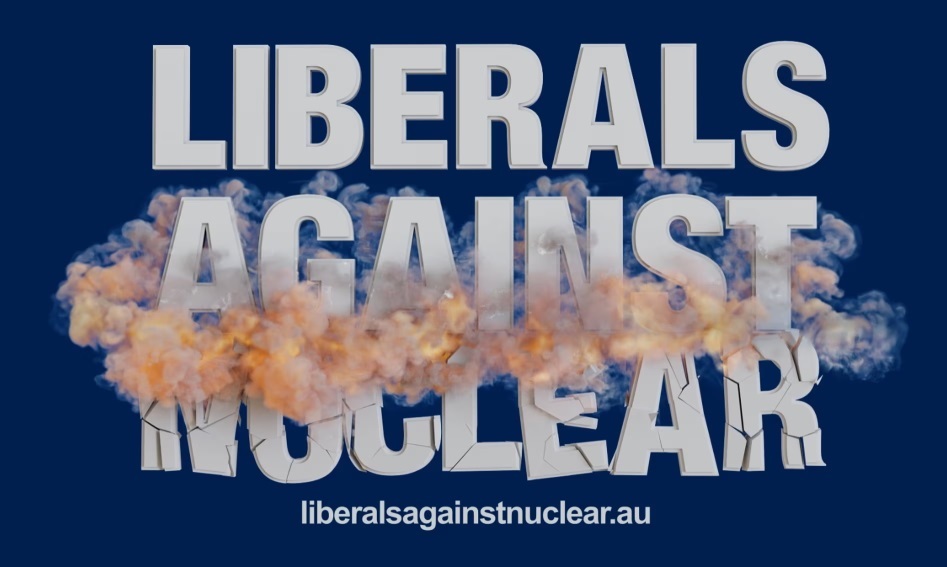
The Liberals Against Nuclear group said in a media release that the “Liberal Party’s resounding defeat in Saturday’s federal election has confirmed what Liberals Against Nuclear has warned for months: the party’s nuclear energy policy was poison that contradicted core party principles.”
“As the party chooses its next leader, denouncing the nuclear energy policy and recommitting to traditional Liberal values must be the litmus test for any potential candidate.”
Jim Green, May 7, 2025, https://reneweconomy.com.au/will-the-coalition-ditch-its-nuclear-power-policy/?fbclid=IwY2xjawKIr5RleHRuA2FlbQIxMQBicmlkETEwN2xCZ0tDcWVCOTJLWjlyAR4dM_A5TV1mtAJXuKwDuXNCPTqBkEx6aqXLiVG_4RSf4CuBw0LCKjXx5M_THQ_aem_9Jf-rhE2w-fA5kbvxu0a4A
There is abundant evidence that the Coalition’s nuclear power policy was a significant drag on its vote on Saturday. On election night, energy minister Chris Bowen said:
“I mean this was a policy that was never going to survive contact with reality. It was a policy that was radical and risky … The Australian people have cast a very strong judgement on this. I mean we had polling a while ago showing 47 percent of voters in Dickson were less likely to vote for Peter Dutton because of the nuclear policy. Peter Dutton said it was a referendum on energy, which we were happy with, and the way the results are flowing, the result of that referendum on energy, nuclear vs renewables, is crystal clear.”
Even Clive Palmer was bagging nuclear power on election night, pointing to the troubled Flamanville reactor project in France that was 14 years overdue and five times over-budget.
Seven News political editor Mark Riley said: “The party that chose nuclear energy as its policy has exploded in a nuclear bomb set on them by voters tonight.”
An editorial in the Sydney Morning Herald summarised the Coalition’s nuclear problem:
“But outside the corridors of political power, his nuclear power policy played a role in the Coalition defeat on Saturday. Dutton was unable to justify or explain the cost adequately. His power stations were too expensive and bent future budgets into contortion. The CSIRO was unimpressed, and the private sector wanted nothing to do with them.
“Worse, they were a gift to Labor. It dawned on both sides early in the campaign that the nuclear policy had turned toxic. Labor jumped on it and Dutton’s battle bus steered well clear of the proposed nuclear sites.
“The fantasy of the timeline to bring the nuclear power stations online and the dubious costings only added to the voters’ perceptions that Dutton was talking hot air and that his promised policy would never happen.
“Now it’s back to square one for the Liberals on energy policy. It will not be easy. The shattered party must rebuild to recapture the heartland after it was crudely shoved towards conservative populism by Dutton and friends. Policy development will be a major cornerstone of that recovery. And energy is central to credible reform.”
Liberals Against Nuclear
The Liberals Against Nuclear group said in a media release that the “Liberal Party’s resounding defeat in Saturday’s federal election has confirmed what Liberals Against Nuclear has warned for months: the party’s nuclear energy policy was poison that contradicted core party principles.”
Spokesman Andrew Gregson said that Liberals Against Nuclear would continue its campaign against the nuclear policy:
“This result sees the Liberals facing a generational wipeout. Only significant and immediate change can chart of pathway back. Dropping the disastrous nuclear policy right now would demonstrate they are prepared to listen, learn and act.
“Since launching our campaign, we’ve been overwhelmed by messages from Liberals across Australia who share our dismay that such a consequential policy emerged without the robust debate that has always defined our party’s decision-making. Fellow Liberals have expressed frustration that a policy of this magnitude was imposed without the transparent consultation that true Liberal values demand.
“Saturday’s election results are simply the latest and most compelling evidence that the party faithful never signed up for nuclear and would not follow Mr Dutton down this path.
“As the party chooses its next leader, denouncing the nuclear energy policy and recommitting to traditional Liberal values must be the litmus test for any potential candidate.”
Divisions
There are deep divisions within the Coalition over energy policy, so much so that a split is under consideration. Canvassing a split, Queensland Senator Matt Canavan said he wants more coal power plants built and an end to the Coalition’s net zero emissions policy. He appears to be ambivalent about nuclear power: “I’m not against nuclear but … it would take some time. We need solutions now for the Australian people.”
Other Nationals MPs are promoting retention of the nuclear power policy, including leader David Littleproud, senate leader Bridget McKenzie, Colin Boyce and Michelle Landry.
The Nationals are congratulating themselves for outperforming the Liberal Party in the election. But the nuclear policy was initiated and strongly pushed by the Nationals and it was a drag on the Coalition vote across the country.
The ABC’s Jacob Greber said: “Littleproud has driven them onto the rocks, as a political movement, with the nuclear plan.” He further noted: “David Littleproud, the Nationals leader, vowed his nuclear power plan would not come at the expense of Liberals in the cities. He has a tough road ahead after this mess.”
Liberal MPs are beginning to publicly call for the Coalition to ditch its nuclear power policy. Senator Maria Kovacic said: “the Liberal Party must immediately scrap the nuclear energy plan and back the private market’s investment in renewable energy.”
Kovacic added:
“I think the result on Saturday is a pretty clear election review of what Australians think. We will not be electable for Gen Z and millennial voters who thought, you know, we were having them on with this policy. The idea that the party of free markets and small government would nationalise a major portion of the energy system is completely at odds with what we stand for.”
Liberal Senator James Paterson said he is not likely to fight to retain the nuclear policy, that nuclear power would be “logistically challenging” and “self-evidently more difficult” to implement in three years given the looming retirement of coal-fired power stations.
The SA Liberal Party announced two days after the federal election that it has dropped its policy of promoting nuclear power. The state party had promised a nuclear royal commission and created a position of ‘Shadow Minister for Nuclear Readiness’. But leader Vincent Tarzia said on Monday that nuclear power has been “comprehensively rejected and we know the thing is with the energy transition, in three years’ time we will be in another position again.”
If the Coalition persists with its nuclear power policy, it will have no support whatsoever from Liberal / LNP parties in the five states targeted for reactors.
Academic Adam Simpson wrote in The Conversation:
“After Saturday’s Coalition rout, the prospect of nuclear power in Australia should be dead and buried. But that’s not guaranteed. The National Party strongly backs nuclear power. With metropolitan Liberals sceptical of nuclear reduced to a rump, the Nationals and regional Liberals will gain influence within the Coalition. If conservative Nationals prevail, we may well see the nuclear policy survive the election post-mortem and be resurrected for the next election.”
Given the drag of the nuclear policy on the Coalition’s vote, it’s hard to see them going to the next election still promising to build seven taxpayer-funded nuclear power plants across five states. A compromise might be reached whereby a Coalition government would repeal federal laws banning nuclear power, and perhaps establish yet another inquiry, but without the commitment to go ahead with the seven proposed nuclear plants. Colin Boyce hinted at a compromise: “At the bare minimum, we need to remove the moratorium, at least.”
Dr. Jim Green is the national nuclear campaigner with Friends of the Earth Australia and a member of the EnergyScience Coalition.
No comments yet.
1 This month

of the week – Australians for War Powers Reform (AWPR)
To see nuclear-related stories in greater depth and intensity
 Antinuclear
Leave a comment