Nothing to See Here: Australia’s Hidden Arms Trade With Israel
May 19, 2025, Stefan Moore, Consortium News,
Despite the risks of colluding in Israel’s war crimes, Australia’s leaders remain wedded to the business of selling weapons and weapons parts to Israel, writes Stefan Moore.
Australian politicians will go to extraordinary lengths to obfuscate, excuse and lie about their country’s arms trade with Israel but recent investigations by human rights groups, independent media and the Australian Greens reveal that Australia is in breach of every international law prohibiting the sale of arms to countries committing war crimes.
Among the most egregious examples is Australia’s contribution to Israel’s Lockheed-Martin F-35 Joint Strike Fighter — the most technologically advanced and lethal fighter jet in the world. Each plane can carry a payload of up to 10 massive bombs — four internally and six mounted on the wings – each capable of obliterating apartment buildings, schools and hospitals and atomising the bodies of hundreds of Palestinians. Every day in Gaza, survivors of these attacks comb through the rubble for the remains of their loved ones.
Australia plays a critical role in the global supply chain of parts for Israel’s F-35 fighter jets. As reported by Declassified Australia, the “update actuators” that open the bomb bay doors are supplied by Rosebank Engineering in Melbourne. The “weapons adaptors” that release the bombs are supplied by Ferra Engineering in Brisbane.
Australia’s insistence that it does not sell weapons to Israel is both false and nonsensical. When questioned about the sale of F-35 parts by Greens Sen. David Shoebridge in Parliament, Deputy Defence Secretary Hugh Jeffrey claimed that the mechanisms used to open the F-35 bomb bay doors are not weapons because weapons are “whole systems” and not parts like a bomb door opener which he ridiculously compared to a pencil that can either be used to write or as a weapon.
Despite the deputy defence secretary’s claim that Australia’s sale of F-35 parts does not violate international law, it is clearly prohibited by the United Nations Arms Trade Treaty (to which Australia is a signatory) that stipulates in Article 6(3) “arms transfers should be prohibited if the state knows that the weapons will be used for genocide, crimes against humanity, or war crimes.” Specifically, the Treaty restricts the export of weapons “parts and components.”
For Australian politicians, any discussion of Australia’s arms trade with Israel hits a raw nerve. When Foreign Affairs Minister Penny Wong was asked about the F-35 parts sales by Sen. Shoebridge in parliament, instead of answering the question truthfully (that either she didn’t know or that she was aware that Australia is part of the F-35 supply chain) she aggressively attacked Shoebridge for spreading “misinformation and disinformation” that was being spread on social media.
But Australia’s sale of weapons parts to Israel is not restricted to the F-35……………………………………………………………………………………………………………………………………https://consortiumnews.com/2025/05/19/nothing-to-see-here-australias-hidden-arms-trade-with-israel/?eType=EmailBlastContent&eId=a5119662-8aaa-4113-b7c5-e057e49d1f20
David Littleproud cites nuclear energy disagreement as major factor in Coalition split
The Conversation, John Quiggin , Professor, School of Economics, The University of Queensland, May 20, 2025
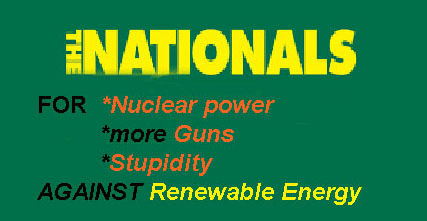
Nationals’ leader David Littleproud has singled out nuclear energy as a key reason for his party’s spectacular split from the Liberals, as both parties seek to rebuild following the Coalition’s devastating election loss.
Speaking to the media on Tuesday, Littleproud said:
our party room has got to a position where we will not be re-entering a Coalition agreement with the Liberal Party […] Those positions that we couldn’t get comfort around [include] nuclear being a part of an energy grid into the future.
The junior partner had long held strong sway over the Coalition’s climate and energy stance, including the plan to build nuclear reactors at seven sites across Australia using taxpayer funds.
After public sentiment appeared to go against nuclear power during the election, the Nationals had reportedly been weighing up changes to the policy. It would have involved walking away from the plan to build reactors and instead lifting a federal ban on nuclear power.
But some quarters of the Nationals remained deeply wedded to the original nuclear plan. Meanwhile, Nationals senator Matt Canavan had called for the net-zero emissions target to be scrapped, and Nationals senator Bridget McKenzie insisted renewable energy was harming regional communities.
Now, with the Nationals unshackled from the binds of the Coalition agreement, the future of its energy policy will be keenly watched.
A graceful way out of nuclear
Littleproud on Tuesday did not confirm where exactly he expected the Nationals to land on energy policy. But he rejected suggestions his party was unwise to stick with the nuclear policy after the Coalition’s poor election result, saying public opinion had been swayed by a “scare campaign”.
Even if the Coalition had won the election, however, the policy was running out of time.
CSIRO analysis showed, contrary to the Coalition’s claims, a nuclear program that began this year was unlikely to deliver power by 2037. But up to 90% of coal-fired power stations in the national electricity market are projected to retire before 2035, and the entire fleet is due to shut down before 2040.Now, the earliest possible start date for nuclear is after the 2028 election. This means plugging nuclear plants into the grid as coal-fired power stations retire becomes virtually impossible.
This very impossibility provided the National Party with a graceful way out of the policy. It could have regretfully accepted the moment had passed.
With nuclear out of the picture, and coal-fired power almost certain to be phased out, that would have left two choices for the Coalition: a grid dominated by gas, or one dominated by renewables.
However, expanding gas supply frequently requires the controversial process of fracking, which is deservedly unpopular in many regions where it’s undertaken.
What’s more, gas is an expensive energy source which can only be a marginal add-on in the electricity mix, used alongside batteries to secure the system during peak times.
Logically, that would have left renewable energy as the only feasible energy policy option for the Nationals – but it wasn’t to be…………………………….
The Nationals’ hostility to renewables may in part be driven by pressure from anti-renewable activist groups.
The Institute of Public Affairs, for example, has sought to promote rural opposition to renewables and emissions reduction and focused its efforts on Nationals-held seats
And the now-defunct Waubra Foundation, named after the small town in northwest Victoria, opposed wind farms and claimed they caused health problems. The group was created by an oil and gas executive with no apparent links to the town…………………………………………………………………………..
Renewables can be good for the bush
Nationals Senate leader Bridget McKenzie last week said her party was concerned that renewable energy targets are “impacting rural and regional communities”. The party has long voiced concern about the impact of large-scale wind and solar projects in the bush.
However, many farmers and other rural landowners benefit financially from hosting solar and wind farms, which, in many cases, do not prevent the land from also being used for farming.
Concerns that wind farms and solar panels might slash the value of neighbouring properties have been shown to be ill-founded.
And importantly, the increasing frequency of extreme climate events is already a challenge to Australia’s agriculture sector and will become more difficult. Tackling the problem is in regional Australia’s interests.
The Nationals’ hostility to renewable energy comes at a cost to rural and regional Australians. But Littleproud clearly could not balance competing views within the Nationals on energy policy while inking a deal with the Liberals. Instead, the party will now go it alone. https://theconversation.com/david-littleproud-cites-nuclear-energy-disagreement-as-major-factor-in-coalition-split-256904
Treaty the planet’s best chance to get rid of its worst weapons
By Dave Sweeney | 19 May 2025, https://independentaustralia.net/politics/politics-display/treaty-the-planets-best-chance-to-get-rid-of-its-worst-weapons,19758
From Jakarta to the Vatican, Prime Minister Albanese’s journey underscores a global call to ban the world’s most destructive weapons, writes Dave Sweeney.
ON HIS FIRST overseas trip since his sweeping election victory, Prime Minister Anthony Albanese made for two very different destinations.
The first stop was steamy Jakarta, the capital of Indonesia, the world’s most populous island nation and home to the world’s largest Muslim population with around 240 million or 13 per cent of the globe’s believers.
After Indonesia, the PM switched time zones and belief systems and headed to the Vatican, the world’s smallest sovereign state in terms of area and population, and the (sacred) heartland of the Catholic faith.
These two places are very different worlds, with very different worldviews, but both have an active desire to protect our shared world from its most avoidable existential threat: nuclear war.
Prime Minister Albanese also holds this view.
In December 2018, he championed Federal Labor’s support for the newly adopted UN Treaty on the Prohibition of Nuclear Weapons (TPNW), stating:
“Nuclear weapons are the most destructive, inhumane and indiscriminate weapons ever created. Today we have an opportunity to take a step towards their elimination.”
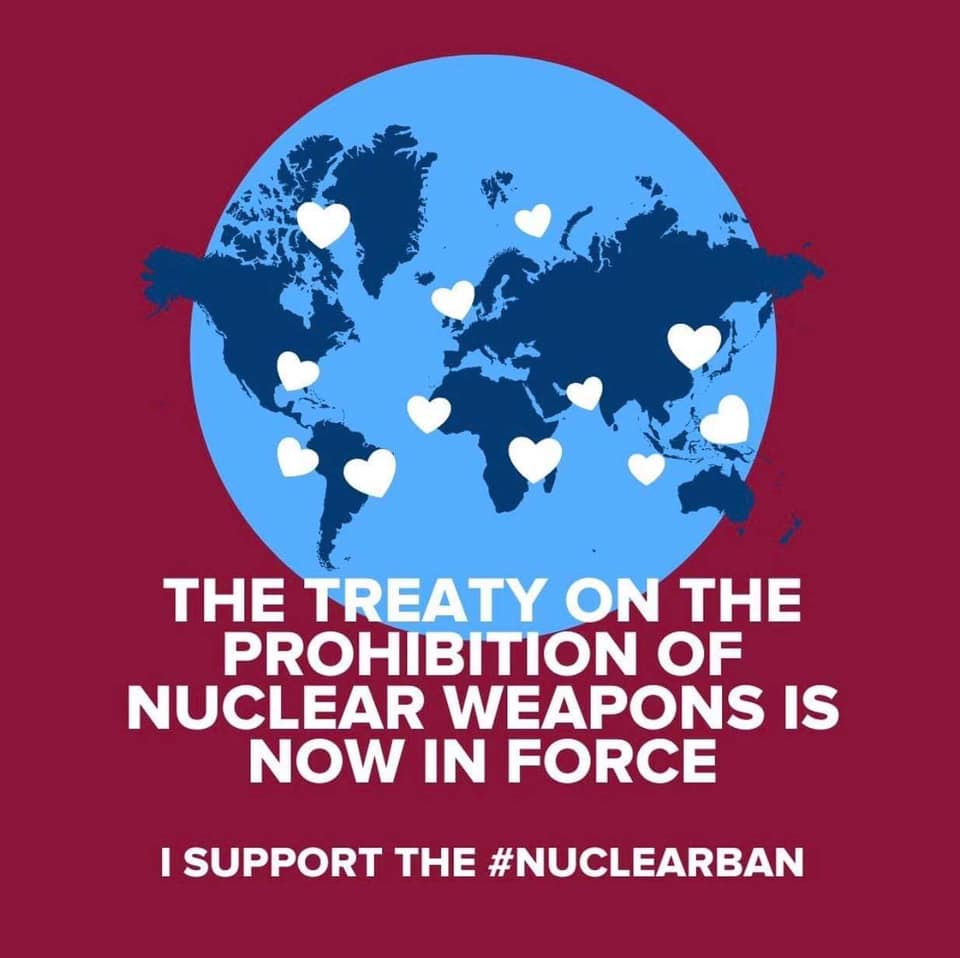
The TPNW, adopted by the UN in 2017 with more than 120 nations voting in favour, grew from an Australian initiative by the International Campaign to Abolish Nuclear Weapons (ICAN).
ICAN was launched in Melbourne in 2007 and was awarded the 2017 Nobel Peace Prize in recognition of the group’s work ‘to draw attention to the catastrophic humanitarian consequences of any use of nuclear weapons’ and its ‘groundbreaking efforts to achieve a treaty-based prohibition of such weapons’.
The TPNW entered into force in January 2021, an act which has finally and formally seen nuclear weapons be declared unlawful under international humanitarian law.
Supporters of the TPNW have described the Treaty as our planet’s best way to get rid of its worst weapons.
The fragile and fractured global situation starkly highlights the urgency of this task.
Two nuclear weapon states, Israel and Russia, are actively involved in hot wars.
Two more, India and Pakistan, are engaged in risky posturing that could dramatically escalate, while two others, China and the United States, are shaping up for a trade war with hints of worse to come.
Against this grim background, the TPNW is a star that provides some light and hope and a navigation point to help chart a safer and saner course for our shared future.
Nations are embracing this path with half of the world’s countries having signed, ratified or acceded to the Treaty, including Indonesia and the Vatican/Holy See.
When it ratified the TPNW last September, Indonesia – a leading player in the global Non-Aligned Movement – made clear that ‘the possession and use of nuclear weapons cannot be justified for any reason’
Speaking at the time, then Foreign Minister Retno Marsudi posed the fundamental question and delivered the humane answer:
Should fear of nuclear weapons be our guarantee for peace? Indonesia’s answer will forever be no.
Indonesia reaffirms its commitment to a nuclear weapon-free world.
The late Pope Francis was a strong supporter of the TPNW and gave expression to the principle of “blessed are the peacemakers” with the Vatican’s championing and early adoption of the Treaty. The Pope described the very existence of nuclear weapons as “an affront to heaven”. In his final Easter Sunday sermon, shortly before he died, he made a powerful call for peace and weapons abolition.
These calls for nuclear abolition and for ways of addressing conflict that do not risk all that ever was, is or could be on our shared planet are finding a resonance and echo in many other nations.
Labor’s National Platform is clear:
Labor acknowledges the growing danger that nuclear weapons pose to us all and the urgent need for progress on nuclear disarmament.
Labor will act with urgency and determination to rid the world of biological, chemical and nuclear weapons.
Commits itself to redoubling efforts towards a world without nuclear weapons…
Labor in government will sign and ratify the Ban Treaty…
In this year that marks 80 years since the unveiling of the age of Armageddon with the first atom bomb test in New Mexico and the first atom bombings of the Japanese cities of Hiroshima and Nagasaki, it is time to turn a political platform into a prescription for a habitable world.
It is time for Australia to follow the example of Indonesia, the Vatican and many other nations and to show that the pen is mightier than the sword by signing the TPNW.
As they say, Prime Minister, when in Rome…
1 This month
15 April – Zoom –Nuclear Power is Not the Solution
Apr 15, 2026 01:00 AM in Canberra, Melbourne, Sydney

Join the International Physicians for the Prevention of Nuclear War (IPPNW) on Tuesday, April 14th for a timely webinar exploring the risks associated with nuclear power and challenging the myth that it offers a simple, safe, carbon-free solution to the climate crisis

of the week – Australians for War Powers Reform (AWPR)
To see nuclear-related stories in greater depth and intensity
 Antinuclear