AUKUS: A Very Antipodean Stupidity
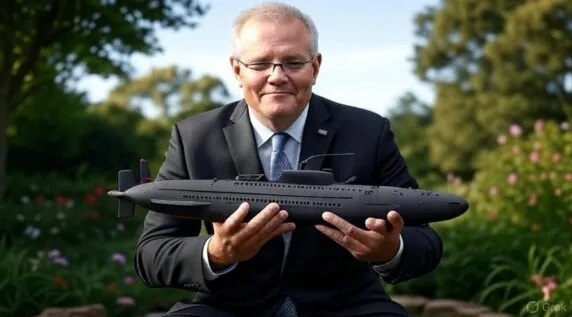
14 June 2025 Dr Binoy Kampmark, https://theaimn.net/aukus-a-very-antipodean-stupidity/
Call it abandonment, anxiety, or just latent stupidity. The messy goo of feelings and fuzzy notions behind Australia’s most injudicious strategic decision is yielding its nasty harvest. Conceived by paranoid armchair strategists, flabby think tankers and profligate spenders happy to expend other people’s money, the tripartite agreement between Australia, the United Kingdom and the United States is rapidly unravelling.
Even during the Biden administration, whose bumbling watch this agreement was hatched under, there were doubts. The ogrish price tag (US$239 billion or A$368 billion) that would be billed to the Australian taxpayer; the absurd time schedules (delivery of nuclear-powered submarines by the 2030s and 2040s); the contingencies and qualifications (Congressional concerns about transferring Virginia Class (SSN-774) submarines to the Royal Australian Navy), all pointed to the fact that Canberra had fallen for a lemon, childishly refusing to taste its stinging bitterness.
The central point of the tediously named Pillar One of the AUKUS agreement (there is no pillar, one or otherwise), which involves the transfer of US Virginia class boats to the RAN – was always its viability. While President Joe Biden was gradually losing his faculties in the White House, the Congressional Research Service was pertinently noting the obstacles that would face any transfer. The CRS report released on May 22, 2023 was the sort of thing that should have alarmed Australian defence planners, instead of turning them into paid up ostriches dreaming of consultancies. For one thing, it made it clear that Congress was always going to be the one to convince in the matter. “One issue for Congress is whether to approve, reject, or modify DOD’s AUKUS-related legislative package for the FY2024 NDAA [National Defense Authorization Act] sent to Congress on May 2, 2023.” That package included the authorisation for the transfer of “up to two Virginia-class SSNs to the government of Australia in the form of sale, with the costs of the transfer to be covered by the government of Australia.”
There were also weighty doubts about the “net impact on collective allied deterrence and war fighting capabilities of transferring three to five Virginia-class boats to Australia while pursuing the construction of three to five replacement SSNs for the US Navy.” This is a point that has never gone away. To give, even to an ally, and a perceived advantage yet diminish, however small and fictional, the supposed power of the US submarine fleet, is never going to take place if the annual production of 1.2 Virginia boats remains as it is. Mississippi Senator Roger Wicker was always of the view that “the AUKUS plan would transfer US Virginia-class submarines to a partner nation even before we have met our own Navy’s requirements.”
The fact that the Trump administration is now conducting a review of AUKUS can be seen as a mere formality – for those who think formalities smooth matters. The Australian Defence Minister Richard Marles certainly hopes so, calling it “a completely natural step for an incoming government to take.” That Yankee stronghold of renown in Canberra, the Australian Strategic Policy Institute, apes the line with simian consistency: “It’s normal, after a change of government, for a new administration to review existing commitments in the light of new policy priorities: in this case, ‘America First’.”
But nothing about the Trump government is a formality, or any review’s outcome a foregone conclusion. The presence of Undersecretary of Defense Policy Eldridge Colby should be disconcerting to the AUKUS band leaders and comparisons to Britain’s own review of the pact by Sir Stephen Lovegrove should be seen as fantastically distant. “AUKUS,” in Colby’s assessment, “is only going to lead to more submarines collectively in 10, 15, 20 years, which is way beyond the window of maximum danger, which is really this decade.” Putting to one side the warmongering stirring in the latter part of the statement, Colby is certainly not wrong about the time that will elapse before any delivery takes place.
Down under, the strategists are scurrying and fretting, a sight that is proving enormously entertaining. But the political classes have only themselves to blame for this pigsty of a conundrum. As former Australian Prime Minister Malcolm Turnbull notes with snappy precision, the AUKUS agreement is perfectly positioned for the US to not follow through. It can still stick to the letter of the agreement without having to ever transfer a single submarine to Australia, all the time raking in Australian largesse. “This is because it has always been part of the deal, and part of the US legislation, that the transfer of submarines to Australia is highly conditional.”
The legislation in question notes that the President will submit to the relevant congressional committees and leadership a certification no later than 270 days prior to the transfer of vessels that the move “will not degrade the United States underseas capabilities”; is consistent with the country’s foreign policy and national security interests and furthers the AUKUS partnership. That furtherance, however, involves the US ensuring “sufficient submarine production and maintenance investments” that will meet undersea capabilities; Australia supplying “appropriate funds and support for the additional capacity required to meet the requirements” under the provisions; and Canberra’s “capability to host and fully operate the vessels authorized to be transferred.”
The latest development in this overpriced show shows it up as a series of fictions: for Australia, the boyish hankering for nuclear powered submarines in the first place; for the United States, the fact that it needs more nuclear armed boats in order to look more ridiculous in having an arsenal it can never use. It was the military industrial complex in full song, nourished by expensive games, dubious scenarios and drab excuses for war.
With Donald Trump in the White House, the Make America Great Again philosophy mushes the terminology of sweet friends and mortal foes, turning it into the mortar of self-interest. Washington’s interests come first, and Australia’s own idiotically misplaced interests are barely visible in the White House situation room. Then again, never ask Australian strategic thinkers about their interests, ever the hostage of governing fears and treasured prejudices.
Freedom Of Information win as Information Commissioner rebukes Defence secrecy

by Rex Patrick | Jun 15, 2025 , https://michaelwest.com.au/foi-win-as-information-commissioner-rebukes-defence-secrecy/
After more than four years, the Information Commissioner has compelled the Defence Dept. to hand over information sought about expert advice on Australia’s Naval shipbuilding program. Rex Patrick reports.
In the FOI review decision, the Information Commissioner issued a scathing rebuke of Defence secrecy, saying,
“… the assertion made by the Department that disclosure of the relevant material would undermine the willingness of individuals to serve on the panel and provide full and frank advice.
“does not appear to be supported by cogent reasoning or evidence.”
Ouch!
The information we had sought was about advice provided to the Government by the Naval Shipbuilding Expert Advisory Panel, formerly the Naval Shipbuilding Advisory Board. The panel exists to “provide independent, expert advice on all matters relating to the performance of the naval shipbuilding enterprise, and assist in identifying emerging challenges that may require further consideration by Government.”
Recent costs for the board, which is laden with retired US admirals, are not available, but from 2016/17 to 2018/19 the taxpayer forked out $6.4m– an average of $2.1m a year – for their advice.
When I asked to see some of that expensive advice in 2021 (not an unreasonable proposition given the disaster area Defence shipbuilding management had already become, and it’s not got better since), I was denied access to all of the documents, bar some trivial logistical information.
I appealed the decision with the Information Commissioner, who, four years later, has ordered Defence to hand over more information.
Fearful advice
Defence told the Information Commissioner
“There is a close connection between the documents at issue to a governmental process, and disclosure of the relevant material would impair the Government’s ability to receive frank and candid advice.”
That was Defence’s ‘argument’ for secrecy. The sky was going to fall in if advice on an almost $200B naval shipbuilding program (as it was before AUKUS came along and made that look cheap) was made available to the public who were paying for it.
I pushed back hard, pointing out to the Information Commissioner that the Department had not provided any evidence to establish that disclosure of the relevant material would discourage members of the panel from providing quality advice and recommendations.
I further pointed out that the advisory board members would be under a contractual obligation to provide comprehensive advice and recommendations having regard to their expertise, and failure to do so would amount to a breach of their contractual obligations.
The Information Commissioner accepted this and berated Defence for its fantasy claims:
“The Department was provided several opportunities to make submissions in support of their claim that disclosure of the material at issue would be contrary to the public interest. However, other than an assertion that panel members would be less likely to provide full and frank advice and recommendations, the Department has not provided any evidence of substance to establish that disclosure would have this effect.”
And when it came to the idea that no one would serve on the $2m per annum advisory board if their advice were at risk of being disclosed, the Information Commissioner was again scathing, stating:
“Similarly, although the Department contends that disclosure of the relevant material would undermine the willingness of individuals to serve on the panel, the Department has not provided any evidence to support its claim.”
In other words, no evidence from a department that’s committed to spending $56.1B in the coming financial year.
Secrecy does not help
Defence procurement is a mess. MWM has been reporting this for some time. The mainstream media is just waking up to the incompetence of our Defence procurement organisation.
Defence procurement is in need of significant reform. Excessive secrecy, a default setting for Defence bureaucrats, conceals incompetence, maladministration and waste. It enables corruption in a portfolio where tens, even hundreds of millions, are regarded as small change.
The capabilities of our Defence Force and its current operations deserve a level of secrecy,
“but the same is not true for projects that deliver that capability.”
Oversight requires access to information. That includes access to the very expensive advice Government receives in relation to Defence projects. If the providers of that advice are not willing to have it peer reviewed by experienced project management experts in the general community, the Government should not rely on it.
We now await the release of the documents, and to find out what the Defence Minister knew, or didn’t know.
Unfortunately, Defence procurement change will not occur until the Prime Minister, Anthony Albanese, demands it. Defence Minister Richard Marles won’t counsel the Prime Minister because, time and time again, he’s been caught out drunk on Defence-Kool-Aid.

Crossbench Calls for AUKUS Inquiry

Crossbench MPs from the House of Representatives and Senate have written to Deputy Prime Minister and Defence Minister Richard Marles, calling for an urgent parliamentary inquiry into AUKUS.
In April, the UK Parliament’s Defence Committee announced an inquiry into the AUKUS arrangements, and this week the US defence department announced they were undertaking a rapid review of AUKUS.
AUKUS represents Australia’s largest defence investment in decades and is central to our defence and foreign affairs strategy.
Australians are concerned to know more about the strategic and financial implications of this policy which has been jointly adopted by major party governments without significant parliamentary scrutiny.
A full and formal parliamentary inquiry is therefore both important and timely.
Quotes from letter to Deputy Prime Minister, Richard Marles
Allegra Spender, Independent MP for Wentworth
AUKUS is the centrepiece of our defence and foreign policy strategy, but it’s been adopted by the major parties with very poor public engagement. AUKUS will shape Australia’s future for decades with enormous implications both financially, economically, and strategically, but in discussions at the community level, there are consistent questions and concerns that have not been addressed. AUKUS won’t work without wider community interrogation and engagement, and a parliamentary inquiry is the first step to building that.
We also need a more open discussion of the challenges facing AUKUS. Most urgently, the US Navy is currently short of attack submarines and there is a very clear risk that the US President at the time will not be able to certify that the Virginia class submarines can be transferred to Australia without undermining US Navy capability: a requirement of the current enabling legislation. We must publicly face those risks and actively manage them including identifying viable alternatives.
Helen Haines, Independent MP for Indi
In light of the reviews of AUKUS by our two partner nations and the consequential nature of the agreement, it important for our Parliament to apply the same level of scrutiny.
Andrew Wilkie, Independent MP for Clark
More than ever an Australian Inquiry into AUKUS is needed, and President Trump’s caution about the deal gives Australia a great chance to reset. Nuclear subs were always the wrong technology for Australia’s future submarine needs given the shallow littoral and offshore waters in our region, not to mention the ridiculous cost and impractical timeframe.
Nicolette Boele, Independent MP for Bradfield
Any time Parliament commits to spend $368 billion, we should at least have a full parliamentary inquiry. The case for an inquiry on AUKUS is even stronger given the rules of global co-operation have dramatically changed since it was signed.
AUKUS now risks our defence — because we don’t know if these submarines will ever arrive. It risks our budget — because we may waste $368 billion in taxpayer’s money. And it risks our Australian values, which we do not import from the United States.
Sophie Scamps, Independent MP for Mackellar
Circumstances have changed significantly since the AUKUS deal was first announced and it’s only reasonable it be reviewed in the current context.
This is the largest investment in our defence capability in decades, other parties are conducting their own reviews, and the Australian community largely supports a parliamentary inquiry – it’s high time the Government responds.
Senator Jacqui Lambie
We’ve poured billions into AUKUS with nothing to show for it but broken promises and cancelled defence programs. It’s a $368 billion blank cheque to the US and UK with zero guarantee of real capability for decades.
Australians deserve better and it’s time for a full parliamentary inquiry into this dud deal.
Senator David Pocock
With the UK and now the US reviewing AUKUS, Australia is now the only country not actively considering whether the agreement in its current form best serves our national interest. Given the scale and cost of this deal, a transparent review is not just sensible, it’s overdue.
Kate Chaney, Independent MP for Curtin
AUKUS is a monumental strategic commitment with far-reaching implications for our economy, sovereignty, and security posture, yet it continues to unfold with minimal public transparency and virtually no parliamentary accountability. Australians want to understand whether this is the best use of our resources and the right path for our security.
1 This month

of the week – Australians for War Powers Reform (AWPR)
To see nuclear-related stories in greater depth and intensity
 Antinuclear