Why Richard Marles Backs the U.S. War Machine
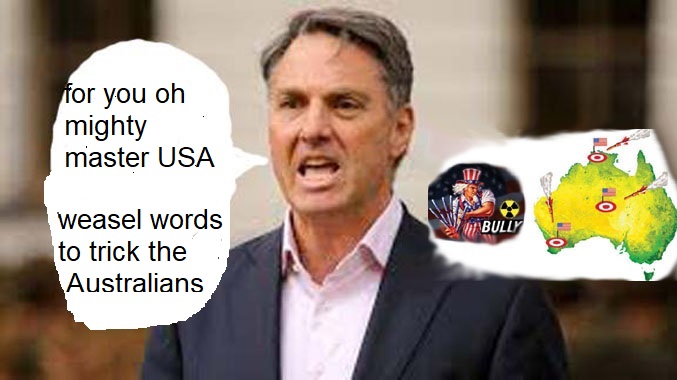
Since becoming Defence Minister, Richard Marles has overseen a shift that aligns Australia more closely with U.S. military goals than ever before.
Richard Marles backs the U.S. military, not just with rhetoric, but with billions in public funds diverted from services Australians urgently need.
Richard Marles is a senior figure in the Labor Right, a faction increasingly indistinguishable from the Liberal Party on core issues such as defence, foreign policy, and trade.
20 June 2025 AIMN Editorial, By Denis Hay
Description
Richard Marles backs the U.S. military power on Australian soil. Discover how it risks our sovereignty, and what citizens can do to reclaim it.
Introduction – A Quiet Coup Over Australia’s Defence
Location: Tindal, Northern Territory. Action: A U.S. B-52 bomber roars overhead. Thoughts: “Are we a launchpad for war?” Emotions: Unease, betrayal.
It’s 2025. As Defence Minister Richard Marles smiles beside a Pentagon official, another defence deal is signed. Few Australians notice. Even fewer understand its implications. Our government says it’s about ‘defending democracy.’ But whose democracy, and against what threat?
While China is still our biggest trading partner, we’re warned of its menace. Meanwhile, U.S. troops, bombers, and weapons quietly embed themselves deeper into our soil. This isn’t protection, it’s occupation by consent.
How did we end up here? And why is it that Richard Marles backs the U.S. military over Australia’s sovereign interests?
Problem: The Erosion of Australian Sovereignty
A Defence Strategy Written in Washington
Since becoming Defence Minister, Richard Marles has overseen a shift that aligns Australia more closely with U.S. military goals than ever before. The 2021 USFPI agreement expanded joint military operations.
Billions have since been given to help U.S. base upgrades in Darwin and Tindal, alongside hosting U.S. nuclear-capable planes.
This is yet another example of how Richard Marles backs the U.S. military agenda, prioritising American strategic interests over national independence.
“It’s not just alliance cooperation, it’s dependence,” says defence analyst Dr. Alison Broinowski.
The Permanent U.S. Footprint
- U.S. bases in Australia: Pine Gap, Robertson Barracks, and now expanded northern airfields. Ref: How US Military Bases in Australia Threaten Our Future & How to Remove Them
- Rotating forces: Thousands of U.S. Marines cycle through annually, training for potential regional conflicts.
- Infrastructure: Funded by Australian public money for U.S. strategic benefit.
Public Money, Private Empire
Under Marles’ leadership, defence spending reached 2.4% of GDP in 2024. That’s over $60 billion, more than education or climate resilience combined. But this isn’t public defence, it’s public subsidy for the U.S. military-industrial complex.
This is precisely how Richard Marles backs the U.S. military, not just with rhetoric, but with billions in public funds diverted from services Australians urgently need.
The Manufactured ‘China Threat’
A Convenient Villain
There is no evidence that China poses a military threat to Australia. Defence intelligence reports confirm no plans for invasion or aggression. Yet headlines scream of ‘Chinese expansionism,’ fuelling fear and compliance.
Who Benefits?
- Weapons contractors profit from panic.
- U.S. hegemony is preserved through Australian complicity.
- Political careers thrive on appearing ‘tough on China.’
“The U.S. has surrounded China with 200+ military bases,” notes historian John Pilger. “China has none outside its borders. Who’s the aggressor here?”
Real Consequences for Australians
Story: Emily, a nurse in Perth, struggles to afford rent. Her hospital is understaffed. Meanwhile, Marles commits $368 billion for nuclear submarines, years away from delivery, if ever.
“Why do we always find money for war, but never for nurses?” Emily asks.
Because Richard Marles backs the U.S. military, while ignoring the suffering of frontline workers like Emily.
The Labor Right: A Party Captured by Foreign and Corporate Interests
Richard Marles and the Rise of Labor’s Conservative Core
Richard Marles is a senior figure in the Labor Right, a faction increasingly indistinguishable from the Liberal Party on core issues such as defence, foreign policy, and trade.
Rather than upholding the Labor tradition of peace, workers’ rights, and democratic independence, the right faction embraces military alliances and market orthodoxy.
Their influence is evident in Labor’s full-throated support for AUKUS, Marles’ open enthusiasm for U.S. military integration is no coincidence – Richard Marles backs the U.S. military model as central to Labor’s right-faction ideology, and the suppression of internal dissent from more progressive voices within the party.
“Marles speaks more like a U.S. Pentagon spokesperson than an Australian minister,” notes a former Labor policy adviser.
How the Right Faction Is Reshaping Labor
This shift reflects how Richard Marles backs the U.S. military, pushing Labor further from its peace-promoting roots.
Suppresses internal debate on AUKUS, Palestine, and climate.- Aligns with corporate donors, including arms manufacturers.
- Stifles progressive legislation, watering down meaningful reforms.
The result? A Labor Party that once represented workers and peace is now compromised and cautious, often at the expense of sovereignty and social justice.
A Peaceful, Sovereign Path Forward
Reclaiming Foreign Policy Independence
- End the U.S. military presence on Australian soil.
- Cancel or renegotiate treaties that erode autonomy.
- Prioritise diplomacy over deterrence.
Invest in Public Needs, Not Foreign Conflicts
Redirect defence billions to:
Fully fund Medicare.- End homelessness.
- Provide free tertiary education.
Australia, as a sovereign nation with currency-issuing power, can fund peace just as easily as it funds war. The real limitation is a lack of political will, not a shortage of money.
Learn from Global Examples
- Costa Rica abolished its military in 1948. Today, it ranks among the world’s happiest and healthiest nations.
- Finland and Switzerland remain militarily neutral but are globally respected.
“We must stop being a staging post for other nations’ wars,” says Senator David Shoebridge.
Marles, the U.S., and Our Crossroads
For decades, Australia walked a delicate line, partner to the U.S., yet proudly sovereign. That line is vanishing.
Richard Marles has accelerated Australia’s subservience to U.S. military interests under the guise of strategic cooperation. But what we face is not defence, it’s deterrence at the cost of independence.
This is the inevitable outcome when Richard Marles backs the U.S. military without accountability or public consent.
And it’s happening with full ministerial approval, Richard Marles backs the U.S. military posture without public scrutiny or debate.
It’s time Australians asked: Who does our government really serve?
Q&A – Reader Questions Answered…………………………. https://theaimn.net/why-richard-marles-backs-the-u-s-war-machine/
Cross your fingers, Australia, and hope the AUKUS deal collapses

he Americans agreed to the deal because they saw it to be in their strategic interest, not ours. As then-U.S. Deputy Secretary of State Kurt Campbell observed (indiscreetly) last year, “we have them locked in now for the next 40 years.”
All that AUKUS and its associated alliance commitments have done for Australia is paint more targets on our back.
The crazy irony is that we are spending huge sums to build a new capability intended to defend us from military threats that are most likely to arise simply because we have that capability
The U.S. sub purchase was a bad deal then and it makes even less sense now.
By Gareth Evans, Project Syndicate, https://www.japantimes.co.jp/commentary/2025/06/18/world/australia-should-hope-for-aukuss-collapse/
MELBOURNE –
The AUKUS partnership, the 2021 deal whereby the United States and the United Kingdom agreed to provide Australia with at least eight nuclear-propelled submarines over the next three decades, has come under review by the U.S. Defense Department.
The prospect of its collapse has generated predictable handwringing among those who welcomed the deepening alliance, and especially among those interested in seeing Australia inject billions of dollars into underfunded, underperforming American and British naval shipyards. But in Australia, an AUKUS breakdown should be a cause for celebration.
After all, there has never been any certainty that the promised subs would arrive on time. The U.S. is supposed to supply three or possibly five Virginia-class submarines from 2032, with another five newly designed SSN-AUKUS-class subs (built mainly in the U.K.) coming into service from the early 2040s. But the U.S. and the U.K.’s industrial capacity is already strained, owing to their own national submarine-building targets and both have explicit opt-out rights.
Some analysts assume that the Defense Department review is just another Trumpian extortion exercise, designed to extract an even bigger financial commitment from Australia. But while comforting to some Australians (though not anyone in the Treasury), this interpretation is misconceived.
There are very real concerns in Washington that even with more Australian dollars devoted to expanding shipyard capacity, the U.S. will not be able to increase production to the extent required to make available three — let alone five — Virginia-class subs by the early 2030s. Moreover, Elbridge Colby, the U.S. under-secretary of defense for policy who is leading the review, has long been a skeptic of the project and he will not hesitate to put America’s own new-boat target first.
Even in the unlikely event that everything falls smoothly into place — from the transfers of Virginia-class subs to the construction of new British boats, with no human-resource bottlenecks or cost overruns — Australia will be waiting decades for the last boat to arrive. But given that our existing geriatric Collins-class fleet is already on life support, this timeline poses a serious challenge. How will we address our capability gap in the meantime?
Cost-benefit analysis should have killed the project from the outset. But in their eagerness to embrace the deal, political leaders on both sides of parliament failed to review properly what was being proposed. Even acknowledging the greatly superior speed and endurance of nuclear-powered subs and accepting the heroic assumption that their underwater undetectability will remain immune from technological challenge throughout their lifetimes, the final fleet size seems hardly fit for the purpose of national defense.
Given the usual operating constraints, Australia would have only two such subs deployed at any one time. Just how much intelligence gathering, archipelagic chokepoint protection, sea-lane safeguarding or even deterrence at a distance will be possible under such conditions? Moreover, the program’s eye-watering cost will make it difficult to acquire the other capabilities that are already reshaping the nature of modern warfare: state-of-the-art drones, missiles, aircraft and cyber defense.
The remaining reason for believing, as former Australian Prime Minister Paul Keating put it, that an American opt-out “will be the moment Washington saves Australia from itself,” concerns AUKUS’s negative implications for Australia’s sovereignty. The Americans agreed to the deal because they saw it to be in their strategic interest, not ours. As then-U.S. Deputy Secretary of State Kurt Campbell observed (indiscreetly) last year, “we have them locked in now for the next 40 years.”
It defies credibility to believe that the U.S. would transfer such a sensitive technology to us — with all the associated emphasis on the “interchangeability” of our fleets and new basing arrangements in Australia — unless it could avail itself of these subs in a future war. I have had personal ministerial experience of being a junior U.S. ally in a hot conflict situation — the first Gulf War in 1991 — and my recollections are not pretty.
Alongside the Pine Gap satellite communications and signals intelligence facility — which has always been a bull’s-eye — one can add Perth’s Stirling submarine base, the Northern Territory, with its U.S. Marine and B-52 bases and possibly a future east-coast submarine base.
The crazy irony is that we are spending huge sums to build a new capability intended to defend us from military threats that are most likely to arise simply because we have that capability — and using it to support the U.S., without any guarantee of support in return should we ever need it.
If the AUKUS project does collapse, it would arguably still be possible for Australia to acquire replacements for its aging submarine fleet within a reasonable time frame — and probably at less cost, while retaining real sovereign control — by purchasing off-the-shelf technology elsewhere. One can even imagine us going back to France, which was snubbed in the AUKUS deal, and making a bid for its new-generation Suffren-class nuclear-powered sub.
But a better defense option may simply be to recognize that the latest revolution in military technology is real and that our huge continent and maritime surroundings will be better protected by a combination of self-managed air, missile, underwater and cyber capabilities than by a handful of crewed submarines. There is no better time to start thinking outside the U.S. alliance box.
Gareth Evans was Australia’s foreign minister (1988-1996), president of the International Crisis Group (2000-2009) and chancellor of the Australian National University (2010-2019). © Project Syndicate, 2025
1 This month
7 April – WEBINAR – Australia and the Doomsday Clock – Preventing nuclear war through NoFirstUse and other policies
Online | Tuesday April 7, 4:00-5:30pm, Australian Eastern Time / 8:00-9:30am Central Europe Time
– Access the registration link
15 April – Zoom –Nuclear Power is Not the Solution
Apr 15, 2026 01:00 AM in Canberra, Melbourne, Sydney

Join the International Physicians for the Prevention of Nuclear War (IPPNW) on Tuesday, April 14th for a timely webinar exploring the risks associated with nuclear power and challenging the myth that it offers a simple, safe, carbon-free solution to the climate crisis
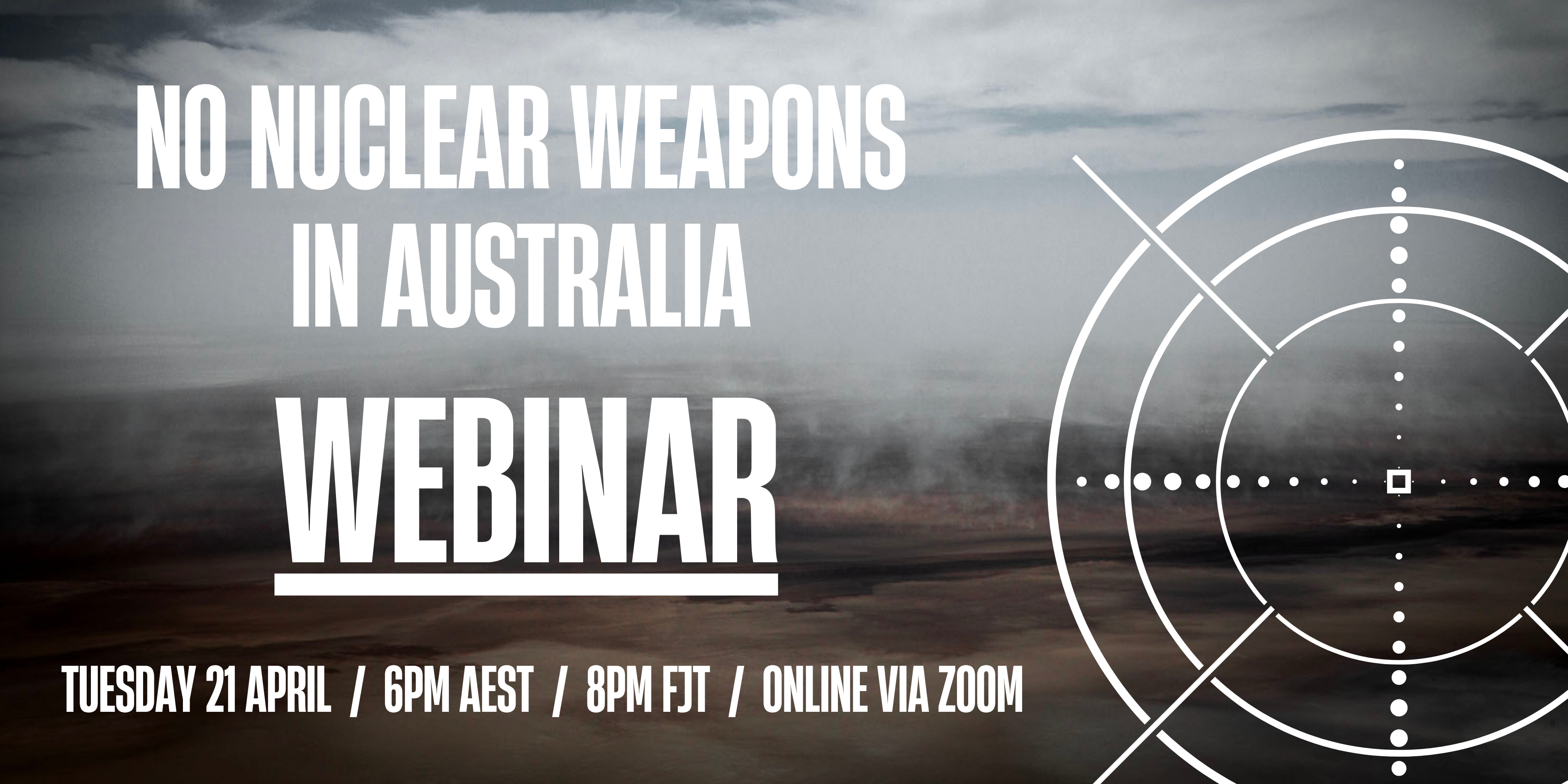
21 April Webinar: No Nuclear Weapons in Australia
Start: 2026-04-21 18:00:00 UTC Canberra, Melbourne, Sydney (GMT+10:00)
End: 2026-04-21 19:30:00 UTC Canberra, Melbourne, Sydney (GMT+10:00)
Event Type: Virtual
A virtual link will be communicated before the event.
Host Contact Info: australia@icanw.org

of the week – Australians for War Powers Reform (AWPR)
To see nuclear-related stories in greater depth and intensity
 Antinuclear