Time for Australia to sign non-nuclear treaty

Tilman Ruff says support for the “illegal and unwarranted” US military action in Iran has damaged Australia’s global reputation, and ratifying the treaty would help to repair its credibility.
The Australian co-founder of a Nobel Prize-winning advocacy group says it is time for Labor to honour its promise, while in opposition, to ratify the UN’s nuclear weapons ban treaty.
The Saturday Paper, By Kristina Kukolja, 28 June 25
Australia has long been at the forefront of global efforts towards the containment of nuclear threats. Now, in the wake of the American military strikes on Iran, the International Atomic Energy Agency says the global nonproliferation system is on the brink of collapse. Australian campaigners are calling on the government to step up its advocacy for nuclear disarmament.
“It’s an alarmingly dangerous time – the nonproliferation regime is under severe threat,” says Dr Tilman Ruff, who is co-founder of the International Campaign to Abolish Nuclear Weapons (ICAN), a Nobel Prize-winning advocacy group founded in Australia.
He calls the United States attack on Iran a “frightening escalation” that dealt a “body blow to the peaceful nonproliferation regime … which was already in a parlous state”.
Ruff says Australia must urgently show it is serious about nuclear disarmament by signing and ratifying the Treaty on the Prohibition of Nuclear Weapons (TPNW). Now in its second term, the Labor government has yet to act on a commitment it made while in opposition to sign and ratify the treaty. Ruff is concerned the US is putting pressure on the Albanese government not to sign. He says ICAN has been told that ratification of the treaty hasn’t been raised in cabinet, and it must be. “The issue needs prime ministerial leadership,” Ruff says.
“The reasons for the delay are American pressure and the displeasure that the US would indicate when Australia does this.”
He says support for the “illegal and unwarranted” US military action in Iran has damaged Australia’s global reputation, and ratifying the treaty would help to repair its credibility.
“Australia joining the TPNW would be of global significance, especially if it became the first nuclear weapons supporting and assisting ally of a nuclear-armed state to do so. It would be the most effective way we could support peace and nuclear disarmament, prevent nuclear war and reinforce the rule of law.”
Australia has maintained a strong bipartisan nuclear nonproliferation stance for decades. The Whitlam Labor government established the Australian Safeguards and Non-Proliferation Office (ASNO) more than 50 years ago. It was a Coalition foreign affairs minister, Alexander Downer, who took the test ban treaty to the United Nations General Assembly in 1996, and Australia now has the third-biggest network of stations monitoring for signs of nuclear testing in the world…………………………………………………………………….
Australia’s decision to join AUKUS has raised questions in the Pacific about its ability to meet its own obligations, as a signatory to the South Pacific Nuclear Free Zone Treaty, also known as the Treaty of Rarotonga.
“Pacific peoples feel a great sense of betrayal from what Australia did,” says Fiji-based Epeli Lesuma, a demilitarisation campaigner with the Pacific Network on Globalisation.
“Australia uses a term in Fiji called the ‘Vuvale’ partnership, which means ‘family’. ‘Vuvale’ and ‘Pacific family’ are thrown around by people in Canberra, but the sentiment behind it is hollow – particularly when you think about what Australia did with AUKUS.”
Lesuma says AUKUS is a danger to the Pacific because it will potentially bring nuclear-powered submarines into the region and has pushed island nations into the geopolitical competition between the US, China and Australia.
“The Australian government chose to betray all of us by exposing us to greater nuclear risk and nuclear violence, submarines cutting through the Pacific Ocean – creating a bigger target on our backs.”
“There is no trust,” agrees Samoan-born Maualaivao Maima Koro, a Pacific security expert at the University of Adelaide. She says Pacific nations are looking to Australia for leadership on nuclear issues, in a region that – decades on – is still living with the health and environmental harms of nuclear testing by France, Britain and the US.
“Pacific leaders have the view that Australia will step up because it is the country that can. It is the country with the means, alliances and exposure to do so,” says Koro.
“The idea of Australia’s responsibility to the Pacific Islands Forum is that you can advocate for the interest of the region – but it’s not happening. Pacific Island states want Australia to commit to the Rarotonga treaty and uphold it.” https://www.thesaturdaypaper.com.au/news/defence/2025/06/28/time-australia-sign-non-nuclear-treaty
Australian foreign policy is in the doldrums

Withdrawing from the ANZUS alliance will have to be managed carefully and determinedly. It requires explaining carefully and patiently to Australians how costly the alliance has been, and continues to be. Not the least of these costs has been lives lost and personnel physically and mentally wounded due to past politicians’ ignorant backing of America’s wars.
America is in terminal decline as a great power. Its end is well and truly in sight.
Allan Patience, June 27, 2025 , https://johnmenadue.com/post/2025/06/australian-foreign-policy-is-in-the-doldrums/
Opinion polls indicate Australians are at last waking up to the fact that their country’s security reliance on Trump’s US is no longer tenable.
Indeed, it never has been. A complete foreign policy overhaul is now urgently needed. But Australia’s foreign minister is dithering. Is she not up to the task?
Penny Wong may go down as one of of the great disappointments in Australia’s foreign policy history – a history which itself is as disappointing as it is long. Her formulaic call for “de-escalation, dialogue and diplomacy” in response to the Iran-Israel conflict is a trilogy of words that mean nothing. Despite Trump’s contempt for the US’ allies, she continually mouths the tired old refrain that America is our most important global ally. Her plaintive defence of the AUKUS deal is not only unconvincing, but crazy mad. That Australia was kept out of the loop when Trump decided to unleash the B-2 stealth bombers on Iran’s nuclear sites is proof of the insignificance Washington places on its naïve Aussie ally.
Senator Wong’s greatest mistake has been her failure to steer the country towards a confident and independent role in regional and global affairs. She shows no interest in laying the groundwork to help her fellow Australians understand that it’s time for the country to embark on a new path towards that independent status. Such a challenge is not going to be easy; it calls for statesmanship of the highest order and leadership of the highest calibre. Increasingly, it seems, Senator Wong lack both of these attributes.
True independence would be a bold step for Australia to take, but it can no longer be delayed. Reliance on America, or any other “great and powerful friend”, is a thing of the past. We need reminding that it has led to the country’s involvement in conflicts that it should have steered well clear of – involvements which at the time were justified by ideologically-blinkered politicians and media interests to demonstrate craven fealty to the US alliance. And lest we forget, none of those conflicts have ever achieved their stated aims.
Withdrawing from the ANZUS alliance will have to be managed carefully and determinedly. It requires explaining carefully and patiently to Australians how costly the alliance has been, and continues to be. Not the least of these costs has been lives lost and personnel physically and mentally wounded due to past politicians’ ignorant backing of America’s wars. Australians urgently need to be educated about the real and present dangers that the alliance with America now poses for the country, not only because of Trump’s unpredictability and bullying, or because of the demands for increasing Australia’s defence budget by the much tattooed Pete Hegseth, but because America is in terminal decline as a great power. Its end is well and truly in sight.
Meanwhile, Senator Wong faithfully toes the government’s propaganda lines that the incorrigible AUKUS plan is important and achievable, and that the ANZUS alliance is in good shape. Her commentaries on what is happening in the world are shallow and unconvincing. A wide sector of the very brightest academic and policy commentators have made clear how ridiculous AUKUS is, yet Senator Wong thumbs her nose at them, while lamely parroting Richard Marles’ line, that AUKUS is in Australia’s best security interests. Many people — including many rank and file Labor members — heartily disagree. Does she know this? Does she care?
Nor has the Senator articulated a vision for Australia’s foreign policy future. She demonstrates little interest in what younger Australians think about how their country should be positioning itself in its region and globally. This, at a time when there should be informed and intelligent public discussions about the parlous state of the ANZUS treaty with the US. These discussions should include canvassing a range of post-ANZUS alternatives before Trump (or his successor) pulls the plug on the whole deal.
There is no sign that Senator Wong, or anyone else in the Albanese go-slow government, has an inkling about what post-ANZUS options Australia should be considering. They obviously don’t have the intellectual wherewithal to think about such a challenge. They believe that abject obeisance to Uncle Sam is all we need as the foundation of the country’s security policy. That view passed its use-by date decades ago. Does Senator Wong not see this?
The first plank of a post-ANZUS Australian foreign policy has to be an understanding of the fact that China is now undeniably a great power in the country’s region. It is “great and powerful”, but will not be a friend if it is mindlessly provoked (as it was by the Morrison Government during the COVID crisis). It has both the economic and military power to demand that its presence be respected, no matter how disagreeable this may be at the time. This means Australia’s foreign policy response to China must bypass the China hawks in the parliament, in the Murdoch media, and in the bureaucracy. Relations with China — our major trading partner — need to be handled with infinite care by diplomats and politicians who have a deep understanding of the language, history, culture and politics of the country. This means facing up to the fact that the Chinese state is now the major force that has to be reckoned with in the Asia Pacific, that America is simultaneously retreating and declining in the region, and that it is in Australia’s national interest to negotiate. and carefully manage, a mutually beneficial quid pro quo relationship with Beijing.
Of course, Australia can’t do this on its own. To achieve a balanced and sensible relationship with China will require developing regional networks and alliances with neighbouring states that have similar diplomatic and security interests. Nostalgia for ties with Britain and Europe has to be recognised for the immature and regressive nonsense that it is. And any residual sentimental ties with America have to be recognised for what they are – mere sentimentality.
Modern Australia’s great challenge today is to truly integrate itself into its geopolitical region through education (first and foremost), trade, diplomacy, cultural exchanges, security alliances, regional organisations and, above all, with humility and sensitivity. There is no evidence that Senator Wong is either interested in, or has the capacity to articulate such an approach. Nor do Albanese or Marles. Australia needs a new generation of political leaders who can formulate and put into action a considered and peace-oriented regional and global role for the country.
Dr Allan Patience is an Honorary Fellow in the School of Social and Political Sciences in the University of Melbourne.
Why Voters Reject Richard Marles US War
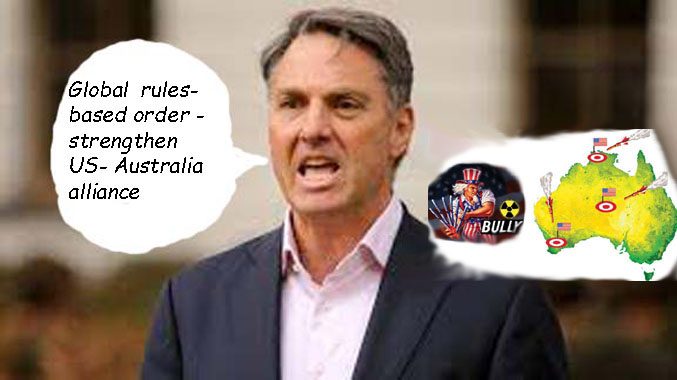
27 June 2025 AIMN Editorial By Denis Hay
Description
Richard Marles US war has anti-war voters turning against him. Learn why peace, sovereignty, and democracy are at stake in 2028.
Introduction
Darwin, 4:42 a.m., June 2025. KC-46 tankers lift off from RAAF Base Darwin, refuelling U.S. bombers returning from a strike on Iranian nuclear sites. Veteran Ron McKinnon, 71, stares from his porch. “Here we go again,” he mutters, haunted by his service in Iraq.
Just hours later, Defence Minister Richard Marles appears on ABC News: “Australia stands shoulder to shoulder with our ally.” Foreign Minister Penny Wong echoes him. But the public mood is shifting fast, as concerns over the Richard Marles US war agenda grow louder.
Agitate: The Iran strike has deepened fears of entanglement in endless U.S. wars.
Solution: Voters now demand a sovereign, peaceful defence policy – and they’re ready to make it an election issue.
PROBLEM – Public Trust Collapse Over U.S. Military Alignment
1. Polls Signal a Sea Change
• 40% of Australians now believe we should distance ourselves from the U.S. (Lowy Institute, 2025)
• Only 26% say we should follow the U.S. into military conflicts.
• 74% oppose involvement in a future war with Iran or China, reflecting a growing rejection of the Richard Marles US war direction.
2. The Trigger: Iran Strike
Australia’s support for the June 2025 U.S. strike on Iran shocked many voters. While the government called it a “measured response,” Australians viewed it as another unjustified conflict.
3. Personal Voices
Ella Tait, an ICU nurse from Newcastle, recalls messaging her brother at RAAF Tindal: “Are you being deployed?” He didn’t reply for hours. Online, #MarlesWarMachine trended as thousands shared anti-war posts.
“We save lives in hospitals, not bomb people across the world,” Ella said.
4. Strategic Concerns
• Pine Gap may have been used to assist the Iran targeting
• Darwin and Tindal bases make Australia a first-strike target in future retaliations
• Experts warn Australia’s role in U.S. wars increases – not decreases – our risk
Consequences of Following the U.S. War Machine
1. Economic Trade-Offs
• AUKUS subs will cost taxpayers $368 billion over 30 years
• Meanwhile, public housing, health, and disaster funding suffer under the financial burden of the Richard Marles US war priorities.
• Australia’s dollar sovereignty means we don’t need to choose war over welfare, but our leaders are
2. Voter Backlash
• Greens, Teals, and Independents have made “Peace Vote” pledges
• In 18 marginal electorates, candidates are calling for War Powers reform
• Many voters say: “If Marles won’t represent peace, we’ll find someone who will”, a clear repudiation of the Richard Marles US war stance.
3. Moral Injury
Every new conflict escalates demand for veterans’ services.
• Defence-linked trauma spikes 19% during combat support operations
• Public sympathy for veterans turns into public anger at those who sent them
“It’s not anti-troop to be anti-war,” says veteran Ron. “It’s anti-stupidity.”
A Peace-First Defence Strategy
1. Use Australia’s Monetary Power for Peace
As a sovereign currency issuer, Australia can fund:
• Fire & flood resilience
• National mental health services
• Cyber defence and coastal radar
No foreign wars required.
2. Model Countries
• Costa Rica abolished its military in 1948 and outperforms neighbours on education & health
• Austria maintains military neutrality and invests heavily in civil defence
• Ireland avoids entangling alliances yet contributes to UN peacekeeping missions, offering a powerful contrast to Richard Marles US war framework.
3. A Legislative Blueprint
A new, independent body could investigate and publicly review Pine Gap’s involvement in past conflicts such as the Iraq and Iran strikes, both tied to Richard Marles US war alignment.
Peace Policy Roadmap: A legislative alternative to Richard Marles US war approach, focused on sovereignty, diplomacy, and the public good.
• Defence of Australia Act – Bans combat beyond 1,000 nm (1,852 km) without a referendum
• War Powers Tribunal – Reviews Pine Gap’s role in Iraq & Iran
• Universal Housing & Health Fund – Redirect defence funds toward social programs
• Pacific Peace Office – Expands diplomacy and soft power in the region
Voter Toolkit
TheyVoteForYou.org.au – Track MPs’ war‑powers votes…………………………………………………………………https://theaimn.net/why-voters-reject-richard-marles-us-war/
1 This month
7 April – WEBINAR – Australia and the Doomsday Clock – Preventing nuclear war through NoFirstUse and other policies
Online | Tuesday April 7, 4:00-5:30pm, Australian Eastern Time / 8:00-9:30am Central Europe Time
– Access the registration link
15 April – Zoom –Nuclear Power is Not the Solution
Apr 15, 2026 01:00 AM in Canberra, Melbourne, Sydney

Join the International Physicians for the Prevention of Nuclear War (IPPNW) on Tuesday, April 14th for a timely webinar exploring the risks associated with nuclear power and challenging the myth that it offers a simple, safe, carbon-free solution to the climate crisis

21 April Webinar: No Nuclear Weapons in Australia
Start: 2026-04-21 18:00:00 UTC Canberra, Melbourne, Sydney (GMT+10:00)
End: 2026-04-21 19:30:00 UTC Canberra, Melbourne, Sydney (GMT+10:00)
Event Type: Virtual
A virtual link will be communicated before the event.
Host Contact Info: australia@icanw.org

of the week – Australians for War Powers Reform (AWPR)
To see nuclear-related stories in greater depth and intensity
 Antinuclear