Federal Labor is taking up powers to impose AUKUS N-sub nuclear wastes on communities across SA, WA and the NT:
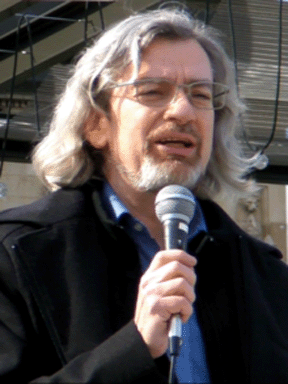
Democratic Rights and Public Safety are compromised by AUKUS Regulations Section.105, an untenable override of State & Territory laws that prohibit nuclear waste storage.
Public Submission by Mr David Noonan B.Sc., M.Env.St, -to AUKUS ‘Australian Naval Nuclear Power Safety Regulations – public consultation’ 12 July 2025 https://nuclear.foe.org.au/wp-content/uploads/Noonan-AUKUS-N-sub-regulations-to-override-SA-laws-July-2025.pdf
Contents:
Overview p2
The public has a ‘Right to Know’ who is targeted for storage of High-Level nuclear wastes 3
Indigenous People have a UN recognised Human Right to Say No to nuclear wastes 4
Regulations Section 105 overrides SA, NT and WA prohibitions on nuclear waste storage 5
Port Adelaide Enfield Council opposes AUKUS N-sub waste storage at Osborne 6
Premier Rann passed Laws that prohibits the storage of nuclear reactor waste at Osborne 7
Recommendations, in public interest disclosures required by Defence 8
As to my Relevant Background 9
Re: Democratic Rights and Public Safety are compromised by AUKUS Regulations Sec.105,
an untenable override of State & Territory laws that prohibit nuclear waste storage.
An array of key Public Interests are at stake across SA, NT and WA as a consequence of draft
AUKUS Australian Naval Nuclear Power Safety Regulations 2025 and in particular Section
105 State and Territory laws that do not apply in relation to a regulated activity.
I provide public input along with Recommendations as disclosures required by Defence (p.8) on
public interest matters pertaining to the Regulations, some of my relevant background to these
issues as a long-term environment, nuclear and public interest campaigner is cited (p.9).
Integrity, transparency, and accountability are key to public confidence in governance in
Australia. The AUKUS nuclear submarine (N-sub) agenda repeatedly fails these standards. The
AUKUS Regulations are the pointed end of an unfolding federal Labor agenda to take up powers
to impose unwelcome and illegal AUKUS N-sub nuclear wastes on our communities. AUKUS
Regulations Section 105 further undermines public confidence and trust in government.
The public has a ‘Right to Know’ who is targeted for storage of High-Level N-sub nuclear wastes.
Over three years into AUKUS: Why is there still not even an announced N-waste siting process?
An uncosted liability in AUKUS N-sub nuclear wastes is being imposed on all future generations
through the Regulations Section 105 over-ride of State and Territory Radiation Safety and
nuclear waste related laws. As a consequence, communities across SA, the NT and WA face a
future as primary targets for a federal imposed AUKUS High-Level nuclear waste storage site.
Community health and nuclear safety regards AUKUS N-subs is to be taken over by a nonindependent military nuclear regulator, set in ‘conflict of interest’ reporting to the Defence
Minister – to replace the independent civilian ARPANS Agency that reports to Health Minister.
Nuclear risks to community safety warrant full transparency, accountability and public interest
disclosures. The storage of N-sub so called ‘Low Level’ radioactive wastes at Osborne has been
rejected by the Port Adelaide Enfield Council (12 Nov 2024, p.213-218). It is an illegal act under
the SA Nuclear Waste Storage (Prohibition) Act 2000 as amended by Labor Premier Mike Rann.
These AUKUS Regulations are to override SA Law and to override the will of the people in SA.
The AUKUS Regulations place the Safety, Health and Welfare, and democratic Rights and
Interests of targeted Australian communities and Indigenous People at risk and unacceptably
compromise’s the protection of the Environment in which they live. The Regulations specifically
fail to recognise and respect Indigenous People’s UN recognised Human Right to Say No to
imposition of hazardous materials, re AUKUS N-sub nuclear wastes, on their lands.
Defence should realise civil society across SA, NT and WA will actively oppose an unacceptable
imposition of intractable nuclear wastes in Australia, what-ever the source. High-Level nuclear
waste is a dangerous and undemocratic imposition on all future generations.
The untenable state of AUKUS N-sub nuclear waste issues demonstrates why an AUKUS
military nuclear regulator can-not be trusted to protect the public interest.
The public has a ‘Right to Know’ who is targeted for storage of High-Level nuclear wastes:
Minister Richard Marles MP has still not made a promised ‘announcement’, said to be by early
2024, on a process to manage High-Level nuclear waste and to site a waste disposal facility, he
saying “obviously that facility will be remote from populations” (ABC News 15 March 2023).
Best safety practice requires a storage site to be identified before acquisition or generation of
High-Level nuclear wastes. AUKUS requires a site before purchase of a N-sub in early 2030’s.
The national press (11 August 2023) reports the Woomera rocket range is understood to be a
‘favoured location’ for storage and disposal of nuclear sub wastes (“Woomera looms as
national nuclear waste dump site including for AUKUS submarine high-level waste afr.com).
Political leaders in WA, Qld and Vic have already rejected a High-Level nuclear waste disposal
site. SA’s Premier has so far only said it should go to a ‘remote’ location in the national interest.
A ‘Review’ of the Woomera Prohibited Area was announced by Minister Marles MP: “to ensure it
remains fit for purpose and meets Australia’s national security requirements” – to read also as
AUKUS requirements. Public input to that Review has opposed an AUKUS N-waste storage.
Federal Labor can-not claim to have a ‘social license’ for Defence to operate on AUKUS in SA,
NT and WA while failing to inform affected communities of the AUKUS nuclear risks, the
cultural, environmental & socio-economic impacts they face in siting for nuclear waste storage.
The public and Traditional Owners have rights to full disclosure of nuclear risks and impacts in
advance of this flawed Regulatory process that assumes a right to impose High-Level nuclear
waste storage in SA, NT or WA through override of democratic laws prohibiting such wastes.
Nuclear wastes are a threat to the democratic rights of a people to decide their own future.
Storage of nuclear wastes is known to compromise the Safety and Welfare of the people of SA,
that is why it is prohibited by the SA Nuclear Waste Storage (Prohibition) Act 2000. The Objects
of this Act set out the fundamental public interests that are at stake:
“The Objects of this Act are to protect the health, safety and welfare of the people of
South Australia and to protect the environment in which they live by prohibiting the
establishment of certain nuclear waste storage facilities in this State.“
This Defence regulatory process must declare in advance whether or not Defence will commit
to comply with the United Nations Declaration on the Rights of Indigenous Peoples Article 29
provision of Indigenous People’s Rights to “Free, Prior and Informed Consent” over storage or
disposal of hazardous materials, including nuclear wastes, on their lands.
I refer this Defence process to consider “The Politics of Nuclear Waste Disposal: Lessons
from Australia”, a Report by Dr Jim Green and Dimity Hawkins AM, Published by the Asia-Pacific
Leadership Network (January 2024). Labor’s AUKUS agenda is failing to learn these lessons.
There is an onus on this Defence regulatory process to see that it doesn’t add to a sad history of
nuclear disrespect for Indigenous Human Rights and Interests across SA, the NT and WA.
Indigenous People have a UN recognised Human Right to Say No to nuclear wastes:
Traditional owners Human Right to Say No to imposition of nuclear wastes must be respected.
The AUKUS N-sub agenda triggers the United Nations Declaration on the Rights of Indigenous
Peoples (UNDRIP, adopted by United Nations, Sept 2007) in Indigenous People’s Article 29
Rights to “Free, Prior and Informed Consent” over storage or disposal of hazardous materials
on their lands. AUKUS N-sub nuclear wastes absolutely are ‘hazardous materials’.
These Regulations should be framed in accordance with the Recommendations of the Federal
Inquiry Report (Nov 2023) into the UN Declaration on the Rights of Indigenous Peoples and
respect Chair of the Inquiry, Indigenous Labor Senator Patrick Dodson’s clear views, stating
“the Commonwealth Government ensure its approach to developing legislation and
policy on matters relating to Aboriginal and Torres Strait Islander people be consistent
with the Articles outlined in the UNDRIP”.
It is concerning Labor has so far failed to act on key Rec. No.6 of that UNDRIP Inquiry, stating:
“The Committee recommends that the Human Rights (Parliamentary Scrutiny) Act 2011
(Cth) be amended to include the UNDRIP in the definition of ‘human rights’, so that it be
formally considered when scrutinising legislation.”
Transparency is a minimum public interest standard to expect from a Federal Government.
The intensions of the Labor Federal Government AUKUS N-sub agenda, and of the Regulations in governing N-sub wastes, must be made clear: does Labor support or intend to override the
Rights of Indigenous Australians under the UNDRIP Article 29 to “Free, Prior and Informed
Consent” – as a Human Right to Say No – over Storage of AUKUS N-sub wastes on their lands?
Issues of Indigenous Rights verses imposition of AUKUS N-sub wastes have been repeatedly
raised without response. For instance, my public input to the 2023 Defence Review and to an
Inquiry into the AUKUS Bill that led to these Regulations called for needed transparency:
Defence should become transparent over proposed Navy High-Level nuclear waste
disposal, policy, siting process, rights and legal issues. Defence should commit to
respect and to comply with the United Nations Declaration on the Rights of Indigenous
Peoples Article 29 provision of Indigenous People’s rights to “Free, Prior and Informed
Consent” over storage or disposal of hazardous materials on their lands.
The Labor Federal Government has long standing questions to answer, see “AUKUS nuclear
waste dump must be subject to Indigenous veto” (by Michelle Fahy, May 2023):
“Bipartisan secrecy and Defence’s poor record with Indigenous groups at Woomera are
red flags for consultations over an AUKUS nuclear waste dump. Human rights experts
say government must establish an Indigenous veto right.”
The draft AUKUS Regulations unacceptably disregard Indigenous Peoples UN recognised
Right to Say No to the imposed storage of AUKUS N-sub nuclear waste on their land.
Regulations Section 105 overrides SA, NT and WA prohibitions on nuclear waste storage:
Federal Labor is taking powers to impose AUKUS nuclear waste on SA, or on the NT, or on WA.
The Australian Naval Nuclear Power Safety Regulations 2025 sets out Section 105 State and
Territory laws that do not apply in relation to a regulated activity to override State & Ter Laws.
The Draft Explanatory Statement (DOCX, 145.38 KB (p.73) explains Section 105 as (extract):
Subsection 105(1) prescribes, for the purposes of section 135 of the Act, the
subsections of the provision which prescribes the laws of States and Territories that do
not apply in relation to a regulated activity. …
Subsection 105(3) provides that any provision of any other State or Territory law that
regulates nuclear activities is prescribed and do not apply in relation to a regulated
activity. This means that the laws prescribed in subsection 105(2) are expressly
excluded and do not apply in relation to regulated activities; and that any parts of any
other laws of States or Territories that also regulate nuclear activities do not apply to
regulated activities, as defined by the Act.
The note under subsection 105(3) clarifies that such provision of a law includes
provisions regulating the disposal of nuclear waste, the handling or storage of nuclear
material or material contaminated with radiation, or the design, construction, operation,
decommissioning or disposal of nuclear facilities.
Subsection 105(4) clarifies that subsection 105(3) does not apply to a provision of a law
that is predominately for the purposes of regulating work or occupational health and
safety, or protecting the environment.
The Parliamentary Report “Current prohibitions on nuclear activities in Australia: a quick
guide” (May 2024) provides an overview of current prohibitions on nuclear activities under SA,
NT and WA laws that protect community from the risks and impacts of nuclear wastes:
The Nuclear Waste Transport, Storage and Disposal (Prohibition) Act 2004 (NT) prohibits the
construction and operation of nuclear waste storage facilities, as well as the transportation of
nuclear waste for storage at a nuclear waste storage facility in the NT (Sec.6 & 7). Nuclear waste
is defined as including waste material from nuclear plants or the conditioning or reprocessing of
spent nuclear fuel (Sec.2). …
The Nuclear Waste Storage Facility (Prohibition) Act 2000 (SA) prohibits the construction or
operation of a nuclear waste storage facility, and the import to SA or transport within SA of
nuclear waste for delivery to a nuclear waste storage facility (Sec.8 & 9).
The Nuclear Waste Storage Facility (Prohibition) Act prohibits the SA Government from
expending public funds to encourage or finance the construction or operation of nuclear waste
storage facilities (Sec.13). The Act would also require the SA Parliament to hold an inquiry into
the proposed construction or operation of a nuclear waste storage facility in SA authorised
under a Commonwealth law (Sec.14). …
The Nuclear Waste Storage and Transportation (Prohibition) Act 1999 (WA) also prohibits the
storage, disposal or transportation in Western Australia of certain nuclear waste, including
waste from a nuclear plant or nuclear weapons (Sec.7 & 7 A, nuclear waste is defined in Sec.3).
Port Adelaide Enfield Council opposes AUKUS N-sub waste storage at Osborne:
Federal and State Labor Governments failed to engage the Port Adelaide Enfield Council (PAE)
on their plan for decades of ongoing storage of AUKUS N-sub nuclear reactor radioactive
wastes at Osborne, see Minutes of an PAE Ordinary Council Meeting 12 Nov 2024 (p.5-6).
11.1 Questions on Notice – Cr. den Hartog – Nuclear Waste Storage
Question 1. Has there been any correspondence or other communication between
Council staff and or any elected member(s) and the Federal or State Government or
Federal or State Government department regarding a dedicated nuclear waste facility at
Osborne under the AUKUS Law?
Answer To the best of our knowledge there has been no correspondence or
communication of this specific nature.
… Question 3. If a nuclear waste facility is established at Osborne, what is the
legislative responsibility of the Council regarding community safety and well-being?
Answer Given the regulations under the Bill have yet to be publicly released, it is still
unclear what legislative responsibilities under the new legislation would rest with
council, if any.
However, councils are charged with many aspects of the health, safety and well-being
of people under existing legislation. The Local Government Act, Public and
Environmental Health Act and Environment Protection Act are examples of legislation
that prescribe Council’s role and responsibilities about community safety and wellbeing. Local Government’s legislated powers in areas related to nuclear power weapons and defence are limited, but under existing legislation councils can advocate on issues relevant to their communities needs and concerns. This is one of the central premises of the draft PAE Decision Making Framework for AUKUS, which is being considered as part of tonight’s Council agenda.
Commendably, PAE decided to advocate on their communities needs & concerns over AUKUS
and decided to oppose storage of low-level radioactive waste at Osborne, see the PAE Council
Recommendations passed at the Ordinary Council Meeting – 12 Nov 2024 (Agenda p.213-218):
Recommendations:
The nuclear safety component of AUKUS in particular demands community
engagement. It is therefore recommended that Council write to the relevant local State
and Federal MPs and Ministers advising them of Council’s
- position that any applications for licencing for the management, storage or disposal of
radioactive waste ‘facilities’ and ‘activities’ at the AUKUS operations at the Osborne
Naval Shipyard should be subject to full community engagement; and, - opposition to the permanent storage or disposal of low-level radioactive waste and,
any temporary or permanent storage or disposal of medium and high-level radioactive
waste in the AUKUS facilities at Osborne Naval Shipyard. (p.217-218)
However, the AUKUS Regulations disrespects PAE’s opposition by taking up powers to
impose radioactive waste storage at Osborne regardless of the will of the local community.
Premier Rann passed Laws that prohibits the storage of nuclear reactor waste at Osborne:
Hon Mike Rann AC CNZM, Premier of SA from March 2002 through to 2011, passed Labor
amendments to expand public interest protections in nuclear reactor waste prohibitions in SA.
Federal Labor’s intended decades of storage of AUKUS N-sub reactor radioactive wastes at
Osborne, promoted by current SA Labor State Government, is illegal – against the Law – in SA.
Following years of silence and secrecy from federal and state Labor over the illegality of their
plans for N-sub waste storage at Osborne, the AUKUS Regulations 2025 are to override our legal
protections in SA and take up powers to impose N-sub waste storage at Osborne by decree.
AUKUS Minister Richard Marles, Defence, local federal MP the Hon Mark Butler the Minister for
Health (also responsible for the ARPANS Agency) and local state MP the Hon Susan Close the
Minister for Environment & Water and Deputy Premier in SA, should explain this to community.
They all have an onus to explain the legal context and consequences of passage of the AUKUS
Regulations 2025 in a federal override of long-standing public interest protections in SA Law.
In 2000 the SA Liberal Premier John Olsen showed leadership in legislating to prohibit the
import, transport, storage and disposal of ‘nuclear waste’ derived from nuclear reactor
operations, using a definition prohibiting High-Level and Intermediate Level radioactive wastes.
This was a response to PM Howard targeting SA for storage of ANSTO nuclear fuel wastes.
This SA Law, the will of the Parliament and the people, still stands and applies to legally prohibit
the storage of AUKUS N-sub nuclear reactor High-Level and Intermediate Level wastes that
Minister Marles may seek to target SA with, with a reported focus on the Woomera Area.
In 2002 the incoming SA Labor Premier Mike Rann showed leadership in legislating to expand
the range of prohibitions on ‘nuclear waste’ derived from nuclear reactor operations to also
cover ‘Low Level’ radioactive wastes (that can require isolation for up to 300 years).
Storage of N-sub nuclear reactor ‘Low Level’ radioactive wastes at Osborne is illegal in SA Law.
Minister Marles AUKUS Regulations 2025 Section 105 is intended to override and set aside
these key public interest SA Laws passed under the leadership of Liberal & Labor Premiers.
In the near term, Minister Marles wants to use the proposed draft AUKUS Regulations 2025 to
impose storage of so called ‘Low Level’ radioactive waste at Osborne, and in the long-term
Minister Marles wants the option to impose storage of AUKUS High-Level wastes onto SA.
Q: where is the political leadership today from the State Labor Government in response to this?
It is undemocratic of a Federal Labor Government to seek to override State and Territory laws,
that protect the Health, Safety and Welfare of the People and the Environment in which they
live, so as to impose the hazards, risks and impacts in storage of AUKUS N-sub nuclear wastes.
Recommendation:
The undemocratic AUKUS Regulations “Section 105 (3) State and Territory laws that do not
apply in relation to a regulated activity” that is intended to take up powers to impose N-sub
nuclear reactor wastes which are currently illegal in SA, in the NT, and in WA, must be
withdrawn by the AUKUS Minister Richard Marles MP and by Defence.
Recommendations:
Recommendations by David Noonan comprise public interest disclosures that are required by Defence for an informed, transparent and accountable process on AUKUS Regulations 2025.
1. Civil Society faces federal imposition of untenable AUKUS N-sub nuclear waste storage.
Defence must respect affected Australian communities and Indigenous People’s ‘Right to Know’ the nuclear risks they face in imposed AUKUS nuclear waste storage facilities:
1.1 Defence must declare its intention to over-ride the SA Nuclear Waste Storage (Prohibition) Act 2000 to impose AUKUS N-sub reactor nuclear waste storage at Osborne, Port Adelaide.
1.2 Defence must publicly disclose which Australian regions and Indigenous Peoples are currently under consideration for imposed siting and compulsory land acquisition for an AUKUS High-Level nuclear waste storage, and which – if any – existing Defence lands are included in the regional short list that is currently being prepared across SA, the NT and WA.
1.3 Defence must become accountable over the future and fate of the Woomera Area, understood in national media to be a ‘favoured location’ for storage and disposal of AUKUS Nsub nuclear waste (“Woomera looms as national nuclear waste dump site including for AUKUS submarine high-level waste afr.com AFR 11 August 2023).
1.4 Defence must declare its reserved right to override the SA Nuclear Waste Storage (Prohibition) Act 2000 through powers in the Australian Naval Nuclear Power Safety Act 2024 Section.135 “Operation of State and Territory laws” to impose an AUKUS nuclear waste dump on outback lands and unwilling community in SA, by decree through these AUKUS Regulations.
2. Indigenous People have a UN recognised Human Right to Say No to nuclear wastes.
Defence should respect the clear views of Indigenous Labor Senator Patrick Dodson and act to make the AUKUS Regulations consistent with the Recommendations of a Federal Inquiry Report (Nov 2023) into the UN Declaration on the Rights of Indigenous Peoples, stating:
“the Commonwealth Government ensure its approach to developing legislation and policy on matters relating to Aboriginal and Torres Strait Islander people be consistent with the Articles outlined in the UNDRIP”.
2.1 Defence must provide a clear disclosure as to whether or not they will commit to respect and comply with the United Nations Declaration on the Rights of Indigenous Peoples Article 29 provision of Indigenous Peoples Rights to “Free, Prior and Informed Consent”, as a Right to Say No, over storage or disposal of hazardous materials on their lands – in this case AUKUS HighLevel & Intermediate Level nuclear waste storage.
3. The undemocratic AUKUS Regulations “Section 105 (3) State and Territory laws that do not apply in relation to a regulated activity” that is intended to take up powers to impose Nsub nuclear reactor wastes which are currently illegal in SA, in the NT, and in WA, must be withdrawn by the AUKUS Minister Richard Marles MP and by Defence.
As to my Relevant Background:
In 30 years’ experience scrutinising environment & nuclear public interest issues and providing
public input and Recommendations on nuclear waste matters pertinent to these Regulations:
Australia obstructed probe into deadly ‘Rainbow Warrior’ bombing
David Robie, July 10, 2025 , https://johnmenadue.com/post/2025/07/australia-obstructed-probe-into-deadly-rainbow-warrior-bombing/
France’s ‘Operation Satanique’ bombing of the Greenpeace ship Rainbow Warrior, 40 years ago this month, was state-sponsored terrorism – and Australia had a part in helping French secret agents to escape.
A DECLASSIFIED AUSTRALIA SPECIAL REPORT
The French Government terror bombing of Greenpeace ship, Rainbow Warrior, 40 years ago in Auckland harbour backfired on the French disastrously. It added to mounting Pacific and global pressure to force France 11 years later to abandon nuclear testing on its Pacific island colonies.
Australia’s obstruction of the New Zealand police investigation of the French secret agents who conducted the terror bombing still rankles, 40 years on.
David Robie, the only journalist on board the ship in the weeks leading up to the bombing, looks back on the event and on the legacy of this sordid act of state terrorism in a New Zealand port.
Was dubbed “Blunderwatergate”. This was an apt epithet for the Jacques Tati-like farce marking the bombing of the Rainbow Warrior by French secret agents on 10 July 1985.
And the bungled attempts to cover up the murky trail leading back to the highest levels of government, the military and intelligence in Paris.
It was tragic too. The killing of Greenpeace’s photojournalist Portuguese-born Fernando Pereira that night at Auckland’s Marsden Wharf was a shock to the crew – and to me as a journalist who had been on board documenting the ship’s voyage for 10 weeks.
But we had no illusions about French involvement. The Greenpeace ship had just arrived in Auckland and was preparing for a protest voyage to Moruroa Atoll, in the French Pacific territory of Tahiti, to highlight the French nuclear testing.
A combination of a swift investigation by New Zealand police, and curious bystanders, led to the arrest and charging with murder of two French secret agents from France’s secret service, the Directorate-General for External Security (DGSE). The arrested agents had been posing as Swiss honeymooners in the days that followed the bombing.
A lack of co-operation and actual obstruction by Australian authorities stymied an attempt to arrest four more French DGSE agents who had fled to Australian territory of Norfolk Island.
French terror in Opération Satanique
In a sense it was lucky that the death toll on board the Rainbow Warrior that night wasn’t a lot higher. Fernando had gone below deck after the first blast looking for a missing crew member and to rescue his camera gear.
In their appropriately titled “Opération Satanique”, the French spies used a deadly double detonation to bomb the ship twice, precisely seven minutes apart. This technique has similarities to the now-familiar “double tap” bombing that often results in first responders and rescuers being targeted, and has been described as a war crime as it violates the Geneva Convention by targeting civilians and the wounded.
Fernando died when the second bomb exploded, rapidly flooding the ship further and crippling the propellor shaft just behind his cabin – and next to my own.
Ten other crew members on board scrambled off, some thrown into the water. More people could have died, as several had been asleep after the lively 29th birthday party for campaign co-ordinator Steve Sawyer earlier in the evening.
Some were still chatting in the mess when the first French Naval limpet mine went off, blasting a massive hole the size of a garage door in the hull at the engine room, at 10 minutes to midnight.
There had been no warning from the French to the crew or others on board in this worst case of state terrorism ever to happen in New Zealand. And no warning of the second blast to come.
The final voyage
The man killed in the blast, Fernando Pereira, aged 36 and the father of two young children, was on the Rainbow Warrior’s Pacific voyage almost by chance.
At the beginning of the voyage, co-ordinator Steve Sawyer had been seeking a wirephoto machine for transmitting photographs to the world of the campaign voyage to the Marshall Islands.
He phoned Fiona Davies, then heading the Greenpeace photo office in Paris. But he wanted the machine and a photographer separately.
“No, no – I’ll get you a wire machine,” replied Davies. “But you’ll have to take my photographer with it.”
So Fernando Pereira joined the Rainbow Warrior in Hawai’i and he covered the voyage to Rongelap Atoll in the Marshall Islands The islanders there wanted help to leave their contaminated ancestral home, and in May 1985, Greenpeace’s ship, the Rainbow Warrior, set out to help them.
They suffered serious health problems because of radioactive fallout that had dusted their island home from at least five “dirty” US nuclear bomb tests in the 1950s. Marshall Islands, 3500kms north-east of Australia, had been occupied by US forces since WW2, and in 1979 voted to exercise sovereignty in a Compact in Free Association with the United States.
The 15-megaton “Bravo” test on 1 March 1954, a thousand times more powerful than the US atomic bomb that devastated Hiroshima, was the most lethal to the islanders. Hundreds of people were living on the downwind atolls of Rongelap, Rongerik and Utirik, barely 150km to the east. They are left with a deadly legacy of thyroid tumours, cancers, still births, and a host of other illnesses.
Neglected by both the US and Marshall Islands authorities, and despite losing their homes and much cultural heritage, the islanders urged the Greenpeace flagship to evacuate them to Mejatto on Kwajalein Atoll, 120km away.
It took four return voyages for the Rainbow Warrior to move about 320 Rongelapese with their dismantled homes and belongings — some hundreds of tonnes — to their new atoll.
Their future and their health remain uncertain four decades after Greenpeace helped them. But the media spotlight on the humanitarian voyage helped pressure the US to partially make amends.
The US did provide US$150 million as part of the agreement for the Compact of Free Association, to establish a Nuclear Claims Tribunal to deal with health claims over the testing. Established in 1988, the Tribunal ran out of funds in 2011 and ceased to function.
It also provided US$45 million to the Rongelap people to “clean up” the atoll – but so far just one of 60 islands has been cleaned up. The islanders are debating a return to their homeland of Rongelap, but many are not convinced that their atoll is safe yet.
Australian involvement in Opération Satanique
One aspect of the police investigation that rankled with New Zealanders was the lack of co-operation verging on obstruction by Australian authorities. This was the pursuit of the DGSE agents posing as the crew of the yacht Ouvéa that had been chartered in New Caledonia and was suspected of smuggling the explosives into New Zealand.
On 15 July, five days after the deadly bombing, a team of eight New Zealand detectives — including two French speakers — and a forensic scientist on the hunt for the fleeing French agents, were flown in a New Zealand Air Force plane to Australia’s Norfolk Island.
They interviewed the three crew on board (they missed the leader Dr Xavier Maniguet, who had earlier managed to fly to Sydney) – DGSE agents Chief Petty Officer Roland Verge, 32; Petty Officer Gerald Andries, 32; and Petty Officer Jean-Michael Barcelo, 33. They all claimed to be “tourists”.
The next day the detectives searched the Ouvéa, took scrapings from the yacht’s bilges to check for explosives, and seized documents. They also found a map of Auckland with a near-harbour Ponsonby address of a Greenpeace member handwritten on it – later shown to be a map sent by the French spy Christine Cabon, who had infiltrated Greenpeace, to the DGSE. She later fled to Israel, but managed to elude a New Zealand detective who tracked her down.
The 11-metre yacht the Ouvéa had been secretly chartered by the “covert action” arm of the DGSE French spy agency, to carry the two limpet bombs, the diving gear, a zodiac dingy, and radios and other gear to Auckland harbour.
The information collected after analysis produced enough evidence to charge the three agents with murder on the same basis as the two DGSE agents already arrested, but the New Zealand police needed time for the analytics, and even the passport checks took five days.
However, the Australian police and immigration officials on Norfolk Island, without doubt operating under instructions from Canberra (where the Bob Hawke Labor Government was in power), would not allow extra time for holding the suspects.
They gave New Zealand police just one day — an impossible deadline of 2pm on 16 July — and after that the yacht crew and their boat were free to depart, unimpeded by Australian authorities.
By the time the New Zealand police had obtained arrest warrants for the arrest of the Ouvéa crew on 26 July on charges of arson and murder, they and their boat had already sailed away from Australian territory.
Australian assistance to the French may have been more than mere obstruction.
A former head of DGSE in his memoir admitted to many covert sabotage and espionage operations against Greenpeace. He described how its “traditional allies” had ”on several occasions” been informed of plans for covert operations and had either lent a hand or “turned a blind eye on such-and-such a day”.
Whether Australia’s intelligence agencies also directly assisted the French with intelligence, surveillance, or preparations for carrying out the bombing, or in the escape of their agents, is unclear.
Tahitian sources said the DGSE agents, after being released by Australian authorities from Norfolk Island, had rendezvoused with the French Navy’s nuclear-powered attack submarine Rubis which was used for Special Forces deployment and surveillance, and had been conveniently deployed to the Coral Sea area.
The Ouvéa yacht was then scuttled. An empty life raft was detected in the area shortly after by a New Zealand Air Force P-3 Orion surveillance plane dispatched to hunt for the yacht and for the French submarine known to be in the area. The DGSE agents were landed ashore from the submarine at the French Pacific territory of Tahiti.
Four other French agents remained undetected in New Zealand. One of the agents nonchalantly flew out unimpeded through Sydney, while the others laid low under cover for two weeks before quietly slipping out of the country.
French state violence against Greenpeace
So why was the Rainbow Warrior bombed? Many in the French military were blinded by an intense paranoia over Greenpeace and other activists working to highlight nuclear testing in the South Pacific and in supporting independence struggles in their Pacific colonies.
The French secret service, the DGSE, was given a free hand by Defence Minister Charles Hernu to “neutralise” the environmental organisation.
The French prime minister at the time, Laurent Fabius, claimed in a TVNZ interview in 2005 that he had been “betrayed” by his defence minister. Hernu died in 1990 – still popular in France over the bombing.
The sabotage attack on the Rainbow Warrior certainly wasn’t out of character with many other brutal actions taken by French authorities against Greenpeace vessels protesting against nuclear testing in the Pacific.
In 1973, for example, French commandos boarded the Greenpeace yacht Vega off Moruroa Atoll and savagely beat two of the crew, including one of the founders of Greenpeace, David McTaggart, who almost lost an eye.
McTaggart filed a civil action against the French Navy, accusing it of piracy. The Paris court found the Navy guilty of having deliberately rammed the Vega.
In 1995, Greenpeace led another flotilla to Moruroa. Ten years after the lethal bombing in Auckland, French commandos boarded the Rainbow Warrior II, smashed equipment, fired tear gas at crew on the ship’s bridge, arrested Greenpeace activists, and seized the ship.
France only returned the vessel to Greenpeace several months later.
And I also had my personal run-ins with French authorities as a journalist covering environmental and independence issues in the 1980s.
In January 1987, a year after the first edition of my book, Eyes of Fire: The Last Voyage of the Rainbow Warrior, was published, I was arrested at gunpoint by French troops in the French Pacific territory of New Caledonia /Kanaky, near the New Caledonian village of Canala.
The arrest followed a week of being tailed by secret agents in the capital, Nouméa. When I was handed over by the military to local gendarmes for interrogation, accusations of my being a “spy” and questions over my book on the _Rainbow Warrior_bombing were made in the same breath.
After about four hours of questioning by the gendarmes, I was released.
Greenpeace, after being awarded $8 million in compensation — but no apology — from France by the International Arbitration Tribunal, finally towed the Rainbow Warrior to Matauri Bay and scuttled her off Motutapere, in the Cavalli Islands in northern New Zealand on 12 December 1987, to create a living reef.
Her namesake, the Rainbow Warrior II, formerly the Grampian Fame, was launched in Hamburg exactly four years after the bombing, to continue the environmental advocacy work
Cutting a deal
The diplomatic pressure from France heaped upon New Zealand to release the DGSE agents was huge. A deal was finally agreed but it sparked almost as much anger in New Zealand as the bombing itself, when France threatened to block trade access to New Zealand’s European markets.
The compensation deal for New Zealand, mediated in 1986 by then UN secretary-general Javier Perez de Cuellar, awarded the government $13 million. The money was used to fund anti-nuclear projects and the Pacific Development and Conservation Trust.
The compensation agreement and an apology by France was in exchange for the deportation of the two jailed DGSE secret agents, Alain Mafart and Dominique Prieur (“the honeymooners”), after they had served less than a year of their 10-year sentences for manslaughter and wilful damage of the bombed ship.
They were transferred to Hao Atoll in French Polynesia to serve three years in exile at a “Club Med”-style nuclear and military base.
But the bombing scandal didn’t end there. The same day as the “burial at sea” of the Rainbow Warrior in 1987, the French government told New Zealand that Mafart had a “serious stomach complaint”.
French authorities repatriated him to France – in defiance of the terms of the UN agreement and protests from David Lange’s Labour Government.
It was later claimed by a Tahitian newspaper, Les Nouvelles, that Mafart was being smuggled out of Tahiti on a false passport hours before New Zealand was even told of his “illness”.
The other French agent, Prieur, was also repatriated to France in May 1988 because she was pregnant. France ignored protests by the New Zealand Government, and the secret agent pair were honoured, decorated and promoted in their homeland.
A supreme irony is that such an act of terrorism should be publicly rewarded, given the past two decades efforts against terrorism in the so-called “war on terror”.
Satanique mea culpa
In May 2005, the French agents’ lawyer, Gerard Currie, tried to block footage of their 1985 guilty pleas in the New Zealand High Court — shown on closed circuit to journalists, including myself, at the time but not seen publicly — from being broadcast in TVNZ’s Sunday program.
Losing the High Court ruling, the DGSE ‘s lawyer appealed against the footage being broadcast. But the two former agents had lost any spurious claim to privacy over the act of terrorism by publishing their own memoirs – Agent Secrete (Prieur, 1995) and Carnets Secrets (Mafart, 1999).
More than three decades after the bombing, in September 2015, the French secret agent who planted the French Naval limpet mines on the hull of the Rainbow Warrior, “outed” himself and apologised to Greenpeace, the Pereira family, and the people of New Zealand, describing the operation as a “big, big failure”.
Retired colonel Jean-Luc Kister (alias Alain Tonel), revealed in simultaneous interviews with TVNZ’s Sunday program reporter John Hudson and French investigative journalist Edwy Plenel, publisher of _Mediapart_, his role in the sabotage.
Colonel Kister revealed that an early French proposal to merely damage the ship’s engine in Auckland Harbour was rejected.
“There was a willingness at a high level to say: ‘This has to end once and for all. We need to take radical measures’.
“We were told we had to sink it,” Kister said in the interview.
“I have the blood of an innocent man on my conscience, and that weighs on me. We are not cold-blooded killers. My conscience led me to apologise and explain myself.”
The legacy of nuclear resistance
Bengt Danielsson, a Swedish anthropologist, and his French wife, Marie-Thérèse, were an inspiration to the nuclear-free and independent Pacific movement, especially in the Cook Islands, New Zealand and Tahiti.
Along with Elaine Shaw of Greenpeace Aotearoa, they played a vital role in raising public awareness of the plight of Tahitians harmed by the years of French atmospheric nuclear tests.
While the Danielssons published several scientific studies and popular books on the islands, including _Moruroa, Mon Amour_ and Poisoned Reign, they constantly campaigned to expose French nuclear colonialism.
They were honoured for their commitment and achievements with Bengt being awarded the Right Livelihood Award, an alternative Nobel Peace Prize-style international recognition, “exposing the tragic results of and advocating an end to French nuclear colonialism”.
However, Bengt Danielsson’s health deteriorated after this honour and he died in July 1997, barely a year after French nuclear testing in the Gambier Islands ended for good. Marie-Thérèse died six years later in 2003.
France agreed to sign the Comprehensive Test Ban Treaty after a swansong package of eight planned nuclear tests to provide data for simulation computer software.
However, such was the strength of international hostility and protests and riots in Pape’ete that Paris ended the nuclear program after just six tests. France officially ratified the CTBT on 10 September 1996.
Elaine Shaw worked for Greenpeace Aotearoa for 16 years and developed it with a core group into the small but lively movement it had become by the time of the bombing.
But she was not comfortable with the changes and rapid growth of the organisation after the bombing. She worked tirelessly for the people of Rongelap as well as “French” Polynesia, the victims of nuclear testing until she died of cancer in 1990.
“I sensed that her interest stemmed from her concern for the people rather than any political ideology,” said Tahitian activist Tea Hirshon. “She went to many islands and saw for herself what people in the Pacific wanted.”
Still other Greenpeace stalwarts have died since the Rainbow Warrior bombing, including Warrior of the Rainbow author and journalist Robert Hunter (2005), founding president of Greenpeace; and David McTaggart (2004), for many years the inspirational chairman of Greenpeace International.
Kawhia-based Owen Wilkes, who had joined a Vega voyage to the Cook Islands in mid-1986, and Fijian nuclear-free and independent Pacific campaigner Amelia Rokotuivuna, both also died in 2005.
The campaign co-ordinator of the fatal voyage, Steve Sawyer, died of pneumonia caused by lung cancer in 2019. One of the crew members on the Rongelap mission, the Rainbow Warrior’s chief engineer Davey Edward, also died of cancer in 2021.
The best possible memorial for Elaine Shaw, Amelia Rokotuivuna, Owen Wilkes, the Danielssons and other Pacific campaigners came in 2004 when Tahitians elected Oscar Temaru as their territorial President.
He had established the first nuclear-free municipality in the Pacific Islands when he was mayor of the Pape’ete suburb of Faa’a.
Since the Temaru coalition came to power, demands increased for a full commission of inquiry to investigate new evidence of radiation exposure from the atmospheric tests in the Gambiers in French Polynesia from 1966-1974.
Altogether France carried out 193 nuclear tests in the South Pacific, 46 of them dumping more than nine megatons of explosive energy into the atmosphere – 42 over Moruroa, and four over Fangataufa atolls.
It was recently revealed that the French Atomic Energy Commission has spent at least €90,000 in a vain campaign to undermine the research by an investigative journalism unit called Disclose and revealed in the book _Toxique,_ published in 2021 and an associated website “The Moruroa Files“.
The investigators trawled some 2000 pages of declassified documents and carried out scores of interviews, concluding that French authorities consistently underestimated the scale of the impact on the environment, geology and the health of the islanders of the French nuclear testing in Polynesia.
The CEA produced its own booklet, “Nuclear tests in French Polynesia: why, how and with what consequences”, printed 5000 copies, and distributed these around Pacific countries.
However, the pressure on France to atone for its actions will continue.
From death springs life
The sordid Rainbow Warrior affair was a diplomatic debacle for the French, and it has taken years for Paris to recover some mana — spiritual power and authority — in the South Pacific region.
Greenpeace and the general environmental movement have grown dramatically and matured over the past four decades. Greenpeace is currently operating Rainbow Warrior III as its campaign flagship.
Campaigns have broadened from the dangers of nuclear power, into issues such as the climate crisis, driftnet fisheries, genetic engineering, glacier retreat, the illegal rainforest timber trade, and now the growing threat of deep sea mining industry.
The original Rainbow Warrior’s last voyage and the death of Fernando Pereira were not in vain. The struggle lives on.
Republished from Declassified Australia , 1 July 2025
The Australia-Tuvalu climate migration treaty is a drop in the ocean
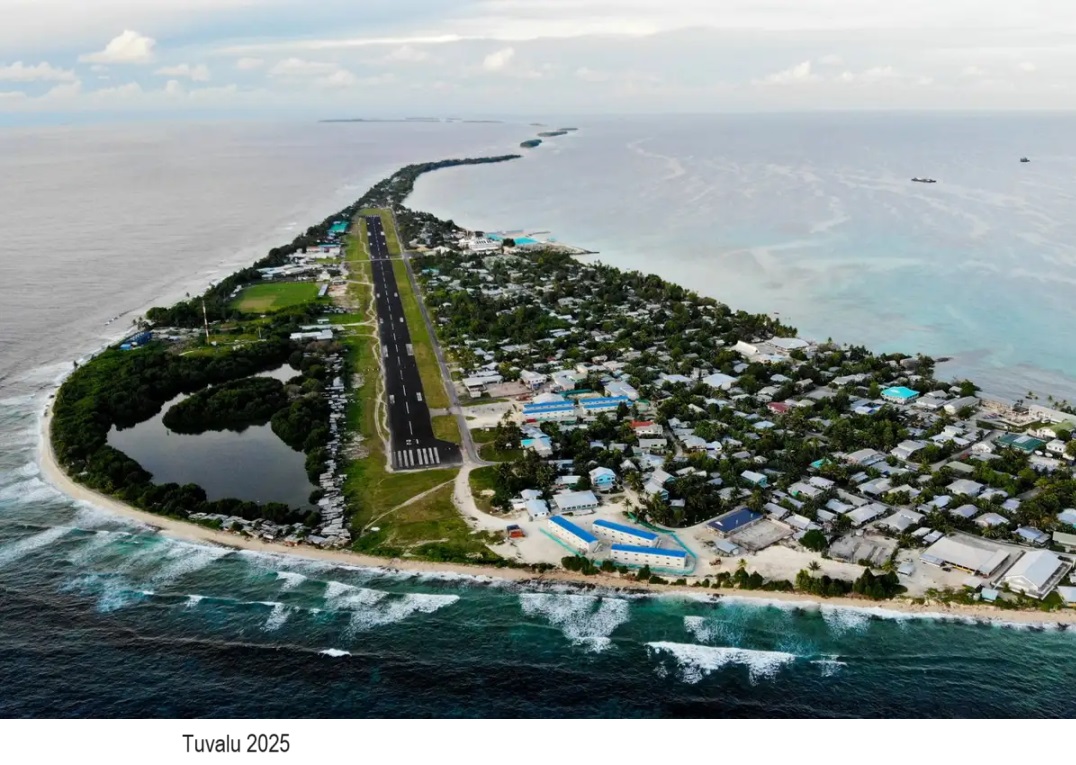
Australia has offered a lifeline to the people of Tuvalu, whose island is threatened by rising sea levels. But the deal comes with strings attached – and there will be millions more climate migrants in need of refuge by 2050
By New Scientist, 2 July 2025, https://www.newscientist.com/article/mg26635502-900-the-australia-tuvalu-climate-migration-treaty-is-a-drop-in-the-ocean/
A lifeline has been extended to the people of Tuvalu, a low-lying Pacific nation where rising sea levels are creating ever more problems. Each year, Australia will grant residency to 280 Tuvaluans. The agreement could see everyone currently living in Tuvalu move within just a few decades.
Effectively the world’s first climate migration agreement, the Australia-Tuvalu Falepili Union will also provide adaptation funds to help those who stay behind.
Is this a model for how climate migration can be managed in an orderly way, before disaster strikes? Far from it. To get this deal, Tuvalu must allow Australia a say in future security and defence matters. Few other countries are likely to agree to similar terms.
Tuvalu’s population is also very small. Taking in around 10,000 climate migrants would be inconsequential for a country of 28 million like Australia. Worldwide, it is estimated that between 25 million and 1 billion people might be forced to move by 2050 because of climate change and other environmental factors. Where will they go?
Many argue that the wealthy countries that emitted most of the carbon dioxide that is warming the planet have a moral duty to help people displaced by climate change. But these kinds of discussions have yet to be translated into the necessary legal recognition or acceptance of forced climate migrants. On the contrary, many higher-income nations seem to be becoming more hostile to migrants of any kind.
There has been a little progress in setting up “loss and damage” funds to compensate lower-income countries for the destruction caused by global warming. This could help limit the need for climate migration in the future – but the money promised so far is a fraction of what is required.
The most important thing nations should be doing is limiting future warming by cutting emissions – but globally these are still growing. Sadly, the Falepili Union is a drop in the ocean, not a turning of the tide.
1 This month
7 April – WEBINAR – Australia and the Doomsday Clock – Preventing nuclear war through NoFirstUse and other policies
Online | Tuesday April 7, 4:00-5:30pm, Australian Eastern Time / 8:00-9:30am Central Europe Time
– Access the registration link
15 April – Zoom –Nuclear Power is Not the Solution
Apr 15, 2026 01:00 AM in Canberra, Melbourne, Sydney

Join the International Physicians for the Prevention of Nuclear War (IPPNW) on Tuesday, April 14th for a timely webinar exploring the risks associated with nuclear power and challenging the myth that it offers a simple, safe, carbon-free solution to the climate crisis

21 April Webinar: No Nuclear Weapons in Australia
Start: 2026-04-21 18:00:00 UTC Canberra, Melbourne, Sydney (GMT+10:00)
End: 2026-04-21 19:30:00 UTC Canberra, Melbourne, Sydney (GMT+10:00)
Event Type: Virtual
A virtual link will be communicated before the event.
Host Contact Info: australia@icanw.org

of the week – Australians for War Powers Reform (AWPR)
To see nuclear-related stories in greater depth and intensity
 Antinuclear