Those left behind: The long shadow of Britain’s nuclear testing in Western Australia
WA TODAY, ByVictoria Laurie, August 10, 2025
son, a daughter and a grandson of Australian servicemen exposed to nuclear testing have made an emotional pilgrimage up to the remote Montebello Islands to capture details of an era with – literally and metaphorically – enduring fallout.
Paul Grace, Maxine Goodwin and Gary Blinco recently stood together in the ruins of a bomb command centre overlooking the scene of three British nuclear tests in the 1950s that few younger Australians have ever heard of.
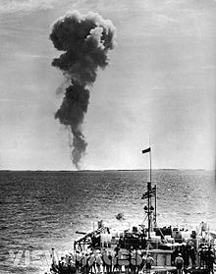
As the world commemorates Japan’s wartime nuclear blasts in Hiroshima and Nagasaki, the trio say Australians should not forget the impact of atomic tests conducted on West Australian soil in the 1950s, starting with Operation Hurricane in 1952 and followed by two more tests in Operation Mosaic in 1956. Other atomic tests at Emu Field and Maralinga bookended the Montebello series.
Grace, Goodwin and Blinco all know the tests left a family legacy of death or ill-health – and lingering contamination 70 years later on several islands. On a recent expedition up to the Montebello archipelago, 80 kilometres offshore from Onslow, the trio gathered documentary and archival material while filling gaps in their own family histories………………………
For Grace and Goodwin, the most poignant moment was when they stood on the tarmac at Onslow airport in the exact spot where his grandfather and her father posed for a photograph with No 86 Transport Wing Detachment RAAF, to commemorate the successful test of Britain’s first ever nuclear bomb detonation on October 3, 1952.
“They performed what they called ‘coastal monitoring sorties’ after testing, but that was code for looking for fallout – the British had promised that no fallout would reach the mainland.”
Grace’s grandfather wrote later: “As pilot of the aircraft, I would have been the most exposed crew member, being shielded only by the Perspex of the front and side windows. The navigator, radio operator and Mr Hale being in the body of the aircraft had, presumably, more protection.
“Further to the above, after leaving the atomic cloud, we spent approximately two more hours in a radioactive airplane (as proved by the Geiger-Counter check) during the return to Onslow, landing, parking and shut-down.”
Maxine Goodwin’s father died of lymphatic cancer aged 49, when she was 16.
“He would have been servicing contaminated aircraft, so my mother and I do believe his illness was the result of his participation in the nuclear tests,” she says…………………………………………….
……………………………………. a 2006 DVA study of Australian participants in British nuclear tests in Australia showed an increase in cancer deaths and cancer incidence (18 per cent and 23 per cent respectively) than would be expected in the general population.
“They tried to explain these figures away, but they are really quite damning,” says Paul Grace, an author whose book Operation Hurricane gives a detailed account of the events and personnel involved in UK nuclear testing in Australia.
The three descendants of nuclear veterans describe the Montebello Islands as haunting but beautiful. “Within the landscape, you’ve got an incredible number of Cold War artefacts lying around, what the British referred to as ‘target response items’,” says Grace………………………………………………………………………
The nuclear fallout was not limited to those servicemen involved. Still affected 70 years later are large tracts of land and seabed across the Montebello archipelago.
New research into plutonium levels in sediment on some islands have found elevated levels up to 4500 times greater than other parts of the WA coastline. The research by Edith Cowan University, released in June, was supported by the Australian Radiation Protection and Nuclear Safety Agency. Visitors are urged to spend no more than an hour on some islands.
Grace says the Montebello story is a cautionary tale of Australia’s over-eagerness to host Britain’s nuclear test series, and of UK authorities’ lack of safety and casual attitude toward radioactive drift.
“It forces you to question the wisdom of tying Australia’s defence to powerful allies, especially in the context of the current debate over AUKUS, where the benefits are vague and shifting and the costs will only become clear decades in the future,” she says.
It might seem like we are doing the same thing all over again.” https://www.watoday.com.au/national/western-australia/those-left-behind-the-long-shadow-of-britain-s-nuclear-testing-in-wa-20250808-p5mlj9.html
No comments yet.
1 This month

of the week – Australians for War Powers Reform (AWPR)
To see nuclear-related stories in greater depth and intensity
 Antinuclear
Leave a comment