Not the corporate nuclear news -this week

Some bits of good news – Superpowers united on a shared green energy vision. Japanese ‘Rental Grandmother’ Service Provides Much-Needed and Much-Loved Purpose for Older WomenUK’s Rarest Breeding Birds Raise Chicks for First Time in Six Years
TOP STORIES.
Remembering Hiroshima 80 years on – https://www.youtube.com/watch?v=dgU-Vc958-k
Jeremy Corbyn: Nuclear Disarmament Now.
Why no Hollywood movie on Nagasaki A Bombing?
As Netanyahu moves toward full takeover of Gaza, Israel faces a crisis of international credibility.
Trump’s Suicidal Nuclear Brinksmanship.The new space race: How the US, China, and Russia are all vying to be the first to build a nuclear reactor on the MOON.
Environment and health. The Lancet Countdown on health and plastics.
AUSTRALIA. Australia to chart its own course on Palestinian statehood, without Trump’s say-so.
Dare To Hope. Julian Assange Joins Historic Anti-Genocide March Across Sydney’s Harbour Bridge.
The lethal legacy of Aukus nuclear submarines will remain for millennia – and there’s no plan to deal with it. The AUKUS Submarine Deal is Dead. AUKUS delusions– More rivets pop in submarine drama.
Those left behind: The long shadow of Britain’s nuclear testing in Western Australia.
NUCLEAR ITEMS.
| ARTS and CULTURE. Patrick Lawrence: Yes, It’s a Genocide. |
| ATROCITIES. The Genocidal Partnership of Israel and the United States.1,500 Killed While Seeking Aid in Gaza Since May: UN. |
| CLIMATE. Europe’s electricity system tested by heatwaves as air-conditioning use soars – nuclear power plants affected- ALSO AT https://nuclear-news.net/2025/08/07/2-a-europes-electricity-system-tested-by-heatwaves-as-air-conditioning-use-soars-nuclear-power-plants-affected/ |
ECONOMICS. EDF shifts nuclear strategy to domestic projects.
How industry is positioning itself for the giant Golden Dome budget.
EMPLOYMENT. Miliband’s Nuclear Quango Chief In Line for £200,000 for Working Three Days a Week. Sellafield nuclear plant contractors to strike. Sizewell C to give jobs to hundreds of ex-offenders.
ETHICS and RELIGION. The Satanic Nature of the Atomic Bombings of Hiroshima and Nagasaki.
The Christian Zionist View of Foreign Policy Is Holy War. Chris Hedges: The Gaza Riviera.
To Future Generations: They Knew-They All Knew What Was Happening In Gaza.
| HEALTH. The Bombs Still Ticking.“Memories that do not heal”: the legacy of uranium mining at Laguna Pueblo. |
| HISTORY. Hiroshima’s fading legacy: the race to secure survivors’ memories amid a new era of nuclear brinkmanship.SEEDS OF PEACE -AUGUST 2025.Atomic testament: Yoshito Matsushige and the first photos of Hiroshima’s nuclear toll. |
| MEDIA. When the Press Becomes the Enemy: The Erosion of Media Independence in Trump’s America. YouTube bans prominent Zelensky critic. |
| OPPOSITION to NUCLEAR . No Nukes for Power, Posturing or Destruction. |
POLITICS. Weekly Briefing: A tipping point for Israel’s legitimacy.
POLITICS INTERNATIONAL and DIPLOMACY. Nuclear Roulette.
80 years since Hiroshima and Nagasaki — time for a nuclear-free world for a peaceful, sustainable future.
Zelensky and the EU increasingly desperate over the inevitable outcome of the conflict.
As the world hurtles ever closer to nuclear oblivion, where is the opposition?
| SAFETY. Trump’s Nuclear Energy Overhaul Sparks Alarms Over Safety.Fire safety improvements required at Dungeness A. |
| SECRETS and LIES. Ukraine hacks Russian submarine as Moscow expands Arctic presence.Microsoft helping Israel spy on millions of Palestinians since 2021: Report. |
| SPACE. EXPLORATION, WEAPONS.Who’s Protecting the Moon? We may not survive a nuclear war but some plan to carry on. Nasa to put nuclear reactor on the Moon by 2030 – US media. A NASA Nuclear Reactor On The Moon? Bold Proposal Is Unfeasible By 2030– Here’s Why. From boots to orbits: Army develops space skills amid growing battlefield reliance on satellites. |
| SPINBUSTER. 80 Years of Lies: The US Finally Admits It Knew It Didn’t Need to Bomb Hiroshima and Nagasaki. |
| TECHNOLOGY. A Second CANDU Reactor for Point Lepreau? Let’s Ponder. |
| WASTES. Tepco wraps up latest round of treated water release in Fukushima. |
WAR and CONFLICT.
Israeli military plans to occupy Gaza City in major escalation of war. Israel Preparing To Escalate Military Offensive in Gaza. Occupation and Slaughter: Netanyahu and Taking Over Gaza.
Trump and Zelensky, two cornered rats with no way out of Ukraine catastrophe.
Threat of Nuclear War Is Rising, But Scientists Say the Public Can Change That.
WEAPONS and WEAPONS SALES.
No more Hiroshimas. Hiroshima anniversary: mayor says Ukraine and Middle East crises show world ignoring nuclear ‘tragedies.
Los Alamos National Laboratory (LANL) Expands Nuclear Bomb Production, Rejects Cleanup, Still Plans to Release Tritium.
$10 billion, 10 year US Army contract elevates Palantir to defense contracting royalty.
Pete Hegseth Doesn’t Want to Talk About Golden Dome
‘Disarm now’: Anti-nuke advocate’s message to world leaders at Pine Gap protest.

Following the breakdown of a nuclear treaty, an antinuclear advocate wants world leaders to hear a message she’s made from the doors of a top secret Territory spy base.
12 Aug 25,https://www.ntnews.com.au/journalists/gera-kazakov
An antinuclear ambassador for a Nobel prize winning group has delivered a message to world leaders at the edge of a Red Centre spy base, days after Russia pulled out of an arms treaty following an American missile test in the Top End.
ICAN ambassador Karina Lester was one of a dozen demonstrators who gathered at the edge of the Pine Gap Joint Defence Facility restricted area on Sunday, where she told world leaders to “disarm now” when speaking with this masthead.
“Get rid of your weapons. Lets fund and focus on world peace, not arm up and test missiles,” she said.
Ms Lester’s visit to the border of the Pine Gap restricted zone on Hatt Rd comes a day after she gave a speech at the sixth Yami Lester memorial event in Alice Springs – an event named after her father.
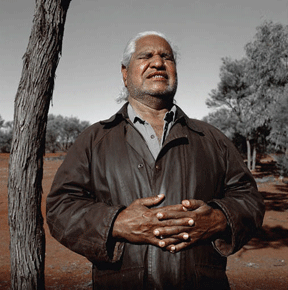
Mr Lester, a Yankunytjatjara elder who died in 2017, was blinded by the British nuclear tests in northern South Australia in the 1950s.
He was blinded as a child, and spent his life advocating against nuclear weapons – a mantle his daughter has taken up with ICAN, who won a Nobel Peace Prize in 2017 for their antinuclear advocacy.
The group got to the edge of the Pine Gap restricted at about 4.30pm Sunday, where they were again met with a police blockade at where the restricted zone begins.
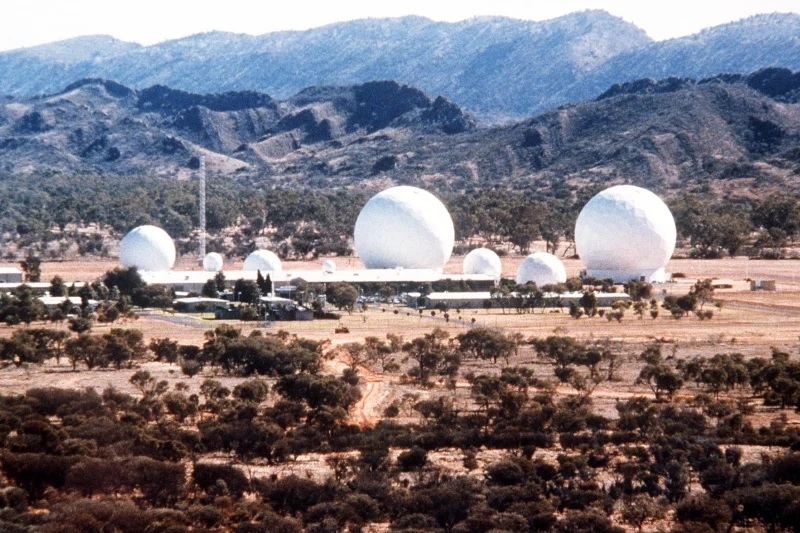
Two unmarked Toyota LandCruisers followed the convoy to their meeting place, and a police drone was also observed overhead.
The group heard from speakers who opposed the US-run base, with members of the crowd holding signs reading “Yankee go home” while others held Palestinian flags.
At the conclusion of the demonstration, the group gathered for a photo and chanted “land back, close Pine Gap” while various media outlets filmed and photographed them.
Federal NSW Greens senator David Shoebridge was also billed to be at the Pine Gap demonstration on Sunday, but pulled out due to covid, this masthead understands.
The Greens defence and foreign affairs spokesman said the political party has opposed the US-run base “for decades” but did not comment on why he was unable to come on Sunday when asked by this masthead.
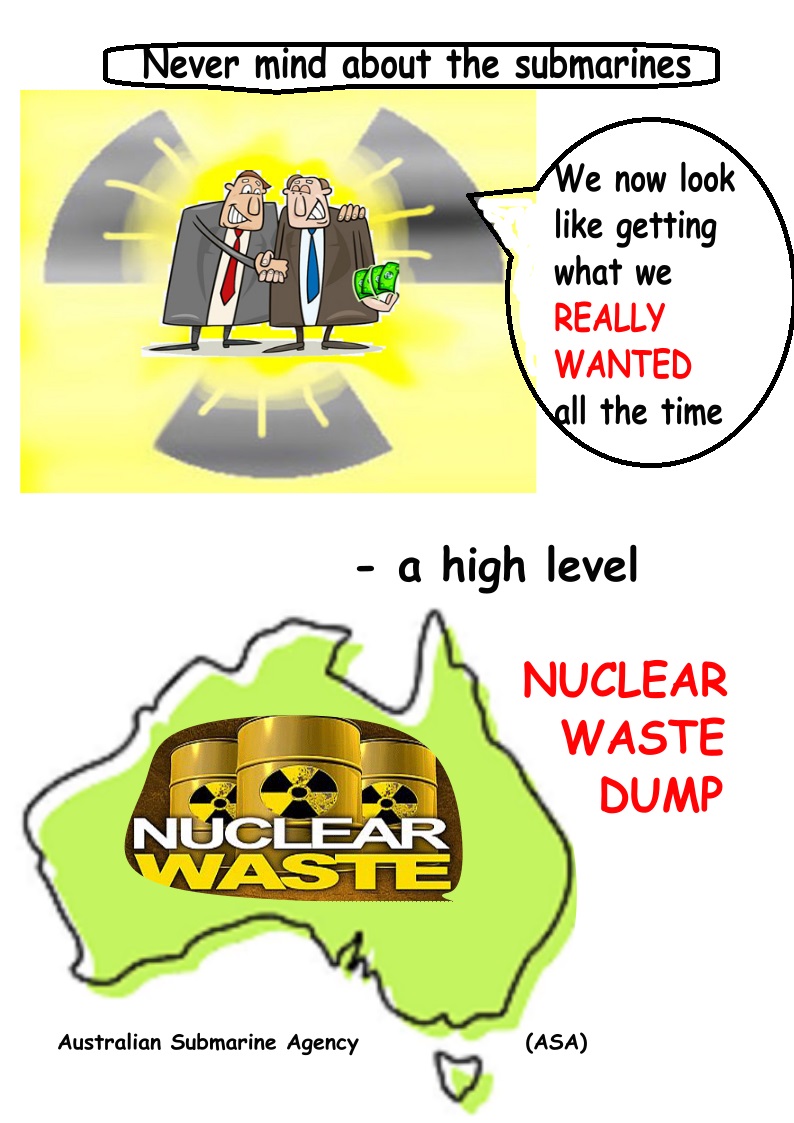
The lethal legacy of Aukus nuclear submarines will remain for millennia – and there’s no plan to deal with it
Ben Doherty, 10 Aug 25, https://www.theguardian.com/world/2025/aug/10/the-lethal-legacy-of-aukus-nuclear-submarines-will-remain-for-millennia-and-theres-no-plan-to-deal-with-it
“None of the leaders who announced Aukus are in power any more,” he tells the Guardian. “One hundred thousand years from now, who knows what the world looks like, but Australia, whatever is here then, will still be dealing with the consequences of that high-level waste.”
Australia’s future nuclear submarines will produce highly radioactive waste, and allies in the UK and the US still don’t have a safe place to store their own.
In the cold deep waters of Rosyth Harbour lie the dormant hulks of Britain’s decommissioned nuclear submarines.
One of the shells lashed to the dock here is HMS Dreadnought, Britain’s first nuclear-powered submarine. It was commissioned in 1963, retired in 1980, and has spent decades longer tied to a harbour than it ever did in service. The spent nuclear fuel removed from its reactor remains in temporary storage.
For decades the UK has sought a solution to the nuclear waste its fleet of submarines generates. After decades of fruitless search there are “ongoing discussions” but still no place for radioactive waste to be permanently stored.
Similarly, in the US – the naval superpower which controls a vast landmass and which has run nuclear submarines since the 1950s – there is still no permanent storage for its submarines’ nuclear waste.
More than a hundred decommissioned radioactive reactors sit in an open-air pit in Washington state, on a former plutonium production site the state’s government describes as “one of the most contaminated nuclear sites in the world”.
This is what becomes of nuclear-powered submarines at the end of their comparatively short life.
A nuclear-powered submarine can expect a working life of three decades: the spent fuel of a submarine powered by highly enriched uranium can remain dangerously radioactive for millennia. Finland is building an underground waste repository to be sealed for 100,000 years.
For Australia’s proposed nuclear-powered submarine fleet there is, at present, nowhere for that radioactive spent fuel to go. As a non-nuclear country – and a party to the non-proliferation treaty – Australia has no history of, and no capacity for, managing high-level nuclear waste.
But Australia is not alone: there is no operational site anywhere on Earth for the permanent storage of high-level nuclear waste.
‘Australia shall be responsible … ’
Documents released under freedom of information laws show that, beginning in the 2050s, each of Australia’s decommissioned Aukus submarines will generate both intermediate- and high-level radioactive waste: a reactor compartment and components “roughly the size of a four-wheel drive”; and spent nuclear fuel “roughly the size of a small hatchback”.
The Australian Submarine Agency says the exact amount of high-level waste Australia will be responsible for is “classified”.
Because Australia’s submarines will run on highly enriched uranium (as opposed to low enriched uranium – which can power a submarine but cannot be used in a warhead) the waste left behind is not only toxic for millennia, it is a significant proliferation risk: highly enriched uranium can be used to make weapons.
The eight nuclear-powered submarines proposed for Australia’s navy will require roughly four tonnes of highly enriched uranium to fuel their sealed reactor units: enough for about 160 nuclear warheads on some estimates.
The spent fuel will require military-grade security to safeguard it.
The problems raised by Australia’s critics of Aukus are legion: the agreement’s $368bn cost; the lopsided nature of the pact in favour of the US; sclerotic rates of shipbuilding in the US and the UK, raising concerns that Australia’s nuclear submarines might never arrive; the loss of Australian sovereignty over those boats if they do arrive; the potential obsolescence of submarine warfare; and whether Aukus could make Australia a target in an Indo-Pacific conflict.
All are grave concerns for a middle power whose security is now more tightly bound by Aukus to an increasingly unreliable “great and powerful friend”.
But the most intractable concern is what will happen to the nuclear waste.
It is a problem that will outlive the concept of Australia as a nation-state, that will extend millennia beyond the comprehension of anybody reading these words, that will still be a problem when Australia no longer exists.
And it cannot be exported.
The Aukus agreement expressly states that dealing with the submarines’ nuclear waste is solely Australia’s responsibility.
“Australia shall be responsible for the management, disposition, storage, and disposal of any spent nuclear fuel and radioactive waste … including radioactive waste generated through submarine operations, maintenance, decommissioning, and disposal,” Article IV, subclause D of the treaty states.
As well, should anything go wrong, at any point, with Australia’s nuclear submarines, the risk is all on Australia.
Australia shall indemnify … the United States and the United Kingdom against any liability, loss, costs, damage or injury … resulting from Nuclear Risks connected with the design, manufacture, assembly, transfer, or utilization of any Material or Equipment, including Naval Nuclear Propulsion Plants,” subclause E states.
“‘Nuclear Risks’,” the treaty states, “means those risks attributable to the radioactive, toxic, explosive, or other hazardous properties of material.”
‘Decide and defend’
An emeritus professor at Griffith University’s school of environment and science, Ian Lowe, tells Guardian Australia that the government’s regime for storing low-level nuclear waste is a “shambles”. He says the government’s “decide and defend” model for choosing a permanent waste storage site has consistently failed.
“You currently have radioactive waste from Lucas Heights, from Fishermans Bend, and from nuclear medicine and research all around Australia, just stored in cupboards and filing cabinets and temporary sheds,” Lowe says.
“The commonwealth government has made three attempts to establish a national facility – it’s a repository if you’re in favour of it, it’s a waste dump if you’re opposed – and on every occasion there’s been local opposition, particularly opposition from Indigenous landowners, and on each of those three occasions … the proposal has collapsed.”
Most of Australia’s low-level and intermediate nuclear waste – much of it short-lived medical waste – is stored at the Australian Nuclear Science and Technology Organisation facility in Lucas Heights in outer Sydney. Lowe says the nuclear safety regulator, ARPANSA, does a commendable job in protecting the public but the facility was never intended to be permanent.
Australia has been searching for a permanent site for nuclear waste for nearly three decades.
Its approach – derided by Lowe as “decide and defend”: where government chooses a place to put radioactive waste and then defends the decision against community opposition – has failed in Woomera, in central South Australia, in the late 1990s, then Muckaty station in the Northern Territory, then on farmland near Kimba, again in SA.
The federal court ruled against the Kimba plan in 2023, after a challenge from the traditional owners, the Barngarla people, who had been excluded from consultation.
Lowe, the author of Long Half-Life: The Nuclear Industry in Australia, says the complexities and risks of storing high-level nuclear waste from a submarine are factors greater than the low- and intermediate-level waste Australia now manages.
“The waste from nuclear submarines is much nastier and much more intractable,” he says. “And because they use weapons-grade highly enriched uranium there is the greater security issue of needing to make sure that not only do you need to protect against that waste irradiating people and the environment, you must also ensure that malevolent actors, who have in mind a malicious use of highly enriched uranium, can’t get their hands on it.”
Australia’s decision to use highly enriched uranium to power its submarines, as opposed to low enriched uranium (reactors would need refuelling each decade), is a “classic case of kicking the can down the road and creating a problem for future generations”, Lowe argues.
“In the short term, it’s better to have highly enriched uranium and a sealed reactor that you never need to maintain during the life of the submarine. But at the end of the life of the submarine, you have a much more serious problem.”
The high-level nuclear waste from Australia’s submarines will be hazardous for “hundreds of thousands of years,” Lowe says.
“There are arguments about whether it’s 300,000 or 500,000 or 700,000 years, but we’re talking a period at least as long as humans have existed as an identifiably separate species. The time horizon for political decision makers is typically four or five years: the time horizon of what we’re talking about is four or five hundred thousand years, so there’s an obvious disconnect.”
Inside ‘Trench 94’
The US and the UK have run nuclear-powered (and nuclear-armed) submarines for decades.
In the UK, 23 nuclear submarines have been decommissioned, none have been dismantled, 10 remained nuclear-fuelled. Most are sitting in water in docks in Scotland and on England’s south-west coast.
The first submarine to be disposed of – the cold war-era HMS Swiftsure was retired from service in 1992 – will be finally dismantled in 2026. Keeping decommissioned nuclear subs afloat and secure costs the UK upwards of £30m a year.
There is still no site for permanent storage of their radioactive waste: there has been “progress and ongoing discussions”, the defence minister, Lord Coaker, told the House of Lords last year, but still no site.
The UK has about 700,000 cubic metres of toxic waste, roughly the volume of 6,000 doubledecker buses. Much of it is stored at Sellafield in Cumbria, a site described by the Office for Nuclear Regulation says as “one of the most complex and hazardous nuclear sites in the world”.
In the US, contaminated reactors from more than 100 retired submarines are stored in “Trench 94” – a massive open pit at the Hanford nuclear site in Washington state. Spent nuclear fuel is also sent to the Idaho National Laboratory and sites in South Carolina and Colorado. Hanford is designed to last 300 years but the site has a chequered history of pollution and radiation leaks. Washington state describes it as “one of the most contaminated nuclear sites in the world”.
Finland is the first country to devise a permanent solution. It is building an underground facility 450 metres below ground, buried in the bedrock of the island of Olkiluoto.
The Onkalo – Finnish for cave or cavity – facility has taken more than 40 years to build (the site was chosen by government in 1983) and has cost €1bn. It is now undergoing trials.
‘A Trojan horse’
In March 2023 Australia’s defence minister, Richard Marles, said high-level nuclear waste would be stored on “defence land, current or future”, raising the prospect that a site could be identified and then declared “defence land”. A process for establishing a site would be publicly revealed “within 12 months”, he said. That process has not been announced nor a site identified.
Australia will require a site for high-level nuclear waste from the “early 2050s”, according to the Australian Submarine Agency. Senate estimates heard last year that there have been no costings committed for the storage of spent fuel. And preparing a site for storing high-level radioactive waste for millennia will take decades.
Guardian Australia sent a series of questions to Marles’ office about the delayed process for selecting a site. A spokesperson for the Australian Submarine Agency responded, saying: “The government is committed to the highest levels of nuclear stewardship, including the safe and secure disposal of waste.
“As the Government has said, the disposal of high-level radioactive waste won’t be required until the 2050s, when Australia’s first nuclear-powered submarine is expected to be decommissioned.”
The spokesperson confirmed that Australia would be responsible for all of the spent nuclear fuel and radioactive waste generated from the Aukus submarines: it would not have responsibility for intermediate- or high-level radioactive waste – including spent fuel – from the US, UK or any other country. No permanent storage site had been identified for low-level radioactive waste, which would include waste from foreign submarines.
The government has consistently said it will engage extensively with industry, nuclear experts and affected communities to build a social licence for a permanent storage site.
But Dave Sweeney of the Australian Conservation Foundation says he has seen little evidence of genuine effort to build social licence.
The leaders who signed the Aukus deal – and those who continue to support it – have failed to comprehend the consequences beyond their political careers, he says.
“None of the leaders who announced Aukus are in power any more,” he tells the Guardian. “One hundred thousand years from now, who knows what the world looks like, but Australia, whatever is here then, will still be dealing with the consequences of that high-level waste.”
Sweeney says the “opacity” of the decision-making around the Aukus agreement itself is compounded by fears that the deal could be only the beginning of a nuclear industry expansion in Australia.
“We see this as a Trojan horse to expanding, facilitating, empowering the nuclear industry, emboldening the nuclear industry everywhere,” he says. “It is creepy, controversial, costly, contaminating, and leading to vastly decreased security and options for regional and global peace.”
Beyond the astronomical cost of the submarine deal, its the true burden would be borne by innumerable future generations.
“We are talking thousands and thousands of years: it is an invisible pervasive pollutant and contaminant and the only thing that gets rid of it is time. And with the whole Aukus deal, that’s what we’re running out of.”
1 This month
15 April – Zoom –Nuclear Power is Not the Solution
Apr 15, 2026 01:00 AM in Canberra, Melbourne, Sydney

Join the International Physicians for the Prevention of Nuclear War (IPPNW) on Tuesday, April 14th for a timely webinar exploring the risks associated with nuclear power and challenging the myth that it offers a simple, safe, carbon-free solution to the climate crisis

of the week – Australians for War Powers Reform (AWPR)
To see nuclear-related stories in greater depth and intensity
 Antinuclear