US bases including Pine Gap saw Australia put on nuclear alert, but no-one told Gough Whitlam.
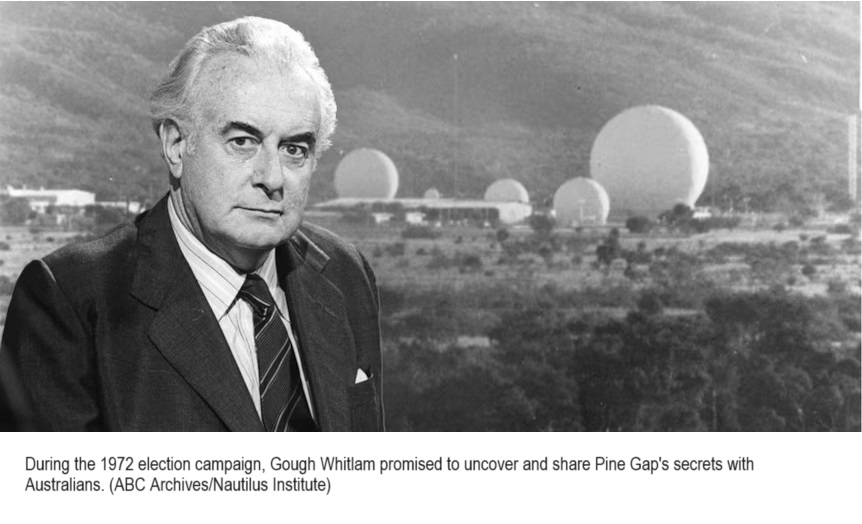
By Alex Barwick for the Expanse podcast Spies in the Outback
When Australia was placed on nuclear alert by the United States government in October 1973, there was one major problem.
No-one had told prime minister Gough Whitlam.
One of the locations placed on “red alert” was the secretive Pine Gap facility on the fringes of Alice Springs.
Officially called a “joint space research facility” until 1988, the intelligence facility was in the crosshairs with a handful of other US bases and installations around Australia.
In fact, almost all United States bases around the world were placed on alert as conflict escalated in the Middle East. Whitlam wasn’t the only leader left out of the loop.
A prime minister in the dark
“Whitlam got upset that he hadn’t been told in advance,” Brian Toohey, journalist and former Labor staffer to Whitlam’s defence minister Lance Barnard, said.
Toohey said Whitlam should have been told that facilities including North West Cape base in Western Australia, and Pine Gap were being put on “red alert”.
“There had been a new agreement knocked out by Australian officials with their American counterparts, that Australia would be given advance warning.”
They weren’t.
Suddenly, the world was on the brink of nuclear war.
Why were parts of Australia on ‘red alert’?
The Cold War superpowers backed opposing sides in the Yom Kippur War.
The Soviet Union supported Egypt and the United States was behind Israel.
As the proxy war escalated in October 1973, United States secretary of state Henry Kissinger believed the crisis could go nuclear and issued a DefCon 3 alert.
A DefCon 3 alert saw immediate preparations to ensure the United States could mobilise in 15 minutes to deliver a nuclear strike.
The aim was to deter a nuclear strike by the Soviets.
And, it simultaneously alerted all US bases including facilities in Australia that a nuclear threat was real.
This level of alert has only occurred a few times, including immediately after the September 11 attacks.
Politics, pressure and protest
The secretive intelligence facility in outback Australia caused Whitlam more trouble beyond the red alert.
During the 1972 election campaign, the progressive politician had promised to lift the lid on Pine Gap and share its secrets with all Australians.
“He gave a promise that he would tell the Australian public a lot more about what Pine Gap did,” Toohey said.
But according to Toohey, the initial briefing provided to Whitlam and Barnard by defence chief Arthur Tange left the prime minister with little to say.
“Tange came along and he said basically that there was nothing they could be allowed to say. And that was just ridiculous,” Toohey said.
“He said, the one thing he could tell them was the bases could not be used in any way to participate in a war. Well, of course they do.”
Whitlam would cause alarm in Washington when he refused to commit to extending Pine Gap’s future.
In 1974 on the floor of parliament he said:
“The Australian government takes the attitude that there should not be foreign military bases, stations, installations in Australia. We honour agreements covering existing stations. We do not favour the extension or prolongation of any of those existing ones.”
According to Toohey, “the Americans were incredibly alarmed about that”.
“As contingency planning, the whole of the US Defence Department said that they would shift it to Guam, a Pacific island that America owned,” he said.
And the following year, allegations would emerge that the CIA were involved in the prime minister’s dismissal on November 11, 1975.
Former Labor defence minister Kim Beazley labels the scuttlebutt as “bulldust”.
“I’d heard that stuff about the Americans getting frightened and therefore getting involved. I put the matter to study, I got a couple of senior public servants to have a look at it, nothing there, nothing there.”
Despite no conclusive evidence, the rumours continue to swirl.
Episode Two of the ABC’s Expanse podcast: Spies in the Outback is now available. This episode explores the wild political tensions surrounding the spy base in Australia’s backyard. Listen here.
Nationals double down on nuclear power policy.

Energy, 25 Aug 25
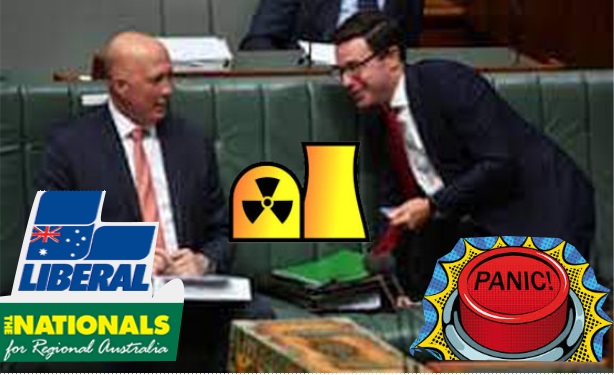
The Nationals are doubling down on introducing nuclear power to Australia, with leader David Littleproud vowing to take the policy to the next election.
Littleproud told National party members the nuclear policy was at the centre of the party’s fallout with the Liberals following the May federal election………………………..
“We have to have, as part of our energy mix, nuclear in that mix. It was something that we believe in passionately because we see the consequences,” he said.
“There is a sensible way to fix it and that’s what we’re going to take to the next election.”
This move comes despite The House of Representatives Select Committee on Nuclear Energy releasing an interim report in which it has found establishing nuclear power generation would be too late and too costly to support the country’s energy targets.
Committee chair Dan Repacholi MP, Federal Member for Hunter, said, “This interim report focuses on two key issues that have dominated the evidence we’ve received to date: whether nuclear power generation could be rolled out in Australia in an acceptable timeframe, and how affordable it would be—particularly compared to alternative power generation technologies currently available in Australia.”
“From the evidence considered by the Committee to date, it is apparent that it could be well into the 2040s before we might see nuclear energy generated in Australia if that form of energy generation were to be pursued. This would be too late to meaningfully support the achievement of Australia’s climate and energy targets or to help our coal power plant workforce and communities as we transition away from coal power.” https://esdnews.com.au/nationals-double-down-on-nuclear-power-policy/
Nationals Leader David Littleproud says nuclear power policy ‘sensible’ next step.
ABC News, Sat 23 Aug, 25
In short:
Nationals Leader David Littleproud told the Liberal National Party annual convention nuclear had to be part of the country’s energy mix.
It would help with food security and the environment, he said.
What’s next?
Nuclear power and energy alternatives dominated discussions at the convention’s opening day on Friday, following the near-unanimous passing of a resolution to abandon net zero by 2050………………………
Coalition practice after an election meant policies taken to the campaign would remain and only be dumped by exception, he told the Liberal National Party annual convention in Brisbane……………………
“We have to have, as part of our energy mix, nuclear in that mix. It was something that we believe in passionately because we see the consequences,” he said……………………………. https://www.abc.net.au/news/2025-08-23/nationals-leader-david-littleproud-says-nuclear-power/105689740
In Alice Springs everyone has an opinion on the Pine Gap spy base, but no-one wants to talk about what happens inside.
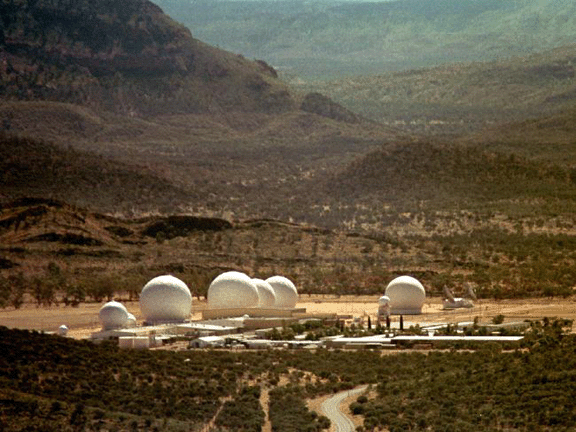
I wanted to hear from the traditional owners of the Arrernte land it was built on, and from the spies tasked with finding targets in Afghanistan and Iraq during the Global War on Terrorism. But how do you investigate something as secretive as Pine Gap when everyone who works there has made a promise never to talk about what they do?
serious claims being made that intelligence gathered at the facility was being used in the Israel-Gaza war.
By Alex Barwick for Backstory, Thu 16 May 2024. https://www.abc.net.au/news/backstory/2024-05-16/backstory-expanse-podcast-spies-in-the-outback-pine-gap-barwick/103844652
In journalism, it’s often politicians who won’t answer your questions.
But in my outback town, it’s just as likely to be the neighbours who won’t, or rather can’t, answer this basic conversation starter: “So, what do you do at work?”
That’s because about 800 of the town’s 25,000 residents are employed at the most secretive intelligence facility in Australia — the Joint Defence Facility Pine Gap — on the edge of Alice Springs/Mparntwe.
When I rolled into this beautiful landscape 16 years ago and began working at the ABC’s Alice Springs bureau, it quickly became clear I wouldn’t hear from this significant section of the community.
Given local radio is all about connecting with the community and sharing people’s stories, this silence felt strange.
My curiosity grew and the book Peace Crimes, written by long-term local journalist Kieran Finnane, motivated me to start looking deeper.
I wanted to know what was going on in my backyard, but I knew trying to make a podcast about a secret military facility hidden in a secluded valley in Central Australia wouldn’t be easy.
Telling this story in a town the size of Alice Springs would undoubtedly feel personal and would likely offend parts of the community.
It’s a line regional journalists walk all the time — telling stories that are in the public interest, while living in the community that is affected by them.
Covering difficult stories in a small town
The words we write as journalists — or say, like in the Expanse: Spies in the Outback podcast — do have real world implications for real people.
That includes everyone from my neighbours, to the parents of my kids’ friends, to people I see regularly at community events.
For them, it’s not a story – it’s their life.
And that can get awkward.
But there are stories in the public interest that the Australian government won’t comment on and this often means they’re shrouded in mystery, or rife with rumour.
Pine Gap is one of those stories.
What goes on beneath the cluster of enormous, oversized-golf-ball-shaped domes covering the military base’s listening antenna on the desert floor, raises big questions for all of Australia, not just my town.
The Pine Gap intelligence-gathering facility is often described as the jewel in the crown of our military partnership with the United States.
But what have we got ourselves into, and do we benefit from it?
Protesters, politicians and spies
Over the past six months, I’ve had lots of off-the-record coffees, trawled the news and library archives, followed some bizarre leads and heard plenty of wild stories, as I have tried to understand the goings-on behind the razor wire.
I wanted to know why America’s Central Intelligence Agency (CIA) decided to build a so-called “space base” in outback Australia in the mid 1960s.
What motivated former prime minister Gough Whitlam to rock the boat and promise to reveal its secrets to the public?
Why were thousands of people so convinced it was a nuclear target they flocked to the desert to demand its closure?
And how had it drawn Australia onto one battlefield after the next through its large-scale surveillance and intelligence gathering?
While plenty of people outside Alice Springs/Mparntwe have never heard of this desert spy base, most people in town have an opinion on it.
There are three main camps: those who say it’s vital for the town’s economy and global peace; those who still see it as a nuclear target and want it shut down; and those who feel generally apathetic to its existence.
And yet, nobody really talks about Pine Gap.
Still, I felt it was important to really understand the diversity of views on this outback spy base as I conducted my research.
I wanted to hear from the traditional owners of the Arrernte land it was built on, and from the spies tasked with finding targets in Afghanistan and Iraq during the Global War on Terrorism.
But how do you investigate something as secretive as Pine Gap when everyone who works there has made a promise never to talk about what they do?
I certainly wasn’t looking to see anyone exiled to Russia like Edward Snowden after he leaked a raft of National Security Agency (NSA) documents, including information on Pine Gap.
In the end, gentle, determined persistence meant I was able to tell the Pine Gap story in a way that lifted the lid but didn’t put national security at risk, and that (I hope) was sensitive to the lives of those in Alice Springs affected by it.
Back in the national spotlight
And then, in late 2023 as I tracked down activists, former spies and politicians … protesters were suddenly blocking the road to Pine Gap again.
There were serious claims being made that intelligence gathered at the facility was being used in the Israel-Gaza war. With Pine Gap back in the spotlight, I knew I had to look deeper.
This spy base, which became operational in 1970 during the Cold War, had expanded through the decades in scale and capability and was more relevant than ever.
The Australian government says Pine Gap is one of the country’s “most longstanding security arrangements” with the United States but it does not comment on its operation.
As each episode of Expanse: Spies in the Outback has been released, I’ve received emails and text messages that confirm why it was an important story to tell.
Some people have been shocked and appalled, while others have been grateful to learn we have this secret intelligence facility in our backyard.
Even in my own town of Alice Springs, where everyone knows someone who works at Pine Gap, there is an appetite to know more – regardless of how uncomfortable that might be.
Follow Expanse: Spies In The Outback on the ABC listen app to hear every episode of season three.
1 This month

of the week – Australians for War Powers Reform (AWPR)
To see nuclear-related stories in greater depth and intensity
 Antinuclear