Opposition to proposed nuclear submarine base at Port Kembla
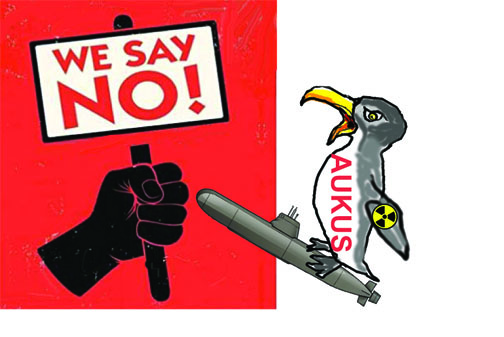
September 25, 2025 , by David Clark, https://www.wavefm.com.au/local-news/opposition-to-proposed-nuclear-submarine-base-at-port-kembla/
Forty local organisations and community groups are launching a joint Port Kembla Declaration today, opposing the establishment of a nuclear submarine base at Port Kembla.
They’re calling for the federal government to rule it out, saying the risks are far too great, the declaration has been endorsed by many organisations, including health, faith, and social justice.
Tina Smith, President of the South Coast Labour Council, said they reject the idea of turning the region into a frontline for war games or nuclear escalation.
Islamophobia in Australia, antisemitism’s ignored cousin
by Fethi Mansouri | Sep 19, 2025 , https://michaelwest.com.au/islamophobia-in-australia-antisemitisms-ignored-cousin/
The National Response to Islamophobia report confirms what Muslim Australians have long known: anti-Muslim prejudice is systemic. Professor Fethi Mansouri calls for rethink.
The report was released this week by the Office of the Special Envoy to Combat Islamophobia, with its main conclusion being that prejudice is not confined to a handful of abusive individuals. It is systemic — embedded in schools, workplaces, laws, media narratives, and in the everyday harassment of visibly Muslim people, especially women.
These findings are also not new. Our own research at Deakin University and much public opinion data have, in recent years, shown a worrying trend of accelerating anti-Muslim attitudes.
There are also a number of areas where the report could and should have done much better. Most strikingly, for a Report on Islamophobia, its silences on major recent and current Islamophobic events are as revealing as its well-meaning recommendations.
Ignoring the main narrative
First, the Christchurch massacre – the worst act of anti-Muslim violence in modern history – barely gets a mention. Fifty-one worshippers were gunned down in their mosques, many with ties to Australia.
Christchurch has devastatingly revealed that Islamophobia is not simply about Muslims feeling offended, being sensitive to criticisms of Islam as a religion, or Muslim migrants being incapable or unwilling to integrate socially and assimilate culturally.
Second, the Report avoids confronting hyper-securitisation. Since 9/11, Muslim Australians have lived under some of the harshest counter-terrorism laws in the democratic world, alongside a sprawling CVE (Countering Violent Extremism) regime that has almost exclusively targeted Muslims. Surveillance, raids, and “community engagement” framed through suspicion have entrenched stigma.
Any serious attempt to tackle Islamophobia must grapple with this machinery of control.
Sensible proposals
The report ranges in scope and ambition. It calls, among other things, for curriculum reform, data collection, community safety programs, and legal change. It points to the weight of evidence, collected by groups such as the Islamophobia Register Australia, showing years of racist abuse and negative media framing. The Report’s call for a coordinated federal response was overdue and would, in theory, be a step in the right direction.
Some of the Report’s proposals are important and achievable.
Data collection is the clearest starting point: police hate-crime figures are inconsistent, and national surveys rarely capture religious discrimination. Embedding Islamophobia in ABS surveys and police registers would make the problem harder to deny.
Education and awareness programs should also be rolled out; research shows sustained anti-racism initiatives can shift attitudes across generations.
But without acknowledging Christchurch, securitisation, and anti-Palestinian racism, the strategy risks reducing Islamophobia to matters of civility and sensitivity. Recognition days, awareness campaigns, and grants may improve atmospherics, but they will not dismantle the structures that cast Muslim and Arab Australians as perpetual outsiders, suspects, or enemies within.
Australia has produced many reports on racism. The question is whether this one will drive structural reform,
or whether Islamophobia will remain endlessly studied, politely condemned, and institutionally entrenched.
The test is clear: will governments act, or will Muslim Australians be told — once again — to wait and to be more resilient in the face of bigotry and hate?
The special envoy conundrum
We have seen in recent years a proliferation of special envoys, from the Special Envoy for Social Cohesion, now defunct, to the two special envoys on Antisemitism and Islamophobia, respectively.
Special Envoys are ‘diplomatic’ appointments that have neither ministerial statutory powers nor, necessarily, broad community or political support. Such appointments appear at best to be a reaction to specific events.
At worst, they can compound the very issues they were meant to address.
Tackling various forms of racism, including those specifically directed against Jewish and Muslim Australians, should be pursued through existing statutory bodies such as the Australian Human Rights Commission. These bodies are best equipped and resourced to deal with all forms of discrimination if properly resourced and supported.
Professor Fethi Mansouri is a Deakin Distinguished Professor in Migration and Intercultural Studies and founding Director of the Alfred Deakin Institute for Citizenship and Globalisation (ADI), a leading research institute that undertakes significant social sciences and humanities research in Australia and across many disciplinary fields.
Say No to Nuclear Financing – World Bank and ADB, Why Turn Away from the Right Path?

Why this petition matters:
- The World Bank and the Asian Development Bank (ADB) are international financial institutions funded by governments to support economic development, poverty reduction, and infrastructure.
- Until now, both institutions have avoided supporting nuclear power projects for the following reasons:
nuclear proliferation risks- serious concerns over safety
- radioactive waste
- extremely high costs
- On June 10, the World Bank’s Board decided to lift its ban on financing nuclear projects.
- The ADB is currently reviewing its energy policy, and indications suggest it may also move to allow support for nuclear power.
- However, the problems of nuclear power — safety risks, radioactive waste, nuclear proliferation, and high costs — remain unresolved.
- Introducing nuclear power in developing countries would impose major risks and costs not only on today’s citizens but also on future generations.
For these reasons, we are preparing to send the following petition to both the World Bank and ADB. We ask for your support by adding your signature. We will submit all signatures and comments to the World Bank and ADB.
Let’s act together to prevent today’s decisions from burdening tomorrow’s generations.
International Petition: “Say No to Nuclear Financing – World Bank and ADB, Why Turn Away from the Right Path?”
To: Mr. Ajay Banga, President of the World Bank Group
To: Mr. Masato Kanda, President of the Asian Development Bank
We are deeply concerned that the World Bank Group and the Asian Development Bank (ADB) are moving toward lifting the ban on financing and supporting nuclear power projects.
The core reasons why the World Bank and the ADB have long refrained from supporting nuclear energy include inseparable risks of nuclear weapons proliferation and the unresolved problems of radioactive waste. These concerns remain unchanged today. Furthermore, Russia’s invasion of Ukraine has revealed that nuclear power plants can become military targets, adding another serious security threat.
As demonstrated by the Chernobyl and Fukushima Daiichi nuclear disasters, one accident can cause widespread, long-term contamination and serious social and economic disruption.
Even without accidents or attacks, nuclear energy releases radioactive substances into the environment at every stage of its lifecycle—mining, fuel production and processing, operation, decommissioning, and the disposal of spent nuclear fuel. Uranium mining, in particular, has often violated the rights of Indigenous peoples and harmed their health, lands and environment.
Nuclear waste generated from operating nuclear power plants remains hazardous for tens of thousands of years, requiring secure isolation from the biosphere for geological periods of time. Yet most countries still have no disposal site.
Due to “security” considerations, some information related to the planning and construction of nuclear power plants is kept secret. As a result, communities and NGOs often have limited access to crucial safety information. This lack of transparency conflicts with the safeguard policies of international financial institutions which emphasize openness, accountability, and stakeholder consultation.
In recent years, the cost of building nuclear power plants has soared, often reaching tens of billions of USD per unit and increasing several-fold beyond initial estimates. Private investors have shifted away from nuclear power and toward renewable energy, leading to the rapid growth of renewable energy technologies. The high costs of nuclear power – now the most expensive form of new electricity generation – and its requirement for large direct and indirect government subsidies have high opportunity costs, delaying and undermining the needed rapid scale-up of benign renewable energy.
Construction of nuclear power reactors typically takes well over a decade, often more than two, too slow for mitigating the accelerating climate crisis.
We must also recognize the vulnerabilities of nuclear power. As a large, centralized source of electricity, nuclear plants can have far-reaching impacts when they unexpectedly shut down due to accidents or technical problems. In recent years, heatwaves have raised seawater and river temperatures, making it impossible to obtain cooling water in some cases.
Small modular reactors (SMRs) also fail to address many of these concerns, especially those related to fissile material, radioactive wastes, nuclear weapons proliferation risks and economic viability.
Supporting the construction of nuclear power plants in developing countries would impose not only serious long-term dangers but also a massive economic burden on current and future generations in those nations.
We therefore call on the World Bank Group and the ADB to refrain from providing any form of support or financing for nuclear power.
Initial Endorsers:
11 march movement, Belgium
350.org Japan, Japan
Aktionsbündnis STOP Westcastor Jülich, Germany
AKW-nee-Gruppe Aachen, Germany
Alliance for Climate & Ecology, Korea
Australian Conservation Foundation (ACF), Australia
AYUS International Buddhist Cooperation Network/アーユス仏教国際協力ネットワーク, Japan
Belgische Coalitie Stop Uraniumwapens (Belgian part of the International Coalition for a Ban on Uraniumweapons), Belgium
Beyond Nuclear, United States
Bündnis für „Sichere Verwahrung von Atom-Müll, Germany
Centre for Financial Accountability(CFA), India
Citizen’s Eyes on Nuclear Regulation/原子力規制を監視する市民の会, Japan
Citizens’ Commission on Nuclear Energy (CCNE) /原子力市民委員会, Japan
Citizens’ Nuclear Information Center/原子力資料情報室, Japan
Climate Express11 march movement, Belgium
Corner House, United Kingdom
Ecodefense, Russia
Environmental Association “Za Zemiata” – Friends of the Earth Bulgaria, Bulgaria
European Environmental Bureau, Belgium
Forum for Protection of Public Interest (Pro Public) , Nepal
Friends of the Earth Australia, Australia
Friends of the Earth India, India
Friends of the Earth International, International
and so many more ………………………………………………….https://www.change.org/p/say-no-to-nuclear-financing-world-bank-and-adb-why-turn-away-from-the-right-path?recruiter=1386886086&recruited_by_id=c79f25d0-86d4-11f0-b695-9765954ef395&utm_source=share_petition&utm_campaign=petition_dashboard&utm_medium=copylink
‘Inevitable’ that nuclear waste facility will go ahead without local consent says former minister.

Now we see it- the nuclear industry, adopted by government, will lead to fascism.
Added to the madness, governments are hell-bent on making more nuclear radioactive trash that they don’t know how to get rid of.
“However, in the case of the UK, the DESNZ’s review raises the possibility that overriding public approval could be a matter of policy.
“These developments point to a growing sense of futility and desperation, to secure both a suitable site for nuclear waste disposal and public support for it.”
it mirrors developments in Australia, where efforts to secure sites for nuclear waste disposal have, just like the UK, been repeatedly stalled by local opposition.
“But critics are now concerned that recent legislation grants broad powers to the Australian government to designate any site as a nuclear waste dump, even without local or indigenous approval.”
23 Sep, 2025 By Tom Pashby https://www.newcivilengineer.com/latest/inevitable-that-nuclear-waste-facility-will-go-ahead-without-local-consent-says-former-minister-23-09-2025/
It is “inevitable” that the government moves away from the consent-based approach for deciding where to site the planned geological disposal facility (GDF) for nuclear waste, a former Department for Energy Security and Net Zero (DESNZ) minister has told NCE.
The comments come as reports suggest the government is considering scrapping the “consent-based” approach for siting the GDF. However, DESNZ has asserted that the reports are “wrong” and “no changes are planned to this process currently”.
The GDF is currently the only solution proposed by the government for disposing of high level nuclear waste (HLW). HLW is generated by both the civil and defence nuclear sectors
It would involve disposing of HLW in an engineered vault placed between 200m and 1km underground, covering an area of approximately 1km2 on the surface.
Work to select a GDF site should take 20 years, according to the government body responsible for the project – Nuclear Waste Services (NWS) – and a further 150 years to build, fill and close the facility.
The HLW then needs to sit and remain undisturbed for 100,000 years before its radioactivity has reduced sufficiently for people to be able to be near it. Due to the hazards associated with radioactive waste, the government has always maintained that a GDF will only be sited in a location where the local community has agreed to host it. This is known as the “consent-based” approach and it has been in discussion with a few communities for a number of years.
Consent-based approach seeing little progress over years
The “voluntary” or “consent-based” approach to deciding where to site a GDF was first proposed by the government in a White Paper published in 2008 titled Managing radioactive waste safely: a framework for implementing geological disposal.
“For the purposes of this White Paper ‘an approach based on voluntarism’ means one in which communities voluntarily express an interest in taking part in the process that will ultimately provide a site for a geological disposal facility,” the paper said.
“Initially communities will be invited to express an interest in finding out more about what hosting a geological disposal facility would mean for the community in the long term.
“Participation up until late in the process, when underground operations and construction are due to begin, will be without commitment to further stages, whether on the part of the community or government. If at any stage a community or Government wished to withdraw then its involvement in the process would stop.
“In practice, development could also be halted by the independent regulators at any point in the process through a refusal to grant authorisations for the next stage of work.”
The government further committed to the approach in 2014, when the then secretary of state for energy and climate change Ed Davey said: “The UK Government also continues to favour an approach to identifying potential sites for a GDF that involves working with communities who are willing to participate in the siting process.”
Despite having been committed to the approach for more than 10 years, NWS only has two communities it is making gradual progress with via community partnerships – Mid Copeland and South Copeland. Lincolnshire withdrew from the process in June after a change in governance.
With the government pushing for the deployment of dozens more nuclear reactors in the coming decades, the need to confirm a long-term solution for the waste is pressing – something that has been stressed to NCE by both the Nuclear Industry Association (NIA) and anti-nuclear campaigners.
Reports say Government reviewing consent-based approach
The Telegraph published a story on 22 September that claimed, based on a government source, that DESNZ had decided to review the consent-based approach to siting the GDF.
The source told the newspaper that conversations were taking place within government to consider prioritising areas with the best geology rather than areas with the most welcoming communities.
Ending the consent-based process could result in ministers effectively imposing a GDF on a community, although they would still face the standard planning and consenting obstacles, including judicial reviews from campaigners.
A DESNZ spokesperson denied the reports, saying: “Our position continues to be that any potential geological disposal facility site will be subject to agreement with the community and won’t be imposed on an area without local consent.
“Progress continues to be made, with two areas in Cumberland taking part in the siting process for this multi-billion-pound facility, which would bring thousands of skilled jobs and economic growth.”
Former minister tells NCE ‘we must get on with GDF’
Lord Hunt of Kings Heath is now a backbench Labour peer but was a DESNZ minister of state from July 2024 to May 2025. He was also an energy minister at the end of the previous Labour government from 2008 to 2010 and served in shadow front bench roles from 2010 to 2018.
“This is an inevitable approach. We must get on with GDF,” Hunt told NCE.
“It’s vital to the nuclear programme. It’s a matter of national strategic importance and should proceed on that basis.”
Reported policy change points to ‘growing sense of desperation’
Nuclear Information Service research manager Okopi Ajonye told NCE: “The prospect of the DESNZ reforming policy to override local consent for hosting a geological disposal facility is very concerning.”
“Furthermore, it mirrors developments in Australia, where efforts to secure sites for nuclear waste disposal have, just like the UK, been repeatedly stalled by local opposition.
“But critics are now concerned that recent legislation grants broad powers to the Australian government to designate any site as a nuclear waste dump, even without local or indigenous approval.”
“However, in the case of the UK, the DESNZ’s review raises the possibility that overriding public approval could be a matter of policy.
“These developments point to a growing sense of futility and desperation, to secure both a suitable site for nuclear waste disposal and public support for it.”
End to consent-based approach would ‘lead to more vociferous public resistance’
Nuclear Free Local Authorities secretary Richard Outram told NCE: “Any decision to abandon the established consent-based approach to siting a nuclear waste dump will be an admission by ministers that no community actually wants to host it.
“Proposals to site a GDF at South Holderness and Theddlethorpe were roundly defeated by massive and persistent public protests, backed by responsive local councillors.
“Opposition is also growing in South Copeland with residents impacted by the declared area of focus up in arms.”
Outram added that two local councils in the South Copeland area – Millom Town Council and Whicham Parish Council – have withdrawn their support for the process, and a third – Millom Without Parish Council – is “about to confer with parishioners about continued engagement”, he said.
He also said that the NWS community partnership was “described in a recent external review as ‘dysfunctional’ and seemingly at war with itself”.
“Replacing voluntarism with a plan to railroad such a controversial project onto an unwilling community will be a retrograde step and simply lead to more vociferous public resistance,” he added.
Government reveals to NCE it is ‘replanning’ GDF project
These latest developments add to the uncertainty that has bubbled around the GDF project in recent months.
In August, the Treasury’s National Infrastructure and Service Transformation Authority (Nista) assessed the delivery confidence of the GDF as “appears unachievable” and said the cost could be as much as £53.3bn.
Following the rating, NCE asked DESNZ via the Freedom of Information Act whether the government was responding by changing its approach to the GDF project. It said that it is “undertaking some replanning to mitigate risks and support ongoing progress” on its major projects, including the GDF.
DESNZ added: “However, a GDF will always remain necessary as there are currently no credible alternatives that would accommodate all categories of waste in the inventory for disposal.”
Nuclear industry says credible GDF plan needed for investor confidence
The Nuclear Industry Association, which represents more than 300 companies across the civil and defence nuclear supply chain, was perturbed by this uncertainty around the GDF and told NCE: “A credible, long-term policy on HLW disposal is very important. Developers need confidence that the back end of the fuel cycle is being responsibly and sustainably managed, not just for regulatory compliance but also to secure investor confidence and public trust.
“Clarity and credibility in government policy reduces uncertainty, helps de-risk new nuclear projects and ensures that developers can focus on safe, efficient generation”
1 This month
15 April – Zoom –Nuclear Power is Not the Solution
Apr 15, 2026 01:00 AM in Canberra, Melbourne, Sydney

Join the International Physicians for the Prevention of Nuclear War (IPPNW) on Tuesday, April 14th for a timely webinar exploring the risks associated with nuclear power and challenging the myth that it offers a simple, safe, carbon-free solution to the climate crisis

of the week – Australians for War Powers Reform (AWPR)
To see nuclear-related stories in greater depth and intensity
 Antinuclear