Nuclear energy to remain a central focus for Coalition
By Kye Halford • 3 October 2025, https://www.thesaturdaypaper.com.au/post/2025/10/03/nuclear-energy-remain-central-focus-coalition
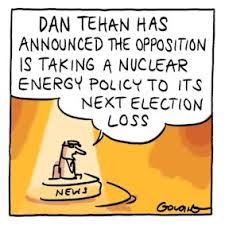
Nuclear technology will be a key aspect of the Coalition’s energy policy heading into the next election, as opposition energy spokesman Dan Tehan argues it is essential to modernise the electricity grid.
Tehan told ABC radio on Thursday: “There is overwhelming agreement on the Coalition side that nuclear needs to be part of our energy mix” (SMH).
“I have no doubt that my colleagues, like I do, see very much a future for nuclear as part of our energy mix here in Australia,” he said.
Tehan has recently returned from a study tour in the United States, where he reportedly toured facilities and spoke with nuclear experts about how the energy source could be used in Australia (Yahoo News).
Nuclear energy was a key proposal for former opposition leader Peter Dutton during his lost election campaign earlier this year, despite voter scepticism regarding its viability (The Saturday Paper).
Dan Tehan fails to grasp difference between baseload and firming as he spouts nonsense on nuclear
Giles Parkinson, 2 Oct 25, https://reneweconomy.com.au/dan-tehan-fails-to-grasp-difference-between-baseload-and-firming-as-he-sprouts-nonsense-on-nuclear/
The Australian Energy Market Operator, along with the owners of the country’s biggest fleets of coal generators have painted a pretty clear picture of the energy future: Forget baseload, it’s time has come and is going and almost gone – the future is about renewables and firming power.
It shouldn’t be too hard a concept to grasp. Low cost wind and solar will provide the bulk of the electricity supply, including and particularly from the rooftops of homes and businesses, and excess power will be stored in batteries at home and on the grid, and flexible “firming” assets will fill the gaps.
The focus on flexibility is the key. Firming assets might not be needed often, or even for long, but they will need to be switched on and off relatively quickly. Flexible demand side management will also play a key role, as will a focus on efficiency.
Australia’s operational paradigm is no longer ‘baseload-and-peaking’, but increasingly it’s a paradigm of ‘renewables-and-firming’,” AEMO boss Daniel Westerman said last year.
It’s a crucial point to understand. “Baseload” is not so much a technical virtue as a business model – the people who invest in coal generators, and nuclear in particular, count on those machines operating at or near full capacity most of the time.
Without it, they haven’t a hope of repaying the money that it took to build their facilities. They can flex a little, but the last thing they want or can do is dial down and up again on a daily or even hourly basis. Other machines are better equipped at doing that, and at much lower cost.
As the ANU’s Centre for Energy Systems wrote this year, the energy industry is aware that baseload is not just endangered, it is already functionally extinct. And they explain why in more detail.
Enter the Coalition’s new energy spokesman Dan Tehan, who quite clearly has not got the memo, and clearly hasn’t the foggiest idea what he is talking about.
Tehan has been on a “fact finding” tour of energy facilities in the US, which appears to have included no renewables, but a lot of nuclear, and – having briefed Coalition colleagues early in the week – he was keen to share his new-found knowledge with the ABC.
“Do you accept that expertise of the Australian energy market operator when it comes to base load power and the transition that’s underway?” Tehan was asked on the 7.30 Report.
“Well, your quote said it all there, Sarah,” Tehan replied. “Renewables and firming, and what nuclear can do is provide that firming over time, it can replace gas and coal, which are providing that firming at the moment.”
Clearly, he was already confused by the difference between baseload and firming. And then Tehan said this: “So my argument is as a replacement for diesel. When it comes to mine sites all that firming capacity over time, that’s exactly the role that nuclear can play.”
Mine sites, it should be noted, use little in the way of gas and diesel capacity. Maybe 10, maybe 20 megawatts (MW). And they are now rarely switched on. Most new mine sites are running on an average 80 per cent renewables, even those partly owned by arch-renewables critic Gina Rinehart.
BHP is sourcing the bulk of its electricity needs for it massive Olympic Dam mine and refinery and nearby sites through two “renewable baseload” contracts with Neoen comprised only of wind and battery storage.
But Tehan was back at the ABC on Thursday morning, this time on Radio National, where he was extolling the virtues of “easily transportable” micro-reactors sized he said – and wait for it – between five and 10 gigawatts!
“And the particular thing that was really of note to me was how the research into micro reactors, so small, sort of five gigawatt, 10 gigawatt reactors, which are very transportable,” he said.
We suspect he meant megawatts, not gigawatts. (A gigawatt is 1,000 megawatts). And, we should point out, these micro reactors do not exist in any commercial form, and it’s doubtful too that they would be “very transportable”.
Tehan said he is convinced that in the US there is a “nuclear renaissance”, despite the recent World Nuclear Industry Status report pointing out there is no such thing. “The simple fact is … that there isn’t a single power reactor under construction in the 35 countries on the American continent,” ACF’s Jim Green writes.
Tehan insisted that 30 nations at COP29 had signed up to triple the amount of nuclear capacity. True, but they said they would do that over a 25 year timeframe, by 2050 – with the aim of lifting global capacity from around 350 GW to just over 1,000 GW.
In the meantime, a total of 120 countries have signed up to treble renewables – in just over five years – from 3,500 GW to 11,000 GW. That is 11 times more capacity than nuclear in one fifth of the time. It is pretty clear to everyone – except perhaps for Tehan and his friends – where the money is going.
And as AEMO’s Westerman told an energy summit hosted by The Australian last week, Australia is experiencing a “stunning democratisation” of energy generation, thanks to rooftop solar and consumer batteries.
Which means that they too will need the grid for “firming”, rather than baseload. Such a dramatic reshaping of the grid will leave no room for nuclear, or any other “baseload” power source. But Tehan and his mates seem intent to jam it into Australia’s energy debate, even if they can’t get it into the grid.
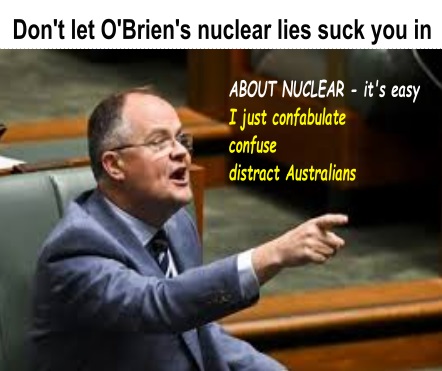
Deputy leader Ted O’Brien confident nuclear will be part of Coalition’s energy policy
By Bridget McArthur and Madigan Landry https://www.abc.net.au/news/2025-10-04/deputy-opposition-leader-confident-nuclear-in-energy-policy-mix/105848854
In short:
The federal shadow energy minister and shadow treasurer are adamant nuclear energy will form part of the Coalition’s future energy policy, though their leader has been less bullish.
Energy analyst Tony Wood says nuclear energy could work in Australia but the uncertainty caused by the lack of bipartisanship threatens to drive up power prices.
What’s next?
Deputy Opposition Leader Ted O’Brien says the Coalition’s energy policy is still in the works and more details will be shared once it is cemented.
Deputy Opposition Leader Ted O’Brien says he is “supremely confident” nuclear will be part of the Coalition’s future vision for Australia’s energy mix.
Shadow Energy Minister Dan Tehan made similar comments this week, signposting the resurrection of the Coalition’s nuclear policy after touring US nuclear facilities.
His predecessor, Mr O’Brien, was a key figure in the Coalition’s nuclear pitch at the last federal election — a policy some political pundits said contributed to their resounding loss.
Now Liberal deputy, Mr O’Brien said he was committed to giving it another go.
Mr O’Brien said the Coalition was yet to settle on the details of its new nuclear policy, including whether it would be government-funded or private sector-led.
Some commentators have speculated that the Coalition may look at narrowing its aspirations to focus on lifting the moratorium on nuclear energy, which has been in place since the late 1990s.
Mr O’Brien would not confirm whether the seven locations proposed to host nuclear reactors would still play a role.
But he maintains people in those regions, including Collie, 190 kilometres south of Perth, were “very open” to the idea.
On a two-party preferred basis, all four of Collie’s polling booths recorded a swing towards the Liberals, which Mr O’Brien said indicated local support for the Coalition’s energy policy.
However, he conceded that on a multi-party basis, there was a swing away from both major parties towards minor parties, such as One Nation and Legalise Cannabis.
Party leader less bullish
Opposition Leader Sussan Ley, also in WA at the moment, was less clear-cut on whether nuclear would play a role in the Coalition’s energy policy.
Asked about her colleagues’ comments at a press conference today, she said Mr Tehan would brief the party and policy teams next week on his US tour, where he had been specifically looking at developments in small modular reactors.
“We know that 19 out of 20 OECD countries … have either adopted or are in the process of adopting nuclear,” she said.
“It’s very important for the future, and we’ll continue to examine it closely.”
Federal Energy Minister Chris Bowen said the Opposition’s pro-nuclear stance was out of touch.
“Ted O’Brien masterminded the nuclear policy that was so comprehensively rejected by the Australian people just a few months ago,” he said.
“Now he says he is ‘supremely confident’ that his nuclear policy is right.
“It shows just how arrogant this LNP is — they just don’t get it.”
Analyst says energy indecision costs
Grattan Institute energy program director Tony Wood said nuclear energy warranted serious consideration.
However, he said a lack of bipartisanship around the future of energy could ultimately prove worse for electricity prices.
“When you’ve got different possible futures with different political parties, investors have to build more risk premiums into their decisions,” he said.
“That means the cost of everything goes up.”
Mr Wood said uncertainty could make the nation less attractive to the private energy sector.
“What [investors] want is clear and predictable policy,” he said.
The Electrical Trades Union (ETU) national secretary Michael Wright said workers in regional communities, such as the coal mining town of Collie, were also seeking clarity.
“When Peter Dutton was spruiking nuclear, we saw projects put on hold and jobs put on hold while developers waited to see which way the election went,” Mr Wright said.
“Now those jobs, for the most part, are back on. This sort of irresponsible attitude to the core business of powering our country costs jobs and jeopardises our grid. It’s just irresponsible and immature.”
Mr Wright said he was not ideologically opposed to nuclear but believed the infrastructure simply would not be ready in time to meet demand.
He said renewable projects had not been without their own challenges, with planning and regulatory approvals continuing to hold up work.
But he said it was time for Australia to pick an energy policy and stick to it.
Powering forward the Transatlantic Nuclear Free Alliance
2 Oct 25, https://www.nuclearpolicy.info/news/powering-forward-the-transatlantic-nuclear-free-alliance/
The UK/Ireland Nuclear Free Local Authorities were proud to partner with Canadian and United States anti nuclear activists at a lively webinar, kindly hosted and organised by SOS: The San Onofre Syndrome, last Thursday (25 September).
Richard Outram, NFLA Secretary, was humbled to join an online panel of distinguished speakers who are working in opposition to new nuclear plants and nuclear waste dumps in both nations. There was an audience of around 50 activists joining us from across the globe, from Colwyn Bay to Hawaii, who had been invited to view the award-winning film ‘SOS – The San Onofre Syndrome: Nuclear Power’s Legacy’.
This time the focus was upon examining the situation in Canada.
Britain’s Nuclear Waste Services, being responsible for locating and building an undersea repository for our nation’s legacy and future high-level radioactive waste – the so called Geological Disposal Facility – has established strong ties with its Canadian counterparts, the Nuclear Waste Management Organisation which has determined to build a similar, though inland and underground, repository – called a Deep Geological Repository – at Ignace in Ontario.
Dr Gordon Edwards is a mathematician, physicist, nuclear consultant, and president of the Canadian Coalition for Nuclear Responsibility (https://www.ccnr.org). CCNR is a not-for-profit organization, federally incorporated in 1978, dedicated to education and research on all issues related to nuclear energy, whether civilian or military — including non-nuclear alternatives — especially those pertaining to Canada. He is based in Montreal.
Brennain Lloyd from We the Nuclear Free North (https://wethenuclearfreenorth.ca/) is a community organizer, public interest researcher and writer. For the last 30 plus years, Brennain has worked with environmental, peace and women’s organizations as a facilitator and adult educator supporting public participation in environmental and natural resource decision-making and various planning processes. She is based in northeastern Ontario.
The panel was also joined by Team SOS in the United States, namely
Mary Beth Brangan and James Heddle, who are award-winning filmmakers of ‘SOS – The San Onofre Syndrome: Nuclear Power’s Legacy’ and co-directors of EON – the Ecological Options Network (https://www.eon3.org) and Morgan Peterson is an Oscar-nominated producer/director and director/editor of ‘SOS – The San Onofre Syndrome’. Mary Beth and James are based in Northern California, USA, whilst Morgan is based in Indiana, USA.
Richard is delighted that colleagues in the USA are looking to start work to build a network of nuclear free local authorities based on the model established from 1981 in the UK and Ireland.
It is almost 45 years since Manchester declared itself the world’s first nuclear free city and hosted the Secretariat of the Nuclear Free Local Authorities. Many cities across the globe followed Manchester’s lead in making similar declarations, many notably in the United States. It would be gratifying if these nuclear free cities could take the lead in establishing a new network across the Atlantic.
Richard said: “The purpose of establishing this Transatlantic Nuclear Free Alliance was to bring together anti-nuclear activists from both sides of the huge ocean which physically divides us in an online forum where we can share information on developments, support one another with campaigns, celebrate our successes, and share our common goals for a nuclear-free, peaceful and sustainable world.
“The UK / Ireland NFLAs would be delighted if from this meeting our colleagues in the United States could begin work to build their own network of nuclear free municipalities and we stand ready to lend support to such an initiative, where we can”.
Lisa Smithline from Moca Media TV, who ably performed the critical job of facilitating the event, summarised the event: “It was a deep and meaningful conversation. The feedback has been extremely positive, people are hungry for this information, the attendees didn’t want it to end!”
A future event will be held in around two months’ time – so do watch out for the invitation.
If you would like to attend and are not yet on the NFLA mailing list for news and future events, please email Richard Outram at richard.outram@manchester.gov.uk
In the meantime, the 25 September event can be viewed online at:
https://us02web.zoom.us/rec/share/Y3wQ_8YDumxukIDLCS5_uuBpUxnuYe9SbUHTF2PhVWEmPtE0Id2qNglFWDShT91n.dY8SN70Lrx5xxyqc
Passcode: RgMr442*
1 This month
15 April – Zoom –Nuclear Power is Not the Solution
Apr 15, 2026 01:00 AM in Canberra, Melbourne, Sydney

Join the International Physicians for the Prevention of Nuclear War (IPPNW) on Tuesday, April 14th for a timely webinar exploring the risks associated with nuclear power and challenging the myth that it offers a simple, safe, carbon-free solution to the climate crisis

of the week – Australians for War Powers Reform (AWPR)
To see nuclear-related stories in greater depth and intensity
 Antinuclear