8 October – Webinar – Submarine Dreams

Register here https://us02web.zoom.us/webinar/register/7217592925374/WN_zx8-oMVtSQKxUXw8to9fkA#/registration
‘Folly’ of nuclear submarines plan floated
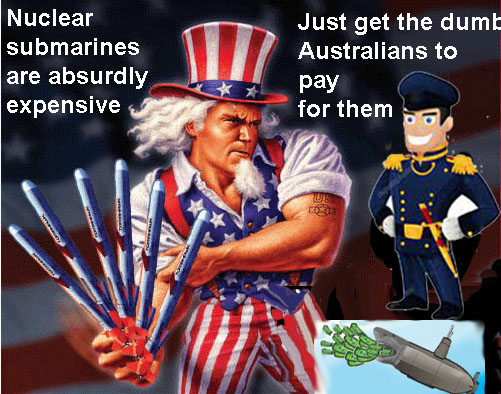
A former navy chief warns outsourcing nuclear subs is risky, raising questions about AUKUS, sovereign capacity and local industry.
Callum Godde, Grace Crivellaro, The Mandarin, 3 Oct 25
The former head of Australia’s submarine squadron has urged Australia against outsourcing boat construction overseas, as bureaucrats express confidence that the US won’t scuttle AUKUS.
A parliamentary inquiry on Thursday ran the ruler over the Geelong treaty, a 50-year AUKUS co-operation agreement between Australia and the UK signed in July.
Under AUKUS, the US has promised to sell at least three Virginia-class nuclear-powered submarines to Australia from the early 2030s.
A submarine solution closer to home should be examined instead, retired navy rear admiral Peter Briggs argued.
“Depending on an overseas supply chain for such a critical capability as our submarines is a folly,” he told the inquiry.
Briggs had serious concerns with the plan, including its potential to limit Australia’s commercial interests. He suggested that the nation should build more submarines, as it had previously done with the diesel-electric Collins class.
“There is no minimum protection in the treaty for a guaranteed work share for genuine Australian industry,” he said.
“The Collins project has established a viable submarine supply chain within Australia.
“We should build on this, not sign a treaty mandating it out of existence.”
Briggs cast doubt on Australia receiving submarines from the US on time, pointing to its falling behind in building its fleet.
Bernard Philip from the Department of Defence said advice was being provided to the federal government on extending the life of Australia’s ageing Collins-class fleet.
The Pentagon has been investigating the AUKUS pact to ensure it aligns with President Donald Trump’s “America-first” agenda.
The review by Under Secretary of War for Policy Elbridge Colby sparked speculation that Trump could walk away from the deal, which is estimated to cost up to $368 billion across 30 years.
Nikkei Asia on Tuesday reported the US would not make changes, with an unnamed member country official declaring AUKUS was “safe”.
Mikaela James from the Australian Submarine Agency strongly hinted that the US would not walk away from the deal.
“(We’re) obviously aware of the US review that is underway, and we are confident the US will continue to find that the program is in line with its interests,” she told the committee.
The review is expected to finish before Prime Minister Anthony Albanese’s visit to the White House on October 20.
Tim Deere-Jones, who has 40 years of experience researching the UK government’s system for monitoring marine radioactivity, said managing nuclear waste was expensive and caused environmental issues.
“You’ve got to build the facilities to remove it from the boats,” he said.
“Then you’ve got to be looking for a long-term, hopefully perpetual dump site for it, none of which we’ve managed to do in the UK despite having many decades of nuclear submarines.”
It was inevitable some waste would be discharged into the ocean, he said.
Nationals MP Alison Penfold said such concerns had the potential to undermine public confidence in AUKUS………………………………………………………………….https://www.themandarin.com.au/300512-folly-of-nuclear-submarines-plan-floated/
The case for some non-nuclear subs
by Lieutenant Commander Jim Halsell, U.S. Navy*, Australian Naval Institute, 5 Oct 25
The United States will require more than its existing inventory of nuclear-powered submarines to ensure victory in a conflict with China. The Navy should augment its existing submarine force with a fleet of conventionally powered submarines capable of launching cruise missiles.
By producing smaller, more cost-efficient submarines with the help of allies, the U.S. submarine force could mitigate the relatively low number of nuclear-powered submarines available for a conflict. …………………………………………………………………………………………………………………………….
The problem with the makeup of today’s submarine force is that these deep-diving, fast-driving, nuclear-powered submarines are expensive. These ships are both too expensive to build in sufficient quantity to meet operational requirements and too costly, in terms of dollars and capabilities, to risk losing in combat.
The cost per hull of a new Virginia-class SSN was originally $2.8 billion, but following the incorporation of the Virginia Payload Module in the USS Arizona (SSN-803) and follow-on Block V boats, that cost now exceeds $4 billion.4 In comparison, Japan spent an estimated $536 million per hull for its Sōryū-class submarines, which feature air-independent propulsion (AIP), allowing them to operate for weeks without snorkeling.5 Japan’s newer Taigei-class submarines are being built at an even cheaper $473 million per hull.6
…………………………………………………………………………………………………………….Much of the disparity stems from the prohibitive cost of nuclear propulsion systems. Conventional submarines are cheaper not only to build, but also to maintain, benefiting from simpler refueling logistics and a dramatically lower cost threshold.
………………………………………………………………………………………………………… Allied Collaboration
One of the most compelling opportunities presented by the development of a U.S. conventionally powered submarine would be the chance to design and build it in partnership with key Indo-Pacific allies. Japan, South Korea, and Australia have decades of experience operating and constructing nonnuclear-powered submarines, and they are getting better with each iteration. ……………………………………………………………. https://navalinstitute.com.au/the-case-for-some-non-nuclear-subs/
1 This month

of the week – Australians for War Powers Reform (AWPR)
To see nuclear-related stories in greater depth and intensity
 Antinuclear