Rare Earths processing – a backdoor way into radioactive waste dumping in Australia?

28 October 2025, Noel Wauchope, https://theaimn.net/rare-earths-processing-a-backdoor-way-into-radioactive-waste-dumping-in-australia/
Joy and delight! Australia is to have a booming rare earths industry, mining and PROCESSING – jobs jobs jobs! Money money money!. And we can stick it up to China, confronting its near monopoly on the industry!
The reality is something very different.
Apart from the enormous and time-consuming problems involved in establishing this industry, and in competing economically with China, there’s that other unmentionable problem – RADIOACTIVE WASTES.
Western Australia’s Lynas Rare Earths company knows all about this. They’ve had no end of trouble with their rare earths processing and its radioactive wastes. They were smart enough, had the foresight, to set up processing in another country. Lynas moved its rare earths processing to Malaysia because of Malaysia’s less stringent laws. But what they didn’t reckon with, was Malaysia’ ‘s history, and awareness of radioactive waste danger. As Lynas’ plant started operations in 2012 – in Kuala Lumpur: 10,000 marched for 13 days, rally against Lynas rare earths processing plant. Former Malaysian Prime Minister Mahathir Mohamad imposed stringent conditions on Lynas’ operations.
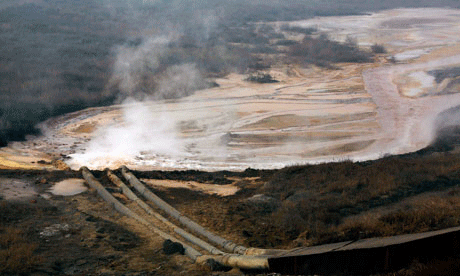
Malaysians remember the environmental and health disaster of Bukit Merah; where, early this century, rare earth processing left a toxic wasteland.
A longer explanation is provided in this documentary –
It is very hard to get information on Lynas’ processing operations in Malaysia. I remember that a few years ago, there was a controversy, and an Australian protest movement against Lynas’ plan to dump these wastes into an old growth forest in Malaysia. I can now find no record of this. And indeed, many news items of the controversies of Lynas’ Malaysia operations have now vanished from the internet.
But this Malaysian issue has not gone away – Pollution issues and controversy over rare earth company Lynas.
If Malaysia’s history of radioactive pollution from processing of rare earths is scandalous, – what about China’s history?
I know that in recent years, China has cleaned up its act on industrial pollution. But its history is shocking – with a legacy of “cancer villages” –
Whole villages between the city of Baotou and the Yellow River in Inner Mongolia have been evacuated and resettled to apartment towers elsewhere after reports of high cancer rates and other health problems associated with the numerous rare earth refineries there. – China’s legacy of radioactive pollution from rare earths processing.
Well, is everybody now pretending that that to introduce rare earths processing in Australia is a good thing, no problem, it’s progress – blah blah?
This new development comes just as Australia’s government introduces its new reforms to the Environment Protection and Biodiversity Conservation Act – including the aim to simplify and speed up approvals for development. We wait to see what that entails – could it be the weakening of environmental standards?
Coincidentally, Mr Trump’s USA is changing the standards on radiation safety. An Executive Order from the White House states:
“In particular, the NRC shall reconsider reliance on the linear no-threshold (LNT) model for radiation exposure and the “as low as reasonably achievable” standard, which is predicated on LNT. Those models are flawed”, – ORDERING THE REFORM OF THE NUCLEAR REGULATORY COMMISSION.
This will likely result in a significant weakening of the current standards at a time when the evidence strongly suggests that they are in need of further tightening.
The environmental movement fights on – but with a wave of enthusiasm for renewable energy development. A recent article discussed recycling of rare earths from our many digital devices. That’s an idea that seems to be ahead of its time, especially given the extreme difficulty of retrieving those elements from mobile phones, laptops etc.fficulty of retrieving those elements from mobile phones, laptops etc.
Well, it’s the (?) futuristic idea of the circular economy. It fits in with those unfashionable concepts of energy efficiency, energy conservation. We used to hear about them, in the early days of action on climate change.
These concepts are anathema to our billionaire leaders, as we are all drawn into the mindless rollercoaster of ever more artificial intelligence, with its ever more energy use.
Australia, federally and in each State has strong restrictions on radioactive processes. The nuclear lobby has tried for decades to weaken or overthrow those restrictions, and to introduce radioactive waste dumping in a big way.
We’ll be pitched the story that the radioactive wastes from rare earths processing are “minor” “low key” – acceptable. Let’s not worry – after all, the whole rare earths thing is so complex, and so far into the future.
But Albanese so readily agreed with Trump, that Australia can have both the mining and the processing of rare earths – it opens the door up to radioactive waste dumping,
Meanwhile, the issue is also relevant to Australia’s agricultural industry, particularly in Victoria. Victoria being blessed with rich agricultural land, regions like the Wimmera and Gippsland could be threatened by these new industries. The nuclear lobby, too, has long salivated on the possibility of a thorium industry there, too
It’s a sad thing – that history is forgotten, in these days of super-fast “progress’ into the Age of AI. We are being led by the nose by those technobillionaires surrounding Donald Trump – to believe that we don’t need to do much working, or thinking – as we race into this golden age, and embrace this new radioactively-polluting industry.
Australia fiddles with fossil gas while the country swelters in record heat. It doesn’t make sense.

Sydney’s record October heat; high winds battering both Melbourne and
New Zealand, causing death and destruction; the algal bloom caused by South
Australia’s marine heatwave wreaking havoc on our marine environment;
coral in both the Great Barrier and Ningaloo reefs suffering horrific
bleaching.
There’s barely an Australian who hasn’t been affected by one
extreme weather event or another, some badly. Some have lost their lives,
their homes or both. The seas around our country are suffering a marine
heatwave. Just a few degrees above normal is causing these climate
change-fuelled warmer oceans to put our weather on steroids, intensifying
heat, rainfall and wind.
And that intense rainfall will lead to increased
plant growth, so another record bushfire season is inevitable at some
point. But this is really only the beginning: global warming has reached an
average of nearly 1.5C, and we’re set to see warming of at least 2.7C by
the end of the century if we don’t take more action.
Australians have an
obvious interest in action against global warming. Focusing on gas instead
of renewables for the energy transition risks sabotaging our future.
Guardian 25th Oct 2025 https://www.theguardian.com/commentisfree/2025/oct/25/australia-fossil-gas-record-heat
ACF responds to Labor’s Environment Protection Agency announcement

26 October 2025 AIMN Editorial, https://theaimn.net/acf-responds-to-labors-environment-protection-agency-announcement/
The Australian Conservation Foundation acknowledges Environment Minister Murray Watt’s announcement today that the Albanese government intends to establish a national Environment Protection Authority (EPA).
The details announced fall short of creating a fully independent EPA. A better model than the one announced by Minister Watt would be one in which the Environment Minister makes nature protection rules, and the EPA assesses and approves projects and enforces the rules based on strong National Environmental Standards.
“For decades, ministers have been able to be influenced and pressured by developers. Tragically, this has resulted in millions of hectares of valuable bushland and habitat being razed by bulldozers, and Australia’s natural wealth significantly degraded,” said ACF Acting CEO Paul Sinclair.
“We remain strongly of the view that independent, expert decision making by the EPA on assessments and approvals is the best way to the deliver the consistency and certainty that is needed under our national nature protection laws. Arm’s length decision making is better for nature and better for business. We will carefully consider the details of the model proposed in the context of the entire reform package by the government once we see the legislation.
“A strong EPA is an important step in addressing the woeful lack of enforcement under the EPBC Act, especially in relation to agricultural deforestation. But an EPA alone will not be enough. We need stronger nature protection laws, we need all decisions to account for climate harm, and deforestation loopholes that allow rampant clearing of precious habitat must be closed. An independent referee is only as good as the rules they have to follow”
1 This month

of the week – Australians for War Powers Reform (AWPR)
To see nuclear-related stories in greater depth and intensity
 Antinuclear