Labor pledged to ban nuclear weapons in opposition. In government it got a reality check
ABC News, By Angus Grigg, 3 Nov 25
Anthony Albanese said the stakes could not be higher.
Banning nuclear weapons, he told delegates at the 2018 ALP National Conference, was the “most important struggle for the human race”.
It was Albanese the activist, showing himself to be a politician of conviction, as he implored the Labor Party to pass a resolution in support of a treaty banning nuclear weapons.
“Labor in government will sign and ratify the UN Treaty on the Prohibition of Nuclear Weapons,” he told the party faithful
“This resolution is Labor at our best.”
The resolution was passed unanimously, but after almost four years in power Labor is yet to honour its promise of signing and ratifying the Treaty on the Prohibition of Nuclear Weapons.
At the National Conference that day in Adelaide, it was Richard Marles who seconded the resolution, albeit with far less passion, saying the treaty was “something we can all agree on”.
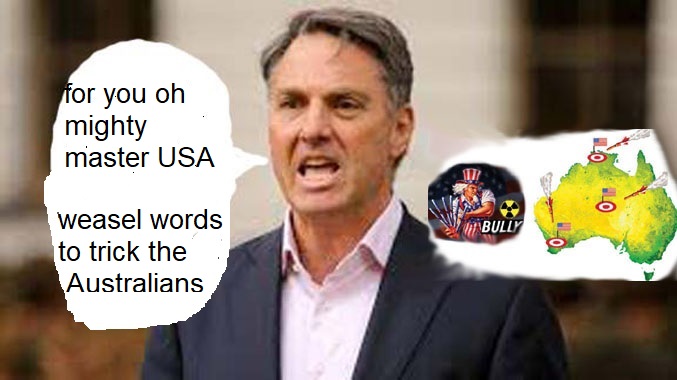
But in an interview with Four Corners, the now Deputy Prime Minister has stepped back from this commitment.
Asked why Labor had yet to sign the treaty, he said: “What’s really clear is that the [national] conference understands that this is a decision of government … a decision of Labor in government.”
“The decision that Labor has made in government has been to follow the non-proliferation treaty.”
While complementary to the nuclear weapons ban treaty, the NPT is something entirely different.
It was ratified by the Whitlam government in 1973 and seeks to limit the number of nuclear-armed states rather than put a prohibition on nuclear weapons.
When asked if Labor was still planning to sign the ban treaty, Marles reiterated that the Party “is pursuing the NPT”.
He denied it was a broken election promise, saying the words adopted by the National Conference meant the Labor government would make the final “decision” on signing the treaty.
That was not the impression Albanese gave the National Conference in 2018.
“Progress always requires leadership,” Albanese told the party faithful.
For an extra injection of political theatre that day, Albanese held up a Nobel Peace Prize medal, awarded in 2017 to Australian advocacy group ICAN for its work on the so-called ban treaty.
All this begs the question: why hasn’t the Albanese government signed the ban treaty?
Managing our alliances
The major stumbling block here is Australia’s alliance with the US.
Australia plays a small but crucial role in the US’s nuclear weapons program through defence facilities at Pine Gap and North West Cape, which provide early warning communications and targeting information.
Australia also seeks protection under America’s so-called “nuclear umbrella”, where the US agrees to protect some of its allies. This would be prohibited by the ban treaty.
Another obstacle is some of the language in the latest Defence Strategic Review, which says Australia’s best protection against the risk of nuclear escalation was the “United States’ extended nuclear deterrence”.
Albanese and Marles both clearly understood these issues back in 2018, when they were burnishing their anti-nuclear credentials with the left of the party.
Albanese even addressed such concerns in his speech.
“I am a very strong supporter of our alliance with the United States,” he told the conference.
“The fact is that we can disagree with our friends in the short term, while maintaining those relations.”
He cited the treaty to ban landmines, which Australia signed despite US opposition.
“The United States and many other countries that ended up supporting it today were hostile to the idea,” he said.
The new frontier
The problem for Albanese and Marles is that Australia is at a point in the geopolitical cycle where we are leaning into our alliance with the US, not pulling back.
Anxious that President Donald Trump will abandon the region, Australia is looking for ways to accommodate the US alliance.
That will see the US nuclear-capable B-52 bombers rotating through Tindal air base south of Darwin. In addition, US Virginia-class submarines docking at HMAS Stirling near Perth, could in the future be carrying nuclear weapons……………………….
, the nuclear arms control regime is breaking down.
The New Start treaty, a comprehensive arms control and transparency agreement limiting the US and Russia’s nuclear arsenals, expires in February and there is little prospect of it being renewed.
For Tilman Ruff, a founding member of ICAN whose Nobel Prize Albanese held at the 2018 conference, this only increases the need to sign the ban treaty.
“At a time of weakened international cooperation, it significantly increases the urgency of getting disarmament, preventing nuclear war,” he said.
“The treaty doesn’t prevent military collaboration with a nuclear-armed state. It only prevents collaboration on nuclear weapons.”
Albanese said signing the ban treaty was “Labor at our best”. As it turns out, we’ve seen Labor at its most pragmatic. https://www.abc.net.au/news/2025-11-03/labor-retreats-from-nuclear-weapons-ban-pledge-four-corners/105959312?utm_source=abc_news_app&utm_medium=content_shared&utm_campaign=abc_news_app&utm_content=other
The SMR boom will soon go bust

by Ben Kritz, 3 Nov 25, https://www.msn.com/en-ph/technology/general/the-smr-boom-will-soon-go-bust/ar-AA1PJi1U
ONE sign that the excessively hyped concept of small modular reactors (SMRs) is now living on borrowed time is the lack of enthusiasm in the outlook from energy market analysts, whether they are individuals such as Leonard Hyman, William Tilles and Vaclav Smil, or big firms such as JP Morgan and Jones Lang LaSalle. None of them are optimistic that the sector will be productive before the middle of next decade, and the more critical ones are already predicting that it will never be, and that the “SMR bubble” will burst before the end of this one. My frequent readers will already know that I stand firmly with the latter view; basic market logic, in fact, makes any other view impossible.
In a recent commentary for Oil Price.com, one of the rather large number of online energy market news and analysis outlets, Hyman and Tilles predicted that the SMR bubble will burst in 2029. They based this on the reasonable observation that power supply forecasts are typically done on a three- to five-year timeframe. The fleet of SMRs that are currently expected to be in service between 2030 and 2035 simply will not be there, so energy planners will, at a minimum, omit them from the next planning window, and might decide to forget about them entirely. Deals will dry up, investors will dump their stocks or stop putting venture capital into SMR developers, and those developers will find themselves bankrupt.
That is an entirely plausible and perhaps even likely scenario, but the SMR bubble may burst much sooner than that, perhaps even as soon as next year, because of the existence of the other tech bubble, artificial intelligence, or AI, an acronym that in my mind sounds like “as if.” The topic of the AI bubble is an enormous can of worms, too complex to discuss right now, but the basic problem with it that is relevant to the SMR sector is that AI developers need a great deal of energy immediately. It has reached a point where AI-related data centers are described in terms of their energy requirements — in gigawatt increments — rather than their processing capacity. The availability of power determines whether or not a data center can be built; if the power is not already available, it must be within the relatively short time it will take to complete the data center’s construction.
Even if SMRs were readily available, their costs would discourage customers; AI developers are not too concerned with energy costs now, but they will be as their needs to start actually generating a profit become more acute. On a per-unit basis, SMRs are and are likely to always be more expensive than conventional, gigawatt-scale nuclear plants, and for that matter, most other power supply options. Hyman and Tilles estimate that on a per-unit cost basis (e.g., cost per megawatt-hour or gigawatt-hour), SMRs will be about 30 percent higher than the most efficient available gigawatt-scale large nuclear plants. Being smaller, SMRs would — hypothetically, as they do not actually exist yet — certainly cost less up front than large nuclear or conventionally fueled power plants, but their electricity would cost much more in the long run. That might not be an issue in some applications, but it certainly would if SMRs were intended to supply electricity to a national or regional grid.
Some analyses point out that some early adopters of SMRs, that is, customers who have put down money or otherwise promised to order one or more SMR units if and when they become available, may not be particularly price-sensitive; for example, military customers, governments taking responsibility for supplying electricity to remote areas, or some industrial customers. However, they would still be tripped up by the fragmented nature of the SMR sector, which was caused by the “tech bro” mindset of ignoring almost 70 years of experience in nuclear development and trying to reinvent the wheel.
JP Morgan’s 2025 energy report noted that there are only three SMRs in existence, with one additional one under construction; there is one in China, two in Russia, and the one not yet completed is in Argentina. All of them had construction timelines of three to four years, but took 12 years to complete; or in Argentina’s case, 12 years and counting. Argentina’s project has had cost overruns of 700 percent so far, while China and Russia’s projects were 300 percent and 400 percent over budget, respectively.
These are all essentially one-off, first-of-a-kind units, so some of these problems are to be expected, such as regulatory delays, design and manufacturing inefficiencies, and challenges from building supply chains from scratch. These problems would be resolved over time, except that there are literally hundreds of different SMR designs all competing for the same finite, niche-application market.
If the SMR developers listened to the engineers and policymakers who built up nuclear energy sectors that took advantage of economies of scale by standardizing a few designs and distributing the workload, they might get somewhere. That is not happening; potential customers, whether they have power cost concerns or not, are reluctant to jump in because it is not at all certain which SMRs will survive the competition. They might be willing to experiment to see if one design or another actually works — that is why the Chinese and Russian SMRs exist — but the fragmented SMR sector prevents them from trying more than one and making comparisons, at least not in a timely or financially rational manner.
I think the bubble begins to burst this coming year. The timeframe for construction to startup in most SMR pitches is four years. That’s entirely too optimistic, of course, but even if it is taken at face value, once we get a few months into 2026 without any tangible development happening, everyone will catch on that there won’t be any SMRs by 2030, and interest will turn elsewhere. It already is, among the data center sector, as was explained above.
1 This month
15 April – Zoom –Nuclear Power is Not the Solution
Apr 15, 2026 01:00 AM in Canberra, Melbourne, Sydney

Join the International Physicians for the Prevention of Nuclear War (IPPNW) on Tuesday, April 14th for a timely webinar exploring the risks associated with nuclear power and challenging the myth that it offers a simple, safe, carbon-free solution to the climate crisis

of the week – Australians for War Powers Reform (AWPR)
To see nuclear-related stories in greater depth and intensity
 Antinuclear